The right enclosure can turn a spare internal SSD into a fast, portable external drive without the cost of buying a finished SSD. However, compatibility and interface speed vary widely between NVMe and SATA models.
We compared 10 USB-C SSD enclosures across drive support, transfer speeds, construction, installation, portability, and everyday value to help you choose the best match for your hardware.
Best 10 USB C SSD Enclosures Picks for 2026
Rugged Pick

- Supports M.2 NVMe and SATA drives
- MIL-STD-810H and IP68 tested
- USB-C 3.2 Gen 2x2 up to 20Gbps
Best For: Rugged portable storage and flexible M.2 upgrades
Budget SATA Choice

- Tool-free sliding installation
- Supports 2.5-inch SATA drives up to 4TB
- USB 3.1 Gen 2 with UASP and TRIM
Best For: Affordable portable storage from a 2.5-inch SATA drive
NVMe Specialist

- Supports M.2 NVMe sizes 2230 through 2280
- Tool-free flip-open installation
- USB 3.2 Gen 2 up to 10Gbps
Best For: Portable NVMe storage, cloning, and troubleshooting
Best Overall NVMe Pick
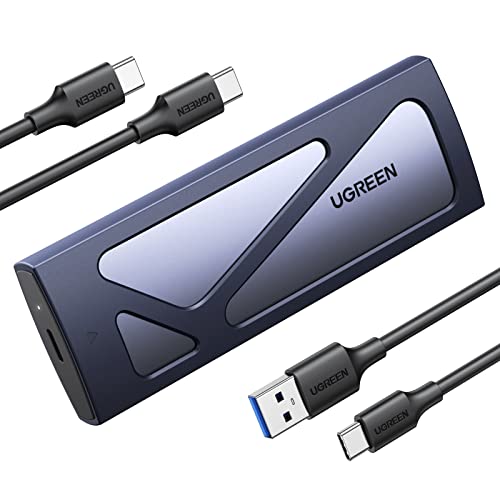
- 10Gbps USB 3.2 Gen 2 performance
- Tool-free support for four M.2 sizes
- Includes USB-C and USB-A cables
Best For: Portable M.2 NVMe storage with broad compatibility
Best SATA Value
BENFEI 2.5-Inch SATA Enclosure

- Supports 2.5-inch SATA drives up to 6TB
- Tool-free plug-and-play installation
- USB-C and USB-A connectivity
Best For: Reusing a 2.5-inch SATA SSD or hard drive
Best Transparent Design

- Transparent shell with LED indicator
- 10Gbps NVMe transfers with UASP
- Includes USB-C cable and USB-A adapter
Best For: Portable NVMe storage with a distinctive look
Best with Extra Features
ORICO 2.5-Inch USB-C Drive Enclosure

- Fits 2.5-inch SATA SSDs and HDDs
- Tool-free, plug-and-play installation
- Includes USB-C-to-A cable and foam pad
Best For: Affordable SATA drive upgrades, backups, and drive recovery
Best Aluminum 10Gbps Option
Cable Matters USB-C SATA Enclosure

- 10Gbps USB-C connection
- Aluminum housing aids protection and cooling
- Supports UASP, TRIM, and S.M.A.R.T.
Best For: Fast, durable portable storage using a 2.5-inch SATA drive
Best High-Speed NVMe Pick

- Supports 2280 PCIe NVMe M-Key drives
- Up to 40Gbps with USB4 or Thunderbolt 3
- Includes cooling hardware and dual-output cable
Best For: High-speed NVMe transfers on compatible USB4 or Thunderbolt systems
Rugged Pick – ASUS TUF Gaming A2
For demanding portable storage, the ASUS TUF Gaming A2 is one of the most versatile usb c ssd enclosures in this roundup. It accepts both M.2 NVMe PCIe and SATA SSDs in 2242, 2260, and 2280 sizes, while USB-C 3.2 Gen 2×2 supports transfers up to 20Gbps.
Best For: Gamers, travelers, and users who want broad M.2 compatibility with added drop, water, and dust resistance.
Pros:
- Supports both M.2 NVMe PCIe and SATA SSDs in three common sizes.
- MIL-STD-810H and IP68 testing, plus a protective silicone-rubber exterior.
- Q-Latch enables screw-free SSD installation and swaps.
- Aluminum construction and a thermal pad help dissipate heat.
Cons:
- Its 20Gbps USB-C performance requires a compatible host device and cable.
- The enclosure is heavier than some compact alternatives at 279g.
The TUF Gaming A2 is a strong choice when durability and drive flexibility matter as much as speed. Its premium protection and dual-interface support make it especially suitable for gaming and mobile work.
Budget SATA Choice – POSUGEAR 2.5-inch Enclosure
The POSUGEAR enclosure is a straightforward option among usb c ssd enclosures for 2.5-inch SATA SSDs and hard drives. Its sliding, tool-free design, USB 3.1 Gen 2 interface, and UASP/TRIM support make drive installation and everyday transfers simple.
Best For: Users converting a 2.5-inch SATA drive into portable storage on a budget.
Pros:
- Tool-free sliding installation with plug-and-play operation.
- Supports 2.5-inch 7mm/9mm SATA drives up to 4TB.
- UASP and TRIM support enable faster transfers than traditional USB 3.0.
- Built-in protections cover overcurrent, overvoltage, and overheating.
Cons:
- Supports 2.5-inch SATA drives only, not M.2 SSDs.
- The plastic-and-ABS shell is less rugged than an aluminum enclosure.
- No warranty is listed in the supplied specifications.
With its clear shell, status LED, and easy sliding assembly, the POSUGEAR is a practical choice for basic backups, drive reuse, and portable media storage. It is best suited to SATA hardware rather than maximum-performance NVMe setups.
NVMe Specialist – SABRENT USB-C NVMe Enclosure
The SABRENT EC-PNVO focuses on fast, uncomplicated NVMe storage in a compact aluminum-and-ABS enclosure. As one of these usb c ssd enclosures built specifically for M.2 PCIe drives, it offers USB 3.2 Gen 2 speeds up to 10Gbps and tool-free installation.
Best For: Creators, gamers, and PC users who need a portable enclosure for an M.2 NVMe SSD.
Pros:
- Supports M.2 NVMe sizes 2230, 2242, 2260, and 2280.
- Flip-open, tool-free design makes drive installation quick.
- Thermal pad and aluminum top help transfer heat away from the SSD.
- USB-C plug-and-play operation requires no drivers or external power.
Cons:
- NVMe only; it is not compatible with M.2 SATA SSDs.
- Its 10Gbps interface is slower than USB 3.2 Gen 2×2 enclosures.
- A USB-C host connection is needed for the stated interface.
The EC-PNVO is a focused, portable solution for NVMe upgrades, cloning, and troubleshooting. Its direct thermal-pad contact and flip-open design are useful for longer transfers without adding installation hassle.
Versatile SATA Case – ORICO Aluminum 2.5-inch Enclosure
The ORICO DD25-C3 is a flexible pick for 2.5-inch SATA SSDs and hard drives. This aluminum option among usb c ssd enclosures includes a USB-C to USB-A/C cable, UASP support, and compatibility with computers, consoles, TVs, tablets, and phones.
Best For: Users who want a 2.5-inch SATA enclosure with broad device compatibility and both USB-C and USB-A connectivity.
Pros:
- Supports 2.5-inch 7mm/9.5mm SATA drives up to 6TB.
- Includes a USB-C to USB-A/C 2-in-1 cable.
- Aluminum housing and ventilation help with heat dissipation.
- Tool-free, hot-swappable design with automatic sleep after 10 minutes.
Cons:
- Limited to 2.5-inch SATA drives rather than M.2 NVMe SSDs.
- The enclosure’s maximum real-world performance is constrained by the SATA drive interface.
- Safe-removal steps are needed before unplugging to help avoid data loss.
ORICO’s DD25-C3 balances compatibility, protection, and convenience for repurposing SATA drives. The included dual-purpose cable makes it a useful choice for mixed setups involving PCs, consoles, smart TVs, and mobile devices.
Best Overall NVMe Pick – UGREEN 10Gbps M.2 Enclosure
For shoppers comparing USB C SSD enclosures, the UGREEN model is a strong all-around choice for M.2 NVMe drives. It combines 10Gbps USB 3.2 Gen 2 performance with tool-free installation, broad size support, and both USB-C and USB-A cables.
Best For: Users who want a portable, feature-rich enclosure for an M.2 NVMe SSD.
Pros:
- Supports 2230, 2242, 2260, and 2280 NVMe SSDs, including M-Key and B&M-Key drives.
- Offers transfer speeds up to 10Gbps with a compatible USB-C 3.2 Gen 2 cable.
- Tool-free design, UASP/TRIM support, and included silicone case and thermal pad.
- Includes USB-C-to-C and USB-C-to-A cables for flexible connectivity.
Cons:
- Does not support SATA NGFF or mSATA SSDs.
- Maximum performance depends on a compatible 10Gbps USB connection.
The UGREEN enclosure is a practical choice when you need broad NVMe compatibility, added protection, and fast everyday file transfers. Its aluminum body and silicone accessories also make it well suited to travel.
Best SATA Value – BENFEI 2.5-Inch SATA Enclosure
Among USB C SSD enclosures, the BENFEI model is designed specifically for 2.5-inch SATA drives. Its tool-free enclosure supports USB-C and USB-A connections, making it a straightforward way to reuse a SATA SSD as external storage.
Best For: Owners of 2.5-inch SATA SSDs or hard drives who want simple, flexible external access.
Pros:
- Supports 2.5-inch SATA I/II/III drives up to 6TB and 7/9.5mm thickness.
- Tool-free, plug-and-play installation with hot-swappable operation.
- USB Type-C and Type-A plug design supports a range of computers and mobile devices.
- Supports UASP and transfer speeds up to 5Gbps.
Cons:
- Designed for 2.5-inch SATA drives, not M.2 NVMe SSDs.
- Its 5Gbps interface is slower than 10Gbps USB 3.2 Gen 2 enclosures.
The BENFEI enclosure makes the most sense if you already have a 2.5-inch SATA drive. It offers an easy installation process and useful Type-C/Type-A connectivity without requiring tools or drivers.
Best Transparent Design – BMKZAYR 10Gbps NVMe Enclosure
This BMKZAYR model is one of the more visually distinctive USB C SSD enclosures, pairing a transparent shell with 10Gbps USB 3.2 Gen 2 connectivity. It supports common M.2 NVMe sizes and includes both a USB-C cable and USB-A adapter.
Best For: Travelers, students, gamers, and creators who want a compact NVMe enclosure with a transparent design.
Pros:
- Supports M-Key and B+M-Key NVMe SSDs in 2230, 2242, 2260, and 2280 sizes.
- Provides speeds up to 10Gbps with UASP acceleration.
- Tool-free installation and plug-and-play compatibility with Windows, macOS, and Linux.
- Includes USB-C-to-C cable and USB-A adapter in a compact transparent casing.
Cons:
- Not compatible with SATA-based M.2 drives.
- Maximum speed requires a compatible 10Gbps connection.
- The listed warranty is one year.
The BMKZAYR enclosure is a good fit when portability and appearance matter alongside speed. Its broad NVMe size support and included adapter make it convenient for moving files among newer and older USB-equipped devices.
Best with Extra Features – ORICO 2.5-Inch USB-C Drive Enclosure
If you need a straightforward option among USB C SSD enclosures, the ORICO 25PW1-C3 is designed for 2.5-inch SATA SSDs and hard drives. Its tool-free design, included USB-C-to-USB-A cable, and broad device compatibility make it useful for backups, storage expansion, or accessing an older drive.
Best For: Users who need an affordable, portable enclosure for a 2.5-inch SATA SSD or HDD.
Pros:
- Supports 2.5-inch 7mm and 9.5mm SATA I/II/III drives.
- Tool-free installation and plug-and-play operation.
- Includes a USB-C-to-USB-A cable and EVA foam pad to help reduce drive movement.
- Works with PCs, laptops, game consoles, routers, and TVs.
Cons:
- Its 5Gbps USB connection is slower than 10Gbps and 40Gbps alternatives.
- Uses a plastic enclosure rather than aluminum.
- Supports SATA drives only, not M.2 NVMe SSDs.
The ORICO is a practical choice when compatibility and simple installation matter more than maximum transfer speed. It is especially appealing for repurposing an older 2.5-inch SATA drive.
Best Aluminum 10Gbps Option – Cable Matters USB-C SATA Enclosure
The Cable Matters enclosure is a strong middle ground among USB C SSD enclosures, pairing a 10Gbps USB-C connection with an aluminum housing. It supports 2.5-inch SATA SSDs and HDDs up to 9.5mm, while UASP, TRIM, and S.M.A.R.T. support can add useful performance and drive-monitoring features with compatible hardware.
Best For: Users seeking a durable 10Gbps enclosure for 2.5-inch SATA storage.
Pros:
- Supports transfer rates up to 10Gbps with a compatible computer.
- Aluminum housing helps protect the drive and assist heat dissipation.
- Supports UASP, TRIM, and S.M.A.R.T. with compatible systems and drives.
- Compatible with USB-C, Thunderbolt 3, Thunderbolt 4, and USB4 ports.
Cons:
- Limited to 2.5-inch SATA drives rather than NVMe SSDs.
- Actual speeds depend on the computer, drive, cable, and port.
- Does not add storage unless a separate SATA drive is installed.
Choose this model if you want a sturdier enclosure and faster USB performance than a basic 5Gbps case. It is well suited to frequent file transfers, drive testing, and portable SATA storage.
Best High-Speed NVMe Pick – ORICO 40Gbps M.2 Enclosure
For shoppers comparing USB C SSD enclosures for NVMe drives, the ORICO M234 is the performance-focused option in this roundup. It accepts 2280 M-Key or compatible M+B-Key PCIe NVMe SSDs and can reach up to 40Gbps through USB4 or Thunderbolt 3, with a bundled USB-C-to-C and USB-C-to-A cable for different host devices.
Best For: Users with a compatible 2280 NVMe SSD and USB4 or Thunderbolt 3 hardware who want very high transfer speeds.
Pros:
- Supports up to 40Gbps connectivity and listed read/write speeds up to 3100MB/s.
- Aluminum cooling design includes a thermal pad and cooling vest.
- Includes a two-output cable for USB-C-to-C and USB-C-to-A connections.
- Supports plug-and-play operation, UASP, TRIM, and S.M.A.R.T. features.
Cons:
- 40Gbps performance requires USB4 or Thunderbolt 3-compatible connectivity.
- Only supports compatible 2280 M.2 NVMe SSDs, not 2.5-inch SATA drives.
- The notes identify possible compatibility issues with some SSD models, including the WD Black SN750, Samsung 970 EVO Plus, and SN850.
This is the most capable choice here for large transfers, but it requires careful checking of both the SSD model and host port. If your system is limited to slower USB versions, its headline speed will not be available.
How We Picked the Best USB C SSD Enclosures
We focused on the factors that most affect real-world use: supported drive type, USB bandwidth, installation method, thermal design, portability, and compatibility with current computers. The roundup includes enclosures for 2.5-inch SATA drives, M.2 NVMe SSDs, and models that support more than one storage format.
Rated speeds are maximum interface figures rather than guaranteed file-transfer rates. Actual performance depends on the SSD, host port, cable, file sizes, operating system, and thermal conditions. We also considered useful extras such as tool-free installation, included USB-C-to-USB-A cables, UASP support, rugged protection, and USB 3.2 Gen 2×2 or USB4-class connectivity.
Quick Comparison
| Drive Type | Typical Interface | Best For |
|---|---|---|
| 2.5-inch SATA SSD or HDD | USB 3.x, commonly up to 5Gbps or 10Gbps | Reusing older drives and affordable external storage |
| M.2 NVMe SSD | USB 3.2 Gen 2, Gen 2×2, or faster | High-speed portable storage and scratch disks |
| Dual-format enclosure | Varies by drive and host connection | Flexible upgrade and testing setups |
| 40Gbps NVMe enclosure | USB4 or compatible high-bandwidth USB-C | Maximum external NVMe performance |
Key Buying Factors for USB-C SSD Enclosures
Drive Compatibility
Check the enclosure before buying based on the SSD you already own. A 2.5-inch SATA enclosure cannot accept an M.2 NVMe drive, while M.2 models may require a specific key type and length. Most NVMe enclosures listed here use M-key drives, but verify support for 2230, 2242, 2260, or 2280 formats as needed.
USB Speed and Port Standards
A 10Gbps enclosure is a strong general-purpose choice, but it only reaches that speed when connected to a compatible host port and cable. USB-C describes the connector, not the bandwidth. Faster 20Gbps and 40Gbps models can be worthwhile for large video files or frequent backups, but they may cost more and run warmer.
Cooling and Physical Protection
NVMe SSDs can throttle during sustained transfers. Aluminum bodies and thermal pads help move heat away from the drive, while ruggedized designs add protection for travel. Look for secure drive retention, sensible ventilation, and a case that will not flex around the connector.
Installation and Included Accessories
Tool-free designs make drive swaps easier, whereas screw-secured models can provide a more secure fit. A USB-C-to-USB-A cable is useful for older computers, and UASP support can improve performance with compatible operating systems.
Who Should Buy Which USB C SSD Enclosures?
- For an M.2 NVMe SSD: Choose a 10Gbps enclosure for a balanced price-to-performance setup, or a 20Gbps/40Gbps model if your computer supports the required port.
- For a 2.5-inch SATA drive: Select a SATA enclosure with USB-C and UASP. These are ideal for repurposing laptop SSDs and hard drives.
- For mixed drive collections: A dual-interface enclosure offers greater flexibility, but confirm exactly which SATA and NVMe formats it supports.
- For travel and field work: Prioritize drop, water, and dust resistance, plus a sturdy connector and compact tool-free design.
- For backups and media work: Choose the fastest enclosure your computer and cable can actually support, and favor aluminum cooling for long transfers.