A good DI box can make an acoustic-electric guitar sound more natural, reduce hum, and help your signal reach the mixer cleanly. The right choice depends on whether you need simple impedance matching, onboard tone shaping, or extra control for live performance.
Below, we compare 10 standout options for different rigs and budgets so you can choose a box that fits your pickup system, stage setup, and sound goals.
Best 10 Di Boxes for Acoustic Electric Guitars Picks for 2026
Premium Acoustic Preamp DI
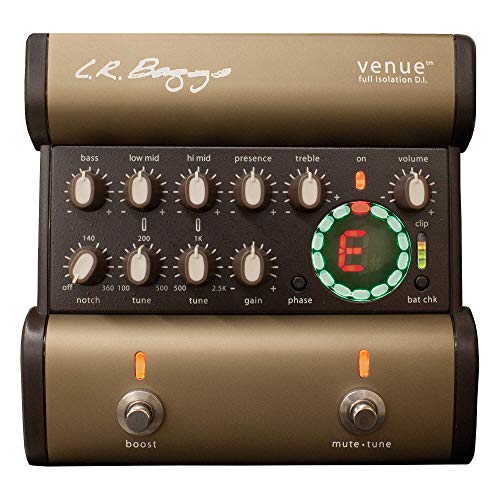
- Adjustable gain for passive and active pickups
- 5-band EQ with tunable mid bands
- Notch filter plus tuner and boost footswitch
Best For: Players wanting a feature-packed stage preamp and DI
Budget Active Direct Box

- Active DI with switchable input attenuation
- Ground lift helps reduce noise
- Buffered output for long cable runs
Best For: Affordable clean signal routing for simple setups
Versatile Acoustic Preamp DI

- 5-band EQ with tunable notch and midrange
- Supports passive and active pickups
- XLR and 1/4-inch outputs with phase inversion
Best For: Players who want flexible EQ and feedback control
Passive Rugged Direct Box

- Passive mono DI with custom transformer
- Rugged I-beam construction
- Suited to acoustic guitars and studio/live use
Best For: Simple, durable routing for stage and studio
Compact acoustic preamp DI
Caline CP-40 DI-Box for Acoustic Guitar
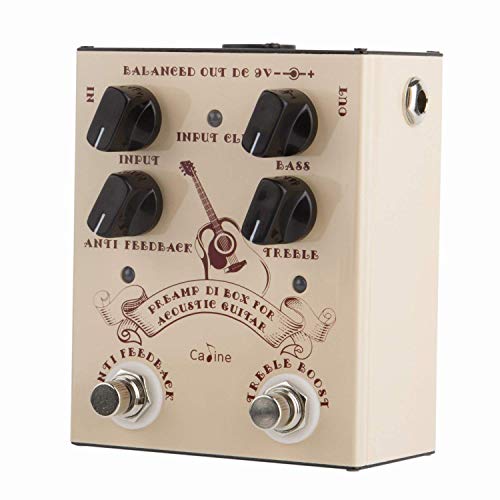
- True-bypass with anti-feedback foot switch
- Higher boost for acoustic level shaping
- Compact 9V corded design with knob controls
Best For: Acoustic players needing a compact preamp DI with boost and feedback control
Compact active DI with pad
Radial Pro48 Active 48-Volt Compact Direct Box
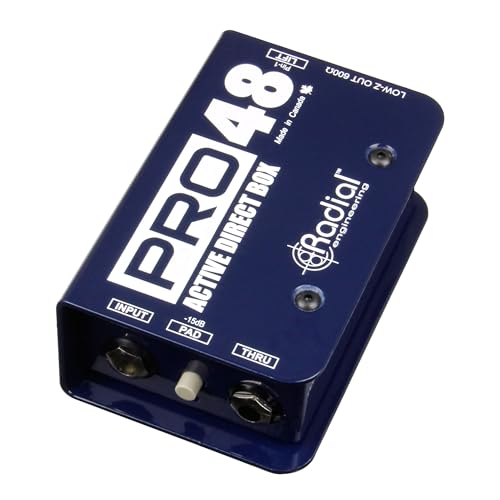
- Phantom-powered active DI design
- -15dB pad helps manage hotter signals
- Balanced mono output in a steel enclosure
Best For: Guitarists and bass players who need a compact active DI with phantom power
Dual-channel passive hum eliminator
PYLE-PRO Premium Direct Injection Audio Box
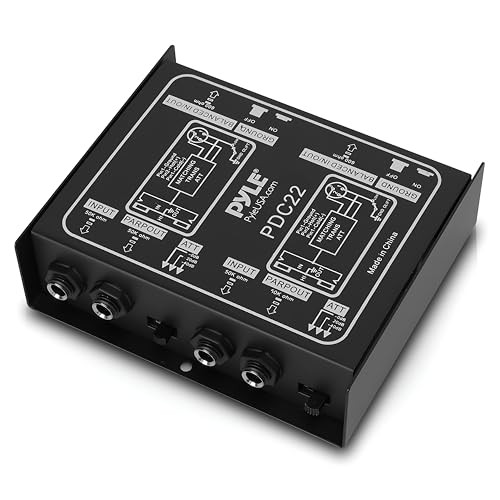
- Passive DI with impedance transformer
- Ground lift and hum cancellation features
- All-steel dual-channel chassis
Best For: Players and engineers needing a flexible passive DI for live-sound connections
Compact Active DI for Clean, Flexible Signal Routing
Samson MDA1 Mono Active Direct Box

- Active mono DI with attenuation switch
- Ground lift and balanced XLR output
- Phantom power or 9V battery support
Best For: Players who want a simple active DI for direct guitar or bass routing
Stereo Passive DI with Transformer Isolation
Radial ProD2 Passive 2 Channel Direct Box

- Two-channel passive stereo DI
- Isolation transformer with lift switch
- 15dB pad for stronger signals
Best For: Stereo or dual-source players needing passive isolation
Budget Passive DI with Hum Rejection
Pyle PDC21 Premium Direct Injection Audio Box

- Passive DI with impedance transformer
- Buzz and hum cancellation support
- All-steel chassis with ground lift
Best For: Budget-minded players needing simple hum-reducing direct connection
Premium Acoustic Preamp DI – L.R. Baggs Venue DI
If you want one of the more feature-rich di boxes for acoustic electric guitars, the L.R. Baggs Venue DI is built for players who need onboard tone shaping, tuner access, and feedback control in a single compact unit. Its adjustable gain works with passive and active pickups, while the 5-band EQ and tunable mid bands give you plenty of room to dial in a live sound.
Best For: Acoustic-electric players who want a full-featured preamp DI for stage use and feedback control.
Pros:
- Adjustable gain supports both passive and active pickups
- 5-band EQ includes tunable low-mid and high-mid control
- Garret Null notch filter helps manage feedback
- Built-in chromatic tuner with footswitch mute/tune function
Cons:
- More complex than a basic direct box
- Compact unit still adds extra gear to a setup
This is the most flexible option in this group if you need tonal control as much as direct output. The boost footswitch also makes it easier to step up volume for solos or set changes without reaching for another pedal.
Budget Active Direct Box – Behringer Ultra-DI DI100
The Behringer Ultra-DI DI100 is a practical choice if you need a straightforward direct box for acoustic electric guitars and other instrument sources. It offers switchable input attenuation and ground lift, plus a buffered active design that aims to keep the signal balanced and noise-free over long cable runs.
Best For: Budget-conscious players and venues needing a simple active DI for clean signal routing.
Pros:
- Switchable input attenuation adds flexibility for different sources
- Ground lift helps reduce noise problems
- Active buffering is designed for clean, balanced output
- Can handle speaker output up to 3,000 watts, per supplied notes
Cons:
- More basic than dedicated acoustic preamp DIs
- Single-channel design keeps the feature set simple
For a no-frills DI box, this one focuses on signal transfer and noise control rather than tone shaping. That makes it a sensible fit when you mainly need reliability and balanced output instead of onboard EQ.
Versatile Acoustic Preamp DI – LR Baggs Para DI
The LR Baggs Para Acoustic D.I. is a strong middle-ground option for players comparing di boxes for acoustic electric guitars. It combines adjustable gain, a 5-band EQ, tunable notch and midrange bands, and phase inversion, so you can shape tone and manage feedback without giving up simple XLR and 1/4-inch output options.
Best For: Acoustic-electric guitarists who want versatile tone control and feedback tools in one box.
Pros:
- Adjustable gain works with passive and active pickups
- 5-band EQ offers broad tone shaping
- Tuneable notch and midrange bands aid feedback control
- XLR and 1/4-inch outputs add routing flexibility
Cons:
- Requires power from a 9V battery or 48V phantom power
- Less immediately simple than a passive DI
This model is a good fit if you want more control than a basic direct box but do not need the extra tuner and boost features of a full-stage preamp. Its balanced, flexible design makes it especially useful for live acoustic setups where feedback management matters.
Passive Rugged Direct Box – Radial Pro DI
The Radial Pro DI is a passive direct box designed for live or studio use with acoustic guitars and other instruments. If you want a simple, rugged way to feed a console or snake system, this model keeps the focus on clean conversion rather than onboard tone shaping.
Best For: Players and engineers who want a durable passive DI for straightforward acoustic instrument routing.
Pros:
- Passive mono design with custom transformer
- Rugged I-beam construction for stage use
- Suitable for acoustic guitars, bass, keyboards, and more
- Made for live or studio performance setups
Cons:
- No EQ or onboard tone controls
- Passive design offers fewer adjustment options than preamp DIs
This is the most stripped-down option in the set, but that can be a strength if you simply need dependable signal conversion. It is a solid pick when durability and straightforward routing matter more than detailed sound shaping.
Compact acoustic preamp DI – Caline CP-40 DI-Box for Acoustic Guitar
If you want one of the more compact di boxes for acoustic electric guitars, the Caline CP-40 is aimed at players who want a simple preamp/DI solution with a true-bypass design and anti-feedback foot switch. Its 9V corded power setup, knob-based controls, and higher boost make it a practical option for straightforward stage use.
Best For: Acoustic players who want a compact preamp DI with boost and feedback control.
Pros:
- True-bypass design with an anti-feedback foot switch
- Higher boost can help bring an acoustic guitar forward in the mix
- Compact cream-colored enclosure with simple knob control
- Uses standard 1/4-inch audio connections
Cons:
- Requires corded electric power
- Single-purpose layout may be less flexible than larger DI units
- Designed specifically for acoustic guitar use
Overall, the CP-40 is a focused choice if you value a small footprint and acoustic-specific features over broader routing options. It fits well for players who want an easy preamp DI with built-in feedback control and a little extra level on demand.
Compact active DI with pad – Radial Pro48 Active 48-Volt Compact Direct Box
For players comparing di boxes for acoustic electric guitars, the Radial Pro48 is a compact active direct box built around a phantom-powered design and a high-resolution signal path. It also includes a -15dB pad, which makes it useful when you need to tame hotter sources and send a balanced mono signal to a mixer or PA.
Best For: Guitarists and bass players who want a compact active DI with phantom power and a pad.
Pros:
- Phantom-powered active design
- -15dB pad for controlling stronger signals
- Balanced mono output for live or recording setups
- Steel enclosure for solid build quality
Cons:
- Not marketed specifically as an acoustic-guitar DI
- Requires phantom power, which may not suit every setup
- More utility-focused than feature-rich for acoustic tone shaping
In practice, the Pro48 is a strong pick when clean conversion and reliable balanced output matter more than onboard tone controls. It suits players who already have their acoustic sound dialed in and mainly need a compact, professional DI path.
Dual-channel passive hum eliminator – PYLE-PRO Premium Direct Injection Audio Box
If you need one of the more budget-oriented di boxes for acoustic electric guitars, the PYLE-PRO PDC22 is a passive direct injection box built for versatility. Its impedance transformer design, ground lift adapter, and buzz-and-hum cancellation focus make it a practical tool for connecting guitars and other unbalanced sources to a mixer or PA.
Best For: Players and engineers who want a passive dual-channel DI for flexible live-sound connections.
Pros:
- Passive DI design with impedance transformer
- Ground lift adapter and hum cancellation features
- Works with guitars, bass, keyboards, and other unbalanced sources
- All-steel chassis for durable use
Cons:
- Battery-powered design may not appeal to everyone
- No onboard tone-shaping controls for acoustic guitar
- More of a utility DI than a dedicated acoustic preamp
The PDC22 is best viewed as a straightforward connectivity tool: it helps clean up signal routing and reduce noise without adding extra complexity. If you want a rugged passive DI that can cover acoustic guitar along with other sources, this one keeps things simple.
Compact Active DI for Clean, Flexible Signal Routing – Samson MDA1 Mono Active Direct Box
If you need di boxes for acoustic electric guitars, the Samson MDA1 is a practical active option that keeps the signal path simple while giving you level control and ground-lift flexibility. Its neutral, transparent sound profile and balanced XLR output make it a straightforward choice for sending an instrument signal to a mixer or interface.
Best For: Players who want an active mono DI with attenuation and dual power options for live or studio use.
Pros:
- Active design with 0dB/-15dB attenuation switch for level matching.
- Ground Lift switch helps reduce hum in connected systems.
- Balanced XLR output supports clean direct connection.
- 48V phantom power or 9V battery operation adds flexibility.
Cons:
- Mono layout may not suit stereo sources.
- Best fit is for straightforward direct routing rather than multi-channel setups.
The MDA1 is a solid pick if you want an active DI that is simple, sturdy, and easy to adapt to different power sources. It is especially useful when you need dependable direct output without extra complexity.
Stereo Passive DI with Transformer Isolation – Radial ProD2 Passive 2 Channel Direct Box
For acoustic electric guitars that need a reliable passive solution, this DI box offers two channels and transformer isolation in a rugged package. The Radial ProD2 is built for clean signal splitting and includes a lift switch plus a 15dB pad for managing hotter sources.
Best For: Stereo or dual-source players who want passive isolation and a durable two-channel direct box.
Pros:
- Passive stereo DI with two channels for flexible routing.
- Isolation transformer helps separate signals.
- Lift switch can help reduce ground-related noise.
- 15dB pad provides added headroom for stronger inputs.
Cons:
- Passive design does not offer active gain or phantom-powered operation.
- May be more DI than a simple mono setup requires.
The ProD2 is a smart choice when you need two channels and dependable isolation in one box. Its passive design keeps things simple while still giving you useful tools for cleaner direct connection.
Budget Passive DI with Hum Rejection – Pyle PDC21 Premium Direct Injection Audio Box
When shopping for di boxes for acoustic electric guitars, the Pyle PDC21 is a straightforward passive unit that focuses on clean connection and hum reduction. It combines an input attenuator, ground lift support, and a steel chassis for a practical direct-injection setup.
Best For: Budget-minded players who want a passive DI with hum cancellation and broad instrument compatibility.
Pros:
- Passive DI design with impedance transformer for balanced and unbalanced XLR use.
- Buzz and hum cancellation features help clean up the signal.
- Input attenuator and ground lift support add setup flexibility.
- All-steel chassis gives it a durable feel.
Cons:
- Passive design means no active power option.
- Single-box layout is aimed at basic direct-injection needs.
The PDC21 is best viewed as a no-frills DI that prioritizes compatibility and noise control. It is a sensible pick if you want an affordable way to route instrument signals directly to a PA or mixer.
How We Picked These Di Boxes for Acoustic Electric Guitars
We focused on Di Boxes for Acoustic Electric Guitars that are practical for real-world use: clean signal transfer, solid noise rejection, reliable build quality, and features that match common player needs. We also considered whether a model is better suited for passive pickups, active preamps, stereo sources, or straightforward plug-and-play use.
Quick Comparison
If you want the simplest setup, a passive DI is often the easiest choice. If your guitar benefits from more headroom or you need stronger buffering, an active DI may be a better fit. Models with onboard EQ or preamp controls are ideal for players who want to shape tone before it reaches the PA.
Key Buying Factors for Di Boxes for Acoustic Electric Guitars
Active Vs. Passive
Active DI boxes usually work well with lower-output pickups and can offer a stronger, more detailed signal. Passive DI boxes are often dependable, require no power, and can be a smart match for hot sources or simple signal chains.
Impedance and Tone Preservation
Acoustic-electric guitars can sound thin or dull if the impedance match is poor. Look for a DI that preserves high-end detail without adding hiss or harshness, especially if you use undersaddle piezo pickups.
Ground Lift and Hum Control
Ground lift switches are valuable when you are dealing with venue noise, laptop rigs, or multiple powered devices. They can help remove low-frequency buzz without changing your tone.
EQ, Pad, and Phase Controls
For live players, these extras can be extremely useful. A pad helps with hot signals, phase reversal can tighten up boomy stage sound, and EQ can reduce the need for last-minute mixer fixes.
Who Should Buy Which Di Boxes for Acoustic Electric Guitars?
Gigging acoustic players who want maximum tone shaping should look at preamp-style DI boxes. Players who want a dependable, no-frills solution may prefer a passive model. If you use multiple instruments or stereo pickups, a dual-channel option can simplify your setup. For budget-conscious buyers, basic active or passive boxes can still deliver a major improvement over a direct cable connection.
In short, the best choice depends on how much control you want and how complicated your rig is. For most players, the right DI box should make setup faster, reduce noise, and keep the natural character of the guitar intact.