Wireless in-ear monitoring can make rehearsals and performances cleaner, more consistent, and easier to control. The right system delivers dependable range, low latency, clear stereo or mono sound, and enough battery life for a full session.
We compared 10 popular options across wireless bands, receiver design, channel flexibility, connection types, and musician-friendly features to help you find the best fit for your setup and budget.
Best 10 Wireless in Ear Monitor Systems with Rechargeable Receivers Picks for 2026
Best Value Classic

- 2.4GHz wireless with less than 5ms latency
- Rechargeable battery lasts up to 5 hours
- Supports XLR and 1/4-inch inputs
Best For: Simple mono monitoring for rehearsals and live performances
Best for Two Performers
Xvive U4R2 Wireless IEM System

- Includes two rechargeable receivers
- Up to 90 feet of operating range
- Less than 5ms latency with six channels
Best For: Shared monitoring for duos and small performance teams
Best Extended Battery
M1 2.4GHz Stereo/Mono IEM System
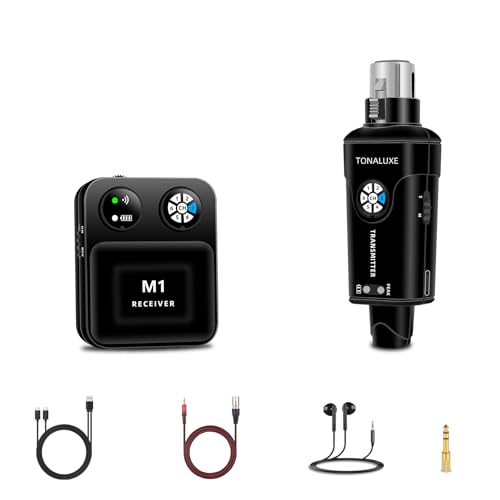
- Up to 8 hours of rechargeable operation
- Switches between stereo and mono modes
- Up to 196 feet of range with six channels
Best For: Longer performances and flexible single-performer monitoring
Best RF Stability
Xvive U45 5.8GHz True Diversity IEM

- 5.8GHz True Diversity with dual antennas
- Smart channel scanning and six-channel operation
- XLR and 1/4-inch input compatibility
Best For: Stage setups requiring stable RF performance and flexible connectivity
Versatile UHF Choice
Stereo IEM System with Rechargeable Receiver

- Stereo/mono modes and 24-bit audio processing
- 10 selectable UHF frequencies with channel lock
- Metal build and hybrid XLR/6.3 mm inputs
Best For: Musicians needing flexible stage and studio monitoring
Long-Runtime Pick
2.4GHz Stereo IEM with Auto Pairing

- Automatic pairing simplifies setup
- Up to 10 hours of stated battery life
- One transmitter can support up to six units
Best For: Churches, rehearsals, and extended performances
Low-Latency Stage Pick

- 1 ms stated latency and 48 kHz/24-bit audio
- Balanced XLR plus AUX/LINE input support
- USB-C charging and 164-foot stated range
Best For: Live bands and performers using mixers
Feature-Rich Choice
Donner CV-3 Wireless IEM System

- Up to 10-hour rechargeable battery life
- Color screen with mono/stereo switching
- 100-foot range and flexible connections
Best For: Performers wanting visual controls and versatile connectivity
Multi-Performer Pick
LEKATO MS-02 Wireless IEM System

- Supports up to four receivers per transmitter
- 6–8 hours of rechargeable operation
- Low-latency mono/stereo monitoring
Best For: Small bands and groups sharing one monitor source
Long-Range Value

- Up to 10–12 hours of rechargeable use
- Advertised 164-foot receiving distance
- Automatic pairing with mono/stereo switching
Best For: Users wanting extended range and simple setup
Best Value Classic – Xvive U4 Wireless IEM System
The Xvive U4 is a straightforward choice for shoppers comparing wireless in ear monitor systems with rechargeable receivers. Its 2.4GHz connection, sub-5ms latency, rechargeable battery, and support for balanced XLR or unbalanced 1/4-inch inputs make it suitable for rehearsals, studios, and live performances.
Best For: Musicians and small performance setups that need a simple, low-latency mono monitoring system.
Pros:
- Rechargeable battery provides up to 5 hours of operation.
- Less than 5ms latency with 24-bit/48kHz audio and a 20Hz–20kHz response.
- Metal housing, built-in limiter, and six selectable channels.
- Works with balanced XLR and unbalanced 1/4-inch outputs.
Cons:
- Approximately 5 hours of battery life may require recharging for longer events.
- Designed for mono monitoring rather than stereo operation.
- Wireless range is not specified in the supplied details.
The U4 focuses on easy setup and dependable core performance. It is a practical option when mono monitoring and a compact rechargeable receiver matter more than extended battery life or advanced RF features.
Best for Two Performers – Xvive U4R2 Wireless IEM System
The Xvive U4R2 is a convenient pick among wireless in ear monitor systems with rechargeable receivers because it includes two receivers with one transmitter. The 2.4GHz system offers up to 90 feet of range, six channels, low latency, and rechargeable power for shared monitoring in small venues.
Best For: Duos, bands, and teams that need to send one monitor mix to two performers.
Pros:
- Includes two receivers and one transmitter in a ready-to-use kit.
- Rechargeable transmitter and receivers provide up to 5 hours of battery life.
- Less than 5ms latency and six simultaneous channel options.
- Up to 90 feet of working range for small clubs and venues.
Cons:
- Only one transmitter is included, so both receivers share the same audio feed.
- Battery life is limited to about 5 hours.
- The supplied details do not specify a headphone jack on the receiver.
With two bodypack receivers included, the U4R2 offers a more economical path to monitoring multiple performers than buying separate single-receiver kits. Its range and battery capacity are best matched to shorter shows and compact venues.
Best Extended Battery – M1 2.4GHz Stereo/Mono IEM System
The M1 stands out for shoppers seeking wireless in ear monitor systems with rechargeable receivers and longer stated runtime. It supports stereo or mono operation, offers up to 196 feet of range, and includes a rechargeable transmitter and bodypack receiver for studio, rehearsal, church, and stage use.
Best For: Performers who want flexible stereo/mono compatibility and up to 8 hours of rechargeable operation.
Pros:
- Rechargeable battery provides up to 8 hours of continuous operation.
- Switchable stereo and mono modes support different monitoring setups.
- Up to 196 feet of range with less than 5ms latency.
- Six channels, 24-bit/48kHz audio, and a 20Hz–20kHz frequency response.
Cons:
- Includes only one bodypack receiver.
- Plastic enclosure may be less rugged than metal alternatives.
- Wireless technology is listed as RF, while the product operates in the 2.4GHz band.
The M1 provides a strong balance of runtime, range, and format flexibility. It is especially appealing when a single performer needs a full-show battery and the option to use either stereo or mono monitoring.
Best RF Stability – Xvive U45 5.8GHz True Diversity IEM
The Xvive U45 is aimed at buyers who want wireless in ear monitor systems with rechargeable receivers and added RF-management features. Its 5.8GHz True Diversity design, dual-antenna receiver, smart channel scan, and selectable line or aux input modes are built for more adaptable stage setups.
Best For: Stage users who prioritize connection stability, channel scanning, and flexible mixer integration.
Pros:
- 5.8GHz True Diversity reception uses dual antennas to help maintain a stable connection.
- 24-bit/48kHz audio, 110dB signal-to-noise ratio, and less than 5ms latency.
- Smart channel scanning helps identify a suitable local RF channel.
- Supports up to six systems and accepts balanced XLR or 1/4-inch TS inputs.
Cons:
- Specified battery life is up to 5 hours.
- Operating range is not provided in the supplied details.
- More advanced RF features may be unnecessary for very simple setups.
The U45 is the most feature-focused option in this group. True Diversity reception and adjustable input modes make it a compelling choice for performers moving between venues or expanding to multiple wireless monitoring systems.
Versatile UHF Choice – Stereo IEM System with Rechargeable Receiver
For musicians comparing wireless in ear monitor systems with rechargeable receivers, this UHF model offers selectable stereo or mono monitoring, 10 tunable frequencies, and a stated range of up to 164 feet. Its metal construction and TFT display suit rehearsals, studio work, and stage use.
Best For: Singers and musicians who want flexible stereo/mono monitoring with detailed system information.
Pros:
- Selectable stereo and mono modes with 24-bit digital audio processing
- Ten UHF frequencies and channel-lock function can help manage interference
- Rechargeable receiver includes battery indication and offers up to 4 hours of operation
- Metal transmitter and receiver with XLR and 6.3 mm hybrid inputs
Cons:
- Listed receiver runtime is shorter than some competing options
- The package includes only one bodypack receiver
This is a practical pick when input flexibility, frequency selection, and stereo monitoring matter more than maximum battery runtime. Confirm that the included 4-hour receiver life fits your performance schedule.
Long-Runtime Pick – 2.4GHz Stereo IEM with Auto Pairing
This 2.4GHz system is a straightforward option among wireless in ear monitor systems with rechargeable receivers. Automatic pairing, a one-button mono/stereo switch, and rechargeable batteries rated for up to 10 hours make it convenient for church services, rehearsals, and live performances.
Best For: Performers and worship teams who prioritize simple setup and extended battery life.
Pros:
- Automatic transmitter-receiver pairing avoids manual channel matching
- Built-in rechargeable batteries are rated for up to 10 hours per charge
- Supports pairing multiple receivers with one transmitter, with up to six units simultaneously
- 24-bit/48 kHz processing and selectable mono/stereo input
Cons:
- Supplied notes specify a 2.4GHz system but do not state a transmission range
- Battery charge time is listed as approximately 3 hours
- Includes one receiver, so additional performers require extra units
Choose this model for its automatic pairing and comparatively long stated runtime. It is especially appealing for group settings, although buyers needing a documented long-distance range may prefer a system with a published range specification.
Low-Latency Stage Pick – 7-Channel UHF IEM System
For performers seeking wireless in ear monitor systems with rechargeable receivers, this POGOLAB model emphasizes fast response and stage connectivity. It combines 1 ms stated latency, 7 selectable UHF channels, balanced XLR support, and a rechargeable belt receiver with a 164-foot line-of-sight range.
Best For: Bands, worship teams, and live performers who need low-latency monitoring and mixer-friendly inputs.
Pros:
- 1 ms stated transmission latency with 48 kHz/24-bit audio
- Seven selectable UHF channels and color-coded connection indicators
- Transmitter supports balanced XLR and AUX/LINE sources
- USB-C charging and up to 5 hours of stated operation for both units
Cons:
- Seven channels provide fewer selections than some 10-channel alternatives
- Stated battery life is limited to up to 5 hours
- The receiver output is 3.5 mm, so adapters may be needed for other connections
This is the strongest fit for stage users who value quick response, XLR connectivity, and clear setup feedback. Its 5-hour battery rating should cover many rehearsals and shows, but longer events may require a recharge plan.
Feature-Rich Choice – Donner CV-3 Wireless IEM System
The Donner CV-3 is a practical option for shoppers comparing wireless in ear monitor systems with rechargeable receivers. It combines 2.4GHz transmission, selectable mono or stereo monitoring, a color receiver screen, and up to 10 hours of battery life for rehearsals, studio work, and live performance.
Best For: Performers who want a lightweight rechargeable system with a visual receiver display and flexible audio connections.
Pros:
- Up to 10 hours of operation from built-in rechargeable batteries.
- Low stated latency of less than 6ms and 192kHz/24-bit audio specifications.
- Color screen, mono/stereo switching, and 100-foot wireless range.
- Includes 1/4-inch, 1/8-inch, and XLR connection options through the supplied cables.
Cons:
- Earbuds or in-ear monitors are not specifically listed among the included accessories.
- No noise-control feature is specified.
Choose the CV-3 if battery endurance and receiver controls matter as much as basic wireless monitoring. Its display and broad connection support make it particularly adaptable for varied rehearsal and performance setups.
Multi-Performer Pick – LEKATO MS-02 Wireless IEM System
The LEKATO MS-02 suits buyers seeking wireless in ear monitor systems with rechargeable receivers for small or medium groups. Its transmitter can support up to four receivers, while mono/stereo modes, automatic pairing, and a compact beltpack design simplify shared stage or rehearsal monitoring.
Best For: Bands, churches, and ensembles that need one transmitter to serve multiple performers.
Pros:
- One transmitter can connect with up to four receivers.
- Up to 6–8 hours of continuous operation after charging.
- Less than 4.5ms mono latency with 24-bit/48kHz audio specifications.
- Includes one-key mute, LED status indicators, and a 100-foot open-area range.
Cons:
- Earbuds are not included and must be purchased separately.
- Battery life is shorter than some systems rated for approximately 10 hours or more.
The MS-02 is most compelling when several performers need monitoring from the same source. Confirm that you have compatible earbuds or IEMs before ordering, since the package contains the wireless hardware but not earphones.
Long-Range Value – M6S Wireless IEM System
The M6S is a straightforward choice among wireless in ear monitor systems with rechargeable receivers, emphasizing range, easy setup, and extended operating time. Automatic pairing, mono/stereo switching, and a stated 164-foot receiving distance make it suited to studio, band, and live-performance use.
Best For: Performers prioritizing long wireless range and all-day battery capacity in a simple transmitter-and-receiver kit.
Pros:
- Rechargeable battery rated for up to 10–12 hours per use.
- Stated 164-foot receiving distance with less than 5ms latency.
- Automatic pairing and one-button mono/stereo switching.
- Supports simultaneous use of up to 10 channels according to the supplied notes.
Cons:
- The package includes one transmitter and one receiver, limiting the basic kit to one performer.
- Only a 6.35mm audio jack and charging cable are listed as included accessories.
- It is not water resistant.
The M6S stands out for its advertised range and battery endurance without adding complicated setup steps. It is a strong fit for users who want a plug-and-play monitor link, provided their source device and earphones match the available connections.
How We Picked the Best Wireless in Ear Monitor Systems with Rechargeable Receivers
We evaluated these wireless in-ear monitor systems with rechargeable receivers by focusing on the features that matter most during practice, recording, and live use. Our comparison considers wireless frequency, operating range, latency, mono and stereo support, transmitter inputs, receiver battery design, pairing convenience, and the number of performers each system can support.
We also looked for practical details such as beltpack size, screen readability, channel selection, charging convenience, and compatibility with mixers, audio interfaces, instruments, and headphone-style IEMs. Published specifications can vary by environment, so treat range figures as best-case estimates rather than guaranteed results in crowded venues.
Quick Comparison
| Feature | What to look for | Why it matters |
|---|---|---|
| Wireless band | 2.4GHz, 5.8GHz, or UHF | Affects interference, range, and venue compatibility |
| Audio mode | Stereo, mono, or selectable | Determines how mixes and monitoring feeds are heard |
| Receiver battery | Rechargeable internal battery | Reduces disposable battery costs and setup time |
| System capacity | One or multiple receivers | Important for bands, ensembles, and shared monitor mixes |
| Connections | XLR, 1/4-inch, AUX, or line input | Determines compatibility with your existing gear |
Key Buying Factors for Wireless In-Ear Monitor Systems with Rechargeable Receivers
Choose the Right Wireless Technology
2.4GHz systems are usually easy to set up and widely available, but they share spectrum with Wi-Fi and other devices. UHF models may offer useful venue flexibility, while 5.8GHz systems can reduce congestion in some environments. Check local regulations and test the system where you plan to use it.
Match Range and Latency to Your Use
For small stages and rehearsals, modest range may be sufficient. Larger stages benefit from stronger signal performance and clear line of sight. Low latency is especially important for singers and instrumentalists because noticeable delay can make timing and pitch feel unnatural.
Check the Audio Connections and Monitoring Format
Confirm whether the transmitter accepts the output from your mixer or interface. XLR is common for balanced professional feeds, while AUX and line inputs can be convenient for compact rigs. Stereo support is useful for detailed mixes, but mono may be simpler and more compatible with certain setups.
Consider Battery Life and Charging
A rechargeable receiver should last through a rehearsal or performance, with enough reserve for soundcheck. Look for convenient charging, clear battery indicators, and a transmitter that can remain powered without creating unnecessary cable clutter.
Who Should Buy Which Wireless in Ear Monitor Systems with Rechargeable Receivers?
Solo performers and small rehearsal setups should prioritize straightforward pairing, compact beltpack receivers, and a simple transmitter with the connections they already use. Bands and worship teams may benefit from multi-receiver packages or systems that support several selectable channels. Musicians playing larger or crowded venues should favor dependable frequency management, low latency, and strong range over the lowest price.
If you record at home, prioritize clean stereo operation and compatibility with your interface. For frequent touring, choose a durable system with easy charging, visible controls, and readily available replacement cables or accessories. Before buying, verify that the package includes the transmitter, receiver, power supplies, and any required adapters.