The best synthesizers for live performances balance expressive sound, dependable controls, portability, and fast access to the tones or sequences you need onstage. This roundup covers compact instruments, standalone production systems, analog synthesizers, and versatile performance keyboards.
Whether you play solo, perform with a band, or build electronic sets around samples and loops, the right choice depends on your workflow, setup, and budget. Use the guide below to narrow the field before comparing the individual products.
Best 10 Synthesizers for Live Performances Picks for 2026
Portable Performance Hub

- Standalone, battery-powered groovebox
- 32 pads with polyphonic aftertouch
- Sampling, sequencing, and Ableton integration
Best For: Portable electronic performance and live sampling
Versatile Keyboard Workstation

- 49-key keyboard with Motif sound engine
- 128-note polyphony for live playing
- USB audio and MIDI connectivity
Best For: Keyboardists needing layered sounds and sequence support
Portable Sampling Rig

- Battery-powered standalone sampler
- 16 pads with fast chopping workflow
- Onboard effects and live connectivity
Best For: Sample-based live sets and DAWless beatmaking
Vintage Polyphonic Powerhouse

- 16-voice multitimbral analog synthesis
- 32 oscillators and multimode filter
- 512 user preset slots and arpeggiator
Best For: Rich vintage-style pads and desktop sound design
All-in-One Performer

- 37 keys, 16 MPC pads, and a 7-inch touchscreen
- Standalone MPC3 production with sequencing and sampling
- USB-C audio, MIDI, and computer integration
Best For: Performers who want keys, pads, and complete track creation in one instrument
Analog Lead Specialist

- Two wavefolding VCOs plus sub-oscillator
- 32 semi-weighted keys with velocity and aftertouch
- 64-step sequencer, arpeggiator, CV, and MIDI
Best For: Live bass, lead, and hands-on analog sequencing
Versatile Polyphonic Voice

- 24-voice polyphony with split and layer functionality
- Three oscillators, 138 types, and 18 filters
- 300 programs, eight-step arpeggiator, and vocoder
Best For: Live keyboardists needing varied layered and vocoder-ready sounds
Stage-Ready Flagship
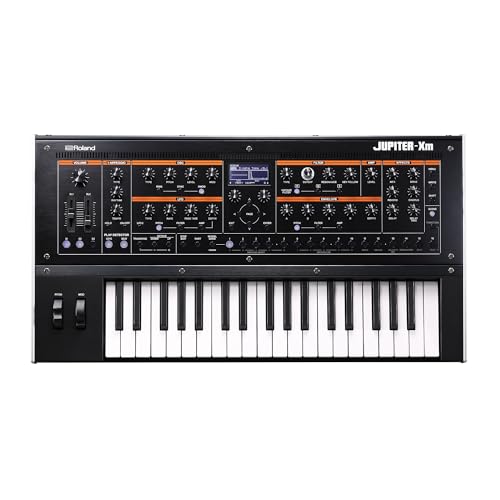
- 37 keys with ZEN-Core and MODEL sound generators
- Balanced XLR outputs and broad stage connectivity
- Extensive presets, effects, EQ, and pedal support
Best For: Versatile live rigs requiring professional connections and deep sound options
Interactive Performance Workstation

- 37 full-size keys and four-voice polyphony
- Color display, loop recorder, and vocal processor
- Portable design with visual sound-editing tools
Best For: Compact live setups involving vocals, loops, and hands-on editing
Portable Analog Experimenter

- Battery-powered with built-in speaker and headphone output
- Analog filter, LFO, delay, PWM, and sub-octave controls
- CV/Gate outputs and expressive touch controls
Best For: Portable analog performance and modular hardware experimentation
Portable Performance Hub – Ableton Move
For musicians seeking synthesizers for live performances, the Ableton Move is a compact standalone groovebox built for untethered sketching and performance. Its rechargeable battery, speaker, microphone, flexible tracks, and hands-on pads make it practical for creating and reshaping ideas without a computer.
Best For: Portable electronic performers, Ableton users, and creators who want an all-in-one instrument for live sampling, sequencing, and beatmaking.
Pros:
- Standalone operation with a rechargeable battery, built-in speaker, and microphone
- 32 velocity-sensitive pads with polyphonic aftertouch for expressive playing
- Four flexible tracks can handle drums, samples, or synthesizers
- Built-in effects, sampling, slicing, resampling, and wireless Ableton integration
Cons:
- Four-track structure may feel limited for more complex arrangements
- Included Ableton Live 12 Intro has limited tracks, instruments, and effects
- Compact pad-based design may not replace a traditional keyboard for some players
The Move is especially compelling when portability and spontaneous control matter more than a full-sized keyboard interface. It offers a focused way to perform, sample, and develop ideas onstage or away from a studio.
Versatile Keyboard Workstation – Yamaha MX49
The Yamaha MX49 is a lightweight 49-key music production synthesizer suited to players who want familiar keyboard control in a live setup. Its Motif sound engine, 128-note polyphony, USB audio/MIDI, and multi-element voice control support layered sounds and sequence-based performance.
Best For: Keyboardists who need a conventional 49-key instrument with broad sounds, reliable polyphony, and straightforward computer connectivity.
Pros:
- 128-note polyphony helps support live playing and 16-track sequences
- Motif sound engine supports layering, zoning, switching, and control of up to eight elements
- Class-compliant USB provides plug-and-play audio and MIDI connectivity
- Can record and play stereo audio plus 16 channels of MIDI through one USB cable
Cons:
- At 12.5 pounds, it is less portable than compact grooveboxes
- The 49-key format offers less range than a full-sized keyboard
- Its feature set is oriented toward a keyboard workstation rather than standalone battery operation
The MX49 is a practical choice for performers who prioritize traditional keys, layered Motif sounds, and high polyphony. It fits best in a powered stage or studio rig where USB integration is useful.
Portable Sampling Rig – Akai MPC Sample
The Akai MPC Sample is a battery-powered sampler and sequencer for performers who want a compact, hands-on alternative to a computer. With 16 responsive pads, a built-in microphone and speaker, onboard effects, and live-friendly audio and MIDI connections, it can anchor sample-based sets and DAWless sessions.
Best For: Beatmakers, finger drummers, DAWless performers, and musicians who build live material from samples.
Pros:
- Standalone operation includes a rechargeable battery, speaker, microphone, and microSD storage
- 16 pads and a 2.4-inch color display support quick chopping and beatmaking
- Four internal effects processors provide 60 effect types with dedicated knob control
- Includes stereo line I/O, headphones, MIDI, sync, USB-C audio/MIDI, and smart-device sampling
Cons:
- MIDI DIN connection requires a separate 1/8-inch-to-DIN adapter
- Its sample-focused workflow may be less suitable for players seeking a traditional synthesizer keyboard
- The compact 16-pad layout provides less physical control than larger MPC systems
The MPC Sample is strongest for tactile, sample-driven performance. Its internal effects, resampling, and portable design make it a flexible centerpiece for grooves, transitions, and improvised live arrangements.
Vintage Polyphonic Powerhouse – Behringer UB-Xa D
Behringer UB-Xa D 16-voice Multi-timbral Polyphonic Desktop Analog Synthesizer
Check Price On AmazonThe Behringer UB-Xa D is a desktop analog synthesizer designed for performers who want warm, vintage-leaning polyphonic sounds in a live rig. Its 16 voices, 32 oscillators, multimode filter, vintage modes, arpeggiator, and multitimbral architecture provide substantial sound-shaping potential.
Best For: Synth players seeking rich analog pads, layered parts, vintage-style tones, and extensive desktop sound design.
Pros:
- 16-voice polyphony supports broad chords and layered live parts
- Multi-timbral design and 32 oscillators offer substantial performance flexibility
- Multimode VCF, VCA/VCF envelopes, vintage modes, and arpeggiator expand sound shaping
- 512 user preset slots provide room for storing custom sounds
Cons:
- Desktop format requires a separate keyboard or controller for traditional key playing
- At 13.6 pounds and over 22 inches wide, it is less convenient for compact rigs
- Analog hardware generally needs external amplification or monitoring in performance setups
The UB-Xa D makes the most sense for players who value expansive analog timbres and hands-on programming over minimal size. Its polyphony and multitimbral design can cover substantial parts of a live arrangement, provided the rig includes suitable control and monitoring.
All-in-One Performer – Akai MPC Key 37 G2
For musicians seeking synthesizers for live performances with production flexibility, the Akai MPC Key 37 G2 combines a 37-key synth-action keyboard, MPC pads, sequencing, sampling, and a touchscreen in one standalone instrument. Its MPC3 workflow is designed for building and arranging complete tracks without a computer.
Best For: Performers and producers who want keys, pads, sampling, and standalone song construction in one setup.
Pros:
- Combines 37 keys, 16 velocity-sensitive MPC pads, pitch and mod wheels, and a 7-inch touchscreen.
- Standalone MPC3 OS supports full-track creation, up to 16 stereo audio tracks, and 32 plugin instruments per project.
- USB-C provides multichannel audio, expanded MIDI, direct sampling, and computer integration through one connection.
- Includes more than 20GB of factory content plus Ableton Live Control Mode and MPC3 Pro Pack features.
Cons:
- Its broad production feature set may be more than players need from a dedicated live keyboard.
- The compact 37-key format offers less range than a larger keyboard.
The MPC Key 37 G2 is a strong hybrid choice when live playing and track building need to happen on the same device. It is especially practical for performers who want to trigger drums and samples while also playing melodic parts.
Analog Lead Specialist – MOOG Messenger Monosynth
The MOOG Messenger is a portable monophonic analog synthesizer suited to live performers who prioritize hands-on sound shaping and expressive lead or bass parts. Its knob-per-function layout, full-size keys, and analog modulation options make it direct to operate onstage.
Best For: Players who need expressive monophonic basses, leads, and evolving analog sequences in a live rig.
Pros:
- Two wavefolding VCOs, a sub-oscillator, sync, and frequency modulation provide substantial analog sound-design range.
- Thirty-two semi-weighted full-size keys include velocity and aftertouch for expressive performance.
- Integrated 64-step sequencer offers probability-based behavior and parameter recording, alongside an arpeggiator.
- Includes CV patch points, external audio input, DIN MIDI, USB-C MIDI, and pedal connections.
Cons:
- As a monophonic synthesizer, it cannot play chords or layered polyphonic parts.
- Its 32-key range may require octave adjustments for some arrangements.
Messenger is a focused option among synthesizers for live performances, particularly for basslines, lead melodies, and interactive sequences. The expressive keybed and immediate controls make it well suited to players who prefer hands-on analog performance.
Versatile Polyphonic Voice – Korg KingKORG NEO
The Korg KingKORG NEO is a practical choice for live players who need polyphonic layers, splits, classic-style modeled tones, and vocal processing. Its 37 velocity-sensitive full-size keys and extensive program library support quick access to varied sounds onstage.
Best For: Keyboardists who need flexible polyphonic patches, splits, arpeggios, and vocoder sounds for performance.
Pros:
- Twenty-four voice polyphony supports rich chords and layered parts.
- XMT modeling provides three oscillators with 138 types and 18 filters for broad tonal variety.
- Thirty-seven full-size velocity-sensitive keys support expressive playing, splits, and two-timbre layers.
- Includes 300 programs, program effects, an eight-step arpeggiator, and a 16-band vocoder.
Cons:
- The 37-key format may be limiting for players who need a wider keyboard range.
- Its USB connection is listed as USB-B rather than USB-C.
KingKORG NEO stands out for live setups that require many contrasting sounds without changing instruments. Its polyphony, splits, effects, arpeggiator, and vocoder make it a versatile performance keyboard for layered parts and sound changes.
Stage-Ready Flagship – Roland JUPITER-XM
Roland JUPITER-XM Professional Iconic Portable Synthesizer with Legendary Sound and Design.
Check Price On AmazonFor performers who need broad sound coverage and flexible connections, the Roland JUPITER-XM is one of the more fully equipped synthesizers for live performances. Its 37-key design combines ZEN-Core and MODEL sound generators with extensive effects, balanced outputs, MIDI, USB audio/MIDI, and multiple pedal connections.
Best For: Live players who want a versatile performance keyboard with extensive connectivity and sound-shaping options.
Pros:
- Balanced XLR and 1/4-inch main outputs support professional stage setups.
- Includes over 4,000 preset tones, 90 or more drum kits, and multiple sound-generation models.
- Four multi-effects systems, part EQ, reverb, chorus, delay, and master processing offer extensive tone control.
- Full-size MIDI, USB audio/MIDI, mic, auxiliary, and two pedal connections suit varied rigs.
Cons:
- The 37-key layout may feel limited for players who need a larger keyboard.
- Its extensive features may require more setup time than a simpler live synth.
The JUPITER-XM is a strong choice when stage connectivity and a large palette of sounds matter more than minimal controls or a compact footprint.
Interactive Performance Workstation – Korg microKORG2
The Korg microKORG2 is a portable option among synthesizers for live performances, pairing 37 full-size keys with a color display, loop recorder, and vocal processing. Its four-voice polyphony and XMT sound engine make it suited to players who want hands-on performance features in a compact format.
Best For: Performers who want a portable keyboard with vocal effects, looping, and visual sound-editing tools.
Pros:
- 37 full-size keys provide a familiar playing surface in a portable design.
- The 2.8-inch full-color IPS display and animated parameter guides simplify editing.
- Loop recorder and vocal processor with harmonizer and hard-tuning functions expand performance options.
- Oscilloscope visualization and four-voice polyphony add useful creative feedback and layered sound capability.
Cons:
- Four-voice polyphony is more limited than higher-polyphony synthesizers.
- The supplied notes identify USB connectivity but do not specify detailed stage output options.
The microKORG2 emphasizes accessible interaction and performance-oriented extras, making it appealing for compact setups that include vocals, looping, and real-time editing.
Portable Analog Experimenter – Stylophone GENX-2
The Stylophone GENX-2 takes a different approach to synthesizers for live performances, offering battery operation, a built-in speaker, and stylus-based playability in a 339-gram format. It combines analog sound-shaping controls, expression features, delay, and CV/Gate outputs for portable performance and hardware integration.
Best For: Mobile performers and hardware enthusiasts who want expressive analog sounds and modular connectivity in a very small instrument.
Pros:
- Battery operation, built-in speaker, headphones, and audio outputs support playing in varied locations.
- LFO, resonant low-pass filter, envelope, PWM, and dual sub-octave switches enable hands-on tone creation.
- CV and Gate outputs allow control of modular and semi-modular equipment.
- Finger-sensitive expression strip supports pitch bends, LFO modulation, and filter sweeps.
Cons:
- The stylus-powered keyboard is less conventional than a standard full-size keyboard.
- Its compact two-octave design may not suit players needing broad keyboard range.
- The built-in speaker and small form factor may be better suited to supplemental parts than a complete stage keyboard role.
The GENX-2 is best viewed as an expressive, portable sound source and controller—especially useful for adding analog character or connecting with a compact hardware rig.
How We Picked the Best Synthesizers for Live Performances
We evaluated these instruments according to the demands of real-world stage use: sound flexibility, hands-on control, portability, connectivity, sequencing or sampling capability, and how quickly a performer can move from setup to playing. We also considered whether each model is best suited to traditional keyboard performance, electronic production, hybrid rigs, or experimental sound design.
Standalone operation matters for performers who want fewer devices, while MIDI, CV/Gate, audio outputs, and computer integration are important for larger setups. Polyphony, multitimbrality, onboard effects, and preset access can also make a major difference during a set.
Quick Comparison
| Best For | Look For |
|---|---|
| Portable electronic sets | Battery-friendly design, compact controls, sequencing, and sampling |
| Band and keyboard players | Playable keys, quick patch changes, broad sound libraries, and reliable outputs |
| Analog sound design | Hands-on controls, expressive modulation, filters, and external-control options |
| Solo production | Standalone sequencing, sampling, effects, and arrangement tools |
| Experimental performance | Vocoder features, CV/Gate, arpeggiators, and accessible sound shaping |
Key Buying Factors for Synthesizers for Live Performances
Portability and Setup
Check the instrument’s size, weight, power requirements, and connection options. A compact synth may be easier to carry, but larger keyboards often provide better playability and more direct controls. If you perform in different venues, confirm that the outputs and power supply suit your typical setup.
Workflow and Hands-On Control
Live players benefit from dedicated knobs, pads, faders, performance modes, and quick preset navigation. A deep menu system can be powerful in the studio but slower onstage. If your sets rely on loops or samples, prioritize onboard sequencing and sampling tools.
Sound, Polyphony, and Expression
Monophonic instruments are excellent for basses and leads, while polyphonic models handle chords, pads, and layered parts. Consider velocity sensitivity, aftertouch, arpeggiation, modulation controls, effects, and the types of synthesis available.
Connectivity and Reliability
For a flexible rig, look for MIDI, USB, audio outputs, headphone monitoring, and—where relevant—CV/Gate connections. Preset backup, stable software support, and straightforward power requirements are also valuable when reliability matters more than novelty.
Who Should Buy Which Synthesizers for Live Performances?
Choose a compact portable instrument if you travel frequently or perform in space-limited setups. Keyboardists who need broad sounds and immediate playability should focus on full-size or performance-oriented keyboards. Producers building complete sets without a laptop may prefer a standalone MPC-style workstation with sequencing and sampling.
Analog enthusiasts should choose a dedicated analog synthesizer when tactile controls and characterful oscillators are the priority. For hybrid performers, a model with strong MIDI, audio, and external-control options can become the central hub of a larger rig. Finally, beginners and experimental musicians may prefer an approachable, compact synth that encourages hands-on exploration without requiring a complex setup.