The best subwoofers for desktop setups add weight and depth without overwhelming a small room or taking over your workspace. The right choice depends on your speakers, available floor space, connection options, and listening habits.
This roundup compares compact multimedia subs, powered home-audio models, and studio-focused options so you can find a bass upgrade that fits your desk and system.
Best 10 Subwoofers for Desktop Setups Picks for 2026
Best Compact Pick

- 5.24-inch long-throw woofer
- 60-watt Class D amplifier
- Includes vibration pads
Best For: Compact desktop gaming and studio audio setups
Best Complete Desktop System

- THX-certified 2.1 system
- 6.5-inch ported subwoofer
- Includes two satellite speakers
Best For: Desktop gaming, movies, and music with a complete speaker package
Best Large-Woofer Value
Polk Audio PSW10 10-Inch Subwoofer
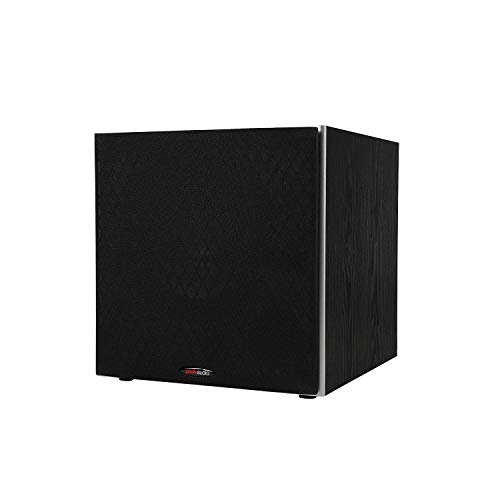
- 10-inch Dynamic Balance woofer
- Up to 100 watts listed
- Adjustable 80–160 Hz crossover
Best For: Larger desktop or room-based computer audio systems
Best for Studio Monitoring

- 8-inch bass-reflex design
- 150-watt amplifier
- Adjustable filter and phase controls
Best For: Recording and computer-based studio monitoring
Flexible Studio Bass

- 8-inch driver with bass down to 30 Hz
- Bluetooth 5.0 plus TRS, RCA, and auxiliary inputs
- Adjustable crossover and room-tuning controls
Best For: Desktop studio monitors and versatile music listening
Professional Low-End Power
JBL LSR310S 10-Inch Studio Subwoofer
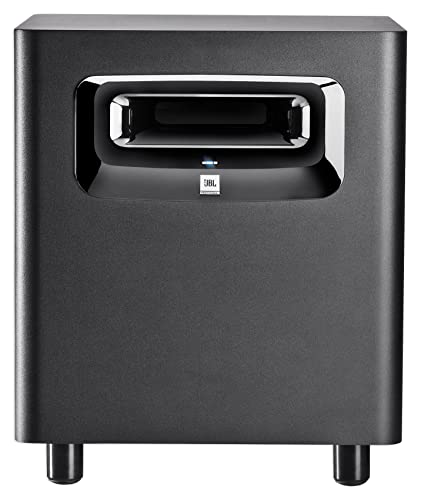
- 10-inch driver reaching into the 20 Hz region
- Balanced XLR and TRS inputs with XLR output
- Selectable XLF tuning for club-style bass
Best For: Powerful production-focused desktop studio systems
Compact Home Audio Bass

- 6-inch front-firing design for compact spaces
- Claimed 210-watt maximum output
- RCA, auxiliary, and Bluetooth connectivity
Best For: Compact desktop, gaming, and home theater audio
Powerful Upgrade Pick
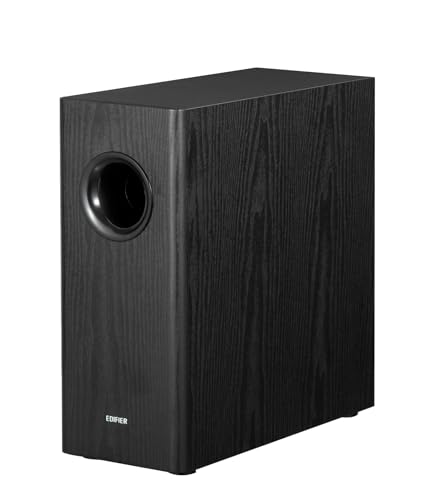
- 8-inch woofer with 70W RMS output
- Adjustable crossover and phase controls
- RCA integration with auto-standby
Best For: Desktop or bookshelf systems needing deeper, stronger bass
Flexible Connectivity Pick
BESTISAN SW65D Powered Subwoofer
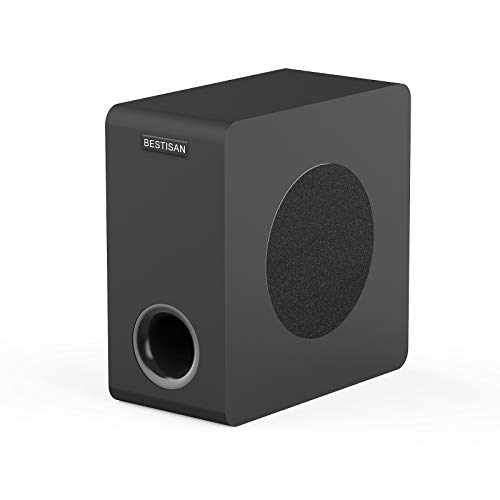
- 6.5-inch side-firing woofer
- RCA, AUX, LFE, and high-level connections
- Remote control with wood cabinet design
Best For: Mixed desktop, TV, and home-theater setups needing input flexibility
Best Compact Pick – Ortizan V8 Active Subwoofer
For shoppers seeking subwoofers for desktop setups, the Ortizan V8 is a compact active option designed for computer, gaming console, and home audio use. Its 5.24-inch long-throw woofer, 60-watt output, Class D amplification, and included vibration pads emphasize a desktop-friendly approach.
Best For: Desktop gaming and studio audio users who want a compact, shelf-mounted subwoofer.
Pros:
- Compact 5.24-inch woofer with deep-bass extension
- Built-in 60-watt Class D amplifier
- Vibration pads help suit shelf placement
- Two-year warranty is included
Cons:
- Less driver area than the larger subwoofers in this roundup
- Listed dimensions still require a sizable desktop shelf area
The Ortizan V8 makes the most sense when space and straightforward desktop placement matter more than maximum bass output. Its active design keeps the setup relatively simple for compatible computer and gaming audio systems.
Best Complete Desktop System – Klipsch ProMedia 2.1 THX
The Klipsch ProMedia 2.1 is more than a standalone subwoofer: it is a complete computer speaker system with two satellites and a 6.5-inch side-firing, ported subwoofer. For subwoofers for desktop setups, its plug-and-play design and wired 3.5-millimeter input offer an uncomplicated way to add full-range sound.
Best For: Computer, gaming, movie, and music listeners who need satellites and bass in one package.
Pros:
- THX-certified 2.1 speaker system
- 6.5-inch ported subwoofer with 200 watts of peak power listed
- Control pod provides main volume and subwoofer gain control
- Compatible with computers, gaming consoles, TVs, and music players
Cons:
- It is a complete speaker system rather than a standalone subwoofer
- Wired connectivity limits placement flexibility
- The subwoofer and satellites need more space than a compact desktop unit
The ProMedia 2.1 is a practical choice if you are building or replacing an entire desktop audio system. Its included satellites and dedicated gain control make it especially convenient for users who do not already have compatible speakers.
Best Large-Woofer Value – Polk Audio PSW10 10-Inch Subwoofer
The Polk Audio PSW10 brings a 10-inch Dynamic Balance woofer to a compact-design powered subwoofer. While it is aimed at home audio and floor placement, its adjustable crossover, phase switch, and speaker- and line-level connections can help integrate it into a larger desktop or computer listening system.
Best For: Users with room beside or under a desk who want a larger woofer for music and movie bass.
Pros:
- Large 10-inch woofer for added bass scale
- Built-in 50-watt RMS amplifier with up to 100 watts listed
- Continuously variable 80–160 Hz crossover
- Offers RCA, speaker-level, and phase-switch integration options
Cons:
- Floor-mount design and large dimensions are not ideal for small desks
- Its supplied use case is home audio rather than specifically desktop audio
- Wired connections are required
The PSW10 is best considered when desktop bass needs extend beyond what a compact shelf unit can provide. Measure carefully before buying, since its 17-inch depth and 14.5-inch height make it a substantial addition to a workstation.
Best for Studio Monitoring – Yamaha HS8S Studio Subwoofer
The Yamaha HS8S is a studio-oriented powered subwoofer for listeners who need controlled low-frequency extension. Among subwoofers for desktop setups, its 8-inch bass-reflex design, 22–150 Hz response, 150-watt amplifier, and dedicated filter controls make it a more specialized choice for recording and monitoring.
Best For: Recording, live-music, and computer-based monitoring setups with space for a full-size floor-standing subwoofer.
Pros:
- 8-inch bass-reflex woofer with a listed 22–150 Hz response
- 150-watt amplifier
- Low-cut switch and adjustable low- and high-cut controls
- Phase switch supports system integration
Cons:
- Large 18-inch depth and 33.6-pound weight make it unsuitable for cramped desks
- Designed primarily for recording and live-music applications
- Wired XLR connectivity is less convenient than a simple desktop plug-in setup
The HS8S is the strongest fit for a serious studio desk or monitoring environment rather than casual desktop listening. Its filtering and phase controls provide useful adjustment options, but the cabinet size calls for careful placement planning.
Flexible Studio Bass – PreSonus Eris Sub 8BT
For desktop setups that need accurate low-end without giving up connection flexibility, the PreSonus Eris Sub 8BT combines an 8-inch front-firing driver with Bluetooth 5.0 and professional wired inputs. Its adjustable crossover and room-tuning controls make it a practical choice for music production, listening, and gaming.
Best For: Desktop studio monitors, music production, and mixed wired/wireless listening setups.
Pros:
- Reaches down to 30 Hz with a 100-watt output.
- Offers Bluetooth 5.0, balanced TRS, RCA, and front-panel auxiliary connectivity.
- Includes highpass, lowpass, and high- and low-frequency tuning controls.
- Front headphone output and power-saving mode add everyday convenience.
Cons:
- Its floor-standing design needs more space than a compact desktop-only speaker.
- Best suited to setups that can accommodate a separate subwoofer and crossover adjustment.
The Eris Sub 8BT is a well-rounded option among subwoofers for desktop setups, especially when accurate bass, flexible inputs, and monitor integration matter more than the smallest possible footprint.
Professional Low-End Power – JBL LSR310S 10-Inch Studio Subwoofer
The JBL LSR310S is a 10-inch powered studio subwoofer built for desktop audio systems that need substantial low-frequency extension. Balanced XLR and TRS connections, selectable input sensitivity, and a dedicated XLF mode make it particularly suitable for production-focused setups.
Best For: Larger desktop studio systems, mixing, and users who want powerful wired connectivity.
Pros:
- Delivers low-frequency response into the 20 Hz region with 113 dB peak output.
- Provides balanced XLR and 1/4-inch TRS inputs and XLR outputs.
- XLF mode offers an alternate club-style bass tuning.
- Input sensitivity switching supports professional and consumer-level sources.
Cons:
- The 10-inch enclosure may be oversized for compact desks or small rooms.
- It uses wired connections rather than Bluetooth or other wireless input.
- Its professional I/O may be more than a basic computer-audio setup requires.
For buyers prioritizing output and studio integration, the LSR310S stands out among subwoofers for desktop setups. Its size and wired design make it a better fit for dedicated workstations than minimalist desktop arrangements.
Compact Home Audio Bass – Audioengine S6 Mini Subwoofer
The Audioengine S6 Mini brings a 6-inch front-firing driver and claimed 210-watt output to a relatively compact subwoofer enclosure. With RCA and auxiliary connections, Bluetooth support, and compatibility with desktop systems, it is designed for listeners who want fuller bass without a large studio subwoofer.
Best For: Compact desktop, gaming, home theater, and general music-listening setups.
Pros:
- Compact 6-inch design measures about 9.92 by 8.74 by 9.96 inches.
- Offers front-firing sound with a claimed 210-watt maximum output.
- Supports RCA, auxiliary, and Bluetooth connectivity.
- Includes a three-year warranty and weighs 15.4 pounds.
Cons:
- Its listed frequency response begins at 33 Hz, so it may not extend as low as larger studio models.
- It is a mono subwoofer and does not provide the professional balanced connections found on some studio-focused options.
- Wireless functionality is listed alongside wired subwoofer connectivity, so setup requirements should be checked carefully.
The S6 Mini is a space-conscious choice among subwoofers for desktop setups, particularly for gaming, movies, and everyday music. It favors compact convenience and broad device compatibility over the deepest studio-oriented extension.
Compact Starter Pick – Logitech Z313
The Logitech Z313 is a straightforward 2.1 speaker system for shoppers seeking subwoofers for desktop setups without assembling separate components. Its wired compact subwoofer, 25-watt RMS output, and included control pod make it suited to everyday desktop listening.
Best For: Desktop users who want an affordable, simple 2.1 system with a dedicated subwoofer.
Pros:
- Complete 2.1 system with a compact wired subwoofer
- 25 watts RMS output for everyday personal listening
- Convenient corded control pod and 3.5mm auxiliary connectivity
Cons:
- Not water resistant
- Wired subwoofer connectivity limits placement flexibility
- Offers stereo output rather than a more expansive multichannel setup
The Z313 focuses on convenience rather than advanced tuning or wireless operation. It is a practical choice when you want a ready-to-use desktop speaker system with bass support and a small footprint.
Powerful Upgrade Pick – Edifier T5s Powered Subwoofer
The Edifier T5s is a dedicated powered subwoofer for shoppers who want deeper bass from subwoofers for desktop setups. Its 8-inch long-throw woofer, 70-watt RMS Class-D amplifier, and 35Hz frequency response give it considerably more output potential than compact all-in-one systems.
Best For: Desktop or bookshelf-speaker systems with RCA connectivity and room for a larger bass upgrade.
Pros:
- 8-inch woofer with 70 watts RMS output
- Adjustable 30Hz–160Hz low-pass filter and 0°/180° phase selector
- Auto-standby and included 3.5mm-to-RCA and RCA cables
- Supports sub-out connections or compatible series connections
Cons:
- Large and heavy for a desktop-oriented setup
- Wired RCA connectivity only; no wireless communication
- Series connection requires main speakers with line input
The T5s offers useful integration controls and strong stated output, but its 15.71-inch depth and 10.38-kilogram weight call for careful placement. Check your speakers’ available inputs before buying.
Flexible Connectivity Pick – BESTISAN SW65D Powered Subwoofer
The BESTISAN SW65D is a versatile powered subwoofer for shoppers comparing subwoofers for desktop setups that may also connect to TVs, receivers, soundbars, or bookshelf speakers. It combines a 6.5-inch side-firing woofer with RCA, AUX, LFE, and high-level speaker connections.
Best For: Users who need multiple wired connection options for a desktop, TV, or home-theater audio system.
Pros:
- 6.5-inch side-firing woofer in a compact wood cabinet
- RCA, 3.5mm AUX, LFE, and high-level speaker inputs and outputs
- Remote control and stated 35Hz–200Hz frequency response
- Bottom port and internal bracing designed to reduce resonance
Cons:
- Wired subwoofer connectivity rather than wireless operation
- Best results call for a source output of 850mV or less
- Manufacturer recommends pairing with BESTISAN speakers or soundbars
The SW65D is a strong fit when connection flexibility matters more than a minimal desktop footprint. Its 12.5-inch depth and floor-standing design may be better beside a desk than directly on it.
How We Picked the Best Subwoofers for Desktop Setups
We focused on powered subwoofers and complete desktop speaker systems that suit computers, nearfield listening, gaming, music, and compact home offices. Our comparison considers amplifier output, woofer size, frequency extension, connection flexibility, cabinet size, control options, and ease of integration.
Because desktop systems vary widely, no single specification determines sound quality. A small sub can be a better match for compact speakers and close listening, while a larger model may provide more effortless low-end energy in a bigger room. We also included several all-in-one speaker systems for buyers who need a straightforward 2.1 setup rather than a standalone subwoofer.
Quick Comparison
- Most compact: Ortizan Compact 60W and Audioengine S6 Mini are suited to limited desk or room space.
- Best for computer speaker simplicity: Klipsch ProMedia 2.1 and Logitech Z313 combine satellite speakers with a subwoofer.
- Best for studio monitoring: Yamaha HS8, JBL LSR310S, and PreSonus Eris Sub 8BT offer features aimed at monitor-based systems.
- Best larger home-audio options: Polk Audio PSW10 and Edifier T5s provide more cabinet and woofer size for fuller bass.
- Flexible budget choice: BESTISAN offers a compact powered design for basic home-audio integration.
Key Buying Factors for Subwoofers for Desktop Setups
Size and Bass Output
Measure the available floor area before buying. An 8- or 10-inch woofer can deliver stronger low bass, but it usually needs more room and may be excessive for a small desk. Compact models are easier to place near a workstation and can still improve kick drums, effects, and game audio.
Connections and Compatibility
Check whether your speakers or computer provide a subwoofer output, RCA connection, 3.5mm input, or studio-monitor connectivity. Some models are designed to sit between a source and powered monitors, while complete 2.1 systems use proprietary satellite connections. Wireless or Bluetooth support can simplify placement, but wired connections are often preferable for critical monitoring.
Controls and Setup
Adjustable volume and crossover controls help blend the sub with your main speakers. Phase controls are useful when bass sounds weak at the listening position. Place the sub on a stable surface, avoid blocking ports, and start with conservative volume before increasing output.
Room and Listening Distance
Desktop listening happens close to the speakers, so excessive bass can quickly become boomy. Consider room size, wall proximity, and whether you mainly listen to music, watch movies, play games, or mix audio.
Who Should Buy Which Subwoofers for Desktop Setups?
Choose a compact model if you have a small desk, modest satellite speakers, or neighbors nearby. Pick a complete 2.1 package if you want the simplest computer setup with minimal compatibility concerns. Buyers using studio monitors should prioritize a subwoofer with appropriate monitor connections, level controls, and a crossover range suited to their speakers. For movies, games, or larger rooms, a bigger powered subwoofer can provide deeper, more dynamic impact—but only if placement and volume can be managed.