Moving 4K and 8K video, large photo libraries, game installations, or professional project files requires more than a basic drive case. The right SSD enclosure can improve transfer speeds, cooling, compatibility, and everyday portability.
We selected 10 options ranging from compact NVMe adapters to high-capacity multi-bay systems, with choices for different drives, interfaces, workflows, and budgets.
Best 10 SSD Enclosures for Large Files Picks for 2026
Top-Speed Pick

- Up to 40Gbps USB4 performance
- Fanless aluminum heat-dissipating design
- Supports M.2 NVMe drives up to 8TB
Best For: USB4 and Thunderbolt users moving large files
Versatile Value
SABRENT Tool-Free M.2 Enclosure
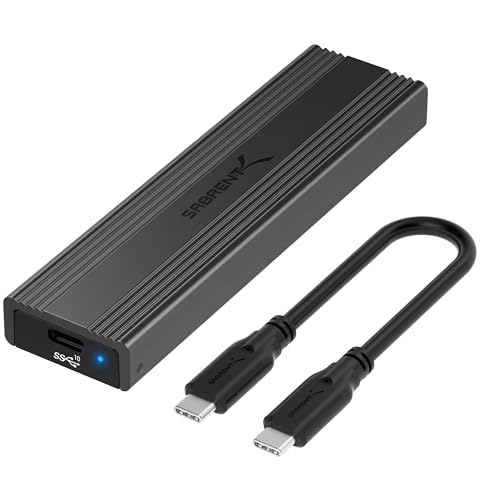
- Supports NVMe and SATA M.2 drives
- Tool-free drive installation
- USB 3.2 Type-C up to 10Gbps
Best For: Mixed M.2 drive collections and easy upgrades
High-Capacity USB4 Pick

- Up to 40Gbps USB4 transfers
- Supports capacities up to 16TB
- Fits multiple M.2 drive lengths
Best For: Large media libraries and high-capacity project storage
Multi-Drive Storage Pick
Yottamaster 5-Bay SATA Enclosure

- Holds up to five SATA drives
- Supports 2.5-inch and 3.5-inch disks
- Cooling fan and aluminum enclosure
Best For: Expandable desktop archives and multi-drive storage
Best Multi-Drive NVMe Pick
Compact 4-Bay 40Gbps Enclosure

- Four NVMe bays support up to 32TB
- Up to 40Gbps connectivity
- Active cooling and hot-swap access
Best For: Large file workflows needing compact, high-capacity NVMe storage
Best Flexible RAID Pick

- Five 2.5-inch bays support up to 40TB
- Seven selectable RAID modes
- USB, SD, and TF expansion ports
Best For: Portable photo and video storage with flexible RAID options
Best Thunderbolt Workstation Pick

- Four PCIe M.2 bays with 40Gbps Thunderbolt 3
- Supports software RAID across major platforms
- Includes DisplayPort and downstream Thunderbolt
Best For: Thunderbolt workstations running multi-drive NVMe workloads
Versatile 10Gbps Pick
SSK M.2 NVMe/SATA SSD Enclosure

- Supports compatible NVMe and SATA M.2 drives
- USB 3.2 Gen 2 up to 10Gbps
- Includes cables, thermal pads, and screwdriver
Best For: Portable use with compatible NVMe or SATA M.2 drives
High-Capacity Multi-Drive Choice

- Four NVMe bays support up to 32TB total
- USB 4.0 bandwidth rated up to 40Gbps
- Built-in fan and aluminum cooling design
Best For: Video editing and other multi-drive professional workflows
Compact NVMe Option
ORICO M.2 10Gbps SSD Enclosure

- Supports NVMe drives up to 8TB
- USB 3.1 Gen 2 up to 10Gbps
- Compact design with USB-C and USB-A connectivity
Best For: Portable single-drive NVMe storage and file transfers
Top-Speed Pick – Qwiizlab USB4 NVMe Enclosure
For demanding transfers of large files, the Qwiizlab ES40UR is a high-speed option among SSD enclosures for large files. Its USB4 and Thunderbolt compatibility supports up to 40Gbps, while the aluminum, fanless design helps manage heat without adding mechanical-fan noise. The enclosure accepts M.2 NVMe drives up to 8TB, but the SSD is not included.
Best For: Users with USB4 or Thunderbolt 4/5 computers who want very fast external NVMe storage for large projects.
Pros:
- Supports USB4 and Thunderbolt 4/5 transfer rates up to 40Gbps.
- Fanless aluminum enclosure provides passive heat dissipation.
- Fits M.2 NVMe drives in 2230, 2242, 2260, and 2280 sizes up to 8TB.
- Includes a 40Gbps USB-C cable and thermal pads.
Cons:
- SSD must be purchased separately.
- Not compatible with Thunderbolt 1 or Thunderbolt 2 ports.
- Its top performance requires a compatible USB4 or Thunderbolt host.
This is a strong choice when transfer speed is the priority. Confirm your computer has a compatible port before buying, since older USB or Thunderbolt connections will limit performance.
Versatile Value – SABRENT Tool-Free M.2 Enclosure
The SABRENT EC-SNVE is a practical choice for SSD enclosures for large files when you need broad M.2 compatibility and simple installation. It supports both NVMe and SATA M.2 drives and reaches up to 10Gbps over USB 3.2 Type-C. This is an enclosure only, so you supply the SSD.
Best For: Buyers who want one compact enclosure for bare M.2 NVMe or SATA drives and value tool-free installation.
Pros:
- Works with M.2 NVMe and SATA drives in 2242, 2260, and 2280 sizes.
- Tool-free installation lets you install or remove a drive quickly.
- USB 3.2 Type-C supports up to 10Gbps and requires no external power supply.
- Slim aluminum-and-ABS construction includes a thermal pad.
Cons:
- Does not include an SSD.
- Cannot accommodate drives with pre-installed heatsinks.
- Not designed for 2.5-inch SATA or mSATA drives.
Its 10Gbps ceiling is below USB4 enclosures, but it is more flexible because it accepts both NVMe and SATA M.2 formats. Check your drive type and size before installation.
High-Capacity USB4 Pick – Satechi NVMe Pro Enclosure
The Satechi USB4 NVMe SSD Pro Enclosure combines high throughput with a stated capacity support of up to 16TB, making it well suited to SSD enclosures for large files. It supports PCIe Gen 4×4 drives and transfer rates up to 40Gbps, with backward compatibility for slower USB standards. The SSD is not included.
Best For: Professionals and power users who need fast external NVMe storage with support for very high-capacity drives.
Pros:
- Supports USB4 transfer rates up to 40Gbps and read/write speeds up to 3840MB/s.
- Accommodates M.2 drives in 2230, 2242, 2260, and 2280 sizes up to 16TB.
- Tool-free setup uses an included silicone pin and thermal pad.
- Compatible with Mac, Windows, and Linux systems.
Cons:
- SSD is not included.
- Maximum performance depends on a compatible USB4 host and drive.
- The enclosure is larger and heavier than some compact M.2 cases.
Choose this model when capacity headroom matters as much as speed. Its 16TB support is notable for large media libraries and project files, while backward compatibility keeps it usable with slower USB ports.
Multi-Drive Storage Pick – Yottamaster 5-Bay SATA Enclosure
The Yottamaster PS500U3 takes a different approach to SSD enclosures for large files by housing up to five SATA drives in one desktop enclosure. It supports 2.5-inch and 3.5-inch HDDs or SSDs, with up to 22TB per drive according to the supplied notes. This is a non-RAID DAS enclosure using USB 3.0 and SATA III connectivity.
Best For: Home and office users who need expandable multi-drive storage for archives, video work, and large collections.
Pros:
- Five bays support 2.5-inch and 3.5-inch SATA HDDs or SSDs.
- Supports up to 22TB per drive, with substantial total expansion capacity.
- Aluminum construction and an 80mm temperature-controlled fan aid cooling.
- Removable trays make drive installation and replacement easier.
Cons:
- USB 3.0 and SATA III are slower than USB4 NVMe enclosures.
- This model does not provide hardware RAID.
- It is a larger desktop enclosure rather than a portable drive case.
This is the better fit for capacity and drive count rather than maximum single-drive speed. Remember that new drives may need formatting and partitioning, and any RAID setup must be handled through software.
Best Multi-Drive NVMe Pick – Compact 4-Bay 40Gbps Enclosure
For shoppers comparing ssd enclosures for large files, the TERRAMASTER D4 SSD stands out when you need four NVMe drives, high throughput, and a compact desktop-friendly design. It supports up to 32TB total and can reach up to 3,224MB/s with four 990 PRO SSDs, making it well suited to demanding transfers and 4K video work.
Best For: Video editors, backup users, and anyone building a high-capacity multi-drive NVMe setup for Windows, Mac, or Linux.
Pros:
- Four M.2 NVMe 2280 bays support up to 32TB total.
- 40Gbps connectivity and up to 3,224MB/s with four compatible SSDs.
- Active cooling, temperature sensors, tool-free access, and hot-swappable drive support.
- Works with Windows, macOS, Linux, Android, and iOS, with backup software included.
Cons:
- Does not include built-in RAID; software RAID requires third-party tools.
- Requires separate M.2 NVMe SSDs.
The D4 SSD is a strong choice if capacity and multi-drive flexibility matter more than a simple one-disk enclosure. Its cooling and hot-swap design are useful for sustained workloads, while the lack of hardware RAID may matter to users who want RAID managed directly by the enclosure.
Best Flexible RAID Pick – 5-Bay All-Flash Storage Hub
The ORICO 2.5-inch enclosure is designed for large project libraries, combining five drive bays with selectable RAID modes and useful connectivity for photographers and video editors. It supports up to 40TB across five 2.5-inch drives and adds USB and memory-card ports for streamlined file transfers.
Best For: Photographers and video creators who want portable 2.5-inch storage, flexible RAID configurations, and built-in card and USB expansion.
Pros:
- Five bays support 2.5-inch SSDs or HDDs, up to 40TB total.
- Offers RAID 0, 1, 3, 5, 10, JBOD, and CLEAR modes.
- Includes two USB 3.2 10Gbps ports plus SD and TF 3.0 card slots.
- Compact all-flash design is more portable than traditional 3.5-inch enclosures.
Cons:
- SATA connections are limited to 5Gbps, despite the 10Gbps USB interface.
- Supports 2.5-inch drives only and does not accept 3.5-inch drives.
- Individual drives are limited to 8TB.
Choose the ORICO when workflow flexibility is a priority. Its RAID choices and card-reader ports make it practical for on-location backups and media projects, though users seeking the highest NVMe-class speeds should consider a faster PCIe enclosure instead.
Best Thunderbolt Workstation Pick – 4-Bay NVMe Enclosure
For Thunderbolt-equipped workstations handling large files, the StarTech 4-Bay enclosure turns up to four PCIe 80mm M.2 NVMe or AHCI drives into a 40Gbps external storage system. Dedicated 8Gbps PCIe lanes, software RAID support, and a cooled metal enclosure make it a capable option for high-performance editing and storage setups.
Best For: Mac and Windows laptop users with Thunderbolt 3 or 4 who need multi-drive NVMe storage, software RAID, and display connectivity.
Pros:
- Supports up to four M-Key 80mm PCIe NVMe or AHCI SSDs.
- Thunderbolt 3 provides up to 40Gbps transfer speeds.
- Supports software RAID through Storage Spaces, macOS RAID Assistant, or Linux mdraid/mdadm.
- Includes DisplayPort output, a downstream Thunderbolt port, power adapter, and certified cable.
Cons:
- Not compatible with SATA SSDs.
- Connected displays and Thunderbolt devices share bandwidth with the SSDs.
- Requires a compatible Thunderbolt host and separate M.2 drives.
The StarTech model is a focused workstation solution for users already invested in Thunderbolt. Its lane allocation, RAID compatibility, and expansion ports provide useful flexibility, but SATA-drive owners or USB-only systems will need a different enclosure.
Versatile 10Gbps Pick – SSK M.2 NVMe/SATA SSD Enclosure
The SSK M.2 enclosure is a flexible option for anyone comparing ssd enclosures for large files. Its RTL9210B controller, USB 3.2 Gen 2 interface, and support for both NVMe and SATA M.2 drives provide up to 10Gbps connectivity, while the aluminum shell and included thermal pads help manage heat during transfers.
Best For: Users who need one portable enclosure for compatible NVMe or SATA M.2 drives.
Pros:
- Supports NVMe PCIe and SATA M-Key/B+M Key drives in 2242, 2260, and 2280 sizes.
- USB 3.2 Gen 2 offers up to 10Gbps, with UASP and TRIM support.
- Includes USB-C and USB-A cables, two thermal pads, and a screwdriver.
- Aluminum construction is slim and designed for heat dissipation.
Cons:
- Does not support M.2 PCIe AHCI, mSATA, Wi-Fi, or capture-card devices.
- Drive is not included and must be formatted before use.
This is a practical, well-equipped choice when compatibility flexibility matters. Confirm your drive type before buying, since its broad support does not extend to every M.2 format.
High-Capacity Multi-Drive Choice – ORICO 40Gbps M.2 SSD Dock
The ORICO 8848U4 is built for demanding workflows and large files, combining four M.2 NVMe bays with a USB 4.0 connection rated up to 40Gbps. It supports up to 8TB per drive and 32TB total, making it a strong fit for video editors, music professionals, and users managing several solid-state drives.
Best For: Professional users who need multi-drive NVMe storage for editing and high-volume transfers.
Pros:
- Four-bay design supports up to 32TB total capacity.
- Supports M-Key NVMe drives in 2230, 2242, 2260, and 2280 sizes.
- USB 4.0 interface provides up to 40Gbps total bandwidth.
- Aluminum housing, built-in fan, and ventilation support sustained workloads.
Cons:
- SSD drives are not included.
- Single-drive operation is specified at up to 10Gbps rather than 40Gbps.
- The built-in fan operates below 30 decibels, so it is not completely silent.
For large-file workflows involving multiple NVMe drives, this dock offers substantially more capacity and expansion than a single-drive enclosure. Its four-bay format is less suitable if you only need a compact travel adapter.
Compact NVMe Option – ORICO M.2 10Gbps SSD Enclosure
The ORICO M2PV is a compact NVMe-only adapter for moving large files between an M.2 drive and a computer or other compatible host. Its RTL9210 controller, USB 3.1 Gen 2 interface, and UASP support provide theoretical speeds up to 10Gbps, with read/write performance listed above 900MB/s when paired with high-performance NVMe media.
Best For: Portable users who want a small enclosure for a single NVMe M.2 SSD.
Pros:
- Supports PCIe NVMe M-Key drives up to 8TB in 2230, 2242, 2260, and 2280 sizes.
- USB 3.1 Gen 2 supports up to 10Gbps with UASP acceleration.
- Includes USB-C-to-C and USB-C-to-A cable options.
- Compact aluminum-and-plastic design is easy to carry.
Cons:
- Does not support M.2 SATA, PCIe AHCI, or SSDs from Mac systems.
- Only one SSD can be installed.
- SSD must be formatted before use and is not included.
This enclosure keeps the setup simple and portable while offering the bandwidth needed for many large-file transfers. Choose it only if your drive is a compatible PCIe NVMe M-Key model, since SATA M.2 drives will not work.
How We Picked These SSD Enclosures for Large Files
We focused on enclosures and storage systems that can handle sustained transfers rather than short benchmark bursts alone. Selection criteria included interface speed, drive compatibility, thermal design, capacity support, portability, expansion options, and connection standards such as USB 3.2, USB4, and Thunderbolt.
Because the products use different drive formats, this list includes single-drive NVMe cases, dual-interface M.2 enclosures, multi-bay NVMe docks, and larger SATA storage enclosures. Actual performance depends on the installed SSD, host computer, cable, operating system, and workload.
Quick Comparison
| Type | Best For | Typical Interface | Main Advantage |
|---|---|---|---|
| Compact M.2 enclosure | Portable file transfers | 10Gbps USB | Affordable and easy to carry |
| Premium single-drive enclosure | Video editing and large project files | 40Gbps USB4 | Higher peak bandwidth |
| Multi-drive NVMe enclosure | Fast scratch storage and editing workflows | 40Gbps USB4 or Thunderbolt | Multiple SSDs in one unit |
| Multi-bay SATA enclosure | Bulk capacity and archives | USB 3.0 | Supports several high-capacity drives |
Key Buying Factors for SSD Enclosures for Large Files
Interface and Real-World Speed
A 10Gbps USB enclosure is usually sufficient for everyday backups and large media transfers, while 40Gbps USB4 or Thunderbolt models are better suited to frequent editing and high-bitrate footage. Your computer must support the enclosure’s interface to achieve its advertised performance.
Drive Compatibility
Check whether the enclosure accepts NVMe, SATA, or both. For M.2 drives, verify the supported key type and physical sizes, including 2230, 2242, 2260, and 2280. Multi-bay models may require separate SSDs and can have different RAID or disk-management limitations.
Cooling and Sustained Performance
Large file transfers can expose thermal throttling. Aluminum bodies, thermal pads, heatsinks, fans, and ventilation can help maintain speed. Fanless designs are quieter, while active cooling may be preferable for long editing sessions.
Capacity, Power, and Portability
Confirm the maximum supported capacity and whether the enclosure needs a dedicated power adapter. Bus-powered cases are convenient for laptops, but multi-drive units generally need external power and more desk space.
Who Should Buy Which SSD Enclosures for Large Files?
Choose a compact 10Gbps M.2 enclosure if you want an inexpensive portable backup or boot drive. A USB4 single-drive model makes more sense for creators who regularly move large video, photography, or engineering files. Select a multi-bay NVMe enclosure when you need several fast SSDs available from one desktop device. For lower-cost bulk storage, a multi-bay SATA enclosure can provide substantially more capacity, although it will usually be slower than NVMe.
Before buying, match the enclosure to your host ports, installed drive, cable quality, and operating system. If sustained speed matters, prioritize cooling and a reputable controller over the highest advertised burst figure.