Speaker selector switches with volume control make it easier to distribute one amplifier’s output across multiple rooms while adjusting listening levels independently. The right model can simplify a multi-zone setup without requiring a separate amplifier for every space.
This roundup compares 10 popular options by zone count, power handling, impedance protection, connection flexibility, and everyday ease of use. Use the guide below to narrow the choices based on your room layout, speaker wiring, and amplifier.
Best 10 Speaker Selector Switches with Volume Control Picks for 2026
Best Multi-Zone Control

- Controls up to six speaker pairs
- Independent volume knobs for each zone
- 100W per channel with overload protection
Best For: Large home theater and whole-home audio setups
Best Compact 4-Zone Pick
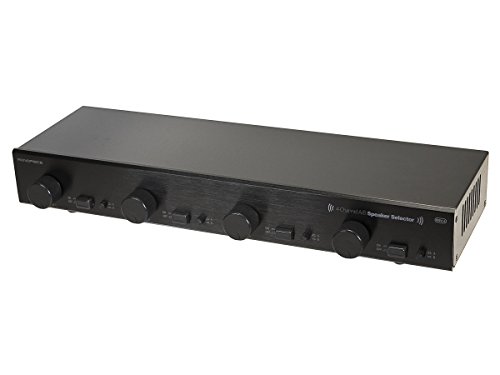
- Supports four speaker channels
- Maintains an 8-ohm load
- Accepts speaker wire up to 14 AWG
Best For: Four-zone home stereo systems
Best High-Power 6-Zone Option

- Controls six zones with individual volume knobs
- Supports two amplifiers or receivers
- Handles 300W RMS per channel
Best For: Whole-house, outdoor, and commercial audio installations
Best 4-Zone Audiophile Choice

- Controls four speaker pairs or zones
- Individual volume knobs for every zone
- Compact metal construction with 2-year warranty
Best For: Residential or commercial distributed background music
Best Multi-Room Pick
PROZOR 4-Zone Speaker Selector

- Switches four speaker pairs independently
- Passive setup with no power adapter
- Supports 4–16Ω speakers and 150W RMS/channel
Best For: Multi-room systems using one amplifier
Best Compact Volume-Control Pick
Monoprice 2-Channel A/B Selector

- Built-in independent volume controls
- Routes two sources to two destinations
- Accepts speaker wire up to 14 AWG
Best For: Small stereo systems needing local volume adjustment
Best Six-Zone Hub
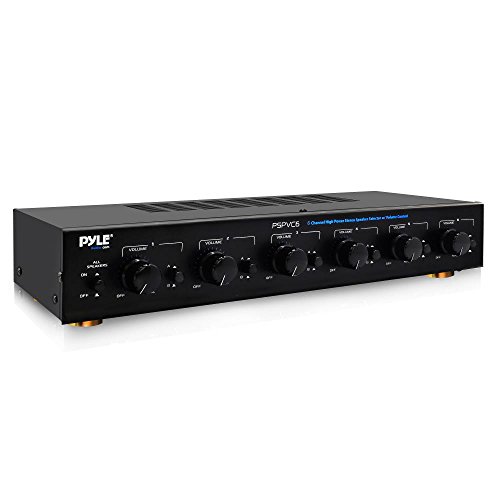
- Provides six speaker ports
- Built for multi-channel amplifier control
- Centralized design for distributed audio
Best For: Larger systems with up to six speaker zones
Best Overall
Monoprice SSVC-4.1 4-Channel Selector
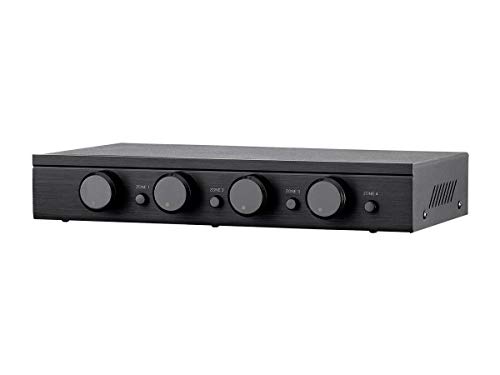
- Four zones with individual volume and power controls
- Automatic impedance protection circuitry
- 100W continuous per channel; 200W peak
Best For: Four-zone home audio systems using one amplifier
Best Compact Option
Pyle PSLSW4.5 4-Channel Selector
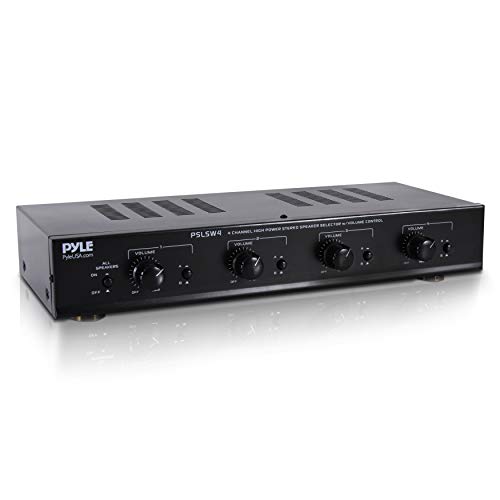
- Independent volume control for all four channels
- Compact tabletop-friendly design
- Supports up to four pairs of 8-ohm speakers
Best For: Space-conscious four-zone stereo and home theater setups
Best for Six Zones
Pyle PSPVC6.5 6-Channel Selector

- Controls up to six speaker pairs
- Individual volume settings for each zone
- Plug-and-play design needs no extra power supply
Best For: Larger multi-room or commercial audio installations
Best Multi-Zone Control – 6-Channel Speaker Selector
If you need speaker selector switches with volume control for several listening areas, the Pyle PSLSW6 manages up to six speaker pairs from one stereo receiver. Its individual volume knobs and push-button zone selection make it practical for customized whole-home audio.
Best For: Home theater and stereo systems requiring control of up to six 8-ohm speaker pairs.
Pros:
- Controls up to six speaker pairs, individually or in combination.
- Provides independent volume controls for each connected pair.
- Supports up to 100 watts per channel and speaker wire up to 14 AWG.
- Includes overload protection and a compact tabletop design.
Cons:
- Designed for 8-ohm speakers.
- Its six-zone layout takes up more space than smaller selectors.
The PSLSW6 is a strong choice when zone count and independent volume adjustment matter most. Screw terminals and straightforward A/B connections also help simplify installation.
Best Compact 4-Zone Pick – Monoprice A/B Selector
The Monoprice 4-Channel A/B Speaker Selector is a practical option if you want speaker selector switches with volume control for routing audio to different rooms. It supports up to four zones, accepts speaker wire up to 14 AWG, and maintains an 8-ohm load.
Best For: Multi-room stereo systems that need four-zone switching with per-channel volume control.
Pros:
- Supports four speaker channels or zones.
- Includes volume control for room-by-room adjustment.
- Maintains an 8-ohm load and accepts wire up to 14 AWG.
- Supports a 20Hz–20kHz frequency range.
Cons:
- Offers fewer zones than six-channel alternatives.
- No warranty is listed in the supplied details.
This Monoprice selector fits buyers who want essential four-zone distribution without moving to a larger six-zone unit. Its 8-ohm load specification is important to check against your speakers and receiver.
Best High-Power 6-Zone Option – Theater Solutions TS6DV
Theater Solutions TS6DV Dual Input 6 Zone Speaker Selector Box Volume Controls
Check Price On AmazonThe Theater Solutions TS6DV combines six-zone speaker switching with individual volume controls, making it a capable choice among speaker selector switches with volume control. Its dual-input design can connect two amplifiers or receivers, while impedance protection helps support multi-zone installations.
Best For: Whole-house, outdoor, business, or retail audio systems using up to six pairs of 8-ohm speakers.
Pros:
- Handles six zones and up to 12 speakers.
- Offers individual volume controls and A/B input selection.
- Supports up to 300 watts RMS per channel.
- Includes impedance protection and removable screw connectors for 14–22 gauge wire.
Cons:
- Requires a receiver or amplifier with raw speaker-wire outputs.
- Its 17-inch-wide steel housing may need dedicated shelf or rack space.
The TS6DV stands out for installations that need six zones, dual-source flexibility, and a higher stated power capacity. Confirm amplifier compatibility and wiring requirements before installation.
Best 4-Zone Audiophile Choice – OSD Audio RSVC4
The OSD Audio RSVC4 is a compact four-zone selector for listeners comparing speaker selector switches with volume control for residential or commercial background music. Individual knobs let you tailor each zone, while the unit is designed to connect multiple loudspeakers without overloading compatible low-ohm amplifiers.
Best For: Four-zone distributed audio in homes, offices, and other background-music environments.
Pros:
- Controls four speaker pairs or zones.
- Provides an individual volume knob for each zone.
- Compatible with low-ohm amplifiers rated at 2 x 80W RMS.
- Uses compact, high-quality metal-cast construction and includes a 2-year warranty.
Cons:
- Limited to four zones.
- Amplifier compatibility should be checked before connecting multiple speakers.
The RSVC4 is a sensible fit when you want four-zone control in a compact enclosure. Its low-ohm amplifier compatibility and metal construction make it especially appealing for distributed background audio.
Best Multi-Room Pick – PROZOR 4-Zone Speaker Selector
The PROZOR 4-Zone is a practical choice among speaker selector switches with volume control considerations, though it does not include built-in volume controls. It connects one amplifier to up to four pairs of passive speakers, with independent A/B/C/D zone buttons and an AMP master switch.
Best For: Whole-home, patio, shop, or studio systems that need simple four-zone switching from one amplifier.
Pros:
- Controls up to four speaker pairs independently.
- Passive design requires no external power adapter.
- Supports 4–16Ω speakers and up to 150W RMS per channel.
- Solid metal housing includes anti-slip feet.
Cons:
- Volume must be controlled from the amplifier, not the selector.
- Requires speaker-wire connections through spring clips.
Choose this model when zone selection matters more than local volume adjustment. Its master AMP switch and long-distance wiring support make it well suited to straightforward multi-room installations.
Best Compact Volume-Control Pick – Monoprice 2-Channel A/B Selector
The Monoprice 2-Channel A/B is a straightforward option for shoppers comparing speaker selector switches with volume control. It provides built-in independent volume controls while routing two stereo audio sources to up to two destinations.
Best For: Smaller stereo setups that need source or destination switching plus separate volume adjustment.
Pros:
- Includes independent built-in volume controls.
- Supports up to 100 watts per channel.
- Accepts bare speaker wire up to 14 AWG.
Cons:
- Limited to two channels and two destinations.
- Does not offer the four- or six-zone capacity of larger selector boxes.
This is the most directly aligned option for buyers who specifically want volume control on the selector itself. Its two-channel layout keeps the installation focused and manageable for modest audio systems.
Best Six-Zone Hub – Pyle PSPVC6 Speaker Selector
The Pyle PSPVC6 is designed for larger distributed-audio installations and is a strong candidate among speaker selector switches with volume control. Its six-zone format provides a central hub for managing multiple speaker pairs with a high-powered amplifier.
Best For: Multi-channel systems that need distribution across up to six speaker zones.
Pros:
- Provides six speaker ports for multi-zone distribution.
- Designed for high-powered amplifier control.
- Uses a broad, rack-style form factor for centralized installation.
Cons:
- The supplied notes do not specify supported wattage or impedance.
- Its larger six-zone design may be more than needed for a small setup.
- Power source is listed as corded electric, so placement requires access to power.
Consider the Pyle when six-zone capacity is the priority. Before installation, verify the amplifier and speaker requirements because the supplied specifications do not state the unit’s supported power or impedance range.
Best Overall – Monoprice SSVC-4.1 4-Channel Selector
The Monoprice SSVC-4.1 is a strong all-around choice among speaker selector switches with volume control. It connects up to four speaker pairs to one amplifier and combines individual zone controls with automatic impedance protection.
Best For: Home audio setups needing four independently controlled speaker zones and broad speaker-wire compatibility.
Pros:
- Supports four speaker pairs with individual on/off buttons and volume controls.
- Automatic impedance protection helps support safe multi-speaker operation.
- Handles up to 100 watts per channel continuously and 200 watts peak.
- Heavy-duty screw connectors accommodate 12–18 AWG speaker wire.
Cons:
- Its 6.9-pound construction may be less convenient for portable or temporary setups.
- Impedance requirements vary depending on the number and impedance of connected speakers.
With isolated left and right circuit grounds and accurate, noise-free switching, this model is particularly well suited to a more carefully configured multi-zone system.
Best Compact Option – Pyle PSLSW4.5 4-Channel Selector
The Pyle PSLSW4.5 offers a compact way to manage four speaker pairs, making it a practical pick for shoppers comparing speaker selector switches with volume control. Each channel has its own volume adjustment, while front-panel overload protection adds a layer of system security.
Best For: Compact home theater or stereo systems using up to four pairs of 8-ohm speakers.
Pros:
- Independent volume controls let you adjust each audio zone separately.
- Supports up to four speaker pairs at a maximum of 100 watts per channel.
- Slim tabletop design fits neatly into a home audio setup.
- Screw-type connectors support speaker wire up to 14 AWG.
Cons:
- The supplied specifications specifically identify compatibility with 8-ohm speakers.
- Its connector details are less straightforward, listing both screw-type speaker connections and 3.5mm/RCA cable information.
This selector prioritizes straightforward four-zone control in a small footprint, with simple installation and overload protection for everyday stereo and home theater use.
Best for Six Zones – Pyle PSPVC6.5 6-Channel Selector
The Pyle PSPVC6.5 expands speaker distribution to six pairs while keeping individual volume controls at the selector. For shoppers seeking speaker selector switches with volume control for larger indoor or outdoor systems, its six-channel layout provides more zone capacity from a single hub.
Best For: Multi-room or commercial audio systems that need control of up to six speaker pairs.
Pros:
- Controls up to six speaker pairs from one distribution hub.
- Individual volume settings help manage separate audio zones.
- Designed for speakers ranging from 4 to 12 inches, including ceiling, wall, home theater, and monitor speakers.
- Plug-and-play setup requires no additional power supply.
Cons:
- The supplied notes do not specify a per-channel wattage rating.
- Its listed cable and connector information is limited compared with the Monoprice model.
Its six-zone capacity and overload-protection circuitry make it the most suitable option here when a system needs more speaker pairs than a typical four-channel selector can accommodate.
How We Picked the Best Speaker Selector Switches with Volume Control
We focused on passive selector boxes designed to route one amplifier or receiver to multiple speaker pairs, with independent volume controls where available. The comparison considers the number of zones, A/B switching, power ratings, impedance protection, supported wire gauges, control layout, and installation practicality.
Because published power figures are not always measured under identical conditions, treat wattage as a compatibility guideline rather than a guarantee of sound quality. Your amplifier’s minimum impedance rating and the selector’s protection circuitry matter just as much.
Quick Comparison
| What to Compare | Why It Matters |
|---|---|
| Zone count | Determines how many speaker pairs can be connected and controlled. |
| Volume controls | Lets each room use a more suitable listening level. |
| Impedance protection | Helps protect the amplifier when several speaker pairs are active. |
| Power handling | Should meet or exceed the realistic output of your amplifier and speakers. |
| Inputs and switching | Dual-input or A/B designs may support more flexible source distribution. |
Key Buying Factors for Speaker Selector Switches with Volume Control
Zone Capacity and Layout
Choose a two- or four-zone unit for a small home, apartment, or simple indoor setup. Six-zone models are better suited to larger homes, patios, offices, or installations with several speaker pairs. Count the rooms you need today, but avoid paying for extra zones if they will remain unused.
Amplifier and Impedance Compatibility
Check the amplifier’s supported impedance before connecting multiple pairs. Selectors with impedance-matching or protection features can reduce the load seen by the amplifier, but they do not eliminate the need to follow the manufacturer’s wiring limits. Passive selectors also cannot create additional amplifier power.
Power Rating and Wire Connections
Compare the selector’s per-channel or total power specification with your receiver’s output. Confirm that the terminals accept your existing cable, especially if you use thicker 14 AWG wire. Keep cable runs secure, correctly polarized, and free from stray strands that could cause a short.
Controls and Installation
Independent knobs and clearly labeled zone buttons make daily use easier. Front-panel controls work well for accessible equipment racks, while a compact enclosure may be preferable when space is limited. Make sure the unit has adequate ventilation and is easy to reach for troubleshooting.
Who Should Buy Which Speaker Selector Switches with Volume Control?
Choose a compact two-zone selector for a basic living-room and patio arrangement. Four-zone models offer the best balance for most homes, particularly when each room needs its own volume adjustment. Six-zone units make more sense for whole-home audio or multiple commercial-style areas. Buyers running powerful amplifiers should prioritize impedance protection and conservative power matching over the highest zone count. If you need separate sources playing simultaneously in different rooms, verify that the selector supports that arrangement—or consider a multi-zone amplifier instead.