The best RAID enclosures for data security make it easier to combine multiple drives into a more resilient external storage system. They can add redundancy, expand capacity, and provide faster access than relying on a single portable drive.
This roundup covers two-, four-, and five-bay models with different RAID options, interfaces, cooling systems, and drive-size support. Use the guide below to match the enclosure to your backup strategy, performance requirements, and budget.
Best 10 Raid Enclosures for Data Security Picks for 2026
Balanced Backup Pick
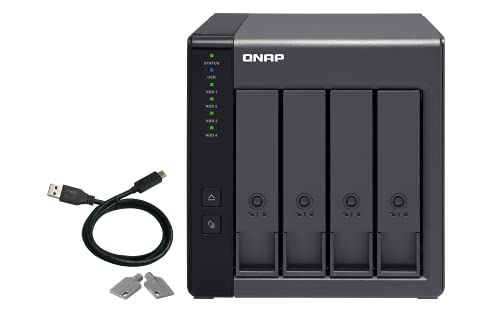
- Four-bay hardware RAID DAS
- Supports RAID 0, 1, 5, JBOD, and individual disks
- Lockable bays and QNAP NAS backup support
Best For: Flexible local backups and QNAP NAS expansion
High-Capacity RAID Pick

- Five-bay design supports up to 110TB as specified
- Eight RAID and disk-management modes
- Cooling fan, aluminum body, and drive locking
Best For: Large desktop storage pools and media libraries
Fast Two-Bay Mirror

- Two-bay hardware RAID enclosure
- USB 3.2 Gen 2 up to 10Gbps
- RAID 1 mirroring with tool-free trays
Best For: Compact, fast mirrored storage
Flexible Four-Bay Workstation

- Eight listed RAID and storage modes
- Up to 96TB with four 24TB drives
- Dual fans, status LEDs, and USB-C connectivity
Best For: Professional backups and large media libraries
Best High-Capacity Pick
ORICO 5-Bay Hardware RAID Enclosure

- Hardware RAID with eight selectable modes
- Supports up to five SATA HDDs or SSDs
- 110TB stated capacity with 150W power supply
Best For: Large backups, media libraries, and workstation storage
Best Hybrid Storage Pick
CENMATE 5-Drive HDD and NVMe RAID Enclosure

- Combines two SATA bays with three M.2 NVMe slots
- Supports RAID 0, RAID 1, Normal, and JBOD
- USB 3.2 Gen 2 with up to 68TB stated capacity
Best For: Mixed HDD, SATA SSD, and NVMe storage setups
Best Compact RAID Pick
CENMATE 2-Bay Aluminum RAID Enclosure

- Supports RAID 1, RAID 0, Normal, and JBOD
- Holds two 2.5-inch or 3.5-inch SATA drives
- ASM1156R chip and USB-A/USB-C connectivity
Best For: Personal or small-business mirrored storage
High-Capacity Performance Pick
ORICO 5-Bay 20Gbps RAID Enclosure
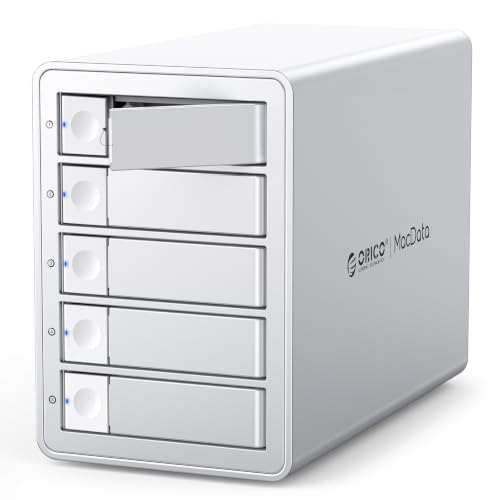
- Six RAID modes, including RAID 5 and RAID 10
- Up to 130TB across five SATA drives
- 20Gbps USB, hot-swap support, and active cooling
Best For: High-capacity video, IT, and research storage
Flexible Backup Choice
Yottamaster 5-Bay USB-C RAID Enclosure

- Seven RAID options, including CLONE and RAID 5
- Up to 110TB with five SATA HDDs or SSDs
- Supports 2.5-inch and 3.5-inch drives with removable trays
Best For: Flexible photo, video, and backup storage
Budget Four-Bay Option

- Eight RAID modes, including CLONE and LARGE
- Up to 80TB across four SATA drives
- USB A/C 3.0 and eSATA connectivity with active cooling
Best For: Personal or small-office direct-attached storage
Balanced Backup Pick – QNAP TR-004
QNAP TR-004 4 Bay USB Type-C Direct Attached Storage (DAS) with hardware RAID (Diskless)
Check Price On AmazonThe QNAP TR-004 is a practical starting point for shoppers comparing RAID enclosures for data security. Its four bays, hardware RAID, lockable trays, and USB Type-C connection support flexible local storage, backups, and NAS expansion.
Best For: Home users and small businesses needing a four-drive DAS for backups, RAID protection, or QNAP NAS capacity expansion.
Pros:
- Supports hardware RAID 0, 1, 5, JBOD, and individual-disk modes.
- Four 3.5-inch SATA bays provide room for expanding storage.
- Lockable drive bays add physical access protection.
- Works with Windows, macOS, and Linux through USB Type-C.
Cons:
- Ships diskless, so drives must be purchased separately.
- NAS integration has specific compatibility and volume limitations.
- USB connectivity is rated at 5Gbps rather than 10Gbps.
The TR-004 is a well-rounded choice when hardware RAID and QNAP backup support matter more than network access. Confirm your NAS model and QTS version before buying.
High-Capacity RAID Pick – ORICO 5-Bay RAID Enclosure
For buyers prioritizing capacity and configuration flexibility, the ORICO five-bay enclosure is a strong option among RAID enclosures for data security. It supports eight RAID modes, high-capacity 3.5-inch drives, active cooling, and a locking mechanism for desktop storage setups.
Best For: Users managing large video libraries, engineering files, or other data sets that need up to five drives and multiple RAID layouts.
Pros:
- Offers eight modes, including RAID 0, 1, 3, 5, 10, JBOD, Clone, and Clear.
- Supports five 3.5-inch SATA drives and up to 22TB per disk.
- An 80mm fan and vented aluminum enclosure help dissipate heat.
- Independent locking helps prevent accidental drive removal.
Cons:
- Ships without hard drives.
- Switching RAID modes can affect data, so backups are recommended first.
- USB 3.0 limits the stated transfer rate to 5Gbps.
With its five bays, 150W power supply, and broad RAID selection, the ORICO is suited to capacity-heavy desktop workflows. Its mode-switching flexibility requires careful backup planning.
Fast Two-Bay Mirror – TerraMaster D2-320
The TerraMaster D2-320 keeps RAID storage compact while adding a fast USB 3.2 Gen 2 connection. It is a useful choice among RAID enclosures for data security when mirrored storage, simple installation, and up to two drives are enough.
Best For: Individuals and small offices wanting a compact two-drive DAS with RAID 1 mirroring and fast USB-C transfers.
Pros:
- Supports RAID 0, RAID 1, JBOD, and Single modes.
- USB 3.2 Gen 2 provides up to 10Gbps connectivity.
- RAID 1 can automatically rebuild data after replacing a damaged drive.
- Tool-free trays and temperature-controlled cooling simplify operation.
Cons:
- Two bays offer less expansion than four- or five-bay alternatives.
- Ships diskless.
- RAID 1 protects against a drive failure but is not a substitute for separate backups.
The D2-320 is a sensible fit for a smaller mirrored backup setup, particularly when a 10Gbps interface is useful. Its two-bay limit makes it less suitable for larger storage arrays.
Flexible Four-Bay Workstation – MAIWO 4-Bay RAID Enclosure
The MAIWO four-bay enclosure targets professionals and power users who want several RAID choices in a direct-attached setup. Its USB-C interface, 96TB stated maximum capacity, status LEDs, and dual fans make it a versatile contender among RAID enclosures for data security.
Best For: Workstations, surveillance storage, backups, and media libraries using up to four 3.5-inch SATA drives.
Pros:
- Supports Normal, RAID 0, 1/10, 3, 5, Clone, and Large/JBOD modes.
- Accommodates up to four 24TB drives for a stated 96TB maximum.
- Includes USB-A-to-USB-C and USB-C-to-USB-C cables with up to 5Gbps transfer.
- Dual switch-controlled fans and drive-status LEDs support practical monitoring.
Cons:
- Ships without drives.
- Cooling fans are controlled by an on/off switch rather than automatic temperature management.
- The listed warranty is one year.
The MAIWO offers broad configuration flexibility and substantial capacity for a desktop DAS. It is most appealing when four bays and multiple RAID layouts are more important than higher-speed connectivity.
Best High-Capacity Pick – ORICO 5-Bay Hardware RAID Enclosure
For buyers comparing raid enclosures for data security, the ORICO 5-bay enclosure combines hardware-controlled RAID modes with substantial desktop storage. It supports up to five 2.5-inch or 3.5-inch SATA drives, with RAID 0, 1, 3, 5, 10, JBOD, Clone, and Clear options selected through hardware switches.
Best For: Large backup projects, video editing, media libraries, and workstation storage that needs flexible RAID configurations.
Pros:
- Supports multiple RAID modes, including RAID 1, 5, and 10 for redundancy-focused setups.
- Accommodates up to five drives and up to 110TB of stated total capacity.
- Includes a 150W built-in power supply and an 80mm cooling fan for multi-drive operation.
- Works with Windows, Mac, and Linux through USB 3.0 without requiring drivers.
Cons:
- USB 3.0 is slower than the USB 3.2 Gen 2 connection found on some newer enclosures.
- RAID configuration options may be more than casual users need.
The ORICO is a strong choice when capacity, hardware RAID flexibility, and sustained cooling matter more than having the newest interface standard. Its five-bay design also leaves room to build a larger storage system over time.
Best Hybrid Storage Pick – CENMATE 5-Drive HDD and NVMe RAID Enclosure
Among raid enclosures for data security, this CENMATE model stands out for combining two SATA drive bays with three M.2 NVMe slots. Its RAID 0, RAID 1, Normal, and JBOD modes let you balance redundancy, performance, or independent drive use, while USB 3.2 Gen 2 provides a modern external connection.
Best For: Users who want one enclosure for high-capacity SATA storage and compact M.2 NVMe drives.
Pros:
- Hybrid layout supports two 2.5/3.5-inch SATA drives and three M.2 NVMe SSDs.
- Offers RAID 1 for mirrored storage along with RAID 0, Normal, and JBOD modes.
- USB 3.2 Gen 2 supports up to 10Gbps, with USB-A and USB-C cables included.
- Tool-free trays and compatibility with Windows, Mac, and Linux simplify setup.
Cons:
- The continuously running fans may be unsuitable for users sensitive to sound.
- RAID modes require careful configuration because changing an array can result in data loss.
- Mac systems do not support RAID software according to the supplied notes.
This is the most versatile option of the three for mixed-drive storage. Choose it when NVMe expansion and a faster USB interface are priorities, but plan the RAID layout carefully before loading important data.
Best Compact RAID Pick – CENMATE 2-Bay Aluminum RAID Enclosure
For a smaller entry into raid enclosures for data security, this two-bay CENMATE enclosure supports RAID 1 mirroring alongside RAID 0, Normal, and JBOD modes. The ASM1156R chip, aluminum construction, and support for both 2.5-inch and 3.5-inch SATA drives make it a practical desktop option for personal or small-business storage.
Best For: Individuals and small businesses seeking a straightforward two-drive RAID enclosure with mirrored-storage capability.
Pros:
- RAID 1 provides a simple mirrored-storage option for two installed drives.
- Supports 2.5-inch and 3.5-inch HDDs or SSDs up to 20TB per drive.
- Uses the ASM1156R chip and includes USB-A/USB-C connectivity.
- Tool-free, plug-and-play operation works with Windows, Mac, and Linux.
Cons:
- Its two-bay design offers less expansion than five-drive alternatives.
- USB 3.0 provides up to 5Gbps rather than the faster USB 3.2 Gen 2 standard.
- The fan is rated around 40–50 decibels, which may bother noise-sensitive users.
The CENMATE 2-bay model is a sensible choice for buyers who want RAID 1 without the size or complexity of a larger enclosure. It is best suited to focused backup and file-storage duties rather than high-capacity expansion.
High-Capacity Performance Pick – ORICO 5-Bay 20Gbps RAID Enclosure
For demanding workflows, the ORICO 5-bay enclosure is one of the more capable raid enclosures for data security, combining several RAID options with a 20Gbps USB 3.2 Gen 2×2 connection. It supports up to five SATA drives and a total capacity of 130TB.
Best For: Video editors, enterprise IT users, and research or AI professionals who need high capacity, flexible RAID modes, and faster large-file transfers.
Pros:
- Supports RAID 0, 1, 5, 10, JBOD, and Normal modes.
- Accepts up to five 3.5-inch SATA drives, with up to 26TB per drive.
- 20Gbps USB interface, aluminum construction, hot-swapping, and a built-in low-noise fan.
Cons:
- Thunderbolt connections are limited to about 10Gbps rather than the full 20Gbps.
- Changing RAID modes erases drive contents, so backups are essential.
Choose the ORICO if capacity and configuration flexibility matter more than a compact footprint. Its broad RAID support and cooling features make it a strong option for centralized desktop storage, provided you plan the array carefully before setup.
Flexible Backup Choice – Yottamaster 5-Bay USB-C RAID Enclosure
The Yottamaster PS500RC3 offers flexible storage for users comparing raid enclosures for data security, with five drive bays, multiple RAID modes, and support for both 2.5-inch and 3.5-inch SATA drives. Its USB-C connection provides transfer speeds up to 5Gbps.
Best For: Photographers, video editors, and home or small-business users who want a large, adaptable DAS enclosure for backups and media storage.
Pros:
- Supports RAID 0, 1, 3, 5, 10, JBOD, and CLONE modes.
- Holds up to five drives with a total rated capacity of 110TB.
- Aluminum housing and temperature-controlled 80mm fan help manage heat and noise.
Cons:
- Its 5Gbps USB 3.1 connection is slower than newer 20Gbps enclosures.
- Drive power consumption must remain within the stated 78W limit unless additional power is provided.
The Yottamaster is a practical middle ground for large-capacity storage and straightforward RAID flexibility. It is less suited to users seeking the fastest possible interface, but its removable trays and mixed drive-size support make upgrades and configuration convenient.
Budget Four-Bay Option – CENMATE 4-Bay RAID Enclosure
The CENMATE 4-bay enclosure is a straightforward choice among raid enclosures for data security, offering eight RAID modes, USB 3.0 and eSATA connectivity, and support for up to four SATA HDDs or SSDs. It is designed for direct-attached storage rather than NAS use.
Best For: Individuals and small offices that need a four-drive external storage system with broad RAID configuration choices and USB A/C connectivity.
Pros:
- Supports RAID 0, 1, 3, 5, 10, CLONE, LARGE, and NORMAL modes.
- Supports 2.5-inch and 3.5-inch drives up to 80TB total.
- Aluminum enclosure, cooling fans, USB A/C 3.0, and eSATA cables are included.
Cons:
- Hot-swapping is not supported.
- Fan noise is approximately 40–50dB.
- Changing RAID modes requires a manual power-off and reset procedure, and can erase data.
The CENMATE makes sense when four bays are sufficient and you value RAID variety over high transfer speeds. Review the eSATA requirements carefully, and maintain current backups before changing the hardware RAID setting.
How We Picked These Raid Enclosures for Data Security
We focused on enclosure design, supported drive types, RAID flexibility, connection standards, cooling, and practical capacity limits. The selection includes compact two-bay units for simple mirrored backups, larger five-bay enclosures for expansion, and hybrid models that combine SATA and M.2 storage.
Hardware RAID support can simplify setup by moving array management into the enclosure, while software-managed options may offer more control and portability. Because RAID is not a substitute for an independent backup, we also favored models that suit layered data-protection strategies.
Quick Comparison
- Best for straightforward desktop storage: A two-bay enclosure with RAID 1 support and USB-C connectivity.
- Best for expandable capacity: A four- or five-bay enclosure that supports large 3.5-inch SATA drives.
- Best for mixed storage: A hybrid enclosure supporting both SATA drives and M.2 NVMe SSDs.
- Best for faster transfers: A model with USB 3.2 Gen 2 or Gen 2×2, provided the host computer supports the same standard.
- Best for quieter operation: An enclosure with temperature-controlled cooling and replaceable or serviceable fans.
Key Buying Factors for Raid Enclosures for Data Security
RAID Levels and Redundancy
RAID 1 mirrors data across two drives and is usually the simplest choice for protecting against a single drive failure. RAID 5 can provide usable capacity and redundancy across three or more drives, while RAID 0 improves performance but offers no fault tolerance. JBOD and single-drive modes are useful when you want separate volumes, but they do not provide redundancy.
Drive Compatibility and Capacity
Check whether the enclosure accepts 2.5-inch drives, 3.5-inch drives, M.2 modules, or a combination. Confirm the stated maximum capacity, drive-interface generation, and whether drives are included. Diskless models let you choose the drives but require a larger initial setup budget.
Connectivity, Cooling, and Noise
USB-C does not automatically mean high speed, so compare the advertised USB generation with your computer’s ports and cables. Multi-drive arrays generate heat, making an active fan valuable for sustained transfers. Consider fan noise if the enclosure will sit near a desk or workstation.
Who Should Buy Which Raid Enclosures for Data Security?
Choose a two-bay RAID 1 enclosure if your priority is a simple mirrored archive, photo library, or document backup. A four-bay model is a better fit for growing collections, flexible RAID layouts, or a mix of capacity and redundancy. Five-bay enclosures suit users who need more usable storage, RAID 5 capability, or room to expand without replacing the whole unit.
Hybrid SATA-and-NVMe models are worth considering for users who want fast working storage alongside larger hard-drive capacity. For business-critical files, pair any enclosure with automated cloud or offline backups, drive-health monitoring, and a tested recovery plan.