The best polyphonic synthesizers make it easier to build chords, pads, basses, leads, and complete arrangements without constantly overdubbing one note at a time. This roundup compares compact keyboards, tabletop modules, grooveboxes, and classic-style analog instruments.
We focus on voice count, sound engine, controls, sequencing, portability, connectivity, and overall value so you can choose a synthesizer that matches your workflow and experience level.
Best 10 Polyphonic Synthesizers Picks for 2026
Hybrid Playground

- Six-voice polyphony with 37 keys
- Hybrid digital-and-analog sound profile
- Includes MiniFreak VST counterpart
Best For: Beginners and portable hybrid-synth users
Experimental Powerhouse

- 60 voices and four stacked oscillators
- Extensive filters, envelopes, LFOs, and modulation
- Built-in KAOSS Pad with expressive controls
Best For: Deep sound design and evolving textures
Portable Vintage Module

- JX-8P sounds with up to 20 voices
- Two-part sequencer and multitimbral operation
- Battery-powered with onboard speakers
Best For: Mobile players seeking vintage Roland character
Analog All-Rounder
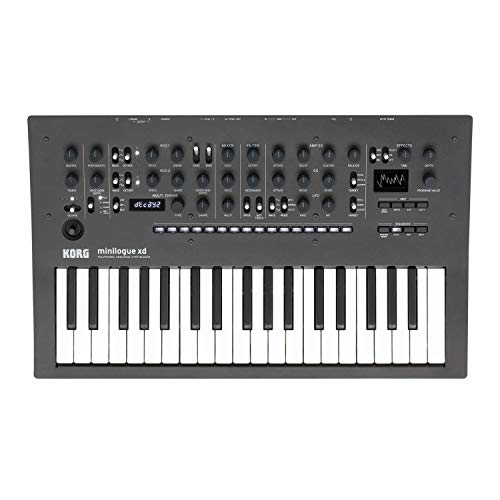
- Four-voice polyphony with dual oscillators
- Digital multi-engine adds noise, VPM, and user slots
- 16-step polyphonic sequencer and OLED oscilloscope
Best For: Accessible analog-modeling synthesis and sequencing
Experimental Hybrid Pick
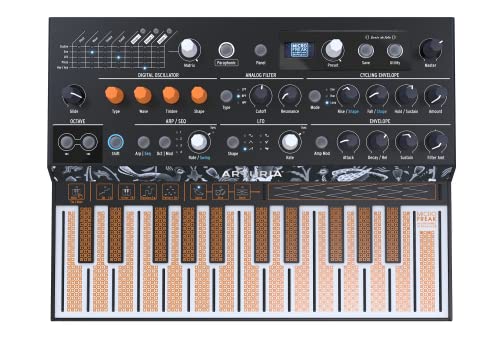
- Hybrid digital oscillator and analog-filter architecture
- 25-key keyboard with individual poly-aftertouch
- CV, USB, MIDI, and creative sequencing tools
Best For: Advanced electronic musicians exploring unusual sounds
Analog Value Pick

- Four-voice analog polyphony
- 37 slim keys and 200 preset sounds
- Polyphonic step and motion sequencer
Best For: Accessible analog synthesis and compact performance setups
Modern Hybrid Performance Pick

- Wavetable and virtual analog sound engine
- Full-size keys and expressive motional pad
- Sequencer and extensive built-in effects
Best For: Live performance and hands-on hybrid sound design
Best Portable FM Pick
M-VAVE Wireless FM Synthesizer

- Battery operation and built-in speaker
- Six-operator FM engine with 32 algorithms
- Effects, arpeggiator, sequencer, and MIDI
Best For: Portable practice and FM sound exploration
Best Groovebox Workflow

- Two polyphonic synth and four drum tracks
- Pattern chaining up to 256 steps per track
- Standalone operation with four-hour battery
Best For: Beatmaking, sequencing, and live groovebox performance
Best Analog Polyphonic Value

- Eight-voice analog polyphony
- Two VCOs per voice with multiple waveforms
- 400 memories, arpeggiator, and sequencer
Best For: Analog chords, basses, leads, and Eurorack setups
Hybrid Playground – Arturia MiniFreak
Arturia MiniFreak 37 Key Polyphonic 6-Voice Hybrid Synthesizer Keyboard (Standard, 37 Key)
Check Price On AmazonThe Arturia MiniFreak is a portable choice for beginners exploring polyphonic synthesizers. Its 37-key layout, six-voice polyphony, hybrid digital-and-analog sound profile, USB connectivity, and included VST counterpart make it suitable for hands-on playing and computer-based production.
Best For: Beginners and producers seeking a portable hybrid polyphonic synthesizer with software integration.
Pros:
- Six-voice polyphony supports chords and layered parts.
- Hybrid sound profile combines digital and analog approaches.
- 37 keys provide a practical playing surface in a portable format.
- Includes the MiniFreak VST counterpart.
Cons:
- USB is the listed connector and connectivity option.
- Its compact 37-key design may not suit players wanting a full-size keyboard.
The MiniFreak stands out among polyphonic synthesizers for its accessible, portable format and hybrid architecture. It is a strong fit when flexibility and computer integration matter more than extensive onboard key range.
Experimental Powerhouse – Korg MULTIPOLY
Korg multipoly Analog Modeling Synthesizer w/Four Oscillators, 60 Voices and built-in KAOSS Pad
Check Price On AmazonThe Korg MULTIPOLY is built for sound designers who want deep control from a modern analog-modeling instrument. Four stacked oscillators, 60 voices, flexible routing, dual filters, extensive modulation, and a built-in KAOSS Pad give this polyphonic synthesizer a broad palette for evolving and experimental sounds.
Best For: Sound designers and synth players who prioritize layered tones, modulation, and expressive performance controls.
Pros:
- 60-voice polyphony supports dense arrangements and layered playing.
- Four oscillators create rich, multidimensional sounds.
- Includes dual filters, four envelopes, five LFOs, and six modulation processors.
- Built-in KAOSS Pad and Kaoss Physics add interactive performance control.
Cons:
- At 11.9 pounds, it is less portable than smaller tabletop options.
- Warranty information must be confirmed with the seller or manufacturer.
With its high voice count and extensive modulation architecture, the MULTIPOLY is one of the most feature-rich polyphonic synthesizers in this group. Choose it when experimentation and evolving textures are higher priorities than minimal controls or ultra-light weight.
Portable Vintage Module – Roland JX-08
The Roland JX-08 brings authentic JX-8P sound and behavior to a compact tabletop format. With up to 20 voices, two-part multitimbrality, onboard sequencing, USB-C audio/MIDI, onboard speakers, and battery operation, it is a flexible option among portable polyphonic synthesizers.
Best For: Mobile musicians and producers wanting vintage-inspired Roland sounds in a battery-powered tabletop module.
Pros:
- Provides authentic JX-8P sound and PG-800 programmer functions.
- Offers up to 20 voices and two-part multitimbral operation.
- Includes a two-part, 64-step polyphonic sequencer with motion recording.
- Supports batteries or USB-C power and includes onboard speakers.
Cons:
- It is a sound module rather than a full keyboard instrument.
- The optional DK-01 dock and K-25m keyboard unit are not listed as included.
The JX-08 is especially compelling if portability and classic JX-8P character are central to your setup. Its sequencing, multitimbral operation, and broad connectivity make it more versatile than its compact size suggests.
Analog All-Rounder – Korg minilogue xd
The Korg minilogue xd combines a dual-oscillator analog engine with a digital multi-engine, four-voice polyphony, and a built-in 16-step polyphonic sequencer. For shoppers comparing polyphonic synthesizers, its four voice modes, OLED oscilloscope, effects, and compact design offer a balanced set of performance and sound-design tools.
Best For: Players who want an accessible four-voice analog-modeling synthesizer with sequencing and visual sound feedback.
Pros:
- Dual-oscillator engine and digital multi-engine expand tonal options.
- Four voice modes include Poly, Unison, Chord, and Arp/Latch.
- Built-in 16-step polyphonic sequencer supports recording and saving sequences.
- OLED oscilloscope displays waveforms in real time.
Cons:
- Four-voice polyphony is more limited than higher-voice alternatives.
- The 37-key format may be restrictive for players who prefer larger keyboards.
The minilogue xd is a well-rounded pick for players who want classic-style synthesis plus digital expansion in a manageable package. Its sequencing, effects, and visual display make it approachable while retaining useful sound-shaping depth.
Experimental Hybrid Pick – Arturia MicroFreak
The Arturia MicroFreak is a compact choice for musicians who want polyphonic synthesizers with an experimental edge. Its digital oscillator engines, resonant analog filter, touch-sensitive keybed, and flexible modulation system support everything from physical-modeling textures to wavetable sounds.
Best For: Advanced users seeking portable, hybrid sound design with expressive sequencing and modular connectivity.
Pros:
- Offers numerous oscillator modes, including wavetable, vocoder, noise, and physical-modeling-inspired options.
- 25-key touch-plate keyboard provides individual pressure or poly-aftertouch response.
- Includes a modulation matrix, Spice and Dice sequencing features, CV, USB, and MIDI connectivity.
Cons:
- The compact 25-key touch-plate design may not suit players who prefer conventional moving keys.
- Its advanced, experimental feature set may require a learning period.
The MicroFreak stands out when versatility, portability, and unusual textures matter more than traditional analog polyphony. It is especially appealing for sound designers and electronic performers who want hands-on control and broad connectivity.
Analog Value Pick – Korg Minilogue
The Korg Minilogue is a practical entry point into polyphonic synthesizers, combining four-voice analog polyphony with a compact 37-key format. Its warm, punchy sound, onboard presets, sequencer, and delay make it suitable for both hands-on sound creation and immediate performance.
Best For: Beginners and experienced players who want accessible analog polyphony for studio work or live use.
Pros:
- Four-voice analog polyphony delivers warm, punchy tones for layered arrangements.
- Includes 200 presets plus controls for building and editing custom sounds.
- Features a polyphonic step and motion sequencer, tape-style delay, and oscilloscope display.
Cons:
- Four voices provide less polyphonic headroom than larger synthesizers.
- The supplied notes identify an audio jack but do not detail broader connectivity options.
The Minilogue balances approachable controls and genuine analog sound in a relatively compact instrument. Its 37 slim keys and built-in sequencing make it a well-rounded option for players who want a straightforward polyphonic workflow.
Modern Hybrid Performance Pick – Roland GAIA 2
The Roland GAIA 2 is a modern option among polyphonic synthesizers, pairing wavetable and virtual analog synthesis in a performance-focused design. Its full-size keys, hands-on controls, motional pad, sequencer, and extensive effects provide a broad platform for creating and shaping sounds in real time.
Best For: Performers and producers who want an approachable hybrid engine with expressive modulation and built-in effects.
Pros:
- Combines wavetable and virtual analog synthesis for varied sound creation.
- Provides full-size keys, assignable modulation routings, and a motional pad for live expression.
- Includes real-time and step sequencing plus 53 MFX types and dedicated chorus and delay/reverb sections.
Cons:
- At 10 pounds, it is less lightweight than the MicroFreak or Minilogue.
- The supplied notes do not specify a voice-count or detailed polyphony limit.
The GAIA 2 is a strong fit for users who value immediate control and motion during performance. Its friendly panel layout keeps the hybrid synthesis workflow accessible while leaving room for detailed modulation and effects-based sound design.
Best Portable FM Pick – M-VAVE Wireless FM Synthesizer
For musicians who want polyphonic synthesizers they can use away from a desk, the M-VAVE FM Synthesizer combines battery operation, a built-in speaker, and a compact design. Its six-operator FM engine, 128 presets, effects, arpeggiator, and sequencer provide a broad starting point for portable sound design and sketching.
Best For: Portable practice, quick songwriting ideas, and players seeking classic FM-style sounds in a small format.
Pros:
- Battery-powered design with a built-in speaker for creating anywhere.
- Six operators and 32 algorithms support detailed FM synthesis.
- Includes 128 presets, six effects, an arpeggiator, and a 16-step sequencer.
- Offers USB MIDI, Bluetooth MIDI, and 3.5mm MIDI connectivity.
Cons:
- The 27-key silicone keyboard is compact rather than full-sized.
- Its FM-focused architecture may be less suitable for users seeking analog synthesis.
This is an approachable portable option for experimenting with FM tones and making ideas without additional equipment. The compact keyboard and built-in speaker prioritize mobility, while the MIDI connections help it fit into a larger setup.
Best Groovebox Workflow – Novation Circuit Tracks
The Novation Circuit Tracks is a practical choice among polyphonic synthesizers for beat-focused production and standalone performance. It combines two polyphonic digital synth tracks with four drum tracks, two MIDI tracks, sequencing tools, and a rechargeable battery in a hands-on groovebox format.
Best For: Producers who want an all-in-one, pattern-based workflow for building tracks, controlling external gear, and performing without a computer.
Pros:
- Combines two synth tracks, four drum tracks, and two MIDI tracks.
- Supports 32-step patterns that can be chained into sequences up to 256 steps per track.
- Velocity-sensitive pads, tactile controls, probability, microtiming, and pattern mutate encourage expressive sequencing.
- Includes full-size MIDI in, out, and thru, analogue sync out, and up to four hours of battery life.
Cons:
- Its synth tracks are digital rather than analog.
- The groovebox workflow may be less familiar to players expecting a conventional keyboard synthesizer.
Circuit Tracks is strongest when sequencing complete ideas rather than simply playing a standalone keyboard sound. Its combination of synths, drums, samples, external MIDI control, and portable operation makes it a flexible center for a compact setup.
Best Analog Polyphonic Value – Behringer PRO-800
The Behringer PRO-800 stands out among polyphonic synthesizers for its eight-voice analog design and classic two-oscillator-per-voice architecture. With authentic VCO, VCF, and VCA designs, multiple oscillator waveforms, unison mode, an arpeggiator, sequencer, and 400 program memories, it targets players who want broad analog chords and substantial bass or lead sounds.
Best For: Musicians seeking an eight-voice analog synthesizer for rich chords, detuned textures, basses, and leads in a Eurorack-format setup.
Pros:
- Provides eight analog voices with two VCOs per voice.
- Uses a pure analog signal path with VCO, VCF, and VCA designs.
- Offers saw, triangle, and pulse waveforms across both oscillators.
- Includes unison mode, an arpeggiator, sequencer, and 400 program memories.
Cons:
- Its Eurorack format may require a compatible installation or setup.
- The supplied notes do not indicate an integrated keyboard.
The PRO-800 is a compelling fit when analog voice count and classic oscillator architecture matter more than portability. Its eight voices support fuller chord work, while unison mode and dual VCOs provide additional weight for monophonic-style parts.
How We Picked These Polyphonic Synthesizers
We selected instruments that cover a broad range of modern synthesis workflows, from hands-on analog and hybrid keyboards to portable digital instruments and integrated grooveboxes. Our comparison considers polyphony, oscillator architecture, filter and modulation options, sequencing, preset storage, physical controls, connectivity, and practical usability.
Voice count matters, but it is not the only measure of performance. A four-voice analog synthesizer can be highly expressive for chords and basses, while a higher-voice digital or modeling instrument may be better suited to layered pads, complex arrangements, and multitimbral playing. We also considered whether each model is best used in a studio, on stage, or as a portable creative tool.
Quick Comparison
| Best For | What to Look For |
|---|---|
| Hands-on sound design | Dedicated knobs, accessible modulation, and a flexible signal path |
| Chord playing | At least four voices, with higher polyphony preferred for sustained pads |
| Live performance | Fast control access, reliable patch recall, and useful sequencing features |
| Portable production | Compact construction, battery operation, speakers, or USB connectivity |
| Pattern-based composition | Built-in sequencer, arpeggiator, motion recording, and groove controls |
| Classic analog character | True analog oscillators and filters with direct front-panel controls |
Key Buying Factors for Polyphonic Synthesizers
Polyphony and Voice Allocation
Polyphony determines how many notes can sound at once. Four voices are suitable for basic chords and shorter releases, while six or eight voices offer more freedom for sustained pads, layered parts, and pedal-heavy playing. Digital and modeling instruments may provide considerably higher voice counts, but check whether effects, splits, or multiple parts reduce the available voices.
Sound Engine
Analog synthesis is valued for its direct, organic response, while virtual analog, wavetable, FM, and hybrid engines can provide greater tonal range and complex digital textures. Choose based on the sounds you want rather than the technology label alone. A flexible modulation system can be more important than having numerous oscillator types.
Keyboard, Controls, and Sequencing
Consider key size, key count, velocity response, and whether the instrument includes aftertouch or another expressive control. Knob-per-function layouts are excellent for learning and live tweaking. A sequencer or arpeggiator is especially useful for turning a compact synthesizer into a self-contained composition tool.
Connectivity and Setup
Check for MIDI, USB, audio outputs, sync, and CV or gate connections if you use external hardware. Tabletop modules may require a separate keyboard, mixer, or audio interface, while keyboard versions are easier to play immediately. Battery power and built-in speakers are useful for sketching away from a studio, though they are not essential for a permanent setup.
Who Should Buy Which Polyphonic Synthesizers?
Beginners should prioritize clear controls, forgiving presets, and an approachable sequencer. A compact hybrid or analog-modeling keyboard can offer more sound variety than a narrowly focused instrument while still encouraging hands-on learning.
Players who want classic analog tones should look at dedicated analog models with multiple voices, sequencers, and direct filter control. Producers focused on experimental textures may prefer a hybrid, wavetable, FM, or modeling synthesizer with deeper modulation and broader preset variety.
Live performers should choose a model with fast patch changes, sturdy controls, dependable MIDI or USB integration, and enough polyphony for sustained parts. Mobile producers and beat makers should prioritize battery operation, portability, pattern sequencing, and the ability to create complete ideas without additional equipment. Before buying, match the synthesizer’s workflow to how you actually make music; the most powerful option is not always the one that gets used most.