Choosing the right MIDI interface can make a big difference in how smoothly your studio or live rig runs. If you need multiple DIN ports, USB connectivity, or standalone routing, the best options are the ones that keep everything simple and dependable.
This roundup of multiport MIDI interfaces focuses on practical features, real-world flexibility, and the kinds of setups musicians actually use every day.
Best 10 Multiport Midi Interfaces Picks for 2026
8-Port USB Hub Pick
ESI M4U eX 8-Port USB 3.0 MIDI Interface

- 8 adaptable MIDI ports
- Built-in USB 3.0 hub
- Standalone routing and merging
Best For: Studio users who want an 8-port MIDI hub with USB expansion
Compact Routing Choice
CME U6MIDI Pro 3-in-3-out MIDI Interface

- 3-in/3-out MIDI I/O
- USB-C with broad OS support
- Standalone router and filter
Best For: Players who want compact routing and cross-platform compatibility
High-Capacity MIDI Hub
ESI M8U eX 16-Port USB 3.0 MIDI Interface

- 16 adaptable MIDI ports
- Built-in USB 3.0 hub
- Standalone low-latency routing
Best For: Large setups that need maximum MIDI port capacity
Pedalboard MIDI Pick
CME U4MIDI WC 2-in-2-out MIDI Interface

- 2-in/2-out USB-C MIDI
- Standalone 5V or 9V power
- Compact pedalboard-friendly design
Best For: Guitarists and pedalboard setups needing compact standalone MIDI control
Compact USB MIDI for Simple 2x2 Setups
Midiplus 2x2 USB MIDI interface

- 2 MIDI inputs and 2 MIDI outputs
- USB powered with no external supply
- Driver-free on Mac and Windows
Best For: Small studios needing a simple computer MIDI interface
High-Port Network MIDI Hub for Complex Rigs
iConnectivity mioXL 8x12 MIDI interface

- 8 DIN inputs and 12 DIN outputs
- 10 USB-MIDI host ports plus Ethernet RTP-MIDI
- Driver-free for Mac, Windows, and iOS
Best For: Large, hardware-heavy MIDI rigs with network routing
Portable Host Interface for Flexible MIDI Routing
CME H4MIDI WC USB host MIDI interface

- Standalone USB host mode for class-compliant devices
- USB-C client mode with 4 in / 4 out virtual MIDI ports
- Routing tools include thru, split, merge, mapper, and filter
Best For: Compact rigs needing standalone host mode and advanced routing
Wireless Bluetooth Bridge
FORE Wireless Bluetooth USB MIDI Interface A+B

- Wireless MIDI for iOS, Android, Mac, and Windows
- Supports 5-pin DIN MIDI gear and multiple modes
- Designed to reduce cable clutter with quick pairing
Best For: Users who want a wireless MIDI bridge for mixed mobile and desktop setups
Compact Host Router
CME H2MIDI Pro Compact USB Host MIDI Interface

- USB host mode for class-compliant MIDI devices
- USB-C computer mode with 2-in-2-out virtual ports
- Routing, filtering, mapping, and presets via HxMIDI Tools
Best For: Hybrid setups that need compact USB hosting and detailed MIDI routing
Six-Way MIDI Splitter
MIDI Thru 6 Box USB MIDI Interface
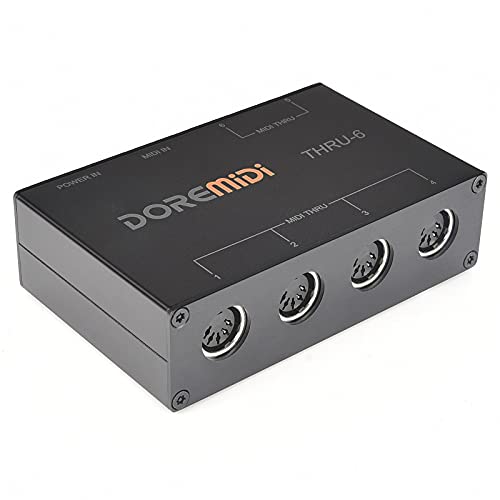
- 1-in, 6-out MIDI splitter for one-to-many setups
- USB powered and plug-and-play
- Supports standard MIDI channels and commands
Best For: Simple MIDI signal splitting to multiple synths or controllers
8-Port USB Hub Pick – ESI M4U eX 8-Port USB 3.0 MIDI Interface
If you want a practical multiport midi interface for a growing studio, the ESI M4U eX gives you 8 adaptable MIDI ports, class-compliant plug-and-play setup, and a built-in USB 3.0 hub. It is designed to simplify routing across multiple MIDI devices while keeping latency low and timing tight, even in standalone use.
Best For: Producers and performers who need an 8-port, no-fuss MIDI hub with standalone routing and USB expansion.
Pros:
- 8 configurable MIDI ports with automatic input/output assignment
- Class-compliant USB 3.0 connection for Windows and macOS
- Built-in USB 3.0 hub with three connectors for extra gear
- Standalone operation supports routing and merging without a computer
Cons:
- Limited to 8 ports, so larger rigs may need a higher-capacity unit
- Windows multi-device/multi-client support depends on the optional driver
The M4U eX is a strong fit if you value straightforward setup and flexible routing over advanced software complexity. It is especially appealing for hybrid studio or live setups that need both MIDI distribution and USB device handling in one box.
Compact Routing Choice – CME U6MIDI Pro 3-in-3-out MIDI Interface
The CME U6MIDI Pro is a compact multiport midi interface built around simple USB-C plug-and-play use and flexible standalone routing. With 3-in/3-out MIDI I/O, it works across major operating systems and supports merge, split, thru, and filtering through the UxMIDI Tools software.
Best For: Musicians who want a small, cross-platform MIDI router with deep message control.
Pros:
- USB-C plug-and-play support across macOS, iOS, Windows, Android, Linux, and Chrome OS
- Standalone 3-in/3-out operation with router and filter functions
- Close to zero latency and no jitter
- Handles notes, clock, sysex, MIDI timecode, and MPE
Cons:
- Only 3-in/3-out, so it is not ideal for larger MIDI rigs
- Advanced routing setup relies on the companion software tool
This is a strong choice if you need a portable interface that still offers serious routing flexibility. Its broad OS compatibility and message support make it especially useful for modern desktop, mobile, and hybrid setups.
High-Capacity MIDI Hub – ESI M8U eX 16-Port USB 3.0 MIDI Interface
For larger rigs, the ESI M8U eX stands out among multiport midi interfaces with 16 adaptable MIDI ports, plug-and-play USB 3.0 connectivity, and a built-in USB hub. It is built for extensive control in studios or live setups, with standalone routing and merging for when you do not want to rely on a computer.
Best For: Large studios and live rigs that need up to 16 MIDI ports plus integrated USB expansion.
Pros:
- 16 configurable MIDI ports for bigger device collections
- Class-compliant USB 3.0 connection for Windows, macOS, and iOS
- Built-in USB 3.0 hub with three connectors
- Standalone operation supports low-latency routing and merging
Cons:
- Larger physical size and heavier build than compact interfaces
- May be more interface than small keyboard or desktop setups need
If your MIDI setup keeps expanding, the M8U eX offers the port count and flexibility to keep everything organized. It is a practical choice when you want one central unit to manage multiple controllers, synths, and USB accessories.
Pedalboard MIDI Pick – CME U4MIDI WC 2-in-2-out MIDI Interface
The CME U4MIDI WC is a compact multiport midi interface designed for tight setups, especially pedalboards and guitar workflows. It offers 2-in/2-out MIDI I/O, USB-C compatibility across major operating systems, and standalone power options for use without keeping a computer connected.
Best For: Guitarists and pedalboard users who need a small, durable MIDI interface with standalone power.
Pros:
- 2-in/2-out USB-C MIDI interface with zero-latency, jitter-free transmission
- Standalone dual power options via 5V USB or 9V DC
- Compact, hexagonally reinforced casing for pedalboard use
- Supports routing features like thru, split, merge, mapper, and filter
Cons:
- Only 2-in/2-out, so it is not suited to larger multi-device studios
- Bluetooth MIDI is optional rather than built in
This model makes sense when space, durability, and standalone flexibility matter more than port count. It is especially useful for guitar pedal editors and compact live rigs that need reliable MIDI control in a small footprint.
Compact USB MIDI for Simple 2×2 Setups – Midiplus 2×2 USB MIDI interface
If you want a straightforward option among multiport midi interfaces, the Midiplus 2×2 USB MIDI interface keeps things simple: two MIDI inputs, two MIDI outputs, and USB bus power with no external supply needed. It is a practical pick for basic computer-based MIDI routing on Mac or Windows systems without extra driver hassle.
Best For: Small studios or players who need a no-fuss 2-in/2-out USB MIDI interface for a computer rig.
Pros:
- 2 MIDI inputs and 2 MIDI outputs for up to 32 MIDI channels each direction
- USB powered, so it does not require an external power adapter
- Driver-free operation on Mac OSX and Windows XP and above
- Includes a USB cable in the package
Cons:
- Only covers a basic 2×2 port layout
- No standalone host, Ethernet, or multi-device expansion features
For users who need reliable core MIDI connectivity rather than advanced routing, this is an easy, compact interface to fit into a minimal setup.
High-Port Network MIDI Hub for Complex Rigs – iConnectivity mioXL 8×12 MIDI interface
Among multiport midi interfaces, the iConnectivity mioXL is built for larger setups that need lots of DIN ports, USB MIDI hosting, and networked routing in one box. With 8 in and 12 out 5-pin DIN ports, 10 USB-MIDI host ports, and RTP-MIDI networking, it is aimed at users coordinating multiple devices and computers.
Best For: Large studios, hardware-heavy rigs, and networked MIDI setups that need extensive routing and device access.
Pros:
- 8 DIN inputs and 12 DIN outputs for extensive hardware routing
- 10 USB-MIDI host ports for class-compliant peripherals
- Ethernet RTP-MIDI support with 22 virtual network ports
- USB, Mac, Windows, and iOS connectivity with driver-free operation
Cons:
- More complex than a simple plug-and-play interface for basic needs
- External power supply included, so it is less minimalist for portable use
The mioXL stands out when a MIDI setup grows beyond a few connections and needs flexible routing, merging, and multi-device access across different platforms.
Portable Host Interface for Flexible MIDI Routing – CME H4MIDI WC USB host MIDI interface
The CME H4MIDI WC is a versatile choice in multiport midi interfaces if you need both USB host capability and computer connectivity in a compact unit. It can connect class-compliant USB MIDI gear directly without a computer, while also offering USB-C client mode with 4 inputs and 4 outputs of virtual MIDI ports for Mac, Windows, iOS, Android, Linux, and ChromeOS.
Best For: Guitarists, producers, and compact rigs that need standalone USB host routing plus computer-based MIDI control.
Pros:
- Standalone USB host mode for direct connection to class-compliant MIDI instruments
- USB-C client mode with 4 in / 4 out virtual MIDI ports
- Flexible power options with 5V USB or 9V DC for standalone use
- HxMIDI Tools supports routing features like thru, split, merge, mapper, and filter
Cons:
- USB host expansion requires a separate USB hub for up to 8 device ports
- Not a high-count DIN hub compared with larger rack-style interfaces
This interface is especially useful when you want advanced routing control in a compact form factor, with enough flexibility to cover both stage and studio workflows.
Wireless Bluetooth Bridge – FORE Wireless Bluetooth USB MIDI Interface A+B
If you want multiport midi interfaces with less cable clutter, this FORE Bluetooth MIDI adapter is built around simple wireless pairing. It supports iOS, Android, Mac, and Windows, and can also work with 5-pin DIN MIDI gear through its A/B setup. The practical appeal is quick plug-and-pair use with low-latency wireless transmission for everyday keyboard and synth setups.
Best For: Players who want a wireless MIDI link for iOS, Android, Mac, or Windows setups and want to reduce cable mess.
Pros:
- Wireless MIDI support with plug, pair, and play setup
- Works with iOS, Android, Mac OS, and Windows
- Supports 5-pin DIN MIDI devices like keyboards, synths, and drum machines
- Can operate in multiple connection modes, including device-to-device use
Cons:
- Requires app-based Bluetooth MIDI connection on iOS/iPadOS
- Setup modes may be more complex than a basic wired adapter
Overall, this is a flexible choice if your priority is wireless convenience rather than a traditional studio box. It makes the most sense for users who value reduced wiring and cross-platform compatibility over advanced routing features.
Compact Host Router – CME H2MIDI Pro Compact USB Host MIDI Interface
Among multiport midi interfaces, the CME H2MIDI Pro stands out for combining USB host capability with traditional 5-pin MIDI and computer connectivity. It can connect class-compliant USB MIDI devices without a computer, or act as a flexible 2-in-2-out virtual MIDI interface over USB-C. That makes it a strong fit for hybrid rigs that mix modern controllers with legacy hardware.
Best For: Musicians building a compact hybrid MIDI setup that needs USB host support, routing control, and broad device compatibility.
Pros:
- Standalone USB host mode for class-compliant MIDI devices
- Expandable up to 8 USB MIDI device ports using a hub
- USB-C connection provides 2-in-2-out virtual MIDI ports
- HxMIDI Tools adds routing, filtering, mapping, and preset storage
Cons:
- Single 1-in/1-out DIN MIDI I/O may be limiting for larger DIN-only rigs
- Advanced features rely on companion software setup
This is the most feature-rich option in the group if you need routing flexibility and host-mode expansion. It is especially practical for players who want one compact box to bridge USB MIDI devices, computers, and traditional gear.
Six-Way MIDI Splitter – MIDI Thru 6 Box USB MIDI Interface
If your goal is simple distribution rather than a full-featured controller hub, this MIDI Thru 6 Box is the most straightforward of these multiport midi interfaces. It takes one MIDI input and sends the same MIDI data to six outputs, making it useful for driving multiple devices from a single controller or synth. With plug-and-play operation and USB power, it is a practical utility box for basic MIDI splitting.
Best For: Users who need a simple 1-in, 6-out MIDI splitter for sending one MIDI source to multiple devices.
Pros:
- 1 MIDI input and 6 MIDI outputs for broad distribution
- Plug-and-play design with no batteries required
- USB-powered for convenient setup
- Supports standard MIDI channels and commands
Cons:
- Focused on splitting rather than advanced routing or host features
- Wired-only design with no wireless option
This box is best seen as a utility splitter, not an all-in-one interface. If you mainly need reliable signal duplication to multiple MIDI devices, it delivers exactly that without extra complexity.
How We Picked These Multiport Midi Interfaces
We looked for interfaces that offer dependable timing, enough I/O for expanding rigs, and features that matter in real use: class-compliant operation, USB or host support, standalone routing, and clear port labeling. We also favored models that suit both DAW-based producers and players managing hardware synths, drum machines, and controllers.
Quick Comparison
The right multiport MIDI interface depends on scale. Compact 2×2 and 3×3 units fit smaller desks and simple controller setups, while 8-port and higher models are better for multi-synth studios, live racks, and complex routing. If you need to merge, split, or distribute MIDI across several devices, higher-port options and standalone functionality are especially useful.
Key Buying Factors for Multiport Midi Interfaces
Port Count and Routing Needs
Start by counting both current and near-future devices. A single keyboard and module may only need a small interface, but a hardware-centered studio can outgrow a basic setup quickly. Multiport Midi Interfaces with more DIN connections reduce chaining and help avoid routing bottlenecks.
USB, Host, and Standalone Support
USB MIDI is ideal for direct computer integration, while USB host support is useful for connecting class-compliant controllers without a computer. Standalone operation matters if you want the interface to act as a hub or router even when your DAW is off.
Compatibility and Power
Class-compliant support is a major convenience for Mac, PC, and often iPad workflows. Also check whether the unit draws power from USB or needs external power, especially if you plan to use it on stage or away from a studio desk.
Timing, Reliability, and Physical Build
For MIDI, stable transmission and clean signal handling are more important than flashy extras. Look for sturdy connectors, solid cable retention, and designs that minimize confusion when multiple devices are connected at once.
Who Should Buy Which Multiport Midi Interfaces?
Choose a compact interface if you mainly work with one or two controllers and a small hardware chain. Step up to a larger model if you want to integrate several synths, expand a hybrid studio, or reduce MIDI thru clutter. If you need wireless convenience, host functionality, or standalone routing, prioritize those features over raw port count. In short, the best Multiport Midi Interfaces are the ones that match your actual workflow today while leaving room to grow tomorrow.