If you want one controller that can handle melodies, chords, and finger drumming, a midi keyboard with drum pads is a smart choice. These compact boards are built for fast ideas and portable studio setups.
Below, we’ve narrowed the field to 10 standout options for beginners and producers who want a better beatmaking workflow without giving up keys.
Best 10 Midi Keyboard with Drum Pads Picks for 2026
Compact Beatmaker Pick
Akai MPK Mini MK3 25-Key Controller

- 8 backlit MPC-style drum pads
- 25 velocity-sensitive mini keys
- 8 knobs plus NKS integration
Best For: portable beatmakers and laptop producers
Workflow-Friendly Choice
Arturia MiniLab 3 Universal Controller

- 8 RGB velocity and pressure pads
- 4 faders and 8 encoders
- 25 slim velocity-sensitive keys
Best For: hands-on producers who value workflow control
Beginner Feature Pack
Donner DMK 25 Pro MIDI Controller

- 8 drum pads with OLED display
- 16 smart scale tones and arpeggio
- 4 DAW apps plus 40 lessons
Best For: beginners who want guided beat-making tools
Expanded Production Pick
Akai MPK Mini Plus 37-Key Controller

- 37 keys with 3 full octaves
- 8 RGB MPC pads and sequencer
- MIDI/CV/Gate I/O for hardware
Best For: producers needing more range and external gear support
Flow-Friendly Starter Controller
Arturia MiniLab 3 Champagne 25-Key MIDI Keyboard

- 8 multi-color pads for drums and triggering
- 8 knobs and 4 faders for hands-on control
- 25 velocity-sensitive keys in a compact design
Best For: Beginners and home producers who want an easy compact controller
Beat-Making Power Pick
Akai MPK Mini IV USB-C MIDI Keyboard Controller

- 8 RGB MPC pads with velocity and pressure response
- 8 knobs, color screen, and DAW integration
- USB-C portability with included software bundles
Best For: Beginners, traveling producers, and beat-makers who want deep pad control
Sleek Pad Performer
Arturia MiniLab 3 Rose Quartz MIDI Controller
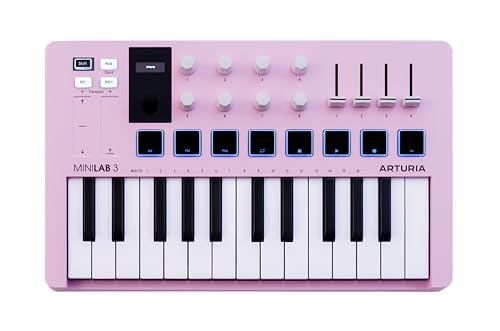
- 8 RGB velocity- and pressure-sensitive pads
- 8 encoders and 4 sliders for DAW control
- Built-in arp, Chord mode, and MIDI DIN support
Best For: Producers who want a compact controller with creative tools and a standout finish
Studio-Ready Compact Beat Maker
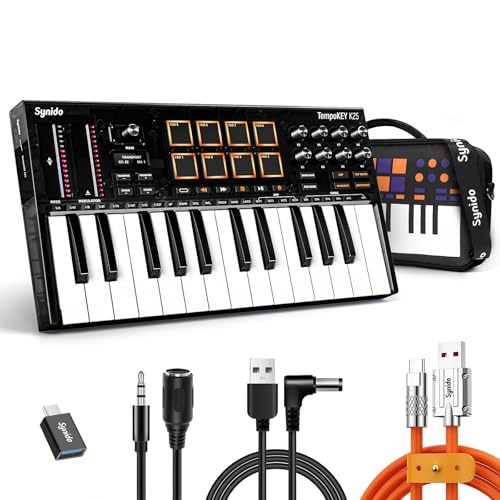
- 8 velocity-sensitive RGB pads with dual drum banks
- OLED screen and smart encoder simplify MIDI editing
- USB-C powered, compact, and easy to carry
Best For: Portable beat makers who want pads, knobs, and screen control
Wireless Beat Pad Controller
DaierTek 25-Key Bluetooth MIDI Piano

- Bluetooth and USB support for flexible setup options
- 8 RGB pads with velocity sensitivity and aftertouch
- Built-in battery lasts about 16 hours
Best For: Travel-friendly producers who want wireless pad control
Classic Pad Controller Favorite

- 8 MPC-style pads with Note Repeat and Full Level
- 8 knobs plus arpeggiator and thumbstick control
- NKS integration and bundled software support
Best For: Beat makers who want proven pad workflow and software integration
Compact Beatmaker Pick – Akai MPK Mini MK3 25-Key Controller
If you want a midi keyboard with drum pads for portable beat making, the Akai Professional MPK Mini MK3 keeps the essentials in a small USB-powered format. It combines 25 velocity-sensitive mini keys, 8 backlit MPC-style pads, 8 knobs, and NKS integration for hands-on control in a compact controller that works well with a laptop-based setup.
Best For: producers who want a compact MIDI controller with classic MPC-style pads and included software.
Pros:
- 8 backlit, velocity-sensitive MPC-style drum pads with Note Repeat and Full Level
- 8 assignable 360-degree knobs for mixing and plugin control
- 4-way thumbstick plus built-in arpeggiator for performance control
- NKS support and bundled music production software included
Cons:
- 25-key mini layout may feel limited for fuller keyboard parts
- USB-powered design is built around computer-based production
This is a strong pick if your priority is a small controller that still gives you pad-based beat programming and practical DAW control. The MPK Mini MK3 is geared toward streamlined studio work rather than a full-size playing experience.
Workflow-Friendly Choice – Arturia MiniLab 3 Universal Controller
The Arturia MiniLab 3 is a midi keyboard with drum pads aimed at a smoother music-making workflow. It pairs 25 slim velocity-sensitive keys with 8 RGB velocity and pressure pads, plus 8 encoders and 4 faders, so you can control instruments, mute tracks, and program drums without leaning on the mouse.
Best For: creators who want an easy, hands-on controller for beat making and track control.
Pros:
- 8 multi-color pads with velocity and pressure sensitivity
- 4 faders and 8 encoders for broader hands-on control
- 25 velocity-sensitive slim keys in a compact layout
- Designed to adapt to different workflow needs
Cons:
- Notes do not mention bundled DAW software details here
- Smaller key count may not suit players who want more range
MiniLab 3 stands out when you want a controller that feels flexible rather than overly specialized. Its mix of pads, faders, and encoders makes it a practical fit for beat sketches, track control, and general production.
Beginner Feature Pack – Donner DMK 25 Pro MIDI Controller
If you want a midi keyboard with drum pads that also leans into learning tools, the Donner DMK 25 Pro packs a lot into a portable 25-key controller. It includes 8 drum pads, an OLED display, smart scale modes, arpeggio and note repeat functions, plus 4 DAW software titles and 40 teaching courses for newer producers.
Best For: beginners who want drum pads, scale tools, and guided learning in one compact controller.
Pros:
- 8 drum pads and touch bar controls for expressive input
- 16 smart scale tones for easier melody and bass creation
- Arpeggio, note repeat, and chord functions for performance ideas
- Includes 4 DAW software titles and 40 teaching courses
Cons:
- Requires connection to a phone or computer DAW to produce sound
- Some mobile devices may need a compatible OTG adapter
The DMK 25 Pro is especially appealing if you want both creative tools and built-in learning support. Its feature set is broad for the size, making it a practical starter controller for beat creation and basic music production.
Expanded Production Pick – Akai MPK Mini Plus 37-Key Controller
The Akai Professional MPK Mini Plus is a midi keyboard with drum pads for users who want more range and deeper studio control. With 37 mini keys, 8 RGB MPC pads, a built-in 64-step sequencer, and MIDI/CV/Gate connectivity, it goes beyond basic laptop control and supports both DAW work and hardware setups.
Best For: producers who want a bigger compact controller with sequencing and external gear connectivity.
Pros:
- 37-key layout gives you 3 full octaves of range
- 8 RGB MPC pads for drum programming and performance
- 64-step sequencer can work without a computer
- MIDI/CV/Gate I/O supports modular gear and sound modules
Cons:
- Still uses mini keys, so it is not a full-size keyboard
- Larger than 25-key compact controllers
This model makes sense if you outgrow tiny controllers and want more room for melodies, chords, and sequencing. It keeps the pad-based workflow but adds connectivity and sequencing features that make it feel more complete for production.
Flow-Friendly Starter Controller – Arturia MiniLab 3 Champagne 25-Key MIDI Keyboard
If you want a midi keyboard with drum pads that feels simple, compact, and ready to build around, the MiniLab 3 is a strong fit. Its 25 velocity-sensitive keys, 8 multi-color pads, 8 knobs, and 4 faders give you hands-on control for playing parts, triggering drums, and adjusting your session without living in the mouse.
Best For: Beginners and home producers who want an easy-to-use compact controller with solid hands-on control.
Pros:
- 8 multi-color drum pads for finger drumming and track triggering
- 8 knobs plus 4 faders for tactile control over instruments and mixes
- 25 velocity-sensitive keys for responsive playing in a small footprint
- Includes music production software and works with Ableton Live
Cons:
- Only 25 keys, so it is not ideal for players who want a larger keyboard range
- USB connectivity is straightforward, but there is no mention of standalone operation
The MiniLab 3 is built around a fluid workflow, so it makes sense if you want an approachable controller that keeps the essentials close at hand. It is a practical choice when compact size, pads, and easy software integration matter more than having a full-sized keybed.
Beat-Making Power Pick – Akai MPK Mini IV USB-C MIDI Keyboard Controller
If you are shopping for a midi keyboard with drum pads that is built for beat-making, the MPK Mini IV gives you a lot of control in a small package. It combines 25 velocity-sensitive mini keys with 8 MPC pads, 8 assignable 360-degree knobs, a color screen, and DAW integration to keep production moving without constant menu diving.
Best For: Beginners, traveling producers, and creators who want a compact controller with strong pad performance and deep workflow tools.
Pros:
- 8 velocity- and pressure-sensitive MPC pads with RGB feedback
- 8 assignable 360-degree knobs plus a color screen for hands-on control
- USB-C connectivity with plug-and-play support for Mac, PC, and mobile setups
- Includes production software, sound packages, and beginner learning tools
Cons:
- 25-key layout keeps it compact, but limits range for more involved keyboard parts
- Many advanced features may be more than casual users need
The MPK Mini IV stands out if you want a portable controller that is clearly aimed at beat production and fast idea capture. Between the MPC pads, DAW mapping, and included software bundle, it offers a lot for creators who want to get producing quickly.
Sleek Pad Performer – Arturia MiniLab 3 Rose Quartz MIDI Controller
This midi keyboard with drum pads is a good match if you want the MiniLab 3 workflow in a more distinctive finish. It pairs 25 velocity-sensitive slim keys with 8 RGB pads, 8 encoders, 4 sliders, and built-in creative features like arp, Chord mode, and custom DAW presets, making it easy to sketch ideas and control a setup from one compact controller.
Best For: Producers who want a compact controller with expressive pads, creative workflow tools, and a standout look.
Pros:
- 8 RGB pads that are velocity- and pressure-sensitive
- 8 encoders and 4 sliders for practical DAW control
- Built-in arpeggiator, Chord mode, and custom DAW presets
- USB-C plus MIDI DIN connectivity for flexible setups
Cons:
- 25 keys mean limited range compared with larger controllers
- Best suited to compact studio workflows rather than full keyboard performance
The Rose Quartz version keeps the same useful MiniLab 3 layout while adding a more expressive visual style. It is a sensible pick if you want a compact controller with drum pads, deeper DAW integration, and a few built-in tools to speed up writing and arranging.
Studio-Ready Compact Beat Maker – Synido TempoKey K25
If you’re shopping for a midi keyboard with drum pads that feels more like a creative control surface than a basic mini keyboard, the Synido TempoKey K25 is built for hands-on beat making. It pairs 25 velocity-sensitive keys with 8 RGB backlit pads, an OLED screen, and a smart encoder, so you can shape ideas quickly without constantly reaching for your mouse.
Best For: Producers who want a compact, portable controller with strong hands-on controls and a polished build.
Pros:
- 8 velocity-sensitive RGB pads with dual drum banks for beat creation and sample triggering
- OLED display and 360° push encoder for direct MIDI editing and faster workflow
- Built-in arpeggiator, plus 8 assignable knobs and 6 transport buttons for deeper control
- Compact, lightweight design with USB-C power and mobile/device connectivity options
Cons:
- As a MIDI controller, it does not generate sound on its own
- Smaller 25-key layout may feel limiting for players who want a larger keyboard
The K25 stands out if you want a modern, portable controller that combines pads, knobs, and screen-based control in one tidy unit. Its feature set is especially useful for beat-focused workflows where quick access matters.
Wireless Beat Pad Controller – DaierTek 25-Key Bluetooth MIDI Piano
This midi keyboard with drum pads is aimed at creators who want portability without giving up performance controls. The DaierTek 25-key controller adds 8 RGB backlit pads, 8 assignable encoders, touch-stripes for pitch and modulation, and Bluetooth support, making it a flexible pick for mobile production setups.
Best For: Mobile producers and beginners who want wireless MIDI control with pad-based beat making.
Pros:
- Bluetooth and USB connectivity for flexible use with computers and mobile devices
- 8 velocity-sensitive RGB pads with aftertouch for expressive beat programming
- Built-in arpeggio, smart chord, and smart scale functions help speed up songwriting
- Built-in 2,000 mAh battery delivers about 16 hours of operation
Cons:
- Windows Bluetooth use requires a MIDI driver
- Android Bluetooth connection must be made inside a compatible music app
- No sound by itself, so it must be used with software or a DAW
For producers who value wireless convenience, this controller covers a lot of ground in a small package. The combination of pads, battery power, and app/DAW compatibility makes it a practical travel-friendly option.
Classic Pad Controller Favorite – Akai MPK Mini MK3
The Akai MPK Mini MK3 is one of the most established choices if you want a midi keyboard with drum pads for beat production and plugin control. It combines 25 velocity-sensitive keys, 8 MPC-style backlit pads, 8 knobs, and a built-in arpeggiator, giving you a familiar hands-on workflow for programming drums and shaping sounds.
Best For: Producers who want a proven, compact controller with deep software integration and classic MPC-style pads.
Pros:
- 8 velocity-sensitive MPC-style pads with Note Repeat and Full Level
- 8 assignable knobs for controlling instruments, effects, and mix parameters
- Built-in arpeggiator and 4-way thumbstick for pitch and modulation control
- NKS integration and bundled software add strong value for studio production
Cons:
- 25 mini keys may feel small for players who prefer a larger range
- USB-only design offers less flexibility than wireless controllers
This is a strong all-around pick if you want a compact pad controller with a long track record. It balances beat-making features, software support, and portable size in a way that suits many home studio setups.
How We Picked the Best Midi Keyboard with Drum Pads
We focused on controllers that balance playable keys, responsive pads, and practical music-production features. The best picks in this category should feel reliable for beat creation, offer useful software or DAW integration, and stay compact enough for desk setups and travel.
We also favored models with clear controls, good portability, and features that matter in real use, such as knobs, OLED screens, arpeggiators, MIDI connectivity, and, in some cases, Bluetooth or CV/Gate support.
Quick Comparison: What Stands Out
Most options here are 25-key controllers designed for beatmakers who prioritize space-saving gear. If you want the most portable setup, mini-key models with pads and knobs make sense. If you want more expressive playing, the 37-key option offers extra range for basslines and two-handed parts.
Controllers with multi-color or backlit pads are helpful for low-light sessions, while display-equipped models can make scale selection, transport control, and editing easier.
Key Buying Factors for a Midi Keyboard with Drum Pads
Pad Feel and Responsiveness
Drum pads should be sensitive enough for finger drumming and consistent enough for repeated hits. Backlighting is helpful, but pad feel matters more than color.
Key Size and Count
Twenty-five keys are ideal for portability, but they can feel limiting for complex parts. A 37-key controller is a better fit if you want more room for chord work or melodic playing.
Control Layout
Knobs, pitch and mod controls, and transport functions can speed up production. If you work in a DAW, look for a layout that reduces menu diving and keeps common actions close at hand.
Workflow Features
Extras like arpeggiators, scale modes, octave shifting, and OLED displays can make a Midi Keyboard with Drum Pads much easier to use, especially for beginners.
Connectivity and Compatibility
USB-C is a plus for modern setups, while Bluetooth can be useful for mobile or cable-light use. Make sure the controller supports your preferred software and operating system before buying.
Who Should Buy Which Midi Keyboard with Drum Pads?
Beginners usually benefit from a simple 25-key controller with pads, knobs, and bundled software. Beatmakers who mainly program drums and loops should prioritize responsive pads and quick-access controls. Producers who play more basslines, chords, or live parts should consider the 37-key model for the extra range.
If portability is your top concern, choose a compact mini controller. If you want a more complete production hub, look for added features like a display, scales, sequencing tools, and broader MIDI I/O.