Making music in an apartment means balancing playability with limited space, shared walls, and the need to keep your setup easy to pack away. The best compact MIDI controllers give you useful keys or pads without demanding a full studio footprint.
This roundup compares 10 apartment-friendly options, from portable 25-key keyboards to wireless pad controllers, so you can choose the right layout, connectivity, and control features for your workflow.
Best 10 Midi Controllers for Apartments Picks for 2026
Most Versatile

- 25 mini keys plus eight RGB MPC pads
- Eight knobs, display, and mapped DAW controls
- USB-C, MIDI Out, and built-in creative modes
Best For: Compact all-in-one apartment production setups
Best Minimal Keyboard

- Compact 25-key velocity-sensitive keyboard
- Arpeggiator, sustain button, and octave controls
- USB-powered with eight programmable presets
Best For: Simple, space-saving keyboard control for Mac or PC
Best Full-Size Keybed

- 49 full-size velocity-sensitive keys
- Pitch/modulation wheels and sustain input
- USB plug-and-play with bundled music software
Best For: Expressive keyboard playing in a room with desk space
Best Wireless Pick

- 25 full-size velocity-sensitive keys
- Bluetooth and USB connectivity
- Rechargeable battery and hands-on controls
Best For: Mobile producers needing wireless flexibility and playable keys
Best Space-Saving Pad Controller

- Compact 12.12-inch-wide design
- Eight RGB MPC-style drum pads
- Eight assignable knobs and four presets
Best For: Beat makers working with limited desk space
Best Beginner Keyboard

- 32 velocity-sensitive scaled-down keys
- Sequencer, chord, and arpeggiator functions
- Includes 40 teaching courses and software
Best For: Beginners wanting a compact keyboard with learning tools
Best Tiny Wireless Pick
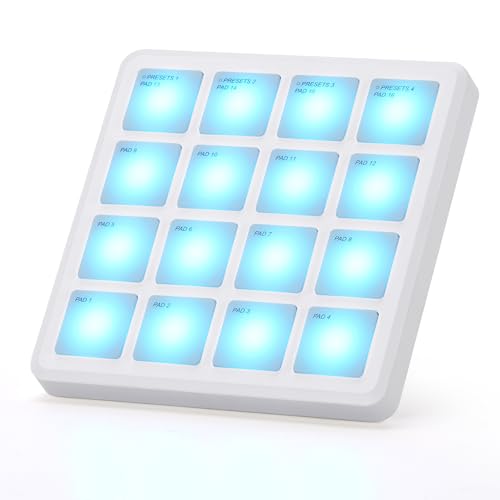
- 4.1-inch, 0.28-pound portable design
- 16 RGB pads with aftertouch and Note Repeat
- Bluetooth, USB, and up to 16-hour battery life
Best For: Apartment beat makers who value maximum portability
Best Customizable Mini Pad
JP-01 Wireless MIDI Controller

- 16 RGB velocity pads with aftertouch
- Up to 15 hours of rechargeable battery life
- Three pad banks provide up to 48 assignable pads
Best For: Beginners and DJs needing flexible mobile control
Best Apartment Mixing Controls
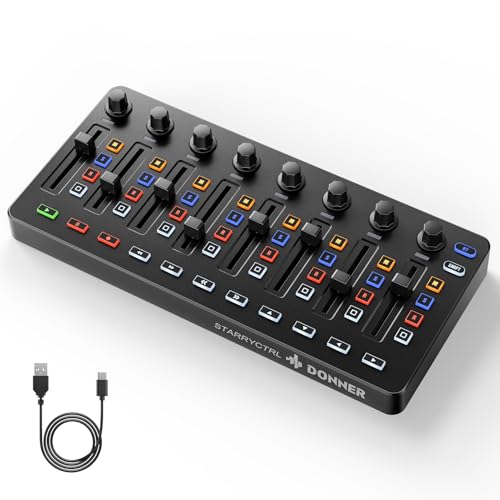
- Eight faders, eight knobs, and 43 assignable buttons
- Smart LED Anti-jump Indicator for smoother changes
- Wireless design with rechargeable 780mAh battery
Best For: Home-studio mixing and hands-on DAW control
Most Versatile – Akai MPK Mini IV
The Akai Professional MPK Mini IV is a strong all-around choice for anyone shopping for MIDI controllers for apartments. Its compact 25-key layout combines a keyboard, pads, knobs, display, and built-in creative tools without requiring a large desk footprint.
Best For: Apartment producers who want one compact controller for keys, beat-making, sound browsing, and DAW control.
Pros:
- Combines 25 velocity-sensitive mini keys, eight MPC pads, eight assignable knobs, and a color display.
- USB-C connectivity, USB power, and full-size MIDI Out support computer and mobile setups.
- Includes arpeggiator, Chord and Scale modes, mapped DAW controls, and a substantial software bundle.
Cons:
- Mini keys provide less physical space than a full-size keyboard.
- The many controls may be more than beginners need for simple keyboard parts.
For small rooms, the MPK Mini IV offers an unusually broad set of production controls in a portable format. It is especially appealing when you want both expressive keys and hands-on beat-making without filling your workspace.
Best Wireless Pad Option – EMP16 MIDI Pad Controller
The EMP16 is a practical pick among MIDI controllers for apartments when finger drumming and flexible placement matter more than piano-style keys. Bluetooth 5.0, battery operation, and a compact pad-focused design can help reduce cable clutter in a small room.
Best For: Beat makers who want wireless pad control, extensive assignable controls, and compatibility with computers, iOS devices, and external MIDI gear.
Pros:
- Sixteen RGB velocity-sensitive pads expand to 64 assignable pads across four banks.
- Bluetooth 5.0 and optional two-AA-battery operation offer flexible placement; USB power is also available.
- Includes faders, buttons, rotary knobs, OLED feedback, USB MIDI, and standard MIDI In/Out.
Cons:
- It does not include piano keys for melodic keyboard performance.
- AA batteries are not included.
- Wireless compatibility and features may require more setup than a basic USB controller.
The EMP16 stands out for apartment users who want a capable beat-making surface without keeping the controller directly beside the computer. Its pad-first workflow and multiple connection options make it particularly adaptable for compact studios.
Best Minimal Keyboard – Akai LPK25
The Akai Professional LPK25 is a straightforward choice for apartment musicians seeking small MIDI controllers for apartments. Its 25 velocity-sensitive mini keys, USB power, and slim footprint keep the setup focused on playing melodies, bass lines, chords, and software instruments.
Best For: Songwriters and producers who need a compact keyboard with basic performance features and broad DAW compatibility.
Pros:
- Compact 25-key design is easy to fit beside other studio equipment.
- Velocity-sensitive keys, octave buttons, sustain control, and an arpeggiator support expressive playing.
- USB plug-and-play operation and eight programmable preset slots simplify computer-based workflows.
Cons:
- It has no built-in drum pads, faders, or rotary knobs for broader hands-on control.
- The mini keys offer less playing surface than full-size keys.
- The supplied details specify Mac and PC compatibility rather than wireless operation.
The LPK25 is best when desk space and simplicity are priorities. It delivers the essential keyboard features without adding a larger pad or control section, making it easy to keep ready in a bedroom or small creative workspace.
Best Full-Size Keybed – M-Audio Keystation 49 MK3
The M-Audio Keystation 49 MK3 suits apartment players who prioritize a more spacious keyboard over the smallest possible footprint. Its 49 full-size velocity-sensitive keys provide room for expressive parts while the USB design keeps the setup uncomplicated.
Best For: Apartment musicians who play piano-style parts, melodies, and bass lines and can accommodate a wider controller.
Pros:
- Forty-nine full-size velocity-sensitive keys provide a more natural playing area.
- Pitch and modulation wheels, octave buttons, volume fader, transport controls, and sustain input expand performance control.
- USB plug-and-play operation works with Mac and PC, with iOS support through an Apple USB Camera Adapter.
Cons:
- The 32.26-inch width takes substantially more desk space than 25-key alternatives.
- It focuses on keyboard control and does not include drum pads.
- iOS use requires a separately sold Apple USB Camera Adapter.
The Keystation 49 MK3 is the practical choice when full-size keys matter more than maximum portability. It remains relatively straightforward to connect, but apartment users should measure their desk before choosing this wider controller.
Best Wireless Pick – Rockville M25
For apartment musicians who want flexible setup options, the Rockville M25 is a compact choice among midi controllers for apartments. Its 25 full-size velocity-sensitive keys, Bluetooth connectivity, rechargeable battery, and hands-on controls support music making without requiring a permanent desk setup.
Best For: Mobile producers who want full-size keys, wireless connectivity, and versatile controls in a compact controller.
Pros:
- Bluetooth and USB connectivity work with PC, Mac, iOS, and Android devices.
- 25 full-size velocity-sensitive keys provide a familiar playing surface.
- Includes 8 velocity-sensitive pads, assignable knobs, and sliders for production control.
- Rechargeable battery provides up to 10 hours of playtime, according to the supplied details.
Cons:
- The 16-by-9-inch footprint is larger than a pad-only controller.
- Battery life is listed as up to 10 hours, so frequent users will still need to recharge it.
- Its broad feature set may be more than needed for simple beat triggering.
The M25 stands out when an apartment setup needs both playable keys and extensive sound-shaping controls. Bluetooth can help reduce cable clutter, while the compact format keeps it easier to store than a larger keyboard.
Best Space-Saving Pad Controller – Akai Professional LPD8
The Akai Professional LPD8 is a particularly compact option for midi controllers for apartments, especially when desk space is limited. It uses eight RGB-backlit MPC-style pads and eight assignable knobs instead of a traditional keyboard, making it suited to beat making, sample triggering, and tactile DAW control.
Best For: Producers and beat makers who need a lightweight pad controller that can fit beside a laptop or in a small studio.
Pros:
- Its slim 12.12-by-3.24-inch design is easy to place on a small desk or store in a laptop bag.
- Eight RGB-backlit responsive pads support samples, loops, and virtual instruments.
- Eight assignable Q-Link knobs provide hands-on control over DAW and plug-in parameters.
- USB-powered plug-and-play operation requires no AC adapter or driver installation on Mac or PC.
Cons:
- It has eight pads rather than piano-style keys, so it is not intended for melodic keyboard playing.
- The supplied details list Mac and Windows compatibility rather than mobile-device compatibility.
- USB is the only listed connectivity option.
For an apartment producer prioritizing a minimal footprint, the LPD8 keeps essential beat-making controls close at hand without taking over the workspace. Its programmable presets also make it practical for switching between different DAWs, instruments, and effects.
Best Beginner Keyboard – Donner N-32 MIDI Keyboard
The Donner N-32 offers a practical middle ground for apartment musicians who want more keys without a full-size keyboard taking over the room. Its 32 velocity-sensitive keys, compact design, built-in display, sequencer, chord and arpeggiator functions, and included teaching courses make it one of the more approachable midi controllers for apartments.
Best For: Beginners and compact-setup producers who want extra keys, guided learning resources, and creative performance features.
Pros:
- 32 velocity-sensitive keys provide more playing range than smaller 25-key controllers.
- Compact, lightweight design measures 16.7 by 4.3 inches and weighs about 1 pound.
- Includes a display, sequencer, chord and arpeggiator functions, pitch shifting, and a sustain-pedal input.
- Works with Android, iOS, Mac, and Windows, and includes music production software plus 40 teaching courses.
Cons:
- The scaled-down keys may feel less spacious than full-size keys.
- It requires DAW software or a compatible music app to produce sound.
- USB is the listed connection method, with no Bluetooth connection specified.
The N-32 is a strong fit for a small apartment workspace that also needs room for learning and experimentation. Its added keys and built-in creative functions offer more than a basic controller, while the lightweight body remains easy to move or store.
Best Tiny Wireless Pick – M-VAVE Pocket Pad
For shoppers seeking midi controllers for apartments, the M-VAVE Pocket Pad prioritizes a compact footprint, quiet operation, and wireless flexibility. Its 16 RGB velocity-sensitive pads include aftertouch and Note Repeat, while the rechargeable battery offers up to 16 hours of use.
Best For: Apartment producers, beat makers, and songwriters who need a highly portable pad controller.
Pros:
- Measures just 4.1 by 4.1 inches and weighs 0.28 pounds.
- Quiet silicone buttons help reduce distractions in shared living spaces.
- Supports Bluetooth and USB MIDI across Windows, Mac, Android, and iOS.
- Works with popular DAWs including Ableton Live, FL Studio, Logic Pro X, and GarageBand.
Cons:
- Provides drum pads rather than piano-style keys, faders, or knobs.
- The compact layout may offer less hands-on control for complex arrangements.
This is the easiest of the three to store and carry, making it a practical choice when desk space is limited. Choose it if quiet finger drumming and mobile production matter more than extensive mixing controls.
Best Customizable Mini Pad – JP-01 Wireless MIDI Controller
The JP-01 is a flexible option among midi controllers for apartments, combining wireless or USB MIDI with a small pad-based design. Its 16 velocity-sensitive pads support aftertouch, and the companion PC software or mobile app lets you customize mappings, velocity curves, and lighting.
Best For: Beginners, DJs, and mobile producers who want customizable pad control in a compact setup.
Pros:
- Offers Bluetooth MIDI and USB MIDI for cable-free or wired sessions.
- Up to 15 hours of battery life supports extended production or performance.
- Three pad banks can expand control to as many as 48 pads.
- Compatible with Windows, macOS, iOS, Android, HarmonyOS, DAWs, synths, and loop software.
Cons:
- Requires software or app setup for deeper customization.
- Its pad-focused design does not provide traditional keys, faders, or knobs.
Compared with a basic pocket pad, this controller emphasizes assignable control and multiple pad banks. It is a strong fit for apartment musicians who want room to tailor the workflow without adding a large desktop controller.
Best Apartment Mixing Controls – Donner STARRYCTRL
For apartment producers who need more than drum pads, the Donner STARRYCTRL brings wireless DAW mixing into a compact format. It includes eight faders, eight knobs, 43 assignable buttons, and a Smart LED Anti-jump Indicator designed to help prevent sudden parameter changes.
Best For: Home-studio producers and DJs who need hands-on volume, pan, transport, and effect control.
Pros:
- Eight faders and eight knobs provide direct volume and pan control.
- 43 assignable buttons support customized CC, note, channel, and aftertouch messages.
- Mackie Control Universal support can simplify DAW mapping.
- Rechargeable 780mAh battery enables wireless use and reduces cable clutter.
Cons:
- At 1.1 pounds and 10.04 inches wide, it is less pocketable than the pad controllers.
- Its broader feature set may be more control than beginners need.
- Wireless connectivity is listed, while the hardware interface uses USB Type-C.
This is the most capable choice for mixing and DAW navigation in a compact home setup. Its faders, knobs, and anti-jump indicator are especially useful when apartment producers want tactile control without a full-size console.
How We Picked the Best Midi Controllers for Apartments
We focused on controllers that suit small rooms, flexible desks, and portable music setups. The selection includes compact keyboards, pad-based beat makers, and wireless models that can work with computers or compatible mobile devices. We considered physical size, key or pad count, velocity sensitivity, connection options, portability, and practical features such as chord modes, sequencers, assignable controls, and Bluetooth support.
Because apartment studios often double as living spaces, we also prioritized controllers that can be stored easily and used without adding unnecessary hardware. A controller does not produce sound by itself, so compatibility with your DAW, virtual instruments, and device ports remains essential.
Quick Comparison
- Best for compact keyboard playing: 25- and 32-key models offer more melodic range while remaining desk-friendly.
- Best for beat making: Pad controllers provide tactile drum triggering, note repeat, and performance-oriented layouts.
- Best for mobile or flexible setups: Wireless Bluetooth models reduce cable clutter and make it easier to move between rooms.
- Best for more traditional piano input: A 49-key controller gives you additional range but requires more desk or stand space.
Key Buying Factors for Midi Controllers for Apartments
Size and Storage
Measure your desk before choosing a controller. A 25-key keyboard is often a practical compromise, while mini keyboards and pad units can fit beside a laptop. Look for lightweight designs if you plan to store the controller after each session.
Keys Versus Pads
Choose keys for melodies, chords, bass lines, and virtual piano parts. Choose pads for drums, clips, finger drumming, and sample triggering. If you produce several genres, a keyboard with performance pads or a separate compact pad controller may be more versatile.
Noise and Playing Feel
MIDI controllers generally make less sound than acoustic instruments, but key and pad impacts can still travel through floors and walls. Velocity-sensitive controls improve expression; a compact layout and moderate playing force can make late-night sessions more considerate.
Connectivity and Software
USB is dependable for computer setups, while Bluetooth can reduce cable clutter. Confirm that the controller works with your operating system and preferred DAW. Also check whether USB-C, USB-A, or an adapter is required.
Controls and Workflow
Assignable knobs, pads, sliders, chord functions, sequencers, note repeat, and aftertouch can speed up production. Prioritize features that match how you work rather than paying for controls you will rarely use.
Who Should Buy Which Midi Controllers for Apartments?
Bedroom producers with limited desk space should start with a compact keyboard controller or small pad unit. Beat makers and electronic performers will likely prefer velocity-sensitive pads, note repeat, and RGB feedback. Mobile musicians should consider a lightweight wireless controller with Bluetooth and USB options. Players who need wider melodic range may accept the larger footprint of a 49-key model. For beginners, choose the layout that matches your main instrument and verify DAW compatibility before buying.