The right keyboard stand can make a home studio more comfortable, organized, and reliable. A stable frame protects your instrument while providing the height, clearance, and workspace you need for playing, recording, or practice.
We compared 10 adjustable keyboard stands across popular Z-style, X-style, U-shaped, folding, and wheeled designs. Use the guide below to match stand type, size, portability, and load capacity to your setup.
Best 10 Keyboard Stands for Home Studio Picks for 2026
Best Adjustable Z-Style Pick
Liquid Stands Adjustable Piano Keyboard Stand

- 250-pound load capacity
- Seated or standing height adjustment
- Includes straps and headphone hook
Best For: Home studios needing a sturdy, flexible single-tier stand
Best Double-X Value
AODSK Heavy-Duty Double X Keyboard Stand

- 132-pound load capacity
- Tool-free snap-lock height adjustment
- Rotating non-slip leveling pads
Best For: Home studios wanting quick, stable single-tier support
Best Rolling Studio Workstation
Liquid Stands Rolling Keyboard Table

- 250-pound capacity with locking wheels
- Accessory-ready mounting points
- Adjustable 26–36.5-inch height
Best For: Expandable home recording and music-production workstations
Best Two-Keyboard Setup
Pyle Heavy-Duty Z-Style Music Stand
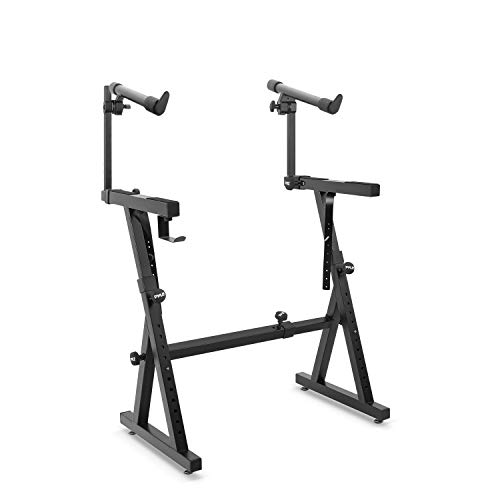
- Removable adjustable second tier
- Supports two keyboards
- Folds compactly for transport
Best For: Home studios running layered two-keyboard rigs
Best Adjustable Z-Stand

- Height and width adjustable
- Fits 61-88 key keyboards
- 250-pound load capacity
Best For: Flexible home studio and practice setups
Best Keyboard-and-Bench Bundle

- Includes adjustable bench
- Seven stand height settings
- Folds flat for storage
Best For: Portable 54-61 key home studio setups
Best Fixed Studio Stand

- 200-pound load capacity
- Non-slip protective padding
- Fits 61-88 key instruments
Best For: Stable, permanent home studio setups
Best Value Z-Frame
Pyle Heavy-Duty Folding Keyboard Stand

- Infinitely adjustable from 20 to 34 inches high
- Padded arms help prevent slips and scratches
- Folds compactly for storage and travel
Best For: Home studios needing an adjustable, portable stand
Best Heavy-Duty Capacity
GrowDaily Adjustable Z-Style Keyboard Stand

- Supports up to 250 pounds
- Includes straps, buckles, pads, and hooks
- Adjusts from 22 to 37 inches high
Best For: Studios using heavier keyboards and extra gear
Best Rolling Design
Liquid Stands Keyboard Stand with Wheels

- Built-in wheels simplify repositioning
- Supports up to 250 pounds
- Includes straps, pads, feet, and headphone hook
Best For: Studios needing heavy-duty mobility
Best Adjustable Z-Style Pick – Liquid Stands Adjustable Piano Keyboard Stand
For musicians comparing keyboard stands for home studio use, this Liquid Stands Z-style model offers broad adjustability, a substantial 250-pound capacity, and flexible seated-or-standing operation. Its flat-folding design also makes it practical for occasional transport.
Best For: Home studios, practice spaces, and musicians who need a sturdy stand for keyboards ranging from 54 to 88 keys.
Pros:
- Adjusts from 22.5 to 33.5 inches high and wide for seated or standing play.
- Supports up to 250 pounds with a reinforced Z-style frame.
- Includes anchoring straps, anti-skid pads, adjustable feet, and a headphone hook.
- Sets up and folds down in less than a minute.
Cons:
- Its 6.35-kilogram weight may be less convenient than lighter X-style stands.
- The one-level design does not provide a second tier for additional equipment.
This is a strong all-purpose option when stability and height flexibility matter more than adding multiple tiers or wheels. The 3-year warranty is an added benefit for regular use.
Best Double-X Value – AODSK Heavy-Duty Double X Keyboard Stand
This AODSK double-X stand is a practical choice among keyboard stands for home studio setups that need quick height changes and dependable support. Its snap-lock adjustment avoids tools, while rotating non-slip pads help accommodate uneven floors.
Best For: Home studios, rehearsal spaces, and stage setups using 61- to 88-key keyboards.
Pros:
- Supports up to 132 pounds for heavy keyboard equipment.
- Snap-lock adjustment changes height from 20.47 to 36.6 inches without tools.
- Rotating non-slip pads help level the stand and reduce sliding.
- Double-X construction is suited to home, studio, and performance use.
Cons:
- It has a single level and does not include a second-tier platform.
- Its 132-pound capacity is lower than some heavy-duty Z-style alternatives.
The AODSK emphasizes straightforward setup and floor stability. It is a sensible pick for players who want a compact, adjustable stand without the extra hardware of a workstation-style design.
Best Rolling Studio Workstation – Liquid Stands Rolling Keyboard Table
For a production-focused home studio, this Liquid Stands model expands beyond a basic keyboard stand. It combines a 250-pound capacity with locking wheels, mounting points, and compatibility with tabletop, speaker, and second-tier accessories.
Best For: Home recording studios and music-production workstations using keyboards, synths, MIDI controllers, mixers, or turntables.
Pros:
- Supports up to 250 pounds and includes 3-inch locking wheels.
- Height adjusts from 26 to 36.5 inches for flexible workstation positioning.
- Includes security straps and a headphone hook.
- Built-in rivnuts and through holes support bolts, screws, clamps, and compatible accessories.
Cons:
- At 27 pounds, it is substantially heavier than a basic portable stand.
- Accessory attachments and tabletop components may require separate purchases.
- Its rolling workstation format may be more than needed for a simple keyboard setup.
This is the most expandable option in the group. Choose it when your keyboard stands for home studio needs include movable gear, accessory mounting, and a broader production surface rather than simple instrument support.
Best Two-Keyboard Setup – Pyle Heavy-Duty Z-Style Music Stand
This Pyle Z-style stand stands out among keyboard stands for home studio use by adding a removable second tier. Independent adjustments let it hold two keyboards while still folding into a compact form for storage and transport.
Best For: Home studios and performers who need support for two keyboards or a keyboard plus secondary equipment.
Pros:
- Removable second tier supports a two-keyboard configuration.
- Second tier offers independent height, depth, and tilt adjustment.
- Heavy-duty construction is rated for a stated 400-pound total capacity, with a 110-pound platform load capacity noted in the supplied details.
- Folds into a compact Z shape and sets up in less than a minute.
Cons:
- The supplied specifications contain two capacity figures, so buyers should verify how the limits apply to their setup.
- The second tier adds adjustment complexity compared with a basic single-tier stand.
- No warranty details are provided in the supplied notes.
For layered rigs, the removable second tier is the key advantage. It offers more configuration flexibility than single-tier stands while preserving the portable Z-style format.
Best Adjustable Z-Stand – AODSK 61-88 Key Piano Stand
For keyboard stands for home studio use, the AODSK Z-style stand offers broad size and height adjustability in a heavy steel design. It fits 61- to 88-key keyboards and can be positioned for different players or setups.
Best For: Home studios, practice spaces, and performers who need adjustable support for a range of keyboard sizes.
Pros:
- Adjusts from 21.2 to 32.4 inches high and 21.8 to 35.2 inches wide.
- Fits 61- to 88-key digital pianos and keyboards.
- Supports up to 250 pounds with rubber-pad feet for stability.
- Designed for straightforward assembly without tools.
Cons:
- The Z-shaped frame does not include wheels.
- Its 10-pound weight may be less convenient than a lighter folding stand.
Choose this model if flexibility is a priority. Its wide adjustment range makes it easier to accommodate different instruments and playing heights, while the heavy-duty construction suits stationary studio use.
Best Keyboard-and-Bench Bundle – Tipatyard Double-X Stand Set
This keyboard stand and bench set is a practical choice for home studio players who want a complete seating and support setup. The double-X stand folds for storage, while multiple height settings help accommodate different playing positions.
Best For: 54- to 61-key keyboard players who want a portable stand, adjustable bench, and compact storage solution.
Pros:
- Includes both a keyboard stand and PU leather bench.
- Stand offers seven height settings; bench offers four.
- Folds flat for transport and storage.
- Non-slip caps and locking straps help keep the setup in place.
Cons:
- It is specified for 54- to 61-key electric pianos, limiting larger-keyboard compatibility.
- The double-X design may be less suitable for users seeking a fixed studio frame.
This bundle stands out when convenience matters as much as support. It provides the essentials for seated practice or recording and can be folded away when floor space is limited.
Best Fixed Studio Stand – AODSK U-Shape Keyboard Stand
For keyboard stands for home studio setups where stability is more important than adjustability, the AODSK U-shaped stand uses a fixed metal frame with padded contact points. It supports 61-, 76-, and 88-key instruments without requiring height or width adjustments.
Best For: Home studios and display-style setups using a compatible 61- to 88-key keyboard.
Pros:
- Supports up to 200 pounds.
- Thick non-slip padding helps protect the instrument and reduce movement.
- Compatible with most 61-, 76-, and 88-key keyboards, digital pianos, and MIDI controllers.
- Includes installation tools for assembly.
Cons:
- Height and width are non-adjustable.
- The fixed design may be less convenient for players who regularly change instruments or playing positions.
This is a sensible pick for a dedicated setup that will remain assembled. Its fixed U-shape prioritizes steadiness, while the padded surface adds protection for a keyboard kept in place between sessions.
Best Value Z-Frame – Pyle Heavy-Duty Folding Keyboard Stand
For musicians comparing keyboard stands for home studio use, the Pyle PKST38.5 offers a practical balance of adjustability, padding, and portability. Its Z-frame adjusts in both width and height, while the folding design makes storage and transport straightforward.
Best For: Home studios, classrooms, beginners, and musicians who need a compact folding stand for 54- to 88-key keyboards.
Pros:
- Infinitely adjustable width and height from 20 to 34 inches.
- Foam-padded arms help reduce slipping and protect the keyboard surface.
- Folds into a compact Z shape for storage and transport.
- Supports up to 85 pounds and includes a stability lock mechanism.
Cons:
- Its 85-pound capacity is lower than the other heavy-duty options in this roundup.
- It does not include wheels or accessory hooks.
The Pyle is a sensible choice when flexible positioning and easy storage matter more than maximum load capacity or rolling mobility. Its padded supports and quick setup make it well suited to a straightforward home studio arrangement.
Best Heavy-Duty Capacity – GrowDaily Adjustable Z-Style Keyboard Stand
The GrowDaily stand is a strong option for keyboard stands for home studio setups that need substantial load support. Its reinforced Z-style frame holds up to 250 pounds and includes protective padding, straps, buckles, and hooks for a more organized playing area.
Best For: Home or studio musicians using heavier keyboards, digital pianos, mixers, turntables, or multiple pieces of compatible gear.
Pros:
- Supports up to 250 pounds with 1.5mm-thick metal construction.
- Height adjusts from 22 to 37 inches and width from 24 to 33.8 inches.
- Includes four keyboard buckles, mounting straps, and non-slip contact pads.
- Angle-adjustable hooks provide a place for headphones or other items.
Cons:
- Height and width adjust in set 1.18-inch increments rather than continuously.
- The heavy-duty construction weighs more than a lightweight portable stand.
With its high capacity and included securing accessories, the GrowDaily emphasizes stability and protection. It is a particularly capable pick for a studio where heavier equipment and extra organization are priorities.
Best Rolling Design – Liquid Stands Keyboard Stand with Wheels
For keyboard stands for home studio use that need to move easily, the Liquid Stands MS1080 combines a Z-style frame with wheels. It supports up to 250 pounds, adjusts for seated or standing play, and includes straps, anti-skid pads, and a headphone hook.
Best For: Home studios and performers who want a heavy-duty stand that can be repositioned or transported with less lifting.
Pros:
- Built-in wheels make repositioning the stand easier.
- Supports up to 250 pounds and uses a stable Z-style design.
- Height adjusts from 22.5 to 33.5 inches for seated or standing play.
- Includes anchoring straps, anti-skid foam pads, adjustable feet, and a headphone hook.
Cons:
- Height and width adjust in preset increments.
- At 7.12 kg, it is less convenient to carry than a lighter folding stand.
The Liquid Stands model is a strong fit when mobility is as important as stability. Its wheels and 250-pound capacity make it useful for flexible studio layouts, while the included straps and pads add security during use.
How We Picked the Best Keyboard Stands for Home Studio
We focused on the practical details that matter in a home recording or practice space: frame stability, adjustable width and height, stated weight capacity, compatibility with common 49-, 54-, 61-, and 88-key keyboards, portability, assembly, and useful extras such as locking straps, padded arms, shelves, benches, and casters. The selection includes multiple stand styles so you can compare compact solutions with heavier-duty furniture-style supports.
Quick Comparison
| Stand type | Best for | Main advantage | Potential trade-off |
|---|---|---|---|
| Z-style | Home studios and larger keyboards | Strong, stable base with useful legroom | Usually heavier than folding designs |
| X-style | Portable setups and occasional use | Folds quickly for storage or transport | Can offer less side-to-side stability |
| U-shaped | Display-oriented or permanent setups | Wide, supportive footprint | May take more floor space |
| Wheeled or tiered | Flexible studio layouts | Easier repositioning or multi-device use | More parts and a larger footprint |
Key Buying Factors for Keyboard Stands for Home Studio
Keyboard Size and Fit
Check both the supported key range and the stand’s adjustable width. An 88-key digital piano needs a longer, more substantial platform than a compact controller. Also measure the instrument’s depth to ensure it sits securely without excessive overhang.
Stability and Weight Capacity
Choose a stand with a capacity comfortably above your keyboard’s weight, especially if you play forcefully or add accessories. Locking straps, non-slip feet, padded arms, and reinforced frames can reduce movement and protect the instrument.
Height and Playing Comfort
Adjustability helps accommodate different players, benches, chairs, and standing positions. Set the keyboard so your elbows remain relaxed and your wrists stay as level as possible. Confirm that the stand leaves enough knee and pedal clearance.
Footprint and Storage
Measure the available floor space before buying. Z-style stands often provide excellent stability but occupy more room, while X-style models are easier to fold away. Casters are useful only when they lock securely and the floor is suitable for rolling equipment.
Extras and Assembly
A second tier can hold a smaller keyboard, laptop, or monitor, while a matching bench may simplify setup. Review assembly requirements and hardware quality, particularly for heavier keyboards that will remain in place.
Who Should Buy Which Keyboard Stands for Home Studio?
- Choose a Z-style stand if you want a sturdy, comfortable permanent or semi-permanent home studio setup.
- Choose an X-style stand if portability, quick folding, and simple storage are more important than maximum rigidity.
- Choose a U-shaped model if you want a broad, furniture-like support for a 61- or 88-key instrument.
- Choose a tiered stand if you use two keyboards, a laptop, or other equipment and need vertical organization.
- Choose a wheeled stand if you frequently rearrange your studio, but prioritize locking casters and a secure frame.
Before ordering, verify your keyboard’s dimensions, weight, and pedal position against the manufacturer’s specifications. The best Keyboard Stands for Home Studio use balance stability, playing comfort, and the amount of space your room can spare.