Recording a guitar cabinet in an untreated room can introduce reflections, background noise, and unwanted bleed that compete with the amp’s natural character. The right isolation shield helps focus the microphone on the speaker while making placement more repeatable.
This roundup compares 10 options, from guitar-specific dual-microphone systems to portable reflection filters and enclosed isolation balls. Consider your microphone size, stand, cabinet setup, and available room space before choosing.
Best 10 Microphone Isolation Shields for Guitar Picks for 2026
Best Dual-Mic Guitar Cab Shield
guitaRF Guitar Amp Isolation Shield

- Four-layer filter for guitar cabinet recording
- Integrated dual microphone mounting
- Multi-axis positioning for phase alignment
Best For: Dual-mic guitar amp recording and loud-stage isolation
Best Complete Stand Setup
Foldable Microphone Isolation Shield

- Includes shield, stand, and thread adapters
- Supports desktop or boom-arm mounting
- Adjustable for seated or standing recording
Best For: All-in-one home, live, and guitar recording setups
Best Portable Filter

- Four-layer design for controlled reflections
- Adjustable height and microphone distance
- Suitable for amps and acoustic instruments
Best For: Home guitar recording in untreated rooms
Best Flexible Panel Design

- Three- or five-panel configurations
- Foldable panels for adjustable coverage
- Works on desktops or microphone stands
Best For: Flexible home guitar and vocal recording setups
Flexible Triple-Layer Control
Moukey Foldable Isolation Shield

- Triple-layer design helps reduce reflections and interference
- Foldable panels allow easy storage and angle adjustment
- Works on a desktop or microphone stand
Best For: Flexible guitar recording setups with desktop or stand mounting
Full-Height Stand Setup
AO-504 Recording Isolation Shield

- Includes an adjustable stand and mounting adapters
- Absorbent foam and vented metal back plate support clearer recording
- Stand height adjusts up to 182 cm
Best For: Stationary home or studio guitar recording setups
Large Instrument-Friendly Coverage

- Large 23.2-inch-wide shield suits guitar and vocal recording
- Foldable metal-and-foam construction is portable
- Includes desktop stand and 3/8-to-5/8-inch mounting compatibility
Best For: Guitarists seeking broader microphone coverage in a portable setup
Compact Five-Sided Shield
Penypeal Microphone Isolation Ball

- Five-sided foam design reduces noise and reflections
- Double-layer filter controls plosives and wind interference
- Lightweight 120 g build supports portable recording
Best For: Guitarists with 50–75 mm USB or XLR microphones
Adjustable Studio Shield
Moukey Five-Sided Isolation Reflector
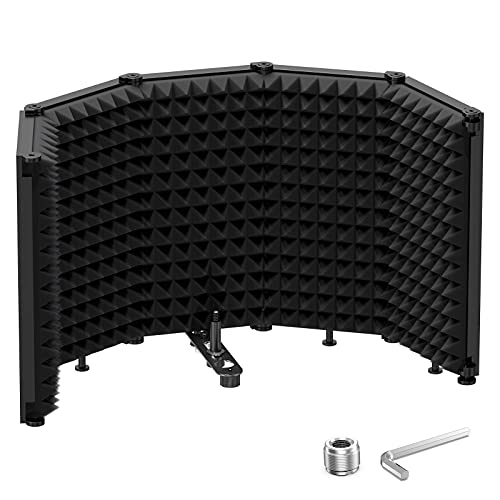
- Foldable five-panel design supports angle adjustment
- High-density foam reduces reflections and interference
- Desktop or stand mounting with conversion nuts included
Best For: Home studios recording guitar and vocals
Lightweight Five-Layer Cover

- Five-layer foam reduces reflections and ambient noise
- Fits 43–68 mm USB and condenser microphones
- Weighs just 58 g for easy transport
Best For: Portable guitar recording with compatible microphones
Best Dual-Mic Guitar Cab Shield – guitaRF Guitar Amp Isolation Shield
For guitarists comparing microphone isolation shields for guitar, the sE Electronics guitaRF is built specifically for amp-cabinet recording. It combines a four-layer reflection filter with dual microphone mounting and adjustable positioning hardware to help reduce bleed and focus the capture.
Best For: Dual-microphone guitar cabinet recording, loud live stages, and studio setups where phase alignment and precise mic placement matter.
Pros:
- Combines a reflection filter, dual mic mount, and positioning hardware in one setup.
- Supports combinations such as an LDC or ribbon microphone with a dynamic or small-capsule mic.
- Adjusts across vertical, horizontal, and depth axes for detailed placement.
- Includes a detachable floor mount, cable clip, and mic-stand thread adapter.
Cons:
- At 4.7 pounds, it is less lightweight than a basic standalone shield.
- Its specialized dual-mic design may be more than needed for simple single-mic recording.
The guitaRF is the most purpose-built option here for guitar amp work. Its dual-mic layout and multi-axis adjustment make it a strong choice when you want repeatable placement, reduced bleed, and a fuller cabinet recording.
Best Complete Stand Setup – Foldable Microphone Isolation Shield
If you want microphone isolation shields for guitar without sourcing a separate stand, this package combines a foldable shield with a height-adjustable microphone stand. Its acoustic sandwich design and dual noise-blocking zones are intended to reduce reflections and ambient interference around the microphone.
Best For: Home recording, standing performances, desktop setups, podcasts, and guitar recording where an all-in-one stand and shield is convenient.
Pros:
- Includes a 17.1-inch foldable isolation shield and 72.8-inch professional stand.
- Offers desktop and boom-arm mounting options.
- Height adjusts from 42 to 71.5 inches for seated or standing use.
- Includes 3/8-inch and 5/8-inch universal thread adapters.
Cons:
- The microphone is not included.
- At 8.1 pounds, the complete setup is relatively heavy for a portable shield.
- The supplied notes do not identify a guitar-specific mounting feature.
This is a practical choice if you need the shield and stand together. It is more versatile than a guitar-cab-only mount, though guitarists seeking specialized cabinet positioning may prefer a dedicated amp solution.
Best Portable Filter – RF-X Reflexion Filter
The sE Electronics RF-X is a portable option for microphone isolation shields for guitar, especially when recording an amp or acoustic instrument in an untreated room. Its four-layer construction is designed to reduce reflections and ambient noise while remaining easier to mount and reposition than larger studio treatments.
Best For: Home studios, guitar amps, acoustic instruments, vocals, and other sources recorded in bedrooms or untreated rooms.
Pros:
- Uses a vented composite panel, wool fabric, air gap, and acoustic foam layers.
- Helps create a drier, more controlled recording environment.
- Includes a height- and distance-adjustable bracket plus a mic-stand thread adapter.
- Designed to be lighter than earlier models while retaining a durable construction.
Cons:
- It is a single-microphone filter rather than a dedicated dual-mic guitar cabinet mount.
- Its 4,240-gram listed weight may still be substantial for frequent repositioning.
- The white finish may show more visible studio wear than a darker finish.
The RF-X is a flexible choice for guitarists who record in rooms with noticeable reflections. It does not offer the guitaRF’s dual-mic cabinet hardware, but its adjustable bracket and portable design suit a broad range of recording situations.
Best Flexible Panel Design – XTUGA MIS02 Isolation Shield
The XTUGA MIS02 gives shoppers considering microphone isolation shields for guitar a foldable, configurable panel design. Its three-layer construction uses reflective and high-density sponge sections to reduce interference, while the panels can be arranged for different recording spaces.
Best For: Budget-conscious home recording, guitar, vocals, and podcast setups that need adjustable desktop or stand-mounted isolation.
Pros:
- Can be configured as a three-panel or five-panel shield.
- Foldable end panels and a foldable top allow angle and coverage adjustments.
- Can be installed on a desktop, countertop, or microphone stand.
- Disassembles for setup changes and storage.
Cons:
- The supplied notes do not specify included mounting adapters or a microphone stand.
- Its plastic body may provide less robust construction than heavier metal-and-ABS stand systems.
- The product notes describe general recording use rather than guitar-cab-specific hardware.
The MIS02 stands out for setup flexibility: you can change the panel arrangement to suit the room and source. It is a sensible option for compact home recording, provided you already have compatible mounting support when needed.
Flexible Triple-Layer Control – Moukey Foldable Isolation Shield
For guitarists looking at microphone isolation shields for guitar, the Moukey offers a flexible setup for home recording, streaming, or studio work. Its reflective, filtering, and absorbing layers are designed to reduce audio-wave bounce and ambient interference around the microphone.
Best For: Guitar recording setups that need a foldable, adjustable shield with desktop or microphone-stand mounting.
Pros:
- Triple-layer construction combines reflection, filtering, and absorption.
- Three-panel foldable design is easy to store, carry, and angle.
- Supports desktop mounting and microphone-stand mounting.
- Includes 3/8-inch and 5/8-inch threaded compatibility.
Cons:
- The shield weighs about 0.96 kg, so it is not the lightest portable option.
- Its compact design may provide less surrounding coverage than a larger shield.
Choose the Moukey when adjustability and mounting flexibility matter. The non-slip support points and ABS back panel also make it a practical choice for repeat recording sessions.
Full-Height Stand Setup – AO-504 Recording Isolation Shield
This AO-504 is a practical option for guitarists comparing microphone isolation shields for guitar and wanting a complete stand-based package. It combines absorbent foam, a vented metal back plate, and an adjustable stand intended for recording vocals and instruments.
Best For: Home or studio users who want an isolation shield with a height-adjustable stand included.
Pros:
- Includes the shield, adjustable stand, thread adapters, and instruction manual.
- Absorbent inner material is designed to help preserve vocal and instrument clarity.
- Steel construction is rugged and scratch-resistant.
- Stand height adjusts up to 182 cm.
Cons:
- The microphone is not included.
- The stand-based setup may be less convenient to transport than a foldable shield.
- Its supplied use cases focus on recording and singing rather than broader mounting flexibility.
The AO-504 makes sense if you want a ready-to-assemble recording station rather than a shield alone. Its adjustable stand can help position the filter for different guitar and microphone arrangements.
Large Instrument-Friendly Coverage – Aokeo Foldable Mic Shield
The Aokeo AO-505 stands out among microphone isolation shields for guitar because its 23.2-by-11-inch shield is large enough for vocal work and recording instruments such as guitars and violins. Its foam front and ventilated metal back are designed to help reduce unwanted recording noise.
Best For: Guitarists who want a relatively large, portable shield with desktop support and broad microphone compatibility.
Pros:
- Large shield dimensions can accommodate vocal and guitar recording.
- Foldable design is light and portable for home or studio use.
- Includes a desktop stand and 3/8-inch mount with a 5/8-inch adapter.
- Solid metal alloy and professional sound-absorbing foam construction.
Cons:
- At about 1.3 kg, it is heavier than the Moukey model listed here.
- The product information lists a one-year manufacturer warranty, despite also mentioning a separate 90-day replacement assurance.
- It is designed for microphone recording and does not replace room treatment around the guitar.
The AO-505 is a strong fit when coverage for guitar recording matters more than minimizing weight. Its included desktop stand and adapter hardware make it easier to integrate with common microphone clips and shock mounts.
Compact Five-Sided Shield – Penypeal Microphone Isolation Ball
For guitar recording setups that need a portable solution, this Penypeal isolation ball combines a five-sided foam enclosure with double-layer filtering. It is designed to reduce reflections, plosives, wind interference, and other unwanted noise around compatible microphones.
Best For: Guitarists using 50–75 mm XLR or USB microphones in home studios, live recording spaces, or portable setups.
Pros:
- Five-sided seal helps reduce noise and reflections from multiple directions.
- Double-layer filter helps control plosives, wind interference, and saliva spray.
- Lightweight 120 g design works with desktop stands, tripods, boom arms, and floor stands.
Cons:
- Compatibility is limited to microphones with removable jackets measuring 50–75 mm.
- The foam enclosure is primarily suited to microphone-focused recording rather than broad room treatment.
This is a practical microphone isolation shield for guitarists who prioritize portability and quick setup. Confirm your microphone’s diameter before buying, especially if you use a compact USB model.
Adjustable Studio Shield – Moukey Five-Sided Isolation Reflector
The Moukey is a larger, foldable option for guitar recording environments where reflections and ambient interference are concerns. Its reflective, filtering, and high-density foam layers are designed to help produce cleaner microphone recordings.
Best For: Home studios, vocal-and-guitar recording, podcasts, and broadcasters who want an adjustable shield that can sit on a desk or attach to a microphone stand.
Pros:
- Five-panel construction allows flexible folding, storage, and angle adjustment.
- High-density acoustic foam helps reduce audio-wave bounce-back and interference.
- ABS rear panel and non-slip support points add stability.
- Included 3/8-to-5/8-inch conversion nuts support many microphone stands and shock mounts.
Cons:
- At 3.26 pounds, it is less portable than lightweight isolation-ball designs.
- The larger shield requires more setup and storage space.
Choose the Moukey when adjustability and a more substantial desktop or stand-mounted enclosure matter more than minimal weight. Its foldable five-panel design is especially useful for repeatable home-studio positioning.
Lightweight Five-Layer Cover – NEEWER MS012 Isolation Ball
The NEEWER MS012 is a compact microphone isolation shield for guitar recording and other close-mic applications. Its five-layer foam construction and double-layer filter are intended to reduce reflections, ambient noise, plosives, wind interference, and saliva exposure.
Best For: Guitarists and creators using 43–68 mm USB or condenser microphones who need a lightweight shield for studio, desktop, or mobile recording.
Pros:
- Five-layer acoustic foam helps absorb noise from multiple directions.
- Compatible with microphones measuring 43–68 mm in diameter.
- Removable foam insert helps stabilize the microphone and block unwanted noise.
- Lightweight 58 g design is easy to transport between recording locations.
Cons:
- It will not fit microphones outside the specified 43–68 mm range.
- The compact cover provides localized microphone treatment rather than full-room isolation.
For guitarists who record in changing locations, the MS012 stands out for its low weight and broad mounting flexibility. Check the microphone diameter first, then use the removable insert to achieve a secure fit.
How We Picked These Microphone Isolation Shields for Guitar
We selected products based on their suitability for close-miking guitar cabinets, acoustic treatment design, mounting flexibility, portability, and likely compatibility with common microphone stands and threaded mounts. The list includes purpose-built guitar amp shields as well as adaptable vocal and studio filters that can help reduce reflections around a guitar microphone.
Because an isolation shield does not make a room completely soundproof, we prioritized designs that surround the microphone with absorptive material or reflective filtering and that can be positioned consistently. Build quality, foldability, microphone access, and setup practicality also matter when recording frequently.
Quick Comparison
| Shield type | Best suited to | Main advantage | Watch for |
|---|---|---|---|
| Guitar-specific cabinet shield | Close-miking guitar amps | Purpose-built positioning and dual-mic support | Higher cost or larger footprint |
| Foldable reflection filter | Home studios and flexible setups | Portable, adjustable, and easy to store | May cover less of the cabinet or room |
| Five-panel foam shield | General recording | Broad microphone-side absorption | Stand stability and mounting fit |
| Isolation ball or enclosed filter | Maximum nearby reflection control | More surrounding coverage | Limited access and possible tonal coloration |
Key Buying Factors for Microphone Isolation Shields for Guitar
Coverage and Acoustic Design
Look for dense acoustic foam, multiple panels, or layered construction around the microphone. More coverage can reduce nearby reflections, but a very enclosed design may alter high-frequency response. For guitar cabinets, leave enough room to position the microphone at the center, edge, or cone boundary without forcing an awkward angle.
Microphone and Stand Compatibility
Check whether the shield uses a standard 3/8-inch or 5/8-inch thread, a dedicated bracket, or a conventional microphone stand. Confirm that your microphone, shock mount, cable, and stand can fit without the filter tipping forward. Heavy shields generally need a sturdy stand and a wide base.
Size, Weight, and Placement
Measure the space around your cabinet, stand, and player position. Foldable models are useful for small rooms and mobile recording, while larger guitar-specific shields can provide more consistent placement. A stable setup is more valuable than maximum panel size if you frequently change microphone positions.
Single- or Dual-Microphone Recording
If you blend a dynamic microphone with a condenser or ribbon, choose a shield designed for two microphones or verify that its opening and mount can accommodate both. Dual-mic positioning also requires enough room to avoid contact between microphone bodies, clips, and cables.
Who Should Buy Which Microphone Isolation Shields for Guitar?
Choose a guitar-specific shield if your main goal is recording an amp cabinet and you want dedicated mounting or dual-microphone support. Choose a foldable reflection filter for a versatile home-studio solution that can also be used for vocals, podcasts, and acoustic instruments.
Choose a multi-panel foam model if you need broad coverage at a moderate price and have a sufficiently stable stand. Choose an isolation ball or enclosed design when nearby reflections are the biggest problem and you are comfortable trading some microphone access and portability for additional surrounding coverage.
Finally, treat the shield as one part of the recording chain. Mic placement, cabinet volume, room treatment, and the microphone itself still have a major effect on guitar tone. Select the design that fits your actual recording space and workflow rather than simply choosing the largest filter.