The best looper pedals for touring make live arrangements more flexible without adding unnecessary complexity to your setup. The right choice depends on loop capacity, hands-free control, reliability, connectivity, and how quickly you can build or change parts onstage.
We’ve selected 10 touring-friendly options ranging from straightforward loop stations to multi-track pedals with drum machines, tuners, app support, and extensive storage. Use the guide below to narrow the list by workflow, rig size, and performance needs.
Best 10 Looper Pedals for Touring Picks for 2026
Reliable Starter

- 12 minutes of stereo recording
- Simple overdub, undo, and redo controls
- 24-segment loop-status indicator
Best For: Straightforward live looping for guitar, bass, or keyboard
Compact Performance Tool

- Six-minute loops with unlimited overdubs
- Half-speed, double-speed, and reverse modes
- Optional external control via expansion jack
Best For: Compact touring rigs needing creative playback options
Budget Memory Pick

- Nine loops and 40 minutes of total recording
- Built-in tuner with uninterrupted switching
- USB WAV import and export
Best For: Value-focused touring guitarists and bassists
Tour-Ready Multitrack

- Dual-track looping with four performance modes
- Stores 128 loops and over three hours of audio
- Mic, instrument, MIDI, and USB connectivity
Best For: Vocalists and multi-instrumental live performers
Touring Loop Control

- Three loop slots and 90 minutes total recording
- Bright screen with loop-status feedback
- Unlimited overdubs and automatic saving
Best For: Touring solo performers needing extended, savable loops
Rhythm-Ready Touring Setup

- Looper, drum machine, tuner, and mixed mode
- 30 preset patterns with app editing and sharing
- USB or 9V power with four loop storage locations
Best For: Touring players who want integrated drums and tuning
Studio-to-Stage Flexibility

- Nine loops and 40 minutes total recording
- 48 kHz/24-bit sampling for detailed loop audio
- USB WAV transfer plus built-in tuner
Best For: Touring guitarists managing loops between computer and stage
Best Drum-Looper Value

- Stereo looper with 110 drum grooves
- 40 slots and 160 minutes total recording
- Screen, USB transfer, and tap tempo
Best For: Solo performers needing rhythm backing and substantial loop storage
Best Compact Practice-to-Stage Pick
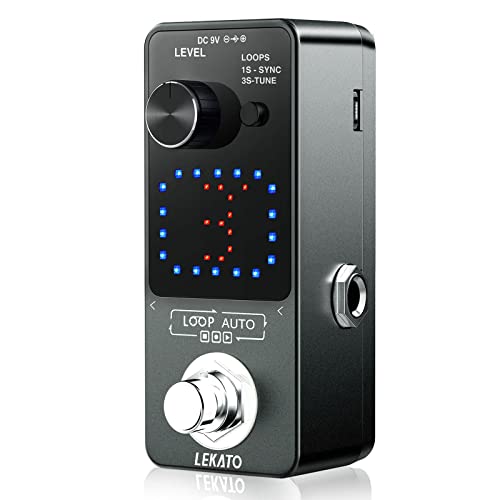
- Three loops with 18 minutes total recording
- Synchronous recording and unlimited overdubs
- Built-in tuner and USB WAV transfer
Best For: Players wanting compact, focused looping for guitar or bass
Best High-Capacity Touring Station

- 300 minutes across 100 loop slots
- Dual footswitches and full-color screen
- 220 drum grooves plus time stretch and auto record
Best For: Touring performers managing many loops and drum-backed sets
Reliable Starter – BOSS RC-1 Loop Station
For players seeking straightforward looper pedals for touring, the BOSS RC-1 is a practical choice. Its simple controls, clear 24-segment loop indicator, stereo connectivity, and 12 minutes of recording time cover essential live looping without an overly complex workflow.
Best For: Guitarists, bassists, and keyboard players who want an intuitive, compact looper for live layering.
Pros:
- Simple record, playback, overdub, undo, and redo functions
- 12 minutes of stereo recording time with memory retention after power-off
- Clear indicator shows Rec, Overdub, and Play modes
- Includes a 9-volt battery and supports optional PSA-series AC power
Cons:
- Optional AC adaptor is sold separately
- Offers a more basic feature set than advanced multi-track loopers
The RC-1 emphasizes dependable, easy-to-learn operation. It is well suited to touring musicians who prioritize quick setup and familiar stompbox control over extensive storage or multi-track features.
Compact Performance Tool – MXR Clone Looper Pedal
The MXR Clone Looper is a compact option for touring players who want high-quality looping with performance-focused playback variations. It records loops up to six minutes, supports unlimited overdubs, and adds half-speed, double-speed, and reverse modes.
Best For: Players who want compact looping with creative playback controls and optional external foot control.
Pros:
- Records loops up to six minutes with unlimited overdubs
- Supports half-speed, double-speed, and reverse playback
- High-resolution storage rates up to 88.2kHz handle high-gain distortion
- Expansion connections support external tap tempo and volume control
Cons:
- External MXR tap tempo or volume pedals are additional purchases
- Provides less total recording time than the larger multi-track options in this roundup
With its compact enclosure and expanded playback modes, the Clone Looper offers more sound-shaping flexibility than a basic looper while remaining pedalboard-friendly. It is a strong fit for touring rigs where space and creative control both matter.
Budget Memory Pick – LEKATO Looper and Tuner Pedal
The LEKATO combines looping and tuning in a compact pedal, making it a useful value-oriented choice among looper pedals for touring. It offers nine loops, up to 40 minutes of total recording time, unlimited overdubs, and USB transfer for moving WAV files to or from a computer.
Best For: Touring guitarists and bassists who want generous loop storage, a built-in tuner, and simple operation.
Pros:
- Nine loop slots with up to 40 minutes of total recording time
- Supports unlimited overdubbing with undo and redo functions
- 48kHz/24-bit uncompressed audio and Analog-Dry-Through design
- Built-in tuner and USB import/export for WAV loop files
Cons:
- Requires a 9-volt electric power source rated at 300 milliamps
- Single-knob volume control and one-button foot commands may feel limited for complex live workflows
The LEKATO is especially appealing when storage capacity and practical extras matter more than extensive multi-track control. Its tuner and USB file management can reduce the amount of supporting gear needed for a touring setup.
Tour-Ready Multitrack – Sheeran Looper + Dual Track
Designed with Ed Sheeran’s touring experience in mind, the Sheeran Looper + is the most performance-oriented option here. It combines dual-track looping, four looping modes, a color display, 128-loop storage, over three hours of total audio, and connections for microphones, instruments, MIDI, and USB.
Best For: Vocalists and multi-instrumental performers who need extensive stage control, storage, and connectivity.
Pros:
- Dual-track design with single, multi, sync, and song modes
- Stores up to 128 loops with more than three hours of total audio
- Rugged steel chassis, two pedals, color display, and RGB loop-status ring
- Functions as a 2-in/2-out USB audio interface and runs over six hours on four AA batteries under typical use
Cons:
- Its 1.7 kg chassis is substantially heavier than compact single-pedal loopers
- Uses four AA batteries for portable operation, with a listed 9-volt, 500-milliamp specification
- Its broader feature set may be more than needed for basic looping
The LOOPER + is built for demanding live workflows rather than minimal pedalboards. Its storage, dual-track modes, microphone input, and USB capabilities make it the strongest choice for performers building complete arrangements onstage.
Touring Loop Control – Donner Triple Looper
For players comparing looper pedals for touring, the Donner Triple Looper emphasizes visible status feedback, generous recording capacity, and straightforward foot control. Its bright screen shows loop status and recording progress, while three independent loop slots support song-section arrangements.
Best For: Solo performers, buskers, and touring guitarists who want long, savable loops with simple operation.
Pros:
- Three independent loop slots with up to 90 minutes total recording time.
- Bright screen makes recording progress and loop status easier to monitor live.
- Unlimited overdubs, undo/redo, auto-save, and true bypass support practical performance use.
- Compact 175 g enclosure is easy to include in a touring pedalboard.
Cons:
- Power supply is not included and requires 9V DC, center-negative power.
- One-foot-switch operation may require practice for managing multiple commands during a performance.
The Donner is a strong capacity-focused option for touring musicians who need multiple stored loops and clear visual feedback without a complicated control layout.
Rhythm-Ready Touring Setup – M-VAVE Circle Looper
The M-VAVE Circle combines looping, drums, and tuning in one pedal, making it a flexible choice among looper pedals for touring. Its mixed mode lets players balance drum-machine and loop volume separately, while the display helps make recording more intuitive.
Best For: Touring musicians who want built-in rhythmic accompaniment, tuner access, and app-customizable drum patterns.
Pros:
- Four modes cover tuning, drum machine, looping, and combined drum-and-loop use.
- Includes 30 preset drum patterns with app editing, saving, and sharing support.
- Four loop storage locations allow up to 11 minutes total recording with unlimited overlapping tracks.
- Supports both 9V DC and USB 5V power, useful for varied touring setups.
Cons:
- Total loop recording time is limited to 11 minutes, with a five-minute maximum per location.
- App-based pattern editing adds an additional setup step compared with a standalone looper.
This pedal suits performers who value integrated rhythm support more than maximum loop time. Its dual power options and all-metal shell also make it adaptable for travel and live setups.
Studio-to-Stage Flexibility – LEKATO Looper with Tuner
The LEKATO combines high-resolution looping, tuning, and USB file transfer in a compact pedal. For touring musicians evaluating looper pedals for touring, its ability to import and export WAV loops can help connect rehearsal, songwriting, and live-performance workflows.
Best For: Guitarists who need stored loop phrases, an onboard tuner, and computer-based WAV loop management.
Pros:
- Nine loop locations provide up to 40 minutes of total recording time.
- 48 kHz/24-bit sampling is designed for lossless, uncompressed loop audio.
- USB import and export supports transferring WAV loops to and from a computer.
- Built-in tuner and unlimited overdubbing add practical stage functionality.
Cons:
- Its listed dimensions and weight may take more pedalboard space than ultra-compact alternatives.
- Single-knob volume control keeps operation simple but offers fewer dedicated controls.
The LEKATO is a versatile choice for touring players who want both live looping and a way to manage loop files externally. The included power supply and USB cable help reduce extra setup purchases.
Best Drum-Looper Value – Donner Circle Looper
For musicians comparing looper pedals for touring, the Donner Circle Looper stands out as a compact stereo looper and drum machine with substantial onboard storage. Its screen, USB transfer, tap tempo, and external-footswitch support make it practical for repeatable live setups, though the power adapter must be supplied separately.
Best For: Solo performers who want drum grooves, stereo looping, and plenty of saved phrases in one pedal.
Pros:
- Combines a stereo looper with 110 drum grooves across 11 styles.
- Provides 40 memory slots and up to 160 minutes of total recording capacity.
- Screen displays loop mode, timing, and progress clearly.
- USB import/export, tap tempo, fade out, and external-footswitch support add flexibility.
Cons:
- Power adapter is not included.
- External footswitch is not included.
- Each memory slot holds up to four minutes of recording.
The Circle Looper is a well-rounded touring option when stored loops and built-in rhythm accompaniment matter more than the smallest possible footprint. Confirm your 9V center-negative, 500 mA power setup before taking it on the road.
Best Compact Practice-to-Stage Pick – LEKATO Looper Pedal
Among looper pedals for touring, the LEKATO Looper Pedal offers a compact format with useful performance controls, including synchronous recording, a built-in tuner, unlimited overdubs, and USB file transfer. Its three-loop design is straightforward for players who prefer a focused setup rather than a large loop library.
Best For: Guitarists and bassists who need compact looping, clean overdubs, and quick foot-controlled operation.
Pros:
- Synchronous recording lets you enter recording during playback.
- Offers three loops, up to six minutes per loop, and 18 minutes total recording time.
- Supports unlimited overdubbing with undo, redo, stop, and erase commands.
- Includes a tuner, 48 kHz/24-bit audio, and USB WAV import/export.
Cons:
- Power supply is not included.
- Storage is limited to three loops and 18 minutes total.
- Its single-knob, single-button layout may provide less direct control than a dual-footswitch design.
The LEKATO is a sensible touring choice for players who value portability and essential looping functions over extensive memory. Its automatic saving and USB transfers can also simplify preparing material before a show.
Best High-Capacity Touring Station – FLAMMA FF20 Looper Pedal
The FLAMMA FF20 is built for demanding looping setups, making it a strong candidate among looper pedals for touring. It pairs dual-footswitch control with 300 minutes of stereo recording, 100 memory slots, a full-color screen, a drum machine, and performance features such as auto record and time stretch.
Best For: Touring soloists, live performers, and musicians who need extensive loop storage plus integrated drum backing.
Pros:
- Stores up to 300 minutes of stereo loops across 100 memory slots.
- Dual footswitches provide direct control for recording, overdubbing, playback, stopping, and loop changes.
- Includes 220 drum grooves across 11 styles.
- Full-color screen, time stretch, auto record, USB-C transfer, and headphone output support live and practice workflows.
Cons:
- The larger feature set may require more setup familiarity than a basic looper.
- Its listed dimensions are larger than the compact LEKATO pedal.
- Power adapter is not identified as included in the supplied details.
With its high capacity and dual-footswitch layout, the FF20 is the most suitable of these three for a setlist containing many saved loops. The headphone output and auto-record function also make it versatile beyond the stage.
How We Picked the Best Looper Pedals for Touring
Touring puts different demands on a looper than casual home practice. We prioritized practical live-performance features: dependable footswitch operation, clear status displays, useful recording capacity, overdub and undo/redo controls, stereo or instrument-friendly connectivity, and fast access to stored loops or rhythms. We also considered whether each pedal suits a compact pedalboard or a more elaborate performance rig.
Simple pedals can be the most reliable choice when you need immediate recording and playback. More advanced models earn consideration when they add multiple tracks, synchronized rhythms, presets, USB or app editing, and enough memory for a complete set.
Quick Comparison
| Best For | Prioritize | Recommended Type |
|---|---|---|
| First-time users | Simple controls and visual feedback | Single-loop pedal |
| Singer-guitarists | Fast overdubs and reliable foot control | Dedicated loop station |
| Solo performers | Multiple tracks and rhythm support | Multi-track looper |
| Electronic or hybrid rigs | Stereo I/O, sync, and presets | Advanced workstation-style pedal |
| Budget touring setups | Core looping features and low cost | Compact multi-function pedal |
Key Buying Factors for Looper Pedals for Touring
Loop Time, Memory, and Track Layout
Check both the maximum recording time and the number of saved slots. A long loop is useful for extended arrangements, while multiple independent tracks are better for verses, choruses, and layered sections. Confirm whether loops remain available after power-down and how easily you can select them during a set.
Footswitch Workflow
Hands-free timing matters more onstage than a long feature list. Look for clearly defined record, play, stop, overdub, undo, redo, and track controls. A display or strong LED feedback can prevent mistakes under low stage lighting.
Rhythm, Sync, and Connectivity
Built-in drum patterns can provide a complete solo backing foundation, but they may add menu navigation. Stereo inputs and outputs matter for keyboards, stereo effects, and wider rigs. USB, app editing, MIDI, or sync functions are valuable if you prepare arrangements away from the stage.
Power and Touring Durability
Verify the required adapter, polarity, current draw, and whether batteries are supported. Metal housings and robust switches are preferable for frequent transport, but a protective case and consistent cable management are just as important for reliability.
Who Should Buy Which Looper Pedals for Touring?
Choose a straightforward loop station if you want dependable guitar or vocal layering with minimal setup. Pick a multi-track pedal if your performance depends on separate sections that need independent control. A drum-equipped model suits solo artists who need rhythm accompaniment without a separate device. Players with larger, synchronized rigs should favor stereo connections, presets, and sync-capable controls. Finally, prioritize the simplest pedal that supports your set list: fewer menus usually mean faster, safer operation during a live show.