Choosing the right processor can make home recording faster, cleaner, and more inspiring. The best guitar effects processors for home studios balance realistic amp tones, easy USB recording, and enough onboard control to skip extra gear.
In this roundup, we focused on versatile units that fit bedroom rigs, desktop studios, and small tracking setups without wasting space or money.
Best 10 Guitar Effects Processors for Home Studios Picks for 2026
Editor’s Pick
VALETON GP-200 Multi-Effects Guitar/Bass Pedal

- 240+ effects with 140 amp/cab sims
- USB-C audio interface with stereo streaming
- 11-block signal chain plus looper and drum rhythms
Best For: Home studio players who want an all-in-one processor with recording-friendly features
Best Compact Control
- Five extra footswitches for easier control
- Eight blocks of dynamic DSP
- USB 2.0 and HX/Helix preset compatibility
Best For: Players who want compact, hands-on control in a studio-friendly format
Best Bundle Value
Valeton GP-200 with Gig Bag Bundle

- 240+ effects and 140+ amp/cab models
- USB-C interface with loopback and re-amping
- Includes padded water-resistant gig bag
Best For: Home studio users who want the GP-200 plus extra protection and portability
Best Premium Routing
BOSS GX-100 Advanced Guitar Effects Processor

- 24-bit AD, 32-bit DA, and 32-bit float processing
- 32 amp types and 170+ BOSS effects
- 15 assignable blocks with flexible routing
Best For: Studio players who want premium sound quality and deep routing control
Budget Home Practice Pick
MOOER GE100 Multi-Effects Guitar Pedal

- 80 preset patches and 80 user patches
- 8 modules and 66 effect types
- 180-second looper plus drum machine
Best For: home practice, tone saving, and looping
Compact Premium Processor
BOSS GX-10 Compact Guitar & Bass Effects Processor

- GX-100 core technology in a compact format
- 32 amp types and 170 BOSS effects
- Up to 15 assignable blocks for routing
Best For: studio-ready tone shaping and portable recording
Smart Editing Choice
MOOER GE100Pro Guitar Multi-Effects Pedal

- 3.5-inch display with Bluetooth and Type-C
- PC/mobile editing plus AI tone assistant
- Supports MNRS, NAM A2, and third-party IRs
Best For: modern home recording and app-based tone editing
Hands-On All-Rounder
BOSS ME-90 Guitar Multi-Effects Processor
- Knob-based interface for fast tone building
- 11 AIRD amp models and 60 effects
- IR loading, effects loop, and patch memory
Best For: Players who want quick, tactile control in a home-studio multi-effects unit
Studio Routing Pick
MOOER GE200 Plus Multi Effects Pedal

- Balanced XLR outputs for direct studio use
- Over 270 effect models and 255 memory slots
- USB MIDI plus ASIO interface for DAW work
Best For: Players who need direct recording connections and deep preset control
Budget Practice Choice
Zoom G1X Four Multi-Effects Processor

- 71 effects and 13 amp models
- 30-second looper with 68 rhythm patterns
- Headphone monitoring and software editing
Best For: Affordable home use with solid practice tools and simple sound editing
Editor’s Pick – VALETON GP-200 Multi-Effects Guitar/Bass Pedal
Valeton GP-200 Multi-Effects Processor for Guitar & Bass, Expression Pedal, MIDI, USB Interface
Check Price On AmazonIf you want guitar effects processors for home studios that can handle practice, recording, and experimentation in one box, the Valeton GP-200 is a strong all-around option. It combines amp modeling, IR cab simulation, USB audio, and a flexible signal chain, so you can build finished tones without adding a lot of extra gear.
Best For: Home studio players who want a feature-packed, all-in-one effects processor with recording-friendly connectivity.
Pros:
- 240+ built-in effects plus 140 amplifier and cabinet simulations
- USB Type-C audio interface with stereo audio streaming
- Adjustable signal chain with up to 11 simultaneous effect blocks
- Includes a looper, 100 drum rhythms, and 256 presets
Cons:
- More complex than a simple stompbox-style unit
- Best value depends on whether you need the full feature set
For a home studio, the GP-200 stands out because it covers tone shaping, direct recording, and preset management in one processor. The combination of a color display, multiple I/O options, and software editing makes it practical for players who want depth without moving into a larger rig.
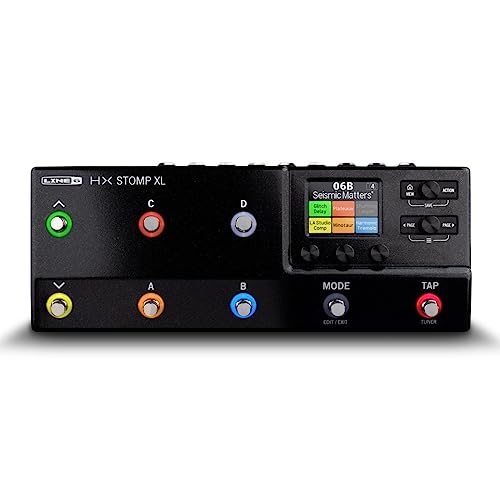
Best Compact Control – Line 6 HX Stomp XL
For guitar effects processors for home studios, the Line 6 HX Stomp XL is a smart pick if you want Helix-family sounds in a compact format. Its extra footswitches and eight-block DSP layout make it easier to control sounds during recording sessions or quiet practice setups.
Best For: Players who want a compact, studio-friendly processor with expanded hands-on control.
Pros:
- Five additional footswitches for easier navigation and control
- Eight blocks of dynamic DSP for flexible tone building
- Fully interchangeable presets with HX/Helix family units
- USB 2.0 connectivity for computer integration
Cons:
- More compact control set than larger floor processors
- Designed around the HX Stomp format, so flexibility is still size-limited
The HX Stomp XL is appealing in a home studio because it balances portability with serious control. If you want a streamlined unit that can sit on a desk or pedalboard while still giving you access to a broad preset ecosystem, this one fits well.
Best Bundle Value – Valeton GP-200 with Gig Bag Bundle
This Valeton GP-200 bundle is a practical choice among guitar effects processors for home studios because it pairs the processor with a protective gig bag. You get the same core modeling, USB audio interface, looper, and drum machine features, plus a padded bag for storage or transport.
Best For: Home studio users who want the GP-200 feature set with added protection and portability.
Pros:
- Over 240 effects with 140+ amp and cabinet models
- USB-C audio interface with 6-in/4-out loopback and re-amping support
- 256 patch slots, built-in looper, and 100 drum patterns
- Includes a padded, water-resistant gig bag with accessory pockets
Cons:
- Larger, more feature-rich unit may be more than some players need
- Gig bag adds convenience, but the core processor remains the main cost driver
If you want a home recording unit that also travels well, this bundle makes sense. The added gig bag is useful, but the main draw is still the GP-200’s broad effects library and recording-oriented connectivity.
Best Premium Routing – BOSS GX-100 Advanced Guitar Effects Processor
The BOSS GX-100 is built for players who want guitar effects processors for home studios with serious tone-shaping depth. It combines high-resolution conversion, 32 amp types, and more than 170 BOSS effects with flexible routing, making it a strong option for detailed recording setups.
Best For: Studio players who want premium sound quality, flexible routing, and deep amp/effect control.
Pros:
- 24-bit AD, 32-bit DA, and 32-bit floating-point processing
- 32 amp types and over 170 BOSS effects
- 15 assignable blocks with ultra-flexible amp/effect routing
- Color touch display plus footswitch and expression pedal control
Cons:
- Larger and heavier than compact processors
- May offer more depth than a casual home setup requires
For a home studio, the GX-100 is best when you care about flexible signal paths and high-quality processing. It feels aimed at players who want to build refined tones, save them as Livesets, and manage their setup from a computer when needed.
Budget Home Practice Pick – MOOER GE100 Multi-Effects Guitar Pedal
If you want one of the more affordable guitar effects processors for home studios, the MOOER GE100 focuses on easy preset-based tones, basic amp-free output, and practice-friendly tools. It gives you 80 preset patches plus 80 user patches, 8 effect modules, 66 effect types, and a 180-second looper, so you can build sounds and sketch song ideas without needing a computer.
Best For: Players who want a simple, feature-packed processor for home practice, tone saving, and looping.
Pros:
- 80 preset patches and 80 user patches for building a personal sound library
- 8 effect modules with 66 effect types for broad tone options
- 180-second looper and drum machine support practice and songwriting
- Line out mode helps when playing without an amp
Cons:
- Uses a more basic knob-and-screen control approach than premium processors
- Effects and editing are geared more toward practical use than deep studio routing
The GE100 makes the most sense if you want a straightforward multi-effects pedal for home use, especially when preset storage, looping, and direct line-out playability matter more than advanced editing depth.
Compact Premium Processor – BOSS GX-10 Compact Guitar & Bass Effects Processor
The BOSS GX-10 is a strong choice if you want guitar effects processors for home studios with a more premium sound engine in a compact format. It uses GX-100 core technology, offers 32 amplifier types and 170 BOSS effects, and includes flexible routing with up to 15 assignable blocks, making it better suited to detailed tone building and recording-oriented setups.
Best For: Players who want a compact, studio-ready processor with deep sound-shaping options and high-quality conversion.
Pros:
- GX-100 core technology in a smaller, travel-ready format
- 32 amplifier types and 170 BOSS effects for wide tonal range
- Up to 15 assignable blocks for flexible signal routing
- 24-bit AD, 32-bit DA, and 32-bit floating-point processing for professional audio quality
Cons:
- More advanced feature set may be more than a casual beginner needs
- Compact layout emphasizes portability over a larger control surface
For a home studio, the GX-10 stands out when you want serious tone quality, flexible routing, and a rugged compact unit that can also handle bass, not just guitar.
Smart Editing Choice – MOOER GE100Pro Guitar Multi-Effects Pedal
The MOOER GE100Pro is aimed at guitar effects processors for home studios where modern editing and connectivity matter. It combines a 3.5-inch color display, Bluetooth audio input, Type-C connectivity, PC and mobile app editing, and built-in AI tone assistance, while also supporting MNRS, NAM A2, and third-party IR files for expanded amp and cabinet tones.
Best For: Home players and creators who want modern app control, AI-assisted tone building, and recording-friendly connectivity.
Pros:
- 3.5-inch color display and RGB lighting make navigation more modern and visible
- PC and mobile app editing allow detailed preset management and tone sharing
- AI Smart Assistant helps with quicker tone creation
- 80-second stereo looper, 40 drum rhythms, and expression pedal support practice and composing
Cons:
- Feature-rich design may feel more complex than a basic practice pedal
- Runs on AC adapter, so it is less flexible than battery-powered versions
If you want a processor that feels built for modern home recording workflows, the GE100Pro offers the most connected and editable feature set of the three.
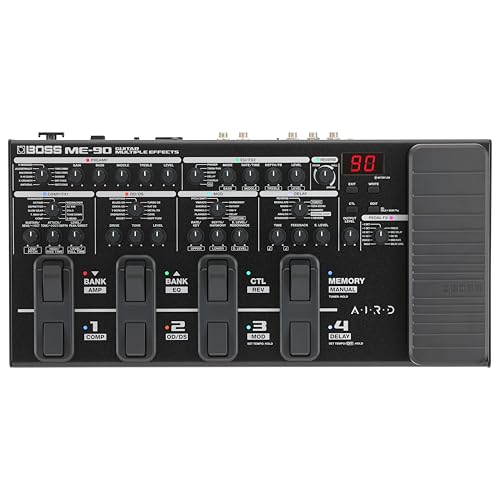
Hands-On All-Rounder – BOSS ME-90 Guitar Multi-Effects Processor
BOSS ME-90 Guitar Multi-Effects Guitar Processor | All-In-One Guitar Processor
Check Price On AmazonIf you want guitar effects processors for home studios that are fast to dial in but still serious on sound, the BOSS ME-90 is built for that workflow. It combines a knob-based, stompbox-style layout with advanced 24-bit AD/DA and 32-bit floating-point processing, plus AIRD amp models, IR loading, and an effects loop for flexible recording setups.
Best For: Guitarists who want an intuitive, all-in-one processor for quick tone shaping, home recording, and practice.
Pros:
- Hands-on knob interface makes sound creation quick and straightforward.
- 11 flagship-grade AIRD amp models and 60 derived effects cover a wide tonal range.
- IR loading and an effects loop add useful home-studio routing options.
- 36 preset patches and 36 user patches help you save and recall setups easily.
Cons:
- Compact all-in-one design may feel less deep than more editor-heavy units.
- Optional Bluetooth adapter is required for mobile editing and audio streaming.
For home-studio players who value speed, tactile controls, and dependable BOSS tones, the ME-90 offers a very practical balance of simplicity and flexibility. It is especially appealing if you want to build sounds directly on the unit instead of living in software.
Studio Routing Pick – MOOER GE200 Plus Multi Effects Pedal
Among guitar effects processors for home studios, the MOOER GE200 Plus stands out for its recording-friendly connectivity and broad preset capacity. It offers over 270 effect models, 255 memory slots, third-party IR support up to 2048 points, and balanced XLR outputs, making it a strong fit when you want to move from practice to direct recording without extra gear.
Best For: Home-studio players who want flexible routing, direct recording options, and deep preset management.
Pros:
- Balanced XLR outputs are useful for direct connection in studio setups.
- 255 memory slots and over 270 effect models provide plenty of sound-building space.
- USB MIDI and a low-latency ASIO audio interface support DAW-based recording.
- Built-in drum machine, metronome, and 60-second looper help with solo practice and writing.
Cons:
- Push-button control layout may feel less immediate than knob-driven units.
- Heavy feature set can take time to learn and organize.
If your home studio benefits from versatile I/O and computer integration, the GE200 Plus is the most routing-focused option here. It is especially attractive for players who want to record, rehearse, and manage presets from both the pedal and the PC.
Budget Practice Choice – Zoom G1X Four Multi-Effects Processor
The Zoom G1X Four is a straightforward pick for guitar effects processors for home studios when you want plenty of sounds without a complicated setup. With 71 effects, 13 amp models, a 30-second looper, and 68 rhythm patterns, it gives you useful practice and songwriting tools in a compact pedal that also supports headphone monitoring for quiet sessions.
Best For: Players who want an affordable, practice-friendly processor with core effects and looping for home use.
Pros:
- 71 effects and 13 amp models cover a wide range of tones.
- 30-second looper and 68 rhythm patterns are great for practice and writing.
- Headphone monitoring and aux input support quiet home sessions.
- Zoom Guitar Lab software adds patch editing on Mac or Windows.
Cons:
- Feature set is strong for practice, but less studio-rig focused than higher-end units.
- Battery-powered design may not suit every desk-based setup.
For home-studio players who mainly need a flexible practice and idea-capture tool, the G1X Four makes sense. It covers the essentials well, and the included expression pedal adds extra control without pushing the price or complexity too far.
How We Picked the Best Guitar Effects Processors for Home Studios
For Guitar Effects Processors for Home Studios, we looked for a mix of tone quality, recording convenience, and everyday usability. Priority went to models with solid amp and cab simulation, USB audio support, low-latency operation, and a control layout that makes editing less frustrating.
We also favored processors that can serve more than one job: practice tool, writing rig, direct recording interface, and gig-ready backup. Compact size mattered, but not at the expense of useful I/O, expression control, or preset flexibility.
Quick Comparison
Some units here are built for maximum versatility, with larger screens, deeper routing, and studio-friendly connections. Others are simpler, easier to learn, and better suited to players who want quick sounds with minimal setup. If you record often, look closely at USB audio, balanced outputs, and IR support. If you mostly play and practice, prioritize straightforward editing and a reliable pedalboard feel.
Key Buying Factors for Guitar Effects Processors for Home Studios
Sound Quality and Amp Modeling
Good amp tones matter more than the number of effects. Look for believable clean, edge-of-breakup, and high-gain sounds, plus cabinet simulation or impulse response loading for direct monitoring.
Recording and Connectivity
For home studios, USB audio interface functionality can be a major advantage. It reduces setup time and lets you capture processed tones directly into your DAW. Balanced outputs, stereo operation, and an effects loop can also be useful depending on your signal chain.
Editing Workflow
A processor that sounds great but is tedious to edit may slow down creativity. Larger screens, footswitch-friendly navigation, and app support can make a big difference when building tones quickly.
Portability and Control
Compact units are ideal for desks and small rooms, while floorboard-style models offer more switches and hands-on control. Choose based on whether you value minimal footprint or immediate access during recording and practice.
Who Should Buy Which Guitar Effects Processors for Home Studios?
If you want the most complete home-studio solution, choose a processor with strong amp modeling, USB recording, and flexible routing. If your priority is simple practice and occasional recording, a budget-friendly model with a built-in expression pedal may be enough. Players who already use external pedals should lean toward units with better I/O and MIDI support, while beginners will usually prefer an intuitive interface and quick preset access.
The best choice is the one that fits your room, your workflow, and how often you actually record. For most buyers, the ideal option among Guitar Effects Processors for Home Studios is the one that gets you from idea to finished take with the fewest steps.