The best drum pads for home studios can serve very different purposes: quiet skill building, finger-drumming, sample triggering, or complete electronic percussion performance. Choosing the right type first helps you avoid paying for features you will not use—or buying a practice pad when you need MIDI control.
This roundup compares 10 options across those use cases, including compact USB controllers, standalone sample pads, multipads, and low-noise practice solutions. Use the guide below to match pad response, connectivity, sound options, and setup requirements to your studio.
Best 10 Drum Pads for Home Studios Picks for 2026
Portable MPC Control

- 16 velocity-sensitive MPC pads
- 48 assignable pads across three banks
- Includes MPC Beats and Ableton Live Lite
Best For: Portable computer-based beat production
Sample-Ready Percussion

- Four velocity-sensitive performance pads
- 25 built-in sounds across eight kits
- Loads custom samples from SD cards
Best For: Compact percussion and sample expansion
Flexible Budget Controller

- 16 pads with 48 assignable positions
- Adds faders, knobs, and MIDI in/out
- Includes Melodics courses and Cubase LE
Best For: Hands-on DAW control on a budget
Standalone Production Hub

- Nine velocity-sensitive RGB pads
- Built-in sampler, looper, and effects
- 32GB storage with over 6GB of content
Best For: Sampling and loop-based studio performance
Best Portable MIDI Pick

- 16 RGB velocity-sensitive pads with polyphonic aftertouch
- Wireless MIDI or USB-C connectivity and up to 10 hours of battery life
- Eight assignable knobs and included music-production software
Best For: Portable DAW-based beat making and home-studio production
Best Sound-Rich Standalone Pad

- 1,061 percussion and effects sounds plus 216 keyboard sounds
- Mute, layer, sequencer, and preset-loop functions
- Inputs for five external pads, foot switch, and hi-hat controller
Best For: Hands-on electronic percussion and expandable home-studio setups
Best Expandable Sample Pad

- Nine dual-zone velocity-sensitive pads and 592-plus sounds
- MIDI, USB, looper, audio, and external trigger connections
- Supports custom kits and sample imports via WaveManager
Best For: Expandable electronic percussion and sample-based studio setups
Best All-Around Practice Pad
Evans RealFeel 12-Inch Two-Sided Pad
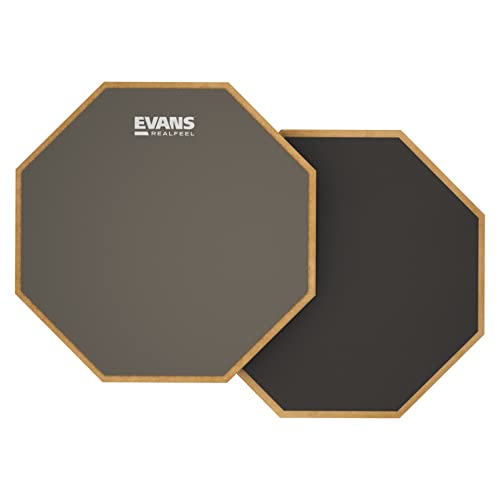
- Two surfaces for different rebound responses
- Works on tables, carpets, laps, or snare baskets
- Portable and quiet for home practice
Best For: Flexible, low-noise practice for beginners through professionals
Best Complete Setup
GrowDaily 12-Inch Pad and Stand Set

- Includes stand, sticks, stick bag, and carrying bag
- Adjustable stand reaches 19.5 to 31.5 inches
- Rubber pad with poplar base and shock-absorbing cotton
Best For: Beginners wanting a ready-to-play home practice station
Best for Quiet Rudiment Work
Donner 12-Inch Snare Practice Pad

- Removable simulator with 800 steel balls
- Quiet construction for home use
- Includes sticks and 40 standard rudiments
Best For: Quiet, structured technique and snare-style practice
Portable MPC Control – Akai MPD218
The Akai Professional MPD218 is a compact choice for drum pads for home studios, with 16 velocity-sensitive MPC pads, three pad banks, and USB connectivity. Its note repeat and full-level controls make it practical for beat production, sample triggering, and expressive programming.
Best For: Home-studio beat makers who want portable MPC-style pad control.
Pros:
- 16 thick, velocity-sensitive MPC pads with 48 assignable pad positions across three banks
- Note repeat and full-level controls support expressive performances
- Includes MPC Beats, Ableton Live Lite, and Drum Synth 500 software
- USB-powered design is compact and portable
Cons:
- Only one USB port is listed
- Camera Connection Kit is required for iOS use and sold separately
- Does not include onboard sounds or standalone operation
The MPD218 focuses on straightforward pad performance rather than built-in sequencing or sound generation. It is a strong fit when your home studio already uses a computer or compatible iOS setup for instruments and effects.
Sample-Ready Percussion – Alesis Sample Pad 4
The Alesis Sample Pad 4 adds hands-on percussion to a home studio with four velocity-sensitive pads, built-in sounds, and SD card sample support. It can also send MIDI to sound modules and software, making it a flexible option among drum pads for home studios.
Best For: Producers and performers who want built-in percussion sounds plus sample expansion.
Pros:
- Four velocity-sensitive pads support expressive playing
- Includes 25 percussion and electronic drum sounds across eight kits
- Standard SD card support allows custom sample loading
- Offers MIDI output and a dual trigger input for expansion
Cons:
- Has fewer performance pads than 16-pad controllers
- Its built-in sound library is focused on percussion and electronic drums
- Power adapter operation may be less portable than USB-powered controllers
With onboard sounds, tuning, reverb, and SD card loading, the Sample Pad 4 can contribute sound without relying entirely on a computer. Its four-pad layout is compact, though performers needing extensive sample mapping may want a larger controller.
Flexible Budget Controller – Donner STARRYPAD
The Donner STARRYPAD combines 16 backlit silicone pads with faders, knobs, pad-bank switching, and MIDI connectivity. For drum pads for home studios, it offers broad hands-on control for drums, samples, effects, and virtual instruments through a DAW.
Best For: Home producers seeking an affordable, highly configurable USB MIDI controller.
Pros:
- 16 backlit pads provide 48 assignable positions across three banks
- Includes two faders, two knobs, three buttons, and shift-layer control
- Adjustable velocity curves, tap tempo, and note repeat support performance control
- Includes MIDI in/out, Melodics courses, and Cubase LE software
Cons:
- Requires DAW software to produce sound and does not operate as a standalone drum machine
- The editor does not record or arrange music
- iPhone and iPad use requires a separate Apple adapter
The STARRYPAD is aimed at producers who want more controls than pads alone provide. Its lighting and multiple control layers are useful for organizing a software-based setup, while the need for a DAW should be considered before buying.
Standalone Production Hub – Alesis Strike Multipad
The Alesis Strike Multipad is a full-featured option for drum pads for home studios, pairing nine velocity-sensitive RGB pads with sampling, looping, effects, and substantial internal storage. Its display and audio/MIDI interface support both performance and production workflows.
Best For: Producers and performers who need sampling, looping, effects, and broad sound storage.
Pros:
- Nine velocity-sensitive RGB-lit pads support one-shots, melodies, and loops
- Includes a built-in looper, sampler, and USB sample loading
- 32GB storage includes more than 6GB of drums, loops, percussion, and melodic content
- Provides built-in effects, USB audio/MIDI, and a 4.3-inch display
Cons:
- Its larger 14.2-by-13.8-inch footprint may require more studio space
- It is heavier than compact pad controllers
- Only nine pads are provided, fewer than some 16-pad controllers
The Strike Multipad is designed as a production-oriented performance center rather than a simple trigger pad. Its looper, sampler, storage, and audio interface make it compelling for creators who want more of their workflow inside one unit.
Best Portable MIDI Pick – STARRYPAD PRO
The Donner STARRYPAD PRO is a flexible choice for home studios that need drum pads for home studios with wireless or USB-C connectivity. Its 16 velocity-sensitive RGB pads, assignable knobs, and compact battery-powered design suit beat making, recording, and mobile production. Keep in mind that it requires DAW software to generate sound.
Best For: Home producers who want a portable MIDI pad controller with expressive pads, software control, and mobile-device compatibility.
Pros:
- 16 RGB velocity-sensitive pads with polyphonic aftertouch and three velocity curves
- Eight assignable knobs plus dedicated DAW transport controls
- Wireless MIDI and USB-C connectivity for computers, tablets, and smartphones
- Built-in battery offers up to 10 hours of use, with Cubase LE, WaveLab LE, and Melodics included
Cons:
- Does not produce audio independently and requires DAW software
- Its feature set is focused on MIDI control rather than standalone percussion sounds
The STARRYPAD PRO stands out when portability and DAW control matter more than built-in sounds. It is a practical, expressive controller for producers who already work with software instruments.
Best Sound-Rich Standalone Pad – Yamaha DTX-MULTI 12
The Yamaha DTX-MULTI 12 is designed for players seeking drum pads for home studios with a substantial internal sound library and performance features. It includes more than 1,000 drum, percussion, and effects sounds, plus sequencing, loops, and support for external pads.
Best For: Drummers and electronic percussionists who want a robust multi-pad instrument with onboard sounds and expansion options.
Pros:
- Includes 1,061 drum, percussion, and effects sounds plus 216 keyboard sounds
- Mute and layer functions support flexible sound arrangements
- Built-in sequencer and preset loops aid practice and performance
- Trigger inputs support five external pads, with connections for a foot switch and hi-hat controller
Cons:
- It is substantially heavier and larger than a compact MIDI pad controller
- The supplied specifications list 64MB of flash ROM for user samples
With its broad sound selection and expandable trigger connections, the DTX-MULTI 12 is better suited to a dedicated percussion setup than a minimalist controller rig. It is a strong option for hands-on playing and standalone sound access.
Best Expandable Sample Pad – LEKATO PD705
The LEKATO PD705 is a versatile option for drum pads for home studios when you want onboard sounds, trigger expansion, and sample support. Its nine dual-zone velocity-sensitive pads, 592-plus sounds, MIDI connections, and looper give it a broader standalone role than a basic pad controller.
Best For: Producers and electronic drummers who need a sample pad that can handle standalone playing, DAW integration, external triggers, and custom kits.
Pros:
- Nine dual-zone velocity-sensitive pads with up to 592 preset sounds and 30 drum kits
- 5-pin MIDI, USB MIDI, audio, trigger inputs, and looper support flexible setups
- Can add two dual-zone trigger pads or acoustic drum triggers
- Supports custom kits and sample imports through WaveManager software
Cons:
- At 3.17 kg, it is less lightweight than a compact MIDI-only controller
- Expanded triggering may require additional pads, triggers, or footswitch equipment
- Sample management uses WaveManager software and external storage options
The PD705 offers a useful middle ground between a standalone electronic percussion unit and a computer-connected production tool. Its trigger inputs and custom-sample support make it especially adaptable as a home studio grows.
Best All-Around Practice Pad – Evans RealFeel 12-Inch Two-Sided Pad
For drummers comparing drum pads for home studios, the Evans RealFeel offers a portable, quiet option with two playing surfaces. Its 12-inch format works on a table, carpet, lap, or inside a standard snare basket.
Best For: Drummers who want flexible, low-noise practice with both realistic rebound and a firmer workout surface.
Pros:
- Two-sided design provides natural gum-rubber rebound on one side and less rebound on the other.
- Portable and usable on multiple surfaces, including a lap or tabletop.
- Fabric-finished gum-rubber side is designed to resist wear and tear.
- Designed and manufactured in the USA.
Cons:
- The 12-inch version is not mountable.
- It is a single practice pad, without sticks or a stand.
The Evans RealFeel is a straightforward choice when quiet, adaptable practice matters more than a full kit. Its reversible surfaces make it useful for both everyday technique work and more demanding rebound exercises.
Best Complete Setup – GrowDaily 12-Inch Pad and Stand Set
For home studios that need more than a loose pad, this GrowDaily set combines a 12-inch practice surface with an adjustable snare stand, sticks, and carrying accessories. The setup is designed to provide a near-snare feel while keeping practice organized.
Best For: Beginners and home drummers who want a ready-to-use practice station with adjustable height and included accessories.
Pros:
- Includes a 12-inch pad, adjustable snare stand, three pairs of maple sticks, stick bag, and dedicated carrying bag.
- High-resilience rubber, a poplar base, and shock-absorbing cotton are designed for a near-snare feel.
- Double-support tripod stand adjusts from 19.5 to 31.5 inches.
- At 4.19 pounds, the pad has a substantial feel for practice.
Cons:
- The included stand and accessories make this set less minimal than a standalone pad.
- The supplied notes do not specify a special noise-reduction rating.
This is a practical bundle for shoppers building a dedicated practice corner. The adjustable stand and included gear reduce the need to buy basic accessories separately, while the 12-inch surface keeps the setup familiar to snare players.
Best for Quiet Rudiment Work – Donner 12-Inch Snare Practice Pad
Among drum pads for home studios, the Donner DTB-1 stands out for its quiet construction and removable snare simulator. The 12-inch pad also includes maple sticks and a 40-rudiment printout, making it suitable for focused technique practice.
Best For: Home drummers who want quiet practice, snare-style techniques, and structured rudiment exercises.
Pros:
- Detachable snare simulator uses 800 steel balls to create a more immersive snare-like response.
- High-density compressed wood, silicone, and a non-scuff EVA bottom provide rugged construction.
- Designed for quiet practice to help limit disturbance to family or neighbors.
- Includes maple sticks and a printout of 40 standard rudiments.
Cons:
- The set includes a pair of sticks but no stand.
- The removable simulator adds a feature that may not be needed for basic pad practice.
The Donner is a strong fit for technique-focused home practice, especially when noise is a concern. Its rim, stick slot, and snare simulator add useful detail for modern snare work beyond a basic flat practice surface.
How We Picked the Best Drum Pads for Home Studios
We evaluated these drum pads by intended use rather than treating every model as interchangeable. The selection includes MIDI controllers for DAW-based production, electronic pads with onboard sounds, multipads for expanded triggering, and acoustic-style practice pads for quiet technique work.
Key considerations included pad feel and velocity response, number of playable zones, MIDI or USB connectivity, onboard sounds and expansion options, noise level, portability, power requirements, and overall usefulness in a home-studio setup. A practice pad can be excellent for rudiments but cannot replace a MIDI controller, while a feature-rich multipad may be unnecessary for simple daily practice.
Quick Comparison
| Best For | Look For | Typical Advantage |
|---|---|---|
| Finger-drumming and beat production | Velocity-sensitive pads, USB MIDI, DAW compatibility | Direct control over software instruments |
| Standalone electronic practice | Onboard sounds, headphone output, simple controls | Works without a computer |
| Expanded percussion performance | Multiple zones, sample loading, MIDI, footswitch support | More sounds and playing flexibility |
| Quiet acoustic practice | Gum-rubber or neoprene surface, stable stand | Low-noise rudiment and timing practice |
Key Buying Factors for Drum Pads for Home Studios
Pad Feel and Response
Velocity sensitivity matters for expressive programming and realistic dynamics. For technique practice, surface rebound is usually more important than the number of sounds. Two-sided pads can offer different responses, while a stand-mounted 12-inch pad may feel more familiar to acoustic drummers.
Connectivity and Software
USB MIDI is convenient for connecting a controller to a computer, tablet, or DAW. Traditional MIDI ports can be useful in hardware-based setups. Before buying, confirm that included software works with your operating system and that the pad supports the mappings you need.
Sounds, Sampling, and Expansion
Onboard sounds are valuable when you want to practice or perform without a computer. If you plan to load samples, check storage limits, file compatibility, trigger-zone options, and whether the device supports external storage or additional inputs.
Noise, Size, and Setup
Rubber practice surfaces are quieter than acoustic drums but still transmit impact through a desk or floor. Controllers are often compact, whereas multipads need more room and may require headphones, speakers, a power adapter, or a stand. Measure your workspace before choosing a larger unit.
Who Should Buy Which Drum Pads for Home Studios?
Choose a MIDI pad controller if your main goal is producing beats in a DAW, triggering samples, or controlling virtual instruments. Models with assignable knobs or faders are especially useful for hands-on mixing and sound shaping.
Choose an electronic sample pad or multipad if you want built-in sounds, standalone practice, live triggering, or a broader percussion setup. Prioritize inputs, sample management, and output options if you expect to expand later.
Choose a dedicated practice pad if quiet rudiment work, timing, and stick control are your priorities. A stable stand and realistic rebound may matter more than MIDI, onboard sounds, or extra controls.
For many home musicians, the best long-term setup combines a quiet practice pad with a separate MIDI controller or electronic pad. That pairing covers technique and production without forcing one device to do everything.