The best compact power amplifiers deliver useful power and flexible connectivity without taking over your equipment rack. This roundup compares mini Class D stereo amps, Bluetooth receivers, car amplifiers, and small PA-ready models.
Whether you need a simple amp for passive bookshelf speakers or a higher-output unit for a home theater, outdoor setup, or vehicle, these picks cover the key formats and features to consider in 2026.
Best 10 Compact Power Amplifiers Picks for 2026
Best Budget Pick
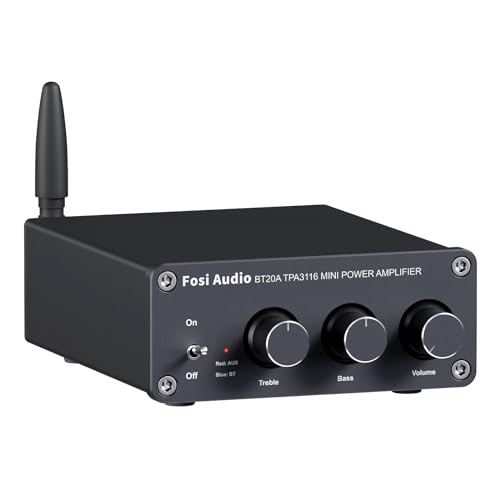
- Bluetooth and RCA inputs
- Compact two-channel Class D design
- Simple bass and treble controls
Best For: Entry-level passive-speaker systems
Best for Upgradability

- TPA3255 Class D stereo platform
- Swappable op-amp design
- AUX pre-out for subwoofer or active speakers
Best For: Customizable desktop and hi-fi systems
Best for Multichannel Car Audio
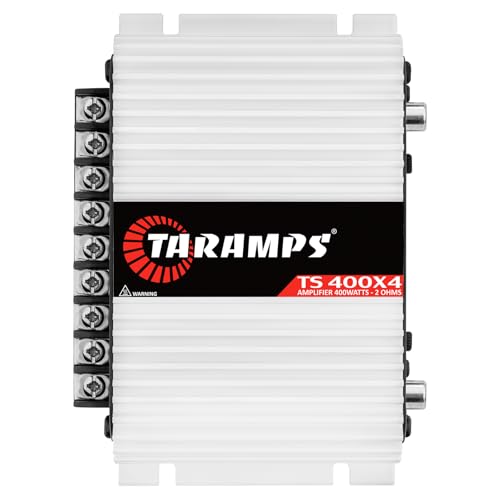
- Four-channel Class D amplifier
- Two channels can be bridged
- Designed for 8–16V car systems
Best For: Custom multichannel vehicle audio
Best Premium Bluetooth Option
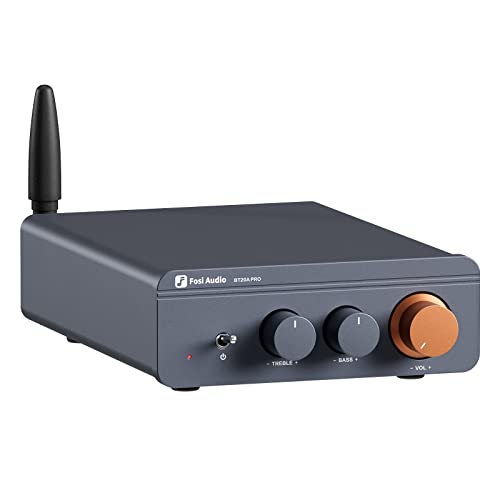
- Bluetooth 5.0 with pairing memory
- Up to 300W x2 stated output
- Replaceable op-amps and tone controls
Best For: Customizable wireless two-channel home audio
PA Versatility Pick
Pyle PCM30A 60W Compact Power Amplifier

- 25V/70V and low-impedance speaker outputs
- Two microphone inputs with talkover
- Paging and music-on-hold connections
Best For: Small PA, office, and paging systems
Minimalist Stereo Pick
Fosi Audio V1.0G Mini Class D Amplifier

- 50 watts per channel
- TPA3116D2 Class D architecture
- Compact aluminum chassis with speaker protection
Best For: Small two-channel home audio systems
Feature-Rich Karaoke Pick
Pyle PDA29BU 200W Bluetooth Amplifier

- Bluetooth, USB, SD, FM, RCA, and AUX inputs
- Two microphone inputs for karaoke
- Remote control and front-panel EQ controls
Best For: Home karaoke and flexible entertainment audio
Versatile Budget Pick
Pyle PFA330BT Bluetooth Amplifier

- 90W dual-channel output for 4–8 ohm speakers
- Bluetooth, RCA, AUX, and microphone inputs
- Compact design with speaker selector
Best For: Small home audio, studio, and basic PA systems
Best Budget Pick – Fosi Audio BT20A
The Fosi Audio BT20A is a straightforward choice among compact power amplifiers for powering passive speakers in a home office, bedroom, garage, living room, or patio setup. Its two-channel Class D design offers Bluetooth and RCA connectivity, plus simple bass and treble controls.
Best For: Entry-level home audio and small-space passive-speaker systems.
Pros:
- Bluetooth and RCA inputs support flexible music sources.
- Compact, lightweight design fits neatly on a shelf or desk.
- Simple controls and one-touch power operation make setup easy.
- Includes a 24-month manufacturer warranty.
Cons:
- It is positioned as a basic, no-frills amplifier.
- The listed 100W x2 output is a maximum rating.
The BT20A focuses on convenient operation and compact placement rather than advanced customization. It is a practical starting point for listeners who want wireless streaming and basic tone adjustment without a larger receiver.
Best for Upgradability – AIYIMA A07 Premium
The AIYIMA A07 Premium is one of the more configurable compact power amplifiers in this group. Its TPA3255 Class D platform is designed for two-channel passive-speaker systems, while the AUX pre-out and swappable op-amp support add flexibility for desktop and 2.1-channel setups.
Best For: Hi-fi listeners who want a compact amplifier with upgrade options and pre-out flexibility.
Pros:
- TPA3255 and NE5532 circuitry is specified for low-noise, low-distortion performance.
- Supports passive speakers rated from 2 to 8 ohms.
- 3.5mm AUX pre-out can feed active speakers, a powered subwoofer, or another amplifier.
- Replaceable op-amps allow experimentation with different compatible models.
Cons:
- Wi-Fi is not supported.
- The maximum 300W x2 output requires an appropriate upgraded power supply; the included adapter is 32V/5A.
- Power-supply compatibility must be checked carefully.
The A07 Premium suits buyers who want more than a basic mini amp. Its pre-out and replaceable op-amp design make it especially adaptable, though achieving the highest stated output depends on using a suitable power supply.
Best for Multichannel Car Audio – Taramps TS 400×4
The Taramps TS 400×4 is a compact power amplifier built for 12-volt-style car audio systems rather than home listening. It provides four channels, RCA input, and a 400-watt RMS specification, with two channels that can be bridged for a more flexible installation.
Best For: Car-audio installations needing four channels or bridged-channel operation.
Pros:
- Four-channel design supports multichannel vehicle audio setups.
- Two channels can be bridged for installation flexibility.
- Class D construction keeps the amplifier relatively compact.
- Aluminum housing and surface-mount design suit dedicated installations.
Cons:
- It is intended for vehicle power systems with an 8–16V supply range, not typical home audio use.
- Installation requires up to 33A of supply current.
- Professional installation is strongly recommended.
The TS 400×4 is the specialized option here for vehicle systems. Its channel count and bridging capability are useful for custom car-audio layouts, but buyers should plan for qualified installation and the correct electrical setup.
Best Premium Bluetooth Option – Fosi Audio BT20A Pro
The Fosi Audio BT20A Pro combines compact power-amplifier sizing with Bluetooth 5.0 and a higher-powered TPA3255 platform. It is designed for two-channel passive-speaker systems and adds replaceable op-amps, bass and treble controls, and a pairing-memory feature for a more customizable listening setup.
Best For: Wireless home audio users who want compact size, strong stated output, and tuning flexibility.
Pros:
- TPA3255 amplification is rated at up to 300W x2.
- Bluetooth 5.0 includes pairing memory and a removable-pairing function.
- Replaceable NE5532 op-amps support compatible upgrades.
- Specified SNR is at least 108dB and THD is no more than 0.005%.
Cons:
- It is a two-channel amplifier, so it is not intended for multichannel systems.
- Its output rating depends on the supplied 32V/5A power adapter and system setup.
- Op-amp experimentation requires selecting compatible replacement parts.
The BT20A Pro is a strong fit when wireless convenience and customization matter more than adding home-theater features. Its compact enclosure keeps installation simple while the TPA3255 platform and replaceable op-amps leave room to tailor the system.
PA Versatility Pick – Pyle PCM30A 60W Compact Power Amplifier
For installations that need more than basic stereo amplification, this 60-watt unit is one of the more flexible compact power amplifiers. It supports multiple speaker output types, microphone inputs, paging connections, and music-on-hold terminals in a relatively small chassis.
Best For: Small public-address, office, paging, and background-music systems.
Pros:
- Offers COM, 4-, 8-, and 16-ohm plus 25V/70V speaker outputs.
- Includes two microphone inputs, AUX RCA input, paging, telephone, and music-on-hold connections.
- Provides independent input controls, bass and treble adjustment, and MIC 1 talkover.
- Compact surface-mount design includes an LED indicator and replaceable fuse.
Cons:
- Its 60-watt output is intended for smaller systems rather than high-power venues.
- The feature set is oriented toward PA and paging applications more than simple home stereo use.
The PCM30A is a practical choice when connection flexibility matters more than minimalist operation. Its varied outputs and paging-oriented controls make it especially useful for distributed audio setups.
Minimalist Stereo Pick – Fosi Audio V1.0G Mini Class D Amplifier
This Fosi Audio model is a straightforward choice among compact power amplifiers for two-channel home audio. Its Class D design, TPA3116D2 chip, aluminum chassis, and included power supply provide a small-footprint way to drive compatible stereo speakers.
Best For: Compact two-channel home speaker systems and desktop-style audio setups.
Pros:
- Delivers up to 50 watts per channel in a compact 5 x 3 x 1-inch chassis.
- Uses a Texas Instruments TPA3116D2 Class D amplifier chip.
- Built-in speaker protection and an aluminum chassis support a clean, cool-running design.
- Includes the amplifier, power adapter, AC cord, and user manual.
Cons:
- Its supplied notes do not list additional inputs or wireless connectivity.
- It is designed for two-channel speaker amplification rather than PA or microphone applications.
The V1.0G keeps the job simple: connect a source and a pair of speakers for compact stereo playback. It is a sensible fit when small size and efficient operation are priorities.
Feature-Rich Karaoke Pick – Pyle PDA29BU 200W Bluetooth Amplifier
If you want compact power amplifiers with built-in playback and karaoke features, the PDA29BU packs considerable functionality into a small two-channel receiver. It combines Bluetooth streaming with microphone inputs, USB and SD playback, FM radio, and a remote control.
Best For: Home karaoke, casual entertainment, and flexible small-room stereo systems.
Pros:
- Provides 200 watts peak power and 100 watts RMS for a pair of speakers.
- Supports Bluetooth, RCA, USB-A, SD card, FM radio, and AUX sources.
- Includes two 1/4-inch microphone inputs with separate microphone volume control.
- Front-panel bass, treble, and master-volume controls complement the included remote.
Cons:
- Its karaoke and media features may be unnecessary for a basic stereo installation.
- The supplied notes specify support for one pair of speakers.
The PDA29BU is best viewed as an all-in-one entertainment amplifier rather than a bare power amp. Its broad source selection and dual microphone inputs make it convenient for casual karaoke and home use.
High-Power Choice – Douk Audio A5 TPA3255 Stereo Amp
The Douk Audio A5 is one of the more powerful compact power amplifiers for passive bookshelf or tower speakers. Its TPA3255 Class D design delivers up to 300 watts per channel, while the adjustable high-pass filter helps refine mid-high frequencies in stereo or home theater setups.
Best For: Home theater, passive speakers, and listeners who want substantial power in a compact aluminum chassis.
Pros:
- Up to 300 watts per channel with two-channel operation
- Adjustable 30–200Hz high-pass filter for system tuning
- Replaceable op-amps, PFFB circuitry, and a four-layer PCB
- Includes a 32V/5A power adapter
Cons:
- Requires passive speakers and a separate source component
- Its high output may be more than needed for small desktop systems
- Compact enclosure has limited room for connections and controls
The A5 stands out when power and adjustability matter more than an all-in-one feature set. Its high-pass filter and upgradeable op-amp design give enthusiasts useful ways to tailor a passive-speaker system.
Versatile Budget Pick – Pyle PFA330BT Bluetooth Amplifier
The Pyle PFA330BT is a practical option among compact power amplifiers for small home audio, studio, or PA setups. It combines 90-watt dual-channel output with Bluetooth, RCA, AUX, and microphone connectivity, plus support for 4–8 ohm speakers.
Best For: Casual home audio, smartphone streaming, and compact systems that need multiple inputs and a microphone connection.
Pros:
- Bluetooth supports wireless streaming from phones, tablets, and computers
- Offers Bluetooth, AUX/MP3, RCA, and microphone inputs
- Supports 4–8 ohm speakers
- Includes a 12V adapter and speaker selector
Cons:
- Its 90-watt rating is lower than the maximum figure listed in the specifications
- Uses a 12V power supply, limiting its role in higher-demand systems
- Included computer microphone may not suit every installation
The PFA330BT favors convenience and connection flexibility over audiophile adjustment features. It is a sensible fit for users who want straightforward wireless playback and basic input selection in a small enclosure.
Desktop Streaming Pick – Nobsound Mini Bluetooth 5.0 Amp
The Nobsound Mini is a particularly small choice among compact power amplifiers, measuring less than 3 inches wide. It provides 50 watts per channel with Bluetooth 5.0, USB, and AUX inputs, making it convenient for desktop, computer, office, and small home audio systems.
Best For: Desktop listeners and PC-based systems that need wired and wireless playback in a one-hand-sized amplifier.
Pros:
- 50 watts per channel in a compact aluminum enclosure
- Bluetooth 5.0, USB, and AUX input options
- USB playback supports lossless music from a computer without a driver
- Includes a 19V power supply and audio cables
Cons:
- Designed for smaller systems rather than demanding large-room setups
- USB functionality depends on a compatible source device
- The supplied specifications list a 12V operating voltage despite the included 19V power supply
The Nobsound is the most space-conscious option here. Its combination of USB computer audio, Bluetooth 5.0, and included cables makes it convenient when a simple desktop system matters more than extensive controls.
How We Picked These Compact Power Amplifiers
We selected models across the most common compact amplifier categories: two-channel home stereo, Bluetooth-enabled mini amps, multichannel car audio, karaoke and public-address equipment, and higher-output Class D designs. We prioritized practical power ratings, connection options, speaker compatibility, ease of use, and value rather than choosing products based only on maximum wattage.
Because amplifier specifications can vary by impedance, power supply, and testing conditions, treat advertised output as a comparison point—not a guarantee of identical real-world performance. Your speakers, listening space, and source devices matter just as much.
Quick Comparison
- Best for simple desktop or bookshelf systems: a small two-channel Bluetooth amplifier with RCA or AUX input.
- Best for higher-output home audio: a TPA3255-based amplifier, provided your power supply and speakers are appropriate.
- Best for vehicle installations: a dedicated multichannel car amplifier with the correct wiring and impedance support.
- Best for karaoke or announcements: a model with microphone inputs, tone controls, and suitable low- or distributed-voltage outputs.
- Best for flexible media playback: an amplifier with Bluetooth plus USB, SD-card, or multiple analog inputs.
Key Buying Factors for Compact Power Amplifiers
Power and Speaker Compatibility
Match the amplifier’s supported speaker impedance and continuous power to your speakers. More watts are not automatically better; an oversized amplifier can damage unsuitable speakers, while an underpowered unit may clip when pushed hard. Check whether the stated output is per channel, bridged, or based on a specific impedance.
Inputs and Wireless Features
Bluetooth is convenient for phones and tablets, while RCA and AUX inputs remain useful for turntables with a preamp, CD players, televisions, and other wired sources. USB and SD playback can be useful in casual or karaoke setups, but they are not substitutes for every digital connection—check exactly what each port supports.
Size, Cooling, and Controls
Compact Class D amplifiers are easy to place on desks, shelves, and workbenches, but they still need ventilation. Avoid enclosing the unit tightly or blocking its heat sink. Front-panel volume controls and speaker selectors improve convenience, especially when the amplifier is used without a separate receiver.
Home, Car, or PA Use
Do not assume a home mini amplifier can replace a car or public-address amplifier. Vehicle models require appropriate automotive power wiring, while PA equipment may support microphone inputs or 25/70-volt distributed speaker systems. Choose the design intended for your installation.
Who Should Buy Which Compact Power Amplifiers?
Choose a basic two-channel Bluetooth model for a desktop, bedroom, garage, or bookshelf-speaker system where simplicity and low cost matter most. Choose a TPA3255-based unit if you want more headroom for demanding passive speakers and have a suitable power supply and source equipment. Choose a multichannel car amplifier only for vehicle audio installations that need multiple channels or bridged output.
For karaoke, small announcements, or community spaces, prioritize microphone inputs and the required speaker-output format over audiophile-style specifications. Finally, select a media-friendly Bluetooth, USB, or SD-equipped model when several people will be supplying music or when you want playback without a separate source component.