The best compact audio mixers make it easier to balance microphones, instruments, playback devices, and streaming sources without taking up much desk or stage space.
We compared 10 compact models across connectivity, controls, portability, recording features, effects, and value to help you choose the right mixer for your setup.
Best 10 Compact Audio Mixers Picks for 2026
Best Compact Mixer with Effects

- Six channels with two microphone preamps
- Built-in digital effects
- Compact XLR-equipped design
Best For: Small performances and presentations
Best Feature-Packed Budget Mixer

- USB recording and USB-drive playback
- Bluetooth streaming and headphone monitoring
- 48V phantom power with echo and delay
Best For: Streaming, podcasting, and small events
Best Analog Build Quality

- D-PRE preamps and three-band EQ
- One-knob compressors on channels
- Rugged powder-coated metal chassis
Best For: Analog recording, lectures, and performances
Best Effects-Focused DJ Mixer

- 99 preset DSP echo effects
- USB recording and Bluetooth connectivity
- U-disk playback and recording
Best For: Streaming, karaoke, DJ use, and parties
Best Broadcast Pick

- Four-channel desktop mixer
- Two Onyx mic preamps with phantom power
- Lightweight 2.5-pound design
Best For: Podcasts, small studios, and broadcast setups
Best for USB Streaming

- Eight-input analog mixer
- Stereo USB audio interface
- Mixes PC or gaming audio into streaming output
Best For: Streaming, podcasting, and computer-based recording
Best Ultra-Compact Option

- Five-channel, 1.4-pound mixer
- One mic/line input with phantom power
- Dedicated stereo RCA inputs and outputs
Best For: Simple small setups with one microphone and stereo sources
Simple Sub-Mixing Pick

- Four independent volume controls
- Stereo/mono switching
- Compact 5V-powered line mixing
Best For: Small-stage sub-mixing and multiple keyboards
Feature-Rich Portable Pick

- Bluetooth and USB playback
- USB recording interface
- +48V phantom power and monitoring
Best For: Podcasting, streaming, karaoke, and small events
Flexible Line-Routing Pick
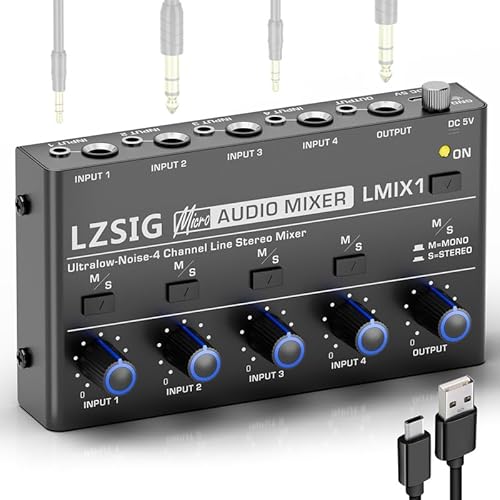
- Four inputs with one stereo or mono output
- 3.5mm and 6.35mm compatibility
- Low-noise component design
Best For: Instrument, computer, and gaming-console sub-mixing
Best Compact Mixer with Effects – Yamaha MG06X
The Yamaha MG06X is a straightforward choice among compact audio mixers for users who want six channels, two microphone preamps, stereo line inputs, and built-in digital effects in a small format. Its XLR output and corded design suit simple live, presentation, and small-performance setups.
Best For: Small performances, presentations, and users who want onboard effects without a complicated mixer.
Pros:
- Six-channel layout with two microphone preamps and four dedicated stereo line channels
- Built-in digital effects for adding ambience to vocals or instruments
- Compact 5.9-by-7.9-by-2.4-inch design
- Includes XLR audio connectivity and 48V voltage specification
Cons:
- Does not list a built-in recording interface or Bluetooth functionality
- Only two microphone preamps are provided
The MG06X focuses on essential analog mixing with a useful effects section. Choose it when compact size and simple operation matter more than computer-oriented features.
Best Feature-Packed Budget Mixer – Aveek 5-Channel Audio Mixer
The Aveek 5-Channel Audio Mixer stands out among compact audio mixers for flexible connectivity and built-in digital features. It combines XLR, 1/4-inch, RCA, USB recording, USB-drive playback, Bluetooth streaming, headphone monitoring, phantom power, and onboard echo and delay controls.
Best For: Live streaming, podcasting, karaoke, meetings, and small events requiring recording and wireless playback.
Pros:
- Three XLR inputs with switchable 48V phantom power
- Built-in PC recording interface through USB-B
- Supports USB-drive playback and recording
- Bluetooth streaming, headphone monitoring, EQ, echo, and delay effects
Cons:
- Bluetooth, USB, and 4/5-channel functions cannot be used simultaneously
- Bluetooth range is specified at approximately 15 feet
- Outputs are intended for active speakers or power amplifiers
This mixer offers an unusually broad feature set for its size, especially for content creators. Its simultaneous-use limitation is important to consider when planning a more complex setup.
Best Analog Build Quality – Yamaha MG06
The Yamaha MG06 is a durable analog option among compact audio mixers, offering six channels, D-PRE preamps, three-band EQ, high-pass filters, and one-knob compressors. Its powder-coated metal chassis and XLR outputs make it suited to users who prioritize dependable hands-on mixing.
Best For: Recording, lectures, and performances where analog controls and rugged construction are priorities.
Pros:
- Studio-grade discrete Class A D-PRE microphone preamps
- Three-band EQ and high-pass filters for shaping and cleaning signals
- One-knob compressors simplify control of guitars, bass, vocals, and drums
- Rugged, impact-resistant powder-coated metal chassis
Cons:
- No USB connectivity; this is an analog mixer
- Does not include built-in digital effects
- Offers six channels but only microphone input details are specified
The MG06 is a practical pick for a traditional mixer workflow. It trades modern recording and wireless features for solid preamps, useful channel processing, and a robust enclosure.
Best Effects-Focused DJ Mixer – MW-6 White 6-Channel Mixer
The MW-6 White is a portable six-channel choice among compact audio mixers, combining Bluetooth, USB connectivity, a built-in recording sound card, and 99 DSP effect presets. It is designed for flexible playback, recording, live streaming, podcasting, karaoke, and family-party use.
Best For: DJ-style streaming, karaoke, parties, and users who want many preset effects in a portable mixer.
Pros:
- Six-channel mixer with 99 built-in digital echo effects
- USB-B recording interface for computer or phone playback and recording
- Supports U-disk audio playback and recording
- Bluetooth compatibility with iOS, Android, tablets, and MP3 players
Cons:
- Listed with a 30-day return and exchange policy
- Dimensions and 4-pound weight are less compact than some smaller mixers
- Power specification is 220V AC, which may require attention to local compatibility
The MW-6 White is most compelling when effects and device connectivity are central to the setup. Verify power compatibility before purchase, particularly for use outside the stated 220V specification.
Best Broadcast Pick – Mackie 402VLZ4
The Mackie 402VLZ4 is a practical choice among compact audio mixers for podcasts, small studios, and broadcast setups. It combines four channels with two Onyx mic preamps, phantom power, and both 1/4-inch and RCA main outputs while weighing just 2.5 pounds.
Best For: Podcasts, small studio systems, and broadcast users who prioritize low-noise mic inputs and a lightweight desktop design.
Pros:
- Two Onyx mic preamps with phantom power
- High headroom, low noise, and improved RF rejection
- Four line inputs plus two mic inputs
- Light 2.5-pound design with included external power adapter
Cons:
- Only four channels
- Uses an external power adapter rather than a built-in power-cord socket
The 402VLZ4 is a focused, portable mixer for users who need quality microphone inputs without a larger console. Its channel count is limited, but its Onyx preamps and flexible main outputs suit compact voice and broadcast rigs.
Best for USB Streaming – Behringer XENYX 802S
Behringer XENYX 802S Premium Analog 8-Input Mixer with USB Streaming Interface
Check Price On AmazonThe Behringer XENYX 802S stands out among compact audio mixers for streaming, podcasting, and recording when USB connectivity matters. Its eight-input analog layout supports direct mixing of computer or gaming audio into the streaming output, with stereo USB audio for a computer or mobile device.
Best For: Streamers, podcasters, and home recordists who want analog mixing alongside USB computer or mobile-device connectivity.
Pros:
- Eight-input analog mixer
- Stereo USB audio interface
- Supports direct mixing of PC or gaming sounds into the streaming output
- Analog equalization and low-noise operation
Cons:
- Requires corded electric power
- Its feature set is oriented toward streaming and recording rather than a minimal analog-only setup
The XENYX 802S is the most connectivity-focused option here. Choose it when integrating computer or mobile audio is central to your setup; users seeking the simplest small analog mixer may prefer a more stripped-down design.
Best Ultra-Compact Option – Mackie Mix5
The Mackie Mix5 is a straightforward pick among compact audio mixers for small playback, recording, and microphone setups. It offers five channels, one mic/line input with phantom power, two stereo 1/4-inch line inputs, and dedicated stereo RCA inputs and outputs in a 1.4-pound chassis.
Best For: Users who need a simple, lightweight mixer for one microphone, stereo line sources, and RCA playback or recording connections.
Pros:
- Compact five-channel design weighing 1.4 pounds
- One mic/line input with phantom power
- Two-band EQ for straightforward tone shaping
- Dedicated stereo RCA inputs and outputs
Cons:
- Only one mic/line input
- Less suitable for multi-microphone setups
The Mix5 keeps the controls and connections focused for small rigs. It is a sensible fit for basic audio routing and playback, but its single mic/line input limits expansion compared with mixers designed for several microphones.
Simple Sub-Mixing Pick – 4-Channel Moukey Mini Mixer
For straightforward compact audio mixers, the Moukey Mini Audio Mixer focuses on combining four line-level sources into one output. Independent volume controls and selectable stereo or mono operation make it practical for small setups involving keyboards, guitars, bass, or drums.
Best For: Small-stage sub-mixing, multiple keyboards, and simple line-level routing.
Pros:
- Four channels with independent volume controls
- Switchable stereo or mono operating modes
- Compact 5V-powered design with low-noise operation
- Useful for keyboards, guitars, bass, and drum setups
Cons:
- Power supply must be sourced with suitable CE or UL certification
- TRS and TS cables are not included
- Designed for line-level mixing rather than a full-featured production console
This is a focused choice when you need basic source combining without extra recording, Bluetooth, or effects features. Verify your cable type and power-supply requirements before ordering.
Feature-Rich Portable Pick – 4-Channel Bluetooth DJ Mixer
This 4-channel model stands out among compact audio mixers for combining microphone, instrument, USB, Bluetooth, and MP3 playback features in a portable board. It also includes a USB recording interface, +48V phantom power, and monitoring support for podcasts, streams, karaoke, and small events.
Best For: Portable podcasting, live streaming, karaoke, home recording, and small DJ or presentation setups.
Pros:
- Supports Bluetooth input, USB playback, and USB recording
- +48V phantom power accommodates condenser microphones
- Compatible with XLR, 6.35mm, and other listed audio connections
- Compact design includes headphone monitoring and easy playback controls
Cons:
- Bluetooth supports input only, not Bluetooth output
- Its broader feature set may be more than needed for simple line mixing
- Requires corded power through the included adapter and cable
Choose this mixer if connectivity and content-creation features matter more than having the smallest possible line mixer. Its combination of wireless playback, USB functions, and phantom power gives it wider use than a basic sub-mixer.
Flexible Line-Routing Pick – LZSIG 4-Channel Mini Mixer
The LZSIG is one of the more compact audio mixers for routing several consumer and instrument sources into a single stereo or mono output. Its four inputs, mono/stereo switch, and support for both 3.5mm and 6.35mm TRS/TS connections suit basic sub-mixing and audio expansion.
Best For: Combining electronic drums, keyboards, guitars, computers, CD players, or gaming consoles.
Pros:
- Accepts up to four audio sources and provides one output
- Supports both stereo and mono mixing modes
- Handles 3.5mm and 6.35mm TRS/TS connections
- Uses low-noise components and a ground-noise-focused power design
Cons:
- Power adapter is sold separately
- Focused on line routing rather than microphone mixing or recording features
- Power-supply compatibility should be checked before use
This is a sensible option for expanding a compact audio system when you need flexible connector support and simple source combining. Budget for a compatible power adapter, and keep the unit away from potential interference sources for the intended clean signal performance.
How We Picked the Best Compact Audio Mixers
We evaluated these Compact Audio Mixers by looking at the features that matter most in small recording, streaming, DJ, rehearsal, and live-sound setups. Key considerations included channel count, input types, preamp quality, USB or computer connectivity, onboard effects, monitoring options, physical size, and ease of use.
We also considered whether each mixer is designed primarily for microphone and instrument mixing, line-level sub-mixing, podcasting, live streaming, or basic DJ playback. A mixer with more channels is not automatically better; the right choice depends on your sources, workflow, and need for expansion.
Quick Comparison
- Best for flexible small live setups: Yamaha MG06X
- Best for straightforward analog mixing: Yamaha MG06
- Best for USB streaming and recording: Behringer XENYX 802S
- Best for premium compact construction: Mackie 402VLZ4
- Best for simple, low-cost mixing: Mackie Mix5
- Best for sub-mixing multiple stereo sources: Moukey Mini Audio Mixer
- Best for portable effects and DJ-style use: MW-6 White
- Best for basic Bluetooth or USB playback: 4-Channel DJ Audio Mixer
- Best for entry-level podcast and PC recording: Aveek 5 Channel Mixer
- Best for minimal low-noise line mixing: LZSIG Mini Audio Mixer
Key Buying Factors for Compact Audio Mixers
Inputs and Channel Layout
Count every source you plan to connect at the same time, including microphones, guitars, keyboards, phones, computers, and playback devices. Microphone inputs with preamps are important for vocal and instrument recording, while stereo line inputs work well for keyboards, media players, and other line-level equipment. Leave at least one spare channel if you expect your setup to grow.
USB Connectivity and Recording
A USB interface can send the mix directly to a computer for streaming, podcasting, or recording. Check whether the mixer supports playback, recording, or both, and confirm how monitoring works to avoid latency or unwanted feedback. Analog models may require a separate audio interface.
Effects and Controls
Built-in reverb and other DSP effects can be useful for vocals, live broadcasts, and casual performances, but they add complexity. Look for clear channel gain, level, pan, EQ, and master controls. Physical knobs and meters are especially valuable when making adjustments quickly during a live session.
Size, Power, and Durability
Compact mixers are useful for mobile rigs, small desks, and crowded stages, but very small units may have limited routing or fewer dedicated controls. Consider the power supply, enclosure quality, connector placement, and whether the mixer can fit where you plan to use it.
Who Should Buy Which Compact Audio Mixers?
Choose the Yamaha MG06X if you want a dependable compact mixer with onboard effects for vocals, instruments, or small live systems. The Yamaha MG06 is a better fit when you prefer a simpler signal path without effects.
For computer-based streaming, recording, or podcasting, consider the Behringer XENYX 802S or Aveek 5 Channel Mixer, depending on your required inputs and budget. The Mackie 402VLZ4 suits buyers who prioritize compact professional construction and high-quality preamps, while the Mackie Mix5 is appropriate for basic analog mixing.
Use the Moukey or LZSIG models for simple line-level sub-mixing, and look at the MW-6 or Bluetooth-equipped DJ mixers if playback features, effects, or portable entertainment are more important than studio-style routing.