The best analog synthesizers make sound shaping immediate and rewarding, whether you want deep bass, expressive leads, vintage-style textures, or a compact instrument for mobile sessions.
This roundup compares 10 standout options across true analog, analog-modeling, hybrid, and portable designs, so you can match the synthesizer to your workflow, experience level, and budget.
Best 10 Analog Synthesizers Picks for 2026
Editor's Choice

- Two wavefolding VCOs plus sub-oscillator
- 32 full-size keys with velocity and aftertouch
- Sequencer, CV, MIDI, USB-C, and 256 presets
Best For: Expressive monophonic performance and studio sound design
Best Value

- Two analog oscillators with sub-oscillator
- Classic and Acid analog filter options
- Arpeggiator, step sequencer, MIDI, and USB
Best For: Bass lines, leads, and compact hands-on sequencing
Best Hybrid Option

- Six-voice polyphonic hybrid engine
- 37-key portable keyboard
- Includes a VST counterpart for computer workflows
Best For: Polyphonic experimentation and modern hybrid synthesis
Best Portable Pick

- Eight-note polyphony with mono mode
- Phrase looper and built-in speakers
- Battery-powered 37-key portable design
Best For: Travel, practice, and spontaneous musical sketching
Best for Easy Setup
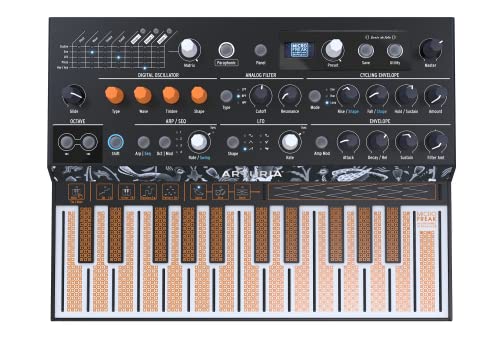
- 17 digital oscillator modes with an analog filter
- Poly-aftertouch touch-plate keyboard
- CV, USB, MIDI, sequencing, and modulation matrix
Best For: Advanced experimental sound designers
Best for Acid Bass

- Fully analog one-VCO synthesis path
- 128 patterns, Song Mode, and step sequencing
- Analog saturation, delay, pads, and MIDI/Sync
Best For: Acid basslines and accessible pattern-based performance
Best Ultra-Portable Pick

- Compact analog ribbon synthesizer
- Lightweight design for portable use
- Simple controls for quick sound exploration
Best For: Portable experimentation and beginner-friendly synthesis
Best Portable Performance Synth
Stylophone GENX-2 Analogue Synthesizer

- Battery operation, built-in speaker, and headphones
- LFO, filter, envelope, PWM, and analog delay
- CV/Gate outputs for modular connectivity
Best For: Portable performers and hands-on experimental sound design
Best Compact Sound-Design Pick
Behringer PHARA-O MINI Synthesizer

- Compact design for space-conscious setups
- Alloy-steel body construction
- MIDI connector for compatible equipment
Best For: Small music-production setups prioritizing size and MIDI
Best Beginner Pocket Synth
Synth-a-Sette Cassette-Sized Synthesizer

- 13-key monophonic touchpad with built-in speaker
- Battery-powered with line out and vibrato
- Conductive-object experiments using included clips
Best For: Beginners, students, and creative STEM-focused music learning
Editor's Choice – MOOG Messenger
The MOOG Messenger is a compelling choice for musicians who want a full-size-key analog synthesizer with substantial bass, hands-on controls, and modern performance features. Its two wavefolding VCOs, flexible ladder filter, presets, and onboard sequencing make it versatile for both studio work and live playing.
Best For: Players seeking a premium, portable monophonic analog synthesizer with expressive keys and deep sound-shaping options.
Pros:
- Two variable-shape VCOs, sync, frequency modulation, and a sub-oscillator deliver broad sonic range.
- 32 semi-weighted full-size keys include velocity and aftertouch.
- 64-step sequencer, arpeggiator, 256 presets, CV, MIDI, and USB-C provide flexible connectivity and control.
- Resonance bass compensation helps preserve a full-bodied low end.
Cons:
- Its monophonic design is intended for one-note lines rather than full polyphonic chords.
- The larger full-size-key format may be less convenient for highly compact setups.
The Messenger stands out when tactile control, expressive playability, and classic MOOG-style bass are priorities. It is especially well suited to performers and producers who want extensive analog modulation without giving up modern sequencing and preset features.
Best Value – Novation Bass Station II
The Novation Bass Station II is a focused analog monosynth for basses, leads, and quickly shaped sequences. Two oscillators, a sub-oscillator, two filter types, and a pattern-based sequencer give this analog synthesizer a wide range of sounds in a relatively compact 25-key format.
Best For: Producers and performers who want a flexible, affordable-feeling monosynth for bass lines, leads, and rhythmic ideas.
Pros:
- Two analog oscillators, four waveforms, sub-oscillator, noise, and ring modulation expand the palette.
- Classic multi-mode and 24dB Acid filters cover mellow, aggressive, and resonant tones.
- Pattern arpeggiator and step sequencer support real-time note, tie, rest, and rhythm recording.
- Includes 128 patch locations, 64 factory sounds, MIDI, USB, and external audio filtering.
Cons:
- Its 25-key keyboard is smaller than the full-size-key options in this roundup.
- It is monophonic, so it is not designed for conventional polyphonic chord playing.
For bass-focused production and hands-on sequencing, the Bass Station II offers a practical balance of controls and sound-shaping features. Its dual filter approach is particularly useful for moving between classic and more aggressive tones.
Best Hybrid Option – Arturia MiniFreak
Arturia MiniFreak 37 Key Polyphonic 6-Voice Hybrid Synthesizer Keyboard (Standard, 37 Key)
Check Price On AmazonThe Arturia MiniFreak is a 37-key, six-voice hybrid synthesizer for players who want to move beyond strictly analog circuitry. Its digital-and-analog sound profile and included VST counterpart make it a flexible option for exploring unusual textures, layered parts, and modern synthesis workflows.
Best For: Beginners and creators who want a portable, polyphonic hybrid synthesizer with room to explore varied sounds.
Pros:
- Six-voice polyphony supports chords, pads, and layered musical parts.
- Hybrid digital-and-analog architecture offers access to multiple sonic directions.
- 37 keys provide more playing range than many compact synthesizers.
- Included VST counterpart extends its use into a computer-based setup.
Cons:
- It is a hybrid synthesizer rather than a strictly analog instrument.
- The supplied notes provide fewer detailed hardware specifications than for the other models.
The MiniFreak is the most natural fit here for shoppers who value polyphony and experimentation over a purely analog signal path. Consider it when chords, pads, portability, and software integration matter as much as traditional analog character.
Best Portable Pick – Yamaha REFACE CS
The Yamaha REFACE CS is a portable analog-modeling synthesizer designed for immediate play anywhere. Its eight-note polyphony, 37-key mini keyboard, phrase looper, built-in speakers, and battery-powered operation make it a practical choice for sketching ideas and performing away from a full studio.
Best For: Mobile musicians, beginners, and players who want an accessible analog-modeling synthesizer with built-in sound and battery operation.
Pros:
- Analog physical-modeling engine provides multiple synthesis and oscillator types.
- Eight-note polyphony handles chords and pads, while mono mode supports bass and leads.
- Integrated phrase looper makes it easy to capture ideas or jam.
- Built-in speakers, 37-key mini keyboard, battery power, MIDI, USB, and headphones output support portable use.
Cons:
- It uses analog modeling rather than fully analog circuitry.
- The mini-key format may feel less substantial than full-size keys for some players.
The REFACE CS is a strong option when portability and immediacy are more important than extensive studio routing. Its combination of polyphony, looping, speakers, and battery operation makes it especially convenient for practice, travel, and spontaneous composition.
Best for Easy Setup – Arturia MicroFreak
The Arturia MicroFreak is a strong option for musicians who want an unusually flexible instrument in the analog synthesizers category. Its digital oscillator engines pair with a resonant analog filter, while the touch-sensitive 25-key surface, modulation matrix, sequencing tools, and CV connectivity support exploratory sound design.
Best For: Advanced users seeking experimental hybrid sounds, expressive sequencing, and modular or DAW integration.
Pros:
- Offers 17 oscillator modes spanning wavetable, physical-modeling, vocoder, noise, and other timbres.
- 25-key PCB keyboard provides note-by-note pressure and poly-aftertouch control.
- Includes a 5×7 modulation matrix, automation recording, Spice and Dice functions, and CV outputs.
- Compact 2.3-pound design with USB, MIDI, CV, audio, and headphone connectivity.
Cons:
- Its advanced feature set is better suited to experienced users than beginners.
- The instrument uses a digital oscillator section, so it is a hybrid rather than a fully analog synthesizer.
Choose the MicroFreak when unusual textures and hands-on experimentation matter more than a conventional keyboard feel. Its combination of digital variety and analog filtering gives it a broad sound palette in a compact format.
Best for Acid Bass – Donner Essential B1
The Donner Essential B1 is a focused analog synthesizer for players who want classic acid-style basslines without a complicated workflow. Its fully analog signal path uses one VCO, one VCF, and one VCA, while the intuitive step sequencer, haptic pads, and onboard effects make pattern creation and live performance accessible.
Best For: Beginners and performers building warm analog basslines, acid patterns, and hardware-based electronic music setups.
Pros:
- Fully analog signal path is designed for warm, organic bass tones.
- Intuitive step sequencer with 128 pattern memories and Song Mode support.
- Dynamic color-changing haptic pads and an eight-mode arpeggiator support live jamming.
- Includes analog saturation and delay effects, plus USB-C, MIDI, and Sync connectivity.
Cons:
- The one-VCO, one-VCF, and one-VCA architecture is focused rather than broadly multitimbral.
- Its bass-oriented sound profile may be less suitable for wide-ranging melodic synthesis.
The Essential B1 makes sense if you want a straightforward analog bass machine with sequencing built in. It emphasizes immediate pattern creation and classic low-frequency character over an expansive synthesis architecture.
Best Ultra-Portable Pick – Korg monotron DUO
The Korg monotron DUO is a compact analog ribbon synthesizer for quick sound experiments and portable setups. Its lightweight design and simple interface make it easy to carry, adjust, and integrate when you want an approachable entry point into analog synthesizers.
Best For: Portable sound exploration, beginners, and musicians who value a simple ribbon-controlled instrument.
Pros:
- Compact and lightweight design is easy to transport.
- Simple interface supports quick adjustments and immediate experimentation.
- Analog sound profile adds a dedicated hardware texture to a setup.
Cons:
- Its compact ribbon-synth format offers less control than a full-size keyboard synthesizer.
- The supplied notes provide limited detail about its specific synthesis controls and connections.
The monotron DUO is best viewed as a small, accessible instrument for creative sound shaping rather than a comprehensive studio centerpiece. Its portability and straightforward operation are the main reasons to choose it.
Best Portable Performance Synth – Stylophone GENX-2 Analogue Synthesizer
For musicians who want hands-on sound design beyond preset playback, the Stylophone GENX-2 is a highly portable choice among analog synthesizers. Battery operation, a built-in speaker, and stylus-based playability make it easy to sketch ideas anywhere, while its filter, LFO, delay, and CV/Gate connections support more advanced setups.
Best For: Portable performers, experimental sound designers, and musicians integrating a compact synth with modular or semi-modular gear.
Pros:
- Battery-powered design with built-in speaker and included headphones.
- Sound-shaping tools include an LFO, resonant low-pass filter, envelope, PWM, and analog delay.
- CV and Gate outputs allow connection to modular and semi-modular equipment.
- Expression strip and stylus keyboard support pitch bends, modulation, and filter sweeps.
Cons:
- The compact stylus-oriented keyboard may not suit players who prefer conventional keys.
- Its broad feature set may take time for beginners to learn.
The GENX-2 stands out when portability and tactile experimentation matter more than a traditional keyboard layout. It is especially appealing for creators who want a small instrument that can also contribute meaningfully to a hardware rig.
Best Compact Sound-Design Pick – Behringer PHARA-O MINI Synthesizer
The Behringer PHARA-O MINI is a compact option for shoppers exploring analog synthesizers without choosing a larger instrument. Its alloy-steel construction and MIDI connector make it suited to a streamlined setup where size and external connectivity are priorities.
Best For: Musicians seeking a small, straightforward synthesizer for compact music-production setups.
Pros:
- Compact dimensions make it practical for space-conscious setups.
- Alloy-steel body material provides a solid-feeling construction.
- MIDI connectivity supports integration with compatible equipment.
Cons:
- The supplied information does not specify its controls, voices, or sound-shaping features.
- Its compact format may be limiting for shoppers wanting extensive onboard controls.
The PHARA-O MINI is best considered when a compact form factor and MIDI connection are central to your buying decision. Because the supplied specifications provide limited detail about synthesis controls, confirm the feature set before purchasing if hands-on sound design is essential.
Best Beginner Pocket Synth – Synth-a-Sette Cassette-Sized Synthesizer
The Synth-a-Sette is an approachable entry point into analog synthesizers, combining a cassette-sized enclosure with a 13-key monophonic touchpad. Its built-in speaker, batteries, line out, and conductive touchpad experiments make it useful for learning, casual music-making, and portable play.
Best For: Beginners, students, educators, and curious musicians who want an accessible pocket-sized introduction to synthesis.
Pros:
- Simple 13-key monophonic touchpad is approachable for first-time users.
- Built-in speaker, batteries, line out, octave-up button, and vibrato switch support portable play.
- Alligator clips let users connect conductive objects and invent custom controls.
- Includes a music sheet and a two-year manufacturer warranty.
Cons:
- Monophonic operation limits simultaneous-note playing.
- The small touchpad layout is less suitable for conventional keyboard technique.
- Its simplified design may not satisfy advanced synthesists seeking extensive sound sculpting.
The Synth-a-Sette is a playful learning instrument rather than a full-featured studio synthesizer. Its unusual conductive-object concept gives beginners a memorable way to explore circuits, notes, and creativity while keeping the hardware highly portable.
How We Picked These Analog Synthesizers
We selected instruments that offer a distinct combination of sound character, hands-on controls, playability, portability, and creative features. The list includes monophonic bass synths, polyphonic and hybrid keyboards, desktop-friendly groove tools, ribbon controllers, and ultra-portable instruments. Because “analog synthesizer” is often used broadly, we distinguish between true analog signal paths, analog modeling, and hybrid designs where relevant.
We also considered practical details such as keyboard or ribbon feel, sequencing, pattern memory, effects, connectivity, built-in speakers, and whether each instrument makes sense for beginners, live performers, producers, or experimental sound designers.
Quick Comparison
| Best for | Recommended model | Why it stands out |
|---|---|---|
| Classic monophonic synthesis | MOOG Messenger | Focused Moog-style bass and lead sound design |
| Affordable bass and sequencing | Novation Bass Station II | Strong monosynth voice with performance-friendly controls |
| Polyphonic and hybrid exploration | Arturia MiniFreak | Six-voice architecture and broad digital-analog sound palette |
| Portable keyboard performance | Yamaha REFACE CS | Compact analog-modeling instrument with expressive controls |
| Compact sequencing | Donner Essential B1 | Bass-focused design with pattern memory and effects |
| Small experimental instruments | Korg monotron DUO or Stylophone GENX-2 | Portable controllers and immediate hands-on experimentation |
Key Buying Factors for Analog Synthesizers
Sound Architecture
Decide whether you specifically need a true analog signal path or whether analog modeling and hybrid synthesis meet your needs. True analog instruments are often prized for their bass, saturation, and responsive filter behavior, while modeling and hybrid designs can provide more voices, timbres, effects, and modulation options in a smaller package.
Voices and Playability
Monosynths play one note at a time and are excellent for basslines, leads, and classic solo phrasing. Polyphonic instruments support chords and layered parts. Also check the control method: a full keyboard suits traditional playing, while ribbons, touch plates, and compact keys encourage different performance techniques.
Sequencing and Connectivity
A built-in sequencer can turn a compact synth into a self-contained idea generator. Look for pattern storage, automation, synchronization, MIDI, USB, CV, and gate connections if you plan to integrate hardware or modular equipment. Built-in speakers and battery-friendly designs matter most for portable use.
Size, Controls, and Effects
More knobs generally mean faster hands-on editing, but compact instruments can be easier to carry and more affordable. Delay, saturation, modulation, and onboard filtering may reduce the need for extra pedals or software, especially in live and mobile setups.
Who Should Buy Which Analog Synthesizers?
Choose the MOOG Messenger or Bass Station II if basslines and expressive monophonic leads are your priority. The MiniFreak is the more flexible choice for players who want polyphony, hybrid textures, and extensive experimentation. The REFACE CS suits musicians who want a portable keyboard with immediate analog-style control.
For pattern-based bass production, consider the Donner Essential B1. The Korg monotron DUO, Stylophone GENX-2, Behringer PHARA-O MINI, and Synth-a-Sette are better suited to portable sketching, unusual interfaces, and casual experimentation than to replacing a full-sized studio synthesizer. Arturia’s MicroFreak is a strong middle ground for adventurous sound design in a compact format.