The right video switcher can make a multi-camera stream look polished without requiring a full production crew. These 10 picks cover compact HDMI switchers, SDI-capable mixers, podcast-focused systems, and models with built-in screens, streaming, recording, and keying tools.
Whether you stream games, interviews, classes, worship services, or live events, compare input formats, output resolution, audio control, streaming features, and portability before choosing your setup.
Best 10 Video Switcher for Streamers Picks for 2026
Best All-Arounder

- Four HDMI inputs with multiview
- Built-in streaming, recording, and audio mixing
- Transitions and keying for advanced productions
Best For: Multicamera streamers and live productions
Best for Video Podcasts

- Four video sources and customizable scenes
- Studio-grade dual combo audio inputs
- Direct streaming and isolated recording
Best For: Video podcasts and audio-focused creators
Best for Advanced Formats
- Four HDMI inputs with PTZ camera control
- Dual RTMPS streaming and recording
- Landscape and 9:16 portrait production
Best For: PTZ productions and multi-format livestreams
Best Budget-Friendly Starter

- Four HDMI inputs for 1080p switching
- USB 3.0 webcam-style output
- Compact design with multiview and remote software control
Best For: Solo streamers and beginner multicamera setups
Best for Eight-Source HDMI Production
- Eight 10-bit HD HDMI inputs
- Input re-sync and format conversion
- Streaming, recording, and multiview support
Best For: Larger multi-camera streaming setups
Best All-in-One Streaming Control

- Four HDMI inputs with dual HDMI outputs
- Streams to three platforms via Ethernet
- Built-in audio, recording, playback, and overlays
Best For: Podcasts, events, and computer-free live production
Best 4K and PTZ Control

- 4K60 input with 1080p60 output
- PTZ control for up to four cameras
- XLR audio, USB streaming, and direct recording
Best For: Advanced event, church, and studio productions
Most Versatile

- Handles SDI, HDMI, USB-C, NDI HX, and playback sources
- Supports portrait and landscape production
- Streams to up to three platforms
Best For: Mixed-camera setups and event streaming
Best Built-In Monitoring

- Includes a 4-inch multiview display
- Switches four HDMI sources with zero latency
- Adds PTZ control and broadcast-style keying
Best For: Portable HDMI multi-camera productions
Best for Direct Streaming

- Streams to three platforms over Ethernet
- Records to SD while outputting over USB
- Adds eight physical macro buttons
Best For: Computer-light live events and institutional streaming
Best All-Arounder – ATEM Mini Pro
The Blackmagic Design ATEM Mini Pro is a strong video switcher for streamers who need four HDMI camera inputs, built-in streaming, recording, multiview, and more advanced live-production controls in one compact unit. It supports transitions, keying, audio mixing, and webcam-style output over USB-C.
Best For: Multicamera livestreams, esports, education, business presentations, and creators who want integrated production features.
Pros:
- Four HDMI inputs with 10-bit 4:2:2 support and multiview.
- Built-in streaming, recording, and a six-input, two-channel audio mixer.
- Includes multiple transition types plus upstream and downstream keyers.
- USB-C webcam output works with streaming software and supports external-drive recording.
Cons:
- Its advanced production controls may be more than a beginner needs.
- Video inputs are HDMI-only.
The ATEM Mini Pro is a flexible choice when you want to grow beyond simple camera switching without adding separate audio and streaming hardware.
Best for Video Podcasts – RØDECaster Video S
The RØDE RØDECaster Video S combines video switching and audio production for streamers who want a centralized setup. It handles up to four video sources, customizable scenes, overlays, chroma keying, direct streaming, recording, and studio-grade microphone inputs.
Best For: Video podcasts, interview shows, multicamera creators, and streamers who prioritize integrated audio controls.
Pros:
- Switches among three HDMI sources and one USB source.
- Includes five customizable multi-source scenes with media playback, overlays, and transitions.
- Two Neutrik combo inputs use high-gain Revolution Preamps for XLR microphones and instruments.
- Supports direct streaming over Wi-Fi or Ethernet, USB streaming, and isolated recording to external storage.
Cons:
- Its broader audio and scene features may be unnecessary for basic camera switching.
- Video input capacity is limited to four sources.
For creators building a polished talk show or podcast, the RØDECaster Video S stands out by putting video, audio, scenes, streaming, and recording in a single workflow.
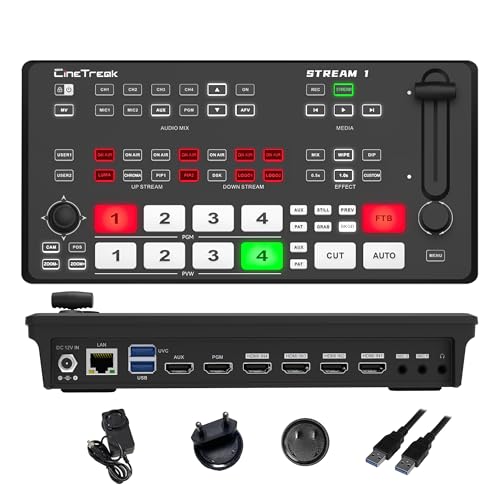
Best for Advanced Formats – Stream 1
The Stream 1 is a feature-heavy video switcher for streamers who need four HDMI inputs, PTZ camera control, dual-destination streaming, recording, playback, and both landscape and portrait production. It also adds chroma and luma keying, picture-in-picture layouts, and an AUX channel for media playback.
Best For: PTZ-based productions, portrait livestreams, virtual studios, and operators who need flexible routing and streaming features.
Pros:
- Offers four HDMI inputs, an AUX media channel, PGM and AUX outputs, and USB connectivity.
- Supports PTZ control for up to four cameras through VISCA, including wireless IP control.
- Can stream to two destinations simultaneously using RTMPS.
- Includes recording, playback, PIP layouts, keying, and more than 30 transition effects.
Cons:
- The extensive feature set may create a steeper learning curve than a basic switcher.
- Only HDMI 1 and HDMI 2 are specified as supporting 4K input.
- Advanced features such as PTZ and dual streaming require a more involved setup.
The Stream 1 is a versatile option for streamers producing in multiple orientations or managing PTZ cameras, especially when integrated routing and two-destination streaming are priorities.
Best Budget-Friendly Starter – FEELWORLD LIVEPRO L1 V1
The FEELWORLD LIVEPRO L1 V1 is a compact video switcher for streamers who want real-time four-camera switching without a complicated setup. Its HDMI inputs, USB 3.0 webcam-style output, multiview monitoring, and software-based remote operation make it practical for solo creators.
Best For: Single-person livestreams, beginner multicamera setups, gaming, presentations, and creators using common streaming software.
Pros:
- Provides four HDMI inputs and supports 1080p across its HDMI connections.
- USB 3.0 output connects to a computer as a built-in webcam for streaming software.
- Compact design includes a 2-inch display, multiview monitoring, and real-time transitions.
- Can be operated remotely through the XPOSE software after LAN connection.
Cons:
- It does not list built-in direct internet streaming; a computer is used through the USB output.
- It is designed for 1080p rather than higher-resolution HDMI production.
The LIVEPRO L1 V1 is a sensible starting point for creators who want hands-on multicamera switching and webcam-style computer connectivity in a small, straightforward unit.
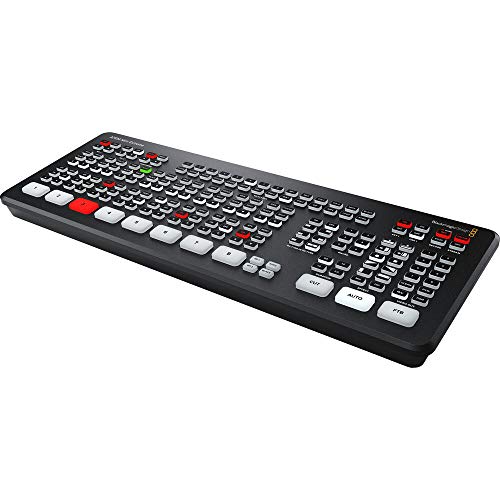
Best for Eight-Source HDMI Production – ATEM Mini Extreme
The Blackmagic Design ATEM Mini Extreme is a video switcher for streamers who need to connect several HDMI cameras or sources at once. With eight HDMI inputs, input re-sync, format conversion, streaming, recording, and multiview support, it is built for larger multi-camera setups.
Best For: Streamers and creators running up to eight HDMI sources who want a dedicated live-production switcher.
Pros:
- Provides eight 10-bit HD HDMI inputs.
- Includes re-sync and frame-rate/format conversion on all inputs.
- Supports streaming, recording, and multiview production workflows.
- Offers two HDMI outputs for monitoring or production use.
Cons:
- Does not provide the 4K input features found on some newer switchers.
- Its eight-input design may be more capability than a small streamer needs.
The ATEM Mini Extreme is a strong choice when input count matters most. It makes sense for established streaming studios, podcasts, and live productions with multiple HDMI sources, while smaller setups may not need all eight connections.
Best All-in-One Streaming Control – GoStream Deck HDMI Pro
The Osee GoStream Deck is a video switcher for streamers who want camera switching, audio control, recording, and direct streaming in one unit. It combines four HDMI inputs with Ethernet streaming, USB connectivity, SD recording, multiview outputs, and hands-on controls.
Best For: Streamers producing podcasts, meetings, events, worship services, or multi-camera broadcasts without relying entirely on a computer.
Pros:
- Connects four HDMI sources and two HDMI displays.
- Can stream to three platforms through Ethernet or output over USB to software such as OBS or vMix.
- Provides audio inputs, headphone monitoring, effects, and physical audio controls.
- Supports SD or USB SSD recording, media playback, graphics overlays, chroma key, and picture-in-picture.
Cons:
- Its four HDMI inputs offer less expansion than eight-input models.
- Advanced features may require time to learn and configure.
The GoStream Deck stands out as a flexible production hub for creators who want fewer separate devices. Its combination of direct streaming, audio processing, recording, and overlay tools makes it particularly practical for organized multi-camera productions.
Best 4K and PTZ Control – FoMaKo KC602
The FoMaKo KC602 is a video switcher for streamers who want 4K input handling, PTZ camera control, and professional audio features. Its four HDMI inputs, 5.5-inch display, USB streaming, RTMP/RTMPS support, and direct recording make it suited to more advanced live-production systems.
Best For: Streamers and event producers using 4K sources, multiple PTZ cameras, and higher-control audio setups.
Pros:
- Accepts 4K at 60 fps and provides 1080p at 60 fps output.
- Controls up to four PTZ cameras with presets and a T-bar.
- Supports USB UVC streaming, RTMP/RTMPS streaming, and direct USB recording.
- Includes XLR audio, 48V phantom power, EQ, monitoring, and multiple audio inputs.
Cons:
- 1080p output means the primary output resolution is lower than its 4K input capability.
- The extensive controls and audio options may be excessive for basic streaming.
The KC602 is the most production-focused option in this group. Its 4K input support, PTZ presets, built-in display, and advanced audio routing are valuable for churches, studios, and events, especially when hands-on control is a priority.
Most Versatile – GoStream Duet
Osee GoStream Duet Multiple Camera SDI and HDMI Live Stream Video Mixer Switcher
Check Price On AmazonThe Osee GoStream Duet is a flexible video switcher for streamers who need to combine SDI, HDMI, USB-C, NDI HX, and media playback sources. It supports portrait and landscape workflows, multiple control options, and direct streaming to up to three platforms.
Best For: Multi-camera creators, event producers, and streamers working with mixed SDI and HDMI equipment.
Pros:
- Accepts four SDI, four HDMI, USB-C, NDI HX, and playback sources.
- Offers chroma key, luma key, pattern key, PIP, DSK, and several transition types.
- Can stream directly over Ethernet or through a smartphone hotspot, or connect with OBS and vMix.
Cons:
- The broad feature set may require more setup than a basic HDMI switcher.
- NDI HX requires the latest firmware to unlock the included license.
Choose the GoStream Duet when input flexibility and direct multi-platform streaming matter more than a minimal control surface. Its mix of professional connections and software control makes it particularly adaptable for evolving setups.
Best Built-In Monitoring – Mixer Plus
The CINETREAK Mixer Plus is a compact video switcher for streamers who want four HDMI inputs and an integrated 4-inch display. Its multiview screen, scene presets, transitions, and production tools help simplify multi-camera switching without requiring a separate monitor for basic source checks.
Best For: Portable multi-camera streaming, online classes, events, YouTube productions, OBS, and Zoom workflows.
Pros:
- Built-in 4-inch display provides multiview monitoring with program, preview, and audio meters.
- Supports four HDMI inputs, zero-latency switching, 30 transition effects, and four scene presets.
- Includes PTZ control over IP plus chroma key, luma key, PIP, DSK, and logo overlay tools.
Cons:
- Its four HDMI inputs do not provide SDI connectivity.
- The built-in display is useful for monitoring but remains compact at 4 inches.
The Mixer Plus is a practical choice when portability and on-device monitoring are priorities. Its configurable AUX output also makes it useful for productions that need separate program, preview, clean, or multiview feeds.
Best for Direct Streaming – GoStream Deck Pro
The Osee GoStream Deck Pro is a video switcher for streamers who want hardware-based production and streaming in one compact unit. It combines four HDMI inputs, a USB camera input, SD card recording, USB output, direct Ethernet streaming, and physical macro buttons for fast control.
Best For: Churches, schools, live event teams, and creators who want direct streaming with local recording backup.
Pros:
- Streams to up to three platforms through its built-in hardware encoder and Ethernet connection.
- Records high-bitrate MP4 video to an SD card while streaming through USB.
- Provides four HDMI inputs, an additional USB camera input, multisource layouts, and eight assignable macro buttons.
Cons:
- Its input configuration is more limited than a switcher with SDI connectivity.
- Advanced workflows may require configuring the macro buttons and network controls.
The GoStream Deck Pro stands out for reducing dependence on an external computer during live production. It is a strong fit for teams that value tactile switching, direct Ethernet delivery, and simultaneous recording for backup.
How We Picked the Best Video Switcher for Streamers
We evaluated these switchers against the needs of real-world creators: camera compatibility, switching workflow, streaming and recording options, audio handling, monitoring, portability, and room for future expansion. HDMI models are often the easiest fit for mirrorless cameras, webcams, and consumer video gear, while SDI support can be valuable for longer cable runs and more demanding installations.
We also considered whether each unit is better suited to a solo creator, podcast host, classroom operator, mobile production kit, or multicamera event. Features such as chroma key, picture-in-picture, PTZ control, dual streaming, built-in displays, and multiview monitoring can make a major difference depending on how you produce.
Quick Comparison
| Best For | Prioritize | Why It Matters |
|---|---|---|
| Gaming and simple live streams | HDMI inputs, easy control, USB output | Reduces setup complexity and works with common cameras and computers. |
| Podcasts and interviews | Integrated audio, scene control, recording | Keeps voices, cameras, and transitions manageable from one device. |
| Events and installations | SDI, reliable outputs, long cable support | Better suited to larger spaces and professional production layouts. |
| Travel and classes | Built-in screen, compact design, direct streaming | Makes monitoring and operation easier away from a studio. |
Key Buying Factors for a Video Switcher for Streamers
Inputs and Signal Compatibility
Count the cameras and other sources you plan to connect now, then leave at least one input for expansion. Check HDMI version, supported resolutions, frame rates, HDCP behavior, and whether the switcher accepts the exact signals your cameras produce. SDI may be preferable when sources are positioned far from the control desk.
Output, Streaming, and Recording
Look for the outputs your workflow requires, such as USB webcam output, HDMI program output, network streaming, or onboard recording. A 4K input does not always mean 4K streaming or recording, so verify the supported output resolution separately. Direct RTMP support can simplify streaming, while computer-based encoding offers more platform and software flexibility.
Monitoring and Production Tools
A multiview display helps you preview sources before taking them live. Built-in screens are convenient for mobile work, but an external monitor may provide a larger and more comfortable view. Picture-in-picture, keying, transitions, stills, playback, and PTZ control are useful only if they match your production style.
Audio and Operation
For interviews and podcasts, prioritize dependable audio inputs, mixing controls, headphone monitoring, and synchronization options. Physical buttons are often faster during a live show, while software control can provide deeper configuration. Consider whether one person can operate the system without losing sight of the stream.
Who Should Buy Which Video Switcher for Streamers?
Choose a compact HDMI switcher if you are a solo streamer using a few nearby cameras and want a straightforward setup. A model with more HDMI inputs is a better fit for growing channels, multicamera gaming, online classes, and small events. Podcast creators should favor integrated audio and scene controls, while mobile producers may benefit most from a built-in monitor and direct streaming.
Choose an SDI-capable unit when cameras are spread across a venue or when your existing production equipment already uses SDI. For advanced events, prioritize redundant workflows, reliable monitoring, multiple outputs, and enough input headroom rather than buying solely for the highest advertised resolution. Finally, confirm power requirements, included cables, software compatibility, and platform support before ordering.