A good microphone isolation shield can help reduce nearby reflections and make recordings sound more focused, especially in untreated rooms. The right design depends on your microphone, stand setup, available space, and recording environment.
We compared 10 microphone isolation shields across panel construction, portability, mounting options, included accessories, and suitability for vocals, podcasts, streaming, and home-studio work.
Best 10 Microphone Isolation Shield Picks for 2026
Best All-in-One Setup
Dmsky Foldable Isolation Shield Kit

- Triple-layer design helps reduce reflections and ambient noise
- Includes pop filter, adapters, and storage tray
- Tabletop or stand-mounted use with adjustable tripod
Best For: Complete podcast, singing, and home-recording setups
Best Flexible Panel Design

- Configurable three- or five-panel arrangement
- Foldable design supports storage and transport
- Desktop or microphone-stand installation
Best For: Adjustable vocal recording and podcast environments
Best Heavy-Duty Stand

- Height adjusts from 42 to 71.5 inches
- Weighted tripod base supports stable positioning
- Includes 3/8-inch and 5/8-inch thread adapters
Best For: Standing or seated voiceover, streaming, and studio recording
Best Compact Shield
Moukey Foldable Reflection Filter

- Foldable three-panel design saves storage space
- Triple-layer construction helps reduce reflections
- Compatible with 3/8-inch and 5/8-inch mounts
Best For: Compact desktop recording, streaming, singing, and broadcasting
Best Compact Microphone Isolation Shield

- Five-sided foam design reduces noise and reflections
- Double-layer filter controls plosives and wind interference
- Lightweight 120 g design fits several stand types
Best For: Portable desktop recording, streaming, and compatible 50–75 mm microphones
Best Adjustable Microphone Isolation Shield
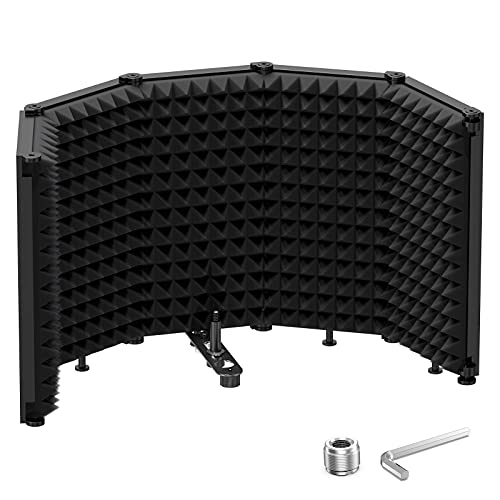
- Five-panel design supports flexible angle adjustment
- Acoustic foam helps reduce reflections and interference
- Includes 3/8-to-5/8 conversion nuts for many stands
Best For: Home studios, podcasts, and adjustable tabletop or stand-mounted setups
Best Lightweight Microphone Isolation Shield

- Five-layer foam reduces reflections and ambient noise
- Double-layer filter helps manage plosives and wind
- Very light 58 g design for portable recording
Best For: Creators using compatible 43–68 mm USB or condenser microphones
Best Overall
Moukey Foldable Triple-Insulation Shield

- Triple-layer design helps reduce reflections and ambient sound.
- Five panels adjust through 180 degrees.
- Includes a stable, height-adjustable desktop stand.
Best For: Desktop recording setups needing stability and flexible positioning.
Best Versatility

- Five panels fold for easier transport.
- Supports desktop or microphone-stand installation.
- Includes a 3/8-to-5/8-inch adapter.
Best For: Flexible home setups that alternate between desk and stand mounting.
Best Compact Pick
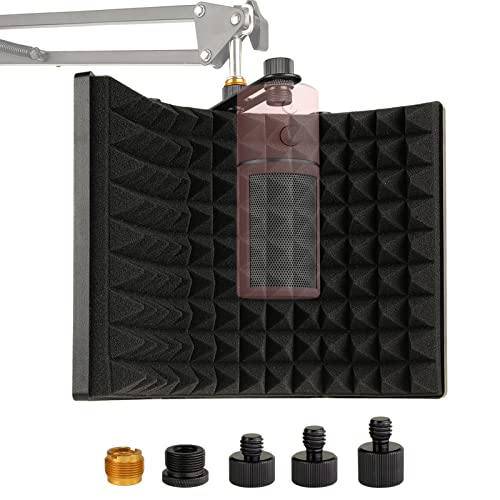
- Lightweight, foldable design suits portable recording.
- Supports tabletop or many microphone-arm setups.
- Includes multiple 3/8-inch and 5/8-inch adapters.
Best For: Space-conscious users recording with compatible microphones.
Best All-in-One Setup – Dmsky Foldable Isolation Shield Kit
If you want a microphone isolation shield with a stand and pop filter included, the Dmsky kit is a versatile option for home recording. Its triple-layer design combines reflection, filtering, and absorption, while the adjustable tripod setup supports both seated and standing sessions.
Best For: Creators who want a complete microphone isolation shield setup for podcasts, singing, broadcasting, and studio recording.
Pros:
- Triple sound-insulation design helps reduce reflections and ambient noise.
- Includes a pop filter, storage tray, and 3/8-inch to 5/8-inch adapter.
- Can be used on a tabletop or mounted to a microphone stand.
- Five foldable panels allow 180-degree angle adjustment.
Cons:
- The full stand setup may take more space than a shield-only solution.
- Stand height details vary between the listed overall height and adjustment range.
The Dmsky stands out when convenience matters as much as isolation. It is a practical choice for buyers who prefer a height-adjustable stand and useful accessories in one package.
Best Flexible Panel Design – XTUGA MIS02 Recording Shield
The XTUGA MIS02 is a flexible microphone isolation shield built around configurable folding panels. Its reflective and high-density foam layers help reduce interference, while the adjustable arch can be arranged to suit different recording environments.
Best For: Vocalists, podcasters, and home studios that need a portable shield with adjustable panel coverage.
Pros:
- Can be configured as a three-panel or five-panel design.
- Foldable end panels and adjustable arch support flexible positioning.
- Three-layer construction helps reduce sound interference from the sides and rear.
- Suitable for desktop placement or microphone-stand mounting.
Cons:
- The product notes identify the body material as plastic.
- A separate microphone stand may be needed depending on your setup.
The MIS02 is a good fit when adjustability is a priority. Its multi-panel format gives you more control over coverage than a fixed, compact reflection filter.
Best Heavy-Duty Stand – Steel Tripod Isolation Shield
This microphone isolation shield combines a foldable acoustic screen with a height-adjustable steel stand. It is designed for stable positioning, with a weighted tripod base, clamp, and adapters for common 3/8-inch and 5/8-inch microphone connections.
Best For: Users who need a sturdy, adjustable microphone isolation shield for seated or standing recording, streaming, and voiceover work.
Pros:
- High-density acoustic foam and layered construction help reduce reflections.
- Steel stand adjusts from 42 to 71.5 inches.
- Weighted triple-leg base is designed to reduce tipping.
- Includes universal thread adapters and a two-year warranty.
Cons:
- At 8.1 pounds, it is heavier than several shield-focused options.
- The microphone is not included.
- Its larger stand may be excessive for compact desktop recording.
The main advantage here is stability. Choose this model if you regularly change recording height or want a more substantial stand for active studio and broadcast sessions.
Best Compact Shield – Moukey Foldable Reflection Filter
The Moukey is a compact microphone isolation shield for buyers who want a straightforward reflection filter without a full floor stand. Its three-panel foldable design uses reflective, filtering, and absorbing layers and can be mounted to a desktop or compatible microphone stand.
Best For: Streamers, singers, and home recordists seeking a portable, easy-to-store microphone isolation shield.
Pros:
- Triple-layer construction helps reduce audio reflections and ambient sound.
- Three-panel design folds for storage and transport.
- Adjustable arch allows positioning for different recording conditions.
- Included 3/8-inch and 5/8-inch conversion nuts support broad compatibility.
Cons:
- It does not include a dedicated floor stand.
- The smaller three-panel format provides less coverage than larger multi-panel shields.
The Moukey is a sensible choice for compact workstations and mobile setups. Its light, foldable construction and universal mounting hardware make it easy to add isolation without committing to a large stand system.
Best Compact Microphone Isolation Shield – Penypeal Isolation Ball
If you want a portable microphone isolation shield for vocals, streaming, or basic recording, the Penypeal isolation ball combines foam absorption with a double-layer filter. Its compact design is made for microphones measuring 50–75 mm in diameter.
Best For: Portable desktop recording, live streaming, and users who need a lightweight shield for compatible XLR or USB microphones.
Pros:
- Five-sided sealed foam design helps reduce noise and reflections from multiple directions.
- Double-layer filter helps control plosives, wind interference, and saliva spray.
- At 120 g, it is easy to move between desktop stands, tripods, boom arms, and floor stands.
Cons:
- Compatibility is limited to microphones with a removable jacket diameter of 50–75 mm.
- Its handheld-style isolation-ball design may provide less flexibility than a larger adjustable studio shield.
The Penypeal is a practical choice when portability and microphone protection matter. Confirm your microphone diameter before buying, especially if you use a USB model with a nonstandard housing.
Best Adjustable Microphone Isolation Shield – Moukey Five-Side Reflector
The Moukey five-panel microphone isolation shield is suited to recording setups that need a larger, adjustable acoustic barrier. Its reflective, filtering, and absorbing layers are designed to reduce ambient sound and audio-wave bounce during vocals, podcasts, and broadcasts.
Best For: Home studios, podcast desks, and recording spaces that benefit from a foldable shield with adjustable positioning.
Pros:
- High-density acoustic foam helps reduce reflections and interference.
- Five foldable panels allow angle adjustment and easier storage or transport.
- Includes 3/8-to-5/8 conversion nuts for compatibility with many microphone stands and shock mounts.
- ABS rear construction and non-slip support points promote stability.
Cons:
- At 3.26 pounds, it is substantially heavier than the portable isolation-ball designs in this roundup.
- The larger folded shield requires more storage space than a compact microphone cover.
The Moukey stands out for users who want positioning control rather than minimum size. Its foldable five-panel structure makes it a versatile option for a tabletop or stand-mounted recording station.
Best Lightweight Microphone Isolation Shield – NEEWER MS012 Isolation Ball
The NEEWER MS012 is a lightweight microphone isolation shield and pop filter for portable vocal recording. Its five-layer foam construction is designed to reduce reflections, ambient noise, plosives, wind interference, and saliva exposure around compatible microphones.
Best For: Content creators, podcasters, and musicians who need a compact shield for 43–68 mm USB or condenser microphones.
Pros:
- Five-layer acoustic foam helps absorb unwanted sound from multiple directions.
- Double-layer filtering helps control plosives, wind noise, and saliva splatter.
- Weighs about 58 g, making it convenient to carry between recording locations.
- Works with desktop stands, small tripods, boom arms, and floor stands.
Cons:
- It fits microphones measuring 43–68 mm, so larger microphones may not be compatible.
- The compact foam cover offers less panel-size adjustability than a folding studio shield.
For creators prioritizing portability, the MS012 is an easy-to-carry solution with substantial filtering and foam absorption. Check the supplied diameter range and use the removable insert to help stabilize your microphone.
Best Overall – Moukey Foldable Triple-Insulation Shield
The Moukey is a substantial microphone isolation shield for home studios, podcasts, singing, and broadcasting. Its reflective, filtering, and absorbing layers are designed to reduce ambient sound and audio reflections, while the included adjustable table stand makes positioning straightforward.
Best For: Desktop recording setups that need a stable, height-adjustable shield with a built-in stand.
Pros:
- Triple-layer construction combines reflection, filtering, and absorption.
- Five foldable panels adjust through 180 degrees for flexible positioning.
- Includes a sturdy 2.2-pound base and a height-adjustable stand.
- Foam-padded base helps prevent sliding during use.
Cons:
- At 5.48 pounds, it is heavier than the other listed options.
- The table stand reaches 22.8 inches, so placement space matters.
Choose this microphone isolation shield if stability and a complete desktop setup matter more than minimal weight. Its foldable design still allows transport and angle adjustments when needed.
Best Versatility – CAHAYA Foldable Mic Shield
The CAHAYA microphone isolation shield balances portability with flexible installation. Its five-panel design folds for transport, and the feet screws support desktop use or mounting to a microphone stand, making it a practical choice for changing recording locations.
Best For: Home recordists who want one shield for both tabletop and microphone-stand setups.
Pros:
- Reflective, filtering, and thick foam absorption layers help reduce reflections.
- Five panels fold into a more portable size and adjust to different angles.
- Includes a 3/8-to-5/8-inch metal adapter for broad stand compatibility.
- ABS exterior, steel bottom structure, and premium screws are designed for long-term use.
Cons:
- No dedicated table stand is included; desktop placement uses the shield’s feet screws.
- Its 2.44-pound weight may provide less heft than a heavier stand-based setup.
For buyers switching between a desk and a microphone stand, this microphone isolation shield offers useful mounting flexibility without giving up foldability. The included adapter also simplifies compatibility with common stands.
Best Compact Pick – Portable 3-Panel Mic Shield
This compact microphone isolation shield is designed for portable vocal and instrument recording. Its high-density absorbing foam helps reduce reflections, while the lightweight three-panel construction can mount on a tabletop or most microphone arms using the included adapters.
Best For: Mobile or space-conscious home recording setups using a compatible condenser microphone.
Pros:
- Lightweight 0.35-kilogram design is easy to carry.
- Foldable panels allow angle adjustments and compact storage.
- Works on a tabletop or with many microphone arm stands.
- Includes multiple 3/8-inch and 5/8-inch adapters plus a lifetime warranty claim.
Cons:
- It is not suitable for the Blue Yeti microphone.
- The compact shield is only 7.48 inches tall and 10.8 inches wide.
- The listed maximum weight recommendation is 9.6 ounces.
This microphone isolation shield is the most travel-friendly option in the group, especially where desk space and carrying weight are priorities. Verify microphone size and mounting requirements before buying.
How We Picked the Best Microphone Isolation Shield Options
We focused on the features that most affect everyday recording performance and setup convenience. Our comparison considered the number and density of acoustic panels, foldability, mounting compatibility, included pop filters or stands, threaded adapters, portability, and overall practicality for home studios.
A Microphone Isolation Shield cannot soundproof a room or eliminate all background noise. Instead, it helps absorb or redirect some reflections close to the microphone, which can reduce boxiness and improve vocal clarity when positioned correctly.
Quick Comparison
- Best for a complete starter setup: Choose a model bundled with a tripod or table stand and pop filter.
- Best for flexible mounting: Look for 3/8-inch and 5/8-inch threaded adapters.
- Best for portability: Foldable three- or five-panel shields are easier to store and transport.
- Best for close vocal recording: Consider a deeper, multi-sided design that surrounds more of the microphone.
- Best for compact desks: A smaller shield or isolation-ball design may take up less space.
Key Buying Factors for a Microphone Isolation Shield
Panel Design and Acoustic Material
More panels can provide broader coverage around the microphone, while dense foam or other sound-absorbing materials may help limit nearby reflections. However, coverage is only useful if the shield fits your microphone and leaves enough room for proper positioning.
Mounting Compatibility
Check whether the shield attaches to a boom arm, microphone stand, or included desktop stand. Thread sizes matter: models supporting both 3/8-inch and 5/8-inch connections offer greater compatibility with common stands and adapters.
Size, Weight, and Stability
Larger shields may provide more coverage but can place extra weight on a boom arm or small stand. For desktop recording, prioritize a stable base and a setup that does not tip when the microphone is mounted.
Included Accessories
A pop filter, tripod, table stand, windscreen, or mounting hardware can make a noticeable difference in value. Confirm what is included before buying, since similarly named shields may be sold as standalone accessories or complete kits.
Room and Recording Position
Use the shield behind and around the microphone according to its design, then keep the microphone at a consistent distance from your mouth. Treating nearby walls, curtains, or other reflective surfaces can improve results further.
Who Should Buy Which Microphone Isolation Shield?
Home vocalists and voice-over artists should favor a dense, multi-panel shield with a pop filter and stable mounting hardware. Podcasters and streamers may prefer a compact foldable model that fits beside a monitor and can be stored easily. Traveling creators should choose a lightweight portable design with simple assembly. First-time buyers will usually get the easiest setup from a bundle that includes a stand, adapter, and pop filter.
Before ordering, measure your microphone, stand, and desk area. The best Microphone Isolation Shield is the one that fits your equipment securely, stays stable during recording, and provides enough coverage without obstructing your preferred position.