Connecting four speaker pairs to one amplifier can make whole-home audio far more convenient, but the wrong selector can overload an amplifier or make zone control frustrating. The best speaker selector switches for 4 pairs provide clear on/off control while matching your system’s power and impedance requirements.
This roundup compares 10 four-zone models, including straightforward passive switchers and options with independent volume controls. Use the buying guide below to narrow your choices by installation, listening habits, and amplifier compatibility.
Best 10 Speaker Selector Switches for 4 Pairs Picks for 2026
Best Value
Monoprice 4-Channel Speaker Selector

- Four-zone audio distribution
- Up to 140W per channel without protection
- Optional impedance protection circuit
Best For: Budget-minded multi-room audio setups
Best Built

- 100W per channel RMS handling
- Bridged-amplifier-compatible ground paths
- Rugged metal chassis with protection
Best For: Durable, installation-focused audio systems
Best Simple Setup
Pyle PSS4 4-Channel Speaker Selector

- A/B/C/D four-pair selection
- Push-button plug-and-play operation
- 100W per channel at 8 ohms minimum
Best For: Straightforward home stereo speaker switching
Best With Volume Control
OSD Audio RSVC4 4-Zone Selector

- Four pairs or zones
- Individual volume knobs per zone
- Supports simultaneous multi-zone playback
Best For: Multi-zone systems needing local volume adjustment
Best All-Around 4-Zone Control
PROZOR 4-Zone Speaker Selector

- Independent A/B/C/D zone buttons
- Supports 4–16Ω speakers up to 150W RMS per channel
- Passive design with AMP master switch
Best For: Multi-room passive speaker systems
Best for Protected Multi-Room Audio
Russound SS-4.2 Speaker Selector

- Impedance matching and automatic overload protection
- Designed for high-power amplifiers
- Includes bypass mode and room labels
Best For: More structured whole-home audio installations
Best Simple Budget Switcher
A ADWITS 4-Channel Speaker Switcher

- Selects two or four speaker pairs
- Heavy-duty rocker switches
- Rated up to 200W RMS maximum
Best For: Basic manual stereo speaker switching
Flexible Multi-Zone Control
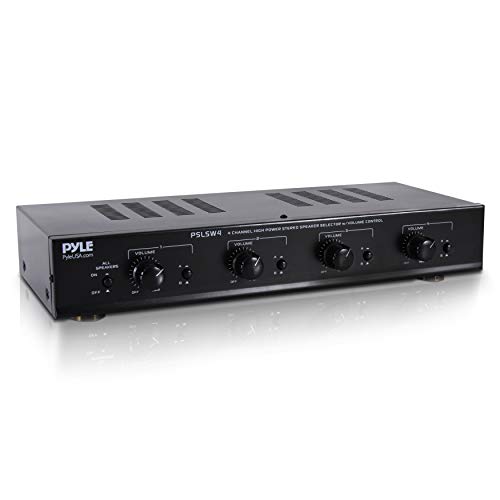
- Controls four speaker pairs
- Independent zone volume knobs
- Overload protection included
Best For: Home theater systems needing separate zone volume control
Protected Zone Switching
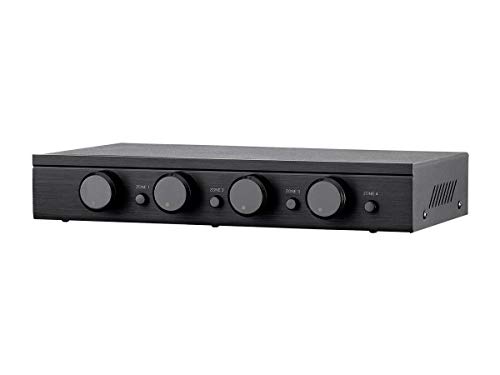
- Four zones with volume controls
- Automatic impedance protection
- 100 watts per channel continuous
Best For: Multi-zone systems prioritizing amplifier protection
Simple Passive Switching
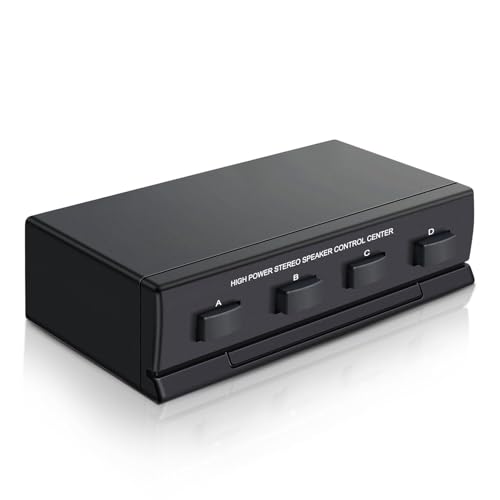
- Four-zone A/B/C/D control
- No external power required
- Tool-free spring clip connectors
Best For: Straightforward passive multi-room speaker setups
Best Value – Monoprice 4-Channel Speaker Selector
If you need speaker selector switches for 4 pairs at a fair price, the Monoprice 4-Channel Speaker Selector is a straightforward option for distributing audio to up to four zones. Its optional impedance protection circuit helps keep the load seen by the amplifier consistent as speakers are added.
Best For: Home theater and whole-home audio setups needing four speaker zones with selectable impedance protection.
Pros:
- Supports up to four separate speaker zones.
- Handles up to 70 watts per channel with protection enabled or 140 watts without it.
- Optional impedance protection helps protect the amplifier from changing speaker loads.
Cons:
- Maximum power depends on whether the protection circuit is enabled.
- The supplied notes do not mention individual zone volume controls.
Choose this model when flexible zone distribution and a budget-conscious design matter more than built-in volume adjustment. Confirm your amplifier and speaker requirements before using the higher power rating without protection.
Best Built – Niles SS-4 Speaker Selector
The Niles SS-4 is a sturdy choice among speaker selector switches for 4 pairs, with a protection circuit, separate left and right ground paths, and connectors that accept speaker wire up to 14 gauge. It is designed for systems where installation details and amplifier compatibility deserve careful attention.
Best For: Home theaters, sound systems, and public-address installations requiring rugged construction and compatibility with bridged amplifiers.
Pros:
- Handles up to 100 watts per channel RMS.
- Separate left and right ground paths support bridged amplifier designs.
- Removable screwless connectors accommodate up to 14-gauge wire.
- Includes a protection circuit and adhesive-backed room labels.
Cons:
- Requires an amplifier compatible with a 4-ohm load.
- Heavier than the other listed options at 2.6 pounds.
- The supplied notes do not mention individual zone volume controls.
Its metal chassis, stable non-skid feet, and amplifier protection make the SS-4 a practical installation-oriented selector. Check the amplifier’s load compatibility before connecting multiple speaker pairs.
Best Simple Setup – Pyle PSS4 4-Channel Speaker Selector
The Pyle PSS4 provides a simple way to manage speaker selector switches for 4 pairs, using push-button A/B/C/D operation to connect up to four speaker pairs to a stereo system. It accepts speaker wire up to 14 gauge and is rated for systems with a minimum 8-ohm impedance.
Best For: Users wanting plug-and-play four-pair speaker selection with uncomplicated push-button controls.
Pros:
- Connects up to four separate speaker pairs.
- Push-button operation makes source distribution straightforward.
- Accepts speaker wires up to 14 gauge.
- Handles 100 watts per channel with speaker systems rated at a minimum 8 ohms.
Cons:
- Requires speakers with a minimum 8-ohm impedance.
- The supplied notes do not mention an impedance protection circuit.
- The supplied notes do not mention individual volume controls.
The PSS4 is a sensible pick for basic four-pair switching when ease of use is the priority. Verify that your connected speakers meet the stated 8-ohm minimum before installation.
Best With Volume Control – OSD Audio RSVC4 4-Zone Selector
The OSD Audio RSVC4 stands out among speaker selector switches for 4 pairs by combining four-zone selection with an individual volume knob for each zone. It can play one pair, several pairs, or all four pairs simultaneously, while its resistor-based design is intended to help protect compatible amplifiers.
Best For: Residential or commercial background-music systems needing per-zone volume adjustment and flexible four-pair operation.
Pros:
- Controls four speaker pairs or zones.
- Provides individual volume control for each zone.
- Supports one, several, or all four pairs simultaneously.
- Designed for low-ohm amplifiers rated at 2 x 80W RMS.
Cons:
- Its stated amplifier compatibility is limited to 2 x 80W RMS low-ohm amplifiers.
- At 4.3 pounds, it is relatively heavy for a compact selector.
- More controls may be unnecessary for a simple on/off speaker distribution setup.
Choose the RSVC4 when independent zone volume is as important as selecting speaker pairs. Its compact metal construction suits tabletops, cabinets, and equipment racks, but amplifier compatibility should be confirmed first.
Best All-Around 4-Zone Control – PROZOR 4-Zone Speaker Selector
The PROZOR is a practical choice among speaker selector switches for 4 pairs when you want one amplifier or receiver to manage four separate listening zones. Independent A/B/C/D buttons, an AMP master switch, and passive operation make it straightforward for multi-room audio setups.
Best For: Homes, patios, shops, or studios needing independent control of up to four pairs of passive speakers.
Pros:
- Supports four speaker pairs with independent zone buttons.
- Works with 4–16Ω passive speakers and up to 150W RMS per channel.
- Requires no external power and includes an AMP master switch.
- Metal housing and anti-slip feet support stable placement.
Cons:
- It is designed for passive speakers, not powered speaker systems.
- Volume must be controlled from the connected amplifier.
With its long-distance wiring support and simple zone controls, the PROZOR offers a flexible, low-complexity way to expand one amplifier across multiple rooms.
Best for Protected Multi-Room Audio – Russound SS-4.2 Speaker Selector
The Russound SS-4.2 is a strong option among speaker selector switches for 4 pairs, particularly for installations where impedance management and amplifier protection are important. It is built for a single-source system and includes individual pair selection with a bypass mode.
Best For: High-quality multi-room installations using high-power amplifiers or remote impedance-matching volume controls.
Pros:
- Provides impedance matching and automatic overload protection.
- Compatible with high-power amplifiers.
- Bypass mode supports direct speaker switching with remote impedance-matching volume controls.
- Brushed aluminum face plates and preprinted room labels add a finished installation feel.
Cons:
- The supplied details identify AC as its power source, so it is less minimal than a passive selector.
- Warranty information requires contacting the seller or manufacturer.
The SS-4.2 stands out for system-protection features and installation-oriented design, making it a better fit for more deliberate whole-home audio setups than bare-bones switching.
Best Simple Budget Switcher – A ADWITS 4-Channel Speaker Switcher
The A ADWITS 4-channel unit is a straightforward choice among speaker selector switches for 4 pairs. It connects two or four speaker pairs to an amplifier’s stereo output, with heavy-duty rocker switches for selecting pairs individually or together.
Best For: Simple stereo systems needing basic manual switching for two or four pairs of speakers.
Pros:
- Can connect and select two or four speaker pairs.
- Each pair can be selected individually or both together.
- Heavy-duty rocker switches provide direct manual control.
- Uses screw terminals for speaker-wire connections.
Cons:
- The supplied specifications list a 200W RMS maximum and 100W switchable rating, so power limits require attention.
- No impedance matching or overload protection is listed in the supplied details.
For shoppers who prioritize uncomplicated switching over added system-management features, this A ADWITS selector provides essential four-zone-style control in a simple black enclosure.
Flexible Multi-Zone Control – Pyle PSLSW4
The Pyle PSLSW4 is a practical choice among speaker selector switches for 4 pairs when you want independent volume adjustment for each connected speaker pair. It supports up to four pairs of 8-ohm speakers and accepts speaker wire through screw-type terminals.
Best For: Home theater and stereo setups needing individual zone volume control.
Pros:
- Controls up to four speaker pairs individually or together.
- Provides independent volume controls for each zone.
- Includes overload protection circuitry and supports up to 100 watts per channel.
- Accepts speaker wire up to 14 AWG through screw terminals.
Cons:
- Designed for 8-ohm speakers, which may limit compatibility with some systems.
- Its tabletop enclosure measures nearly 17 inches wide, so it needs dedicated shelf space.
With zone buttons, separate volume knobs, and a master speaker switch, the PSLSW4 offers hands-on control for multi-room listening. Its overload protection adds reassurance for everyday use within the stated power and impedance limits.
Protected Zone Switching – Monoprice SSVC-4.1
The Monoprice SSVC-4.1 is a strong option among speaker selector switches for 4 pairs for users who want individual zone controls and impedance protection from one amplifier. It handles up to 100 watts per channel continuously and uses heavy-duty screw connectors.
Best For: Multi-zone stereo systems where amplifier protection and flexible speaker selection matter.
Pros:
- Offers individual on/off buttons and volume controls for four zones.
- Automatic impedance protection circuitry helps support safer system operation.
- Supports 100 watts per channel continuous and 200 watts peak power handling.
- Works with 12–18 AWG speaker wire and isolated left/right circuit grounds.
Cons:
- The impedance requirements vary depending on speaker resistance and how many speakers are selected.
- At 6.9 pounds, it is heavier than a basic passive switch box.
The SSVC-4.1 stands out for its combination of zone-by-zone control, volume adjustment, and automatic impedance protection. Check your amplifier and speaker impedance requirements before connecting multiple zones.
Simple Passive Switching – TNP A-1006A
The TNP A-1006A keeps speaker selector switches for 4 pairs straightforward: connect one stereo amplifier to up to four pairs of passive speakers, then use the A/B/C/D controls to select zones. Its passive design requires no external power or adapter.
Best For: Home, office, or multi-room setups that favor simple installation and tool-free connections.
Pros:
- Distributes audio to up to four pairs of passive speakers.
- Requires no external power supply or adapter.
- Spring-loaded connectors allow quick, tool-free wiring.
- All-metal enclosure supports long-term everyday use.
Cons:
- Spring clips accept speaker wire up to 18 gauge, limiting thicker-wire compatibility.
- It is recommended for standard 8-ohm speakers and supports up to 100 watts RMS per channel.
- The supplied notes do not list individual zone volume controls.
The A-1006A is a no-frills selector for switching among four speaker zones from one amplifier. Its passive, plug-and-play design is convenient, provided your speakers and wire fall within the stated specifications.
How We Picked the Best Speaker Selector Switches for 4 Pairs
We focused on selectors designed to connect one amplifier or receiver to up to four speaker pairs. Our comparison emphasizes practical features: independent zone switching, rated power handling, impedance protection, connection style, volume control, and ease of installation. We also considered whether each model is best suited to basic distribution, multi-room listening, or more demanding home audio systems.
Quick Comparison
Basic passive selectors are the simplest and often the most affordable choice when you only need to turn speaker pairs on or off. Models with individual volume controls are better for balancing rooms without repeatedly returning to the amplifier. Impedance-protection circuitry is especially useful when multiple pairs may play simultaneously, although it can affect available amplifier power depending on the design.
| Priority | Look for | Best fit |
|---|---|---|
| Simple zone switching | Independent A/B/C/D buttons | Small home audio systems |
| Room-by-room adjustment | Individual volume controls | Whole-home listening |
| Amplifier protection | Impedance matching or protection | Systems using several zones at once |
| Higher output demands | Conservative RMS power rating | Powerful receivers and larger speakers |
Key Buying Factors for Speaker Selector Switches for 4 Pairs
Power and Impedance Compatibility
Check the selector’s continuous or RMS rating rather than relying only on a maximum figure. Compare it with your amplifier’s output and your speakers’ impedance. If four pairs may operate together, choose a model with appropriate impedance protection or use speakers and amplification designed for multi-zone loads.
Zone Control and Volume Adjustment
Independent A/B/C/D switches let you activate each pair separately. If different rooms need different listening levels, choose a selector with per-zone volume controls. Remember that a passive selector does not create separate music sources; all active zones generally receive the same source.
Connections and Installation
Binding posts or screw terminals are usually more secure and easier to service than basic spring clips, particularly with thicker speaker wire. Confirm that the enclosure fits your cabinet or rack area, and label each zone before connecting cables.
Protection and Everyday Usability
Look for clearly labeled controls, solid switches, and protection features that suit your amplifier. Turn zones off before changing wiring, and never exceed the selector or receiver’s stated limits. A selector is not a substitute for a dedicated multi-zone amplifier when rooms require independent sources or extensive volume control.
Who Should Buy Which Speaker Selector Switches for 4 Pairs?
Choose a basic four-channel switcher if you want affordable, occasional access to multiple speaker pairs. Select a model with impedance protection for a conventional receiver that may drive several zones at once. For whole-home audio, prioritize independent volume controls and clearly separated terminals. If you need different music in different rooms, skip a passive selector and invest in a multi-zone amplifier or networked audio system instead.