The best synthesizers for home studios should fit your music, workspace, and workflow—not just offer the most features. This roundup covers analog, FM, portable, standalone, and controller-based options for producing, practicing, and performing at home.
Whether you want expressive keys, deep sound design, built-in sequencing, or a compact way to sketch ideas, these picks cover a wide range of budgets and production styles.
Best 10 Synthesizers for Home Studios Picks for 2026
Versatile Polyphonic Pick
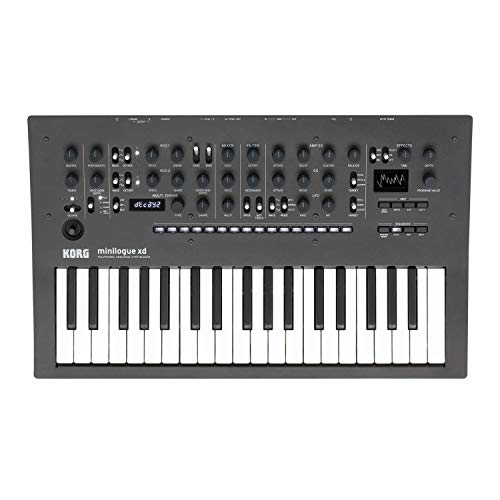
- Four-voice polyphony for chords and layered parts
- Digital multi-engine with noise, VPM, and user slots
- 16-step sequencer, OLED oscilloscope, and 500 programs
Best For: Compact home studios seeking flexible polyphonic sound design
Standalone Production Hub

- Standalone sampling, sequencing, arranging, and performance
- Supports up to 16 stereo audio tracks and 32 plugin instruments
- USB-C, 7-inch touchscreen, 16 pads, and over 20GB of content
Best For: Beatmakers building complete songs without a laptop
Analog Bass Specialist

- Two analog oscillators plus sub-oscillator, noise, and ring modulation
- Two filter types with low-, high-, and band-pass options
- 25 full-size keys, aftertouch, arpeggiator, and step sequencer
Best For: Analog basses, leads, and monophonic sequences
FM Sound-Design Powerhouse

- Six-operator FM synthesis with 64-voice polyphony
- Six synthesis styles, 30 effects, and a deep modulation matrix
- Motion sequencing, randomizer, 500 total program slots, and aftertouch
Best For: Complex digital textures, layered arrangements, and experimental patches
Portable MPC Sampler
Standalone Sampling for Home Studios

- Battery-powered sampler, sequencer, and effects processor
- 16 MPC pads with sample chopping and resampling tools
- Built-in speaker, microphone, storage, and USB-C audio/MIDI
Best For: Portable beatmaking, sampling, and DAWless home-studio workflows
Compact FM Synth
M-VAVE FM-1 for Guitarists and Producers

- 6-operator FM engine with 32 algorithms and 128 presets
- Arpeggiator, 16-step sequencer, 12-voice polyphony, and six effects
- USB-C, Bluetooth MIDI, and 3.5mm MIDI connectivity
Best For: Portable FM synthesis, guitar rigs, and compact production setups
Portable Performance Synth

- Eight synth engines plus sampling and built-in microphone
- Eight instrument tracks and eight auxiliary tracks
- Advanced polyrhythmic sequencing with CV, MIDI, and Bluetooth LE
Best For: Advanced portable production, live performance, and external-hardware control
Best MIDI Controller

- 25 velocity-sensitive mini keys with arpeggiator
- Eight pads and eight assignable control knobs
- Includes software, sounds, and NKS support
Best For: Computer-based beat makers and virtual-instrument users
Best Portable FM Synth

- Six-operator FM engine with 32 algorithms
- Built-in speaker, rechargeable battery, and sequencer
- USB, Bluetooth, and 3.5mm MIDI connectivity
Best For: Portable FM sound design and pattern-based production
Best Pocket Synth

- Iconic vintage sound with three octaves
- Stylus-operated touch-sensitive playing surface
- Built-in speaker, headphone socket, and computer connection
Best For: Beginners and retro sound effects on the go
Versatile Polyphonic Pick – Korg minilogue xd
For home studios needing hands-on polyphony in a compact format, the Korg minilogue xd combines a dual-oscillator analog modeling engine with a digital multi-engine, onboard effects, and sequencing. Its four voices and 37-key layout make it a flexible choice for chords, layered parts, and sound-design work.
Best For: Home-studio producers who want portable polyphonic synthesis, built-in sequencing, and extensive program storage.
Pros:
- Four-voice polyphony with POLY, UNISON, CHORD, and ARP/LATCH modes
- Digital multi-engine adds noise, VPM, and user-slot sound options
- Built-in 16-step polyphonic sequencer and OLED oscilloscope
- Includes 500 programs and a broad selection of onboard effects
Cons:
- Four voices may limit especially dense arrangements
- It is a synthesizer rather than a standalone production workstation
The minilogue xd is a strong all-around option among synthesizers for home studios, especially when you want immediate controls, chord capability, and visual feedback without taking up much space.
Standalone Production Hub – Akai MPC One G2
The Akai Professional MPC One G2 is built for producers who want to sample, sequence, arrange, and perform without a computer. With a 7-inch touchscreen, 16 pressure-sensitive pads, MPC3 OS, and support for audio tracks and plugin instruments, it can serve as the central workstation in a home studio.
Best For: Beatmakers and producers who want standalone song creation, sampling, sequencing, and hybrid DAW integration.
Pros:
- Standalone workflow supports sampling, sequencing, arranging, and performance
- Eight-core processor supports up to 16 stereo audio tracks and 32 plugin instruments per project
- USB-C provides multichannel audio, expanded MIDI, and host/device connectivity
- Includes a 7-inch touchscreen, 16 RGB-backlit pads, and over 20GB of factory content
Cons:
- Its production-center workflow may be more extensive than needed for simple synthesis
- It has pads rather than a conventional keyboard
As a home-studio centerpiece, the MPC One G2 is more than a traditional synthesizer: it is a standalone production environment suited to complete arrangements and hardware-focused workflows.
Analog Bass Specialist – Novation Bass Station II
The Novation Bass Station II focuses on classic analog monosynth duties, with two oscillators, a sub-oscillator, flexible filtering, and hands-on performance controls. For home studios, it is a practical choice for powerful basses, leads, arpeggios, and sequenced monophonic lines.
Best For: Producers who need dedicated analog bass and lead sounds with full-size keys, aftertouch, and MIDI connectivity.
Pros:
- Two analog oscillators, sub-oscillator, noise, and ring modulation offer broad tone shaping
- Classic multimode filter and 24dB Acid Filter cover mellow to aggressive sounds
- Pattern-based arpeggiator and step sequencer support real-time idea generation
- 25 full-size keys, aftertouch, MIDI I/O, USB, and 128 patch slots
Cons:
- Monosynth design is less suited to full chords and broad polyphonic arrangements
- Preset storage includes 64 factory sounds, with additional packs requiring downloads
The Bass Station II earns its place among synthesizers for home studios when bass and lead authority matter most. Its filter options and sequencer add useful variety while preserving a focused analog workflow.
FM Sound-Design Powerhouse – Korg opsix MKII
The Korg opsix MKII brings six-operator FM synthesis together with additional synthesis styles, deep modulation, onboard effects, and 64-voice polyphony. It suits home studios where expressive keys and detailed digital sound design are more important than a minimal control layout.
Best For: Sound designers and keyboard players seeking expansive FM textures, complex modulation, and high polyphony.
Pros:
- True six-operator FM synthesis with 64 voices
- Six synthesis styles include analog modeling, waveshaping, and additive synthesis
- Polyphonic motion sequencing, step sequencing, randomizer, and dice functions encourage experimentation
- Includes 30 effects, a modulation matrix, 250 presets, and 250 user programs
Cons:
- Its extensive synthesis and modulation tools may require more learning than simpler instruments
- It is a digital synthesizer without the analog-focused signal path of a monosynth
For producers exploring synthesizers for home studios, the opsix MKII is a deep digital instrument with enough voices for layered arrangements and enough modulation control for highly customized patches.
Portable MPC Sampler – Standalone Sampling for Home Studios
The Akai Professional MPC Sample is a practical entry point for anyone comparing synthesizers for home studios and wanting a sampling-focused workstation instead of a traditional keyboard synth. Its battery-powered standalone design, built-in speaker and microphone, 16 MPC pads, sequencing tools, and onboard effects support beatmaking without a computer.
Best For: Beginners, beatmakers, finger drummers, DAWless creators, and producers who want portable sampling and sequencing.
Pros:
- Standalone operation with rechargeable battery, speaker, microphone, and microSD storage.
- Intuitive 16-pad MPC workflow with sample chopping, timestretching, repitching, and resampling.
- Over 100 factory kits and 60 internal effects across four FX processors.
- USB-C audio/MIDI, MIDI connectivity, and line inputs and outputs suit home-studio and live setups.
Cons:
- It is primarily a sampler and beatmaking device rather than a conventional synthesizer keyboard.
- MIDI DIN connectivity requires an adapter, which is not included.
For a home studio centered on samples, rhythmic production, and hands-on performance, the MPC Sample offers a compact and accessible workflow. Choose another option here if your priority is deep FM synthesis or a full keyboard-oriented instrument.
Compact FM Synth – M-VAVE FM-1 for Guitarists and Producers
The M-VAVE FM-1 stands out among synthesizers for home studios with its 6-operator FM engine, 128 presets, and compact 27-key silicone keyboard. It combines FM sound design with an arpeggiator, sequencer, effects, and multiple MIDI connections, making it suitable for small production spaces and mobile setups.
Best For: Guitarists, producers, and beginners who want portable DX-style FM sounds with flexible MIDI connectivity.
Pros:
- 6-operator FM synthesis with 32 algorithms and 128 factory presets.
- Includes a 7-mode arpeggiator, 16-step sequencer, and six effects.
- USB-C, Bluetooth BLE MIDI, and 3.5mm MIDI In support integration with DAWs and guitar rigs.
- Very portable, with a rechargeable battery rated for up to 12 hours of play.
Cons:
- The 27-key silicone keyboard may feel less conventional than a standard synth keyboard.
- Its compact format and focus on FM synthesis may not suit players seeking broad analog-style controls.
The FM-1 is a strong fit when portability, FM tones, and connectivity matter more than a traditional keyboard experience. Its built-in sequencing and effects also make it a useful sketching instrument for a compact home studio.
Portable Performance Synth – OP–XY Sequencer and Sampler
The teenage engineering OP–XY is a premium portable option for producers comparing synthesizers for home studios and wanting a combined synth, sampler, sequencer, and performance instrument. Its eight synth engines, eight instrument tracks, eight auxiliary tracks, built-in microphone, speaker, and extensive sequencing features support detailed composition away from a computer.
Best For: Experienced producers and performers who want a highly portable sequencing hub for synths, samplers, effects, and modular gear.
Pros:
- Combines eight synth engines, sampling, sequencing, and performance-focused controls.
- Eight instrument tracks and eight auxiliary tracks provide substantial arrangement and external-control flexibility.
- Independent track lengths and speeds, punch-in effects, step components, polyrhythms, and automation encourage experimental sequencing.
- Built-in microphone, audio input, MIDI over USB-C, Bluetooth LE, CV, and multi-output connectivity support varied setups.
Cons:
- Its advanced workflow may be more than beginners need for straightforward home-studio production.
- The compact portable format may require a learning curve for accessing its extensive sequencing capabilities.
The OP–XY is best viewed as a complete portable production and control center rather than a simple keyboard synthesizer. It is especially compelling for creators who value deep sequencing, sampling, and integration with external hardware.
Best MIDI Controller – MPK Mini MK3
The Akai Professional MPK Mini MK3 is a compact USB MIDI controller for producers seeking synthesizers for home studios without adding a standalone sound engine. Its 25 velocity-sensitive mini keys, pads, knobs, arpeggiator, and included software make it a practical control center for virtual instruments and DAW projects.
Best For: Home-studio beat makers and producers who use virtual synthesizers and software instruments.
Pros:
- Eight MPC-style pads support drum programming, sample triggering, Note Repeat, and Full Level.
- Eight assignable knobs and a four-way joystick provide hands-on control of synths, effects, pitch, and modulation.
- Includes MPC Beats, three virtual instruments, 2GB of sound content, NKS integration, and a Splice trial.
Cons:
- It is a MIDI controller rather than a standalone synthesizer with its own sound engine.
- The 25-key mini keyboard may be less suitable for players wanting a full-size keyboard.
Choose the MPK Mini MK3 if your setup centers on a computer and you want a portable controller with strong beat-making features. It offers broad software control in a compact format, but requires a USB-compatible device and DAW for sound generation.
Best Portable FM Synth – FM-1
The M-VAVE FM-1 is a self-contained digital option for musicians comparing synthesizers for home studios and portable setups. Its six-operator FM engine, built-in speaker, rechargeable battery, sequencer, and multiple MIDI connections support sound design and pattern creation without requiring a permanent desk setup.
Best For: Producers who want portable FM sounds, built-in sequencing, and flexible MIDI connectivity.
Pros:
- Six operators, 32 algorithms, 128 presets, and SYSEX import provide a broad FM-synthesis palette.
- A 16-step sequencer, seven-mode arpeggiator, six effects, and real-time knobs encourage hands-on experimentation.
- Rechargeable battery, built-in speaker, TFT color display, and USB, Bluetooth, and 3.5mm MIDI support improve portability.
Cons:
- Its 27-key silicone keyboard may not feel like a conventional piano-style keybed.
- The supplied notes do not specify detailed computer software compatibility beyond its USB connection.
The FM-1 is a strong fit for creators who value immediate, battery-powered play and classic FM-style tones. It can function as a sound module or MIDI controller, making it more self-contained than a basic computer-only controller.
Best Pocket Synth – Original Stylophone
The Original Stylophone is a tiny, approachable choice for adding character to a collection of synthesizers for home studios. Its touch-sensitive metal playing surface, stylus, vintage analog-style sound, built-in speaker, and headphone socket make it useful for quick ideas, retro textures, and casual portable playing.
Best For: Beginners, sound experimenters, and producers seeking distinctive retro synth textures in a pocket-sized instrument.
Pros:
- Delivers an iconic vintage sound with three octaves and an optional vibrato effect.
- Its stylus-based touch surface is simple to play and offers a distinctive performance approach.
- Battery-powered operation, built-in speaker, headphone output, and computer connectivity support portable use and recording.
Cons:
- It has a highly compact touch-surface layout rather than a conventional keyboard.
- It uses three AA batteries, and the supplied notes describe auxiliary computer connectivity rather than broad MIDI features.
The Stylophone is best viewed as a character instrument rather than the main keyboard in a home studio. Its unusual interface and warm, retro-leaning sound can add playful melodic lines and recognizable texture to recordings.
How We Picked the Best Synthesizers for Home Studios
We compared these instruments by looking at sound-generation methods, keyboard or pad layouts, sequencing and sampling features, connectivity, portability, and how well each option fits a typical home setup. We also considered whether a product works as a complete instrument or depends on a computer, external controller, or additional studio gear.
The list includes true synthesizers, grooveboxes, samplers, and a MIDI controller because home producers often need different tools for writing, arranging, sound design, and performance. Product specifications and intended use matter more than feature count alone.
Quick Comparison
- Best for polyphonic analog sounds: Korg minilogue xd.
- Best for standalone production: Akai MPC One G2.
- Best for bass and leads: Novation Bass Station II.
- Best for FM synthesis: Korg opsix MKII.
- Best for portable sampling: Akai MPC Sample Portable.
- Best for compact experimentation: teenage engineering OP–XY.
- Best for computer-based setups: Akai MPK Mini MK3.
- Best for inexpensive portable FM: M-VAVE FM-1 models.
- Best for simple, tactile fun: Stylophone Original.
Key Buying Factors for Synthesizers for Home Studios
Synthesis and Sound Design
Analog instruments are often appealing for immediate hands-on control and classic bass, lead, and pad sounds. FM instruments can produce precise bells, metallic tones, electric-piano textures, and complex digital timbres, but they may require more programming experience. Grooveboxes and samplers expand the palette with recorded audio, drum sounds, and pattern-based production.
Workflow and Connectivity
Decide whether you want a self-contained instrument or a sound source controlled by a computer. Standalone models are useful when you want to work without a laptop, while a USB MIDI controller can be the most efficient choice if your DAW already supplies instruments. Check USB, MIDI, audio, and synchronization connections before buying.
Size, Controls, and Playability
Compact gear is easier to place in a small room, but smaller keyboards and controls may limit two-handed playing or detailed editing. Consider whether you prefer piano-style keys, pads, a sequencer, knobs, or a highly portable layout. Built-in speakers and batteries are convenient, but they are not essential for a permanent studio setup.
Polyphony and Sequencing
Polyphony determines how many notes can sound simultaneously, while sequencing features affect how easily you can build complete patterns. Monosynths are excellent for focused bass and lead parts; polyphonic synthesizers are more suitable for chords and layered arrangements.
Who Should Buy Which Synthesizers for Home Studios?
Choose the Korg minilogue xd if you want an approachable analog-polyphonic centerpiece. The Novation Bass Station II suits producers focused on basses and leads, while the Korg opsix MKII is better for detailed FM sound design and broader digital textures.
For an all-in-one production workflow, consider the Akai MPC One G2. If portability and sampling are priorities, the Akai MPC Sample Portable or OP–XY may fit better. Choose the MPK Mini MK3 when your computer and DAW are the main studio, and consider an M-VAVE FM-1 or Stylophone for inexpensive, compact experimentation.