Choosing among synthesizers for beginners can be surprisingly difficult. Some models make sound on their own, while others are MIDI controllers that need a computer, tablet, or mobile device to produce instruments.
This roundup includes compact keyboards, pocket synthesizers, and versatile controllers suited to first experiments, music production, practice, and portable sound design. The best choice depends on how you want to learn and where you plan to play.
Best 10 Synthesizers for Beginners Picks for 2026
Best Beginner MIDI Controller

- 25 velocity-sensitive mini keys and eight MPC pads
- Chord, Scale, and Arpeggiator modes
- Software bundle with DAW integration
Best For: Computer-based beat making and virtual synthesizers
Best Compact Analog Experiment

- Compact, lightweight analog ribbon synthesizer
- Simple interface for quick adjustments
- Adds modulation and sound-shaping options
Best For: Portable hands-on analog sound exploration
Best All-in-One Beginner Controller

- 25 velocity-sensitive slim keys
- Pads, encoders, faders, and arpeggiator
- Includes Ableton Live Lite and virtual instruments
Best For: Beginning producers using software instruments and DAWs
Best Small Sound-Design Synth

- Compact metal alloy-steel body
- Lightweight at approximately 0.65 kg
- MIDI connector listed
Best For: Space-conscious desktop sound-design setups
Best All-Around Controller

- 25 velocity-sensitive keys with pads, knobs, and sliders
- Built-in arpeggiator, Chord mode, and DAW integration
- Includes several music-production software tools
Best For: Beginners building a computer-based music setup
Most Experimental Pick
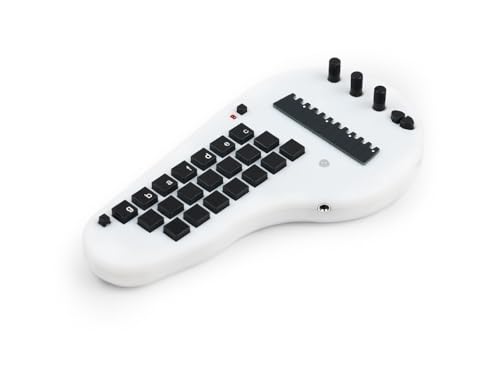
- 21 chord buttons for major, minor, and seventh chords
- 12-section harp touch zone for expressive note triggering
- USB MIDI, presets, and an open-source design
Best For: Beginners exploring unconventional chord-based performance
Best for Beat Making

- 25 velocity-sensitive mini keys and eight MPC-style pads
- Thumbstick, knobs, arpeggiator, and Note Repeat controls
- Includes MPC Beats, instruments, sounds, and Splice access
Best For: Beginners focused on beats and virtual instruments
Best Pocket Pick

- Stylus-controlled three-octave interface
- Built-in speaker and headphone socket
- Compact, battery-powered retro synth
Best For: Portable, playful sound exploration
Best Standalone Controller

- 100+ built-in instrument and drum sounds
- 25 keys, MPC pads, knobs, and arpeggiator
- Works standalone or as a USB MIDI controller
Best For: Beginners learning beats and keyboard production
Best Learning-Focused MIDI Controller

- 16 smart scales for easier melody writing
- Includes 40 teaching courses and DAW software
- USB-C controller for computers and mobile devices
Best For: DAW-based beginners who want guided learning tools
Best Beginner MIDI Controller – Akai MPK Mini IV
The Akai Professional MPK Mini IV is a versatile starting point for anyone shopping for synthesizers for beginners but planning to work primarily inside a computer-based setup. Its 25 velocity-sensitive mini keys, MPC pads, knobs, display, and built-in creative tools provide hands-on control for software instruments, beat making, and songwriting.
Best For: Beginners who want a compact controller for DAWs, virtual synthesizers, beat production, and portable music making.
Pros:
- 25 velocity-sensitive keys with Chord, Scale, and Arpeggiator modes
- Eight MPC pads with velocity and pressure sensitivity plus RGB feedback
- Includes a broad software bundle, DAW integration, Melodics trial, and Splice access
- USB-C connectivity, MIDI Out, and a lightweight portable design
Cons:
- It is a MIDI controller rather than a standalone hardware synthesizer
- Mini keys may feel less spacious than full-size piano-style keys
Choose this model if you want one compact controller that covers keys, pads, sequencing ideas, and software control. It is especially practical for beginners who want room to grow beyond basic synth parts.
Best Compact Analog Experiment – Korg monotron DUO
The Korg monotron DUO is a small analog ribbon synthesizer for beginners who want a simple, tactile way to explore electronic sound. Its compact design and straightforward controls make it suited to quick experimentation, portable setups, and adding modulation-focused textures to a synth collection.
Best For: Beginners interested in compact analog sound exploration and hands-on modulation controls.
Pros:
- Compact and lightweight design for easy transport
- Analog sound profile for direct, characterful experimentation
- Simple interface supports quick sound adjustments
- Provides additional modulation and sound-shaping options
Cons:
- Its compact format offers fewer controls than larger synthesizers
- The supplied notes identify an auxiliary connector rather than broad modern connectivity
The monotron DUO makes sense as an approachable entry into analog-style sound design, particularly if portability and immediacy matter more than extensive sequencing or keyboard features.
Best All-in-One Beginner Controller – Arturia MiniLab 3
The Arturia MiniLab 3 is a friendly choice for beginners seeking synthesizers for beginners through a computer-based music setup. It combines 25 velocity-sensitive keys with pads, encoders, faders, an arpeggiator, a display, and included software, giving new producers practical control without relying entirely on a mouse.
Best For: New producers who want an all-in-one MIDI controller for software instruments, drums, and DAW mixing.
Pros:
- 25 velocity-sensitive slim keys with synth action
- Eight RGB-backed pads, eight rotary encoders, and four faders
- Built-in arpeggiator, display, browsing knob, and touch pitch/modulation controls
- Includes Ableton Live Lite, Analog Lab Intro, and UVI Model D
Cons:
- It requires a computer or compatible software setup for its instruments
- USB connectivity is the primary listed connection, so standalone use is limited
MiniLab 3 is a strong starting point when you want keys, drum pads, software browsing, and basic mixing controls in one approachable unit. Its included software also helps beginners start making sounds quickly.
Best Small Sound-Design Synth – Behringer PHARA-O MINI
The Behringer PHARA-O MINI is a compact synthesizer aimed at users who want a small footprint for sound design. For beginners comparing synthesizers for beginners, its compact metal-bodied format may suit a desktop setup or portable collection, although the supplied information provides limited detail about its controls and synthesis features.
Best For: Beginners seeking a small, portable synth for compact desktop sound-design setups.
Pros:
- Compact dimensions make it suitable for space-conscious setups
- Lightweight design at approximately 0.65 kg
- Metal alloy-steel body construction
- MIDI connector is listed for setup integration
Cons:
- The supplied notes do not specify keys, pads, sequencing, or detailed synthesis controls
- Its compact size may limit hands-on controls compared with larger instruments
This model is worth considering when size and a dedicated compact unit are priorities. Because the available specifications are brief, beginners should confirm the control layout, power requirements, and included features before buying.
Best All-Around Controller – Arturia MiniLab 3
If you’re comparing synthesizers for beginners, the Arturia MiniLab 3 is a practical starting point for computer-based music making. Its 25 velocity-sensitive keys, pads, knobs, sliders, arpeggiator, and included software provide a broad set of controls in a portable format.
Best For: Beginners who want one compact controller for learning keys, triggering drums, and exploring software instruments.
Pros:
- Combines 25 velocity-sensitive keys, eight RGB pads, eight encoders, and four sliders.
- Includes arpeggiator, Hold and Chord modes, plus pitch-bend and modulation touch controls.
- Includes Analog Lab V, Ableton Live Lite, UVI Model D, NI The Gentleman, and additional subscriptions.
- Supports integration with several major DAWs and includes USB-C and MIDI Out.
Cons:
- It is a MIDI controller rather than a standalone synthesizer with built-in sound generation.
- The 25-key layout may feel limited for players who need a wider keyboard.
The MiniLab 3 offers an especially complete beginner package, pairing hands-on controls with a substantial software bundle. Choose it if you want a versatile entry point for computer-based production rather than a self-contained instrument.
Most Experimental Pick – Minichord Synthesizer
Among synthesizers for beginners, the Minichord stands out for its unusual chord-and-touch interface. Instead of relying on a conventional keyboard, it combines chord buttons with a harp-style touch zone, making it an approachable option for experimenting with harmony and expressive note triggering.
Best For: Curious beginners, electronic musicians, and makers interested in chord-based performance and open-source hardware.
Pros:
- Offers 21 chord buttons for selecting major, minor, and seventh chords.
- Its 12-section harp touch zone enables note triggering through touch.
- Includes 12 internal presets and supports custom presets.
- USB MIDI support allows use with music software, while the project is open source.
Cons:
- The unconventional interface may require more experimentation than a traditional keyboard.
- The supplied notes do not indicate included DAW or sound-library software.
- Its plastic construction may be less suitable for users seeking a more traditional instrument feel.
The Minichord is less of a conventional keyboard and more of a creative harmony instrument. It makes sense for beginners who value experimentation, customization, and USB MIDI connectivity over familiar piano-style playing.
Best for Beat Making – Akai MPK Mini MK3
For beginners searching synthesizers for beginners with a strong beat-making focus, the Akai Professional MPK Mini MK3 packs useful production controls into a compact USB controller. Its mini keys, MPC-style pads, arpeggiator, knobs, and bundled software cover both virtual instruments and drum programming.
Best For: New producers who want to combine basic keyboard playing with beat production and plugin control.
Pros:
- Includes 25 velocity-sensitive mini keys and eight backlit MPC-style pads.
- Provides eight assignable knobs plus a four-way thumbstick for pitch and modulation.
- Built-in arpeggiator offers adjustable resolution, range, and modes.
- Includes MPC Beats, three virtual instruments, 2GB of sound content, and two months of Splice.
Cons:
- It uses mini keys and has only 25 of them, which may not suit extended keyboard parts.
- It requires a USB-compatible computer or device and compatible music software for its virtual instruments.
- The supplied warranty is listed as one year.
The MPK Mini MK3 is a straightforward choice if pads and beat controls matter as much as keys. Its bundled production tools also give beginners a useful way to start without immediately assembling a separate software collection.
Best Pocket Pick – Stylophone Original
For beginners seeking synthesizers for beginners that are simple, portable, and immediately playable, the Stylophone offers an approachable introduction to electronic sound. Its touch-sensitive metal surface, stylus control, and distinctive retro tone make it more of a hands-on musical instrument than a traditional keyboard.
Best For: Beginners who want a compact, battery-powered synth for casual playing, experimentation, or travel.
Pros:
- Easy stylus-based playing with three octaves and optional vibrato.
- Compact, pocket-friendly design with a built-in speaker and headphone socket.
- Runs on three AA batteries and offers a warm, vintage analog-style sound.
- Can connect to a computer or other gear through its 3.5mm output.
Cons:
- Its unusual stylus interface may not replace the feel of a conventional keyboard.
- Requires three AA batteries, which are not listed as included.
The Stylophone is a fun starting point for absolute beginners who prioritize simplicity and portability. Choose it for playful sound exploration rather than full-featured music production.
Best Standalone Controller – Akai MPK Mini Play MK3
The Akai MPK Mini Play MK3 is a strong choice among synthesizers for beginners who want keyboard practice, built-in sounds, and beat-making controls in one compact unit. It can operate with internal sounds and a speaker, while also functioning as a USB MIDI controller for computer-based production.
Best For: Beginners who want an all-in-one mini keyboard for learning, beat making, songwriting, and portable use.
Pros:
- Includes over 100 internal drum and instrument sounds, including pianos, pads, and synth leads.
- Features 25 velocity-sensitive keys, eight MPC pads, eight knobs, an arpeggiator, and note repeat.
- Built-in speaker and battery operation support playing away from a computer.
- Includes MPC Beats, AIR Music Tech instruments, Melodics lessons, and other software resources.
Cons:
- Its 25-key layout is compact rather than suitable for extensive piano-style playing.
- Batteries are not included.
With internal sounds and a broad software bundle, the MPK Mini Play MK3 gives beginners room to grow beyond basic keyboard practice. It is especially versatile if you want both standalone play and computer connectivity.
Best Learning-Focused MIDI Controller – Donner DMK 25 Pro
The Donner DMK 25 Pro suits beginners looking for synthesizers for beginners with guided learning features and modern production controls. Its smart scale modes, chord and arpeggio functions, teaching courses, and USB-C connectivity make it a practical controller for working with a computer, phone, or tablet.
Best For: Beginners who plan to make music in a DAW and want scale assistance, lessons, and mobile-device compatibility.
Pros:
- Offers 16 smart scale modes to help create bass lines, melodies, and leads.
- Includes arpeggio, note repeat, chord functions, eight drum pads, and an OLED display.
- Provides 40 teaching courses and four DAW software options.
- USB-C adapter supports use with compatible computers and mobile devices.
Cons:
- Does not produce sound on its own and requires a phone or computer with DAW software.
- Mobile compatibility may require an additional adapter depending on the device interface.
The DMK 25 Pro is a capable entry point for computer-based composition, particularly for users who appreciate guided scales and structured lessons. It is less suitable if you want a standalone synthesizer that plays without external software.
How We Picked These Synthesizers for Beginners
We selected products that offer an approachable entry point into electronic music, prioritizing compact designs, accessible controls, useful keyboard or pad layouts, and features that support experimentation. The list includes both standalone synthesizers and MIDI controllers because beginners often have different goals: some want immediate sound without extra equipment, while others want to learn inside a digital audio workstation.
We also considered portability, connectivity, learning potential, and overall versatility. Features such as arpeggiators, scales, drum pads, onboard speakers, and hands-on knobs can make early practice more engaging, but they should be weighed against setup requirements and long-term usefulness.
Quick Comparison
- Best for computer-based production: Arturia MiniLab 3, Akai MPK Mini IV, or Akai MPK Mini MK3.
- Best for standalone experimentation: Korg monotron DUO, Behringer PHARA-O MINI, or Stylophone.
- Best for portable all-in-one play: Akai MPK Mini Play MK3.
- Best for unusual, hands-on discovery: Minichord Synthesizer.
- Best for budget-friendly features: Donner’s 25-key MIDI controller.
Key Buying Factors for Synthesizers for Beginners
Standalone Sound or MIDI Control
A standalone synthesizer creates sound by itself, making it useful for immediate play and portable practice. A MIDI controller generally produces no sound without connected software or hardware, but it can provide more instruments, recording tools, and upgrade options.
Keyboard Size and Playing Feel
Twenty-five keys are compact and suitable for melodies, bass lines, and basic chords. Mini keys save space but may feel less natural than full-size keys. Ribbon controllers and unusual layouts can be fun, although they may require a longer adjustment period.
Connectivity and Compatibility
Check whether the device uses USB-C, USB, MIDI, or audio connections, and confirm compatibility with your computer, tablet, or phone. If you want a simple setup, onboard speakers, batteries, or a headphone output can be especially valuable.
Controls and Learning Features
Dedicated knobs, drum pads, arpeggiators, scale modes, and presets can help beginners understand rhythm, melody, and sound shaping. More controls are not automatically better; a clear layout is often easier to learn than a crowded panel.
Who Should Buy Which Synthesizers for Beginners?
Choose a compact MIDI keyboard if your main goal is producing songs with software. Arturia’s MiniLab 3 models are strong all-around options for beginners who want a polished workflow, while Akai’s MPK Mini range suits users who value portability and familiar production controls. Donner is worth considering when built-in scale and performance features matter on a tighter budget.
Choose the MPK Mini Play MK3 if you want to practice away from a computer, or select a small standalone synth such as the monotron DUO, PHARA-O MINI, or Stylophone for immediate, tactile sound exploration. The Minichord is best for shoppers seeking a distinctive instrument rather than a conventional keyboard. Before buying, decide whether you need sounds built in; that single choice will narrow the options faster than any specification.