Choosing a wireless headset microphone system can make presentations, classes, and performances sound more polished while keeping your hands free.
Below, we focus on systems that balance range, comfort, setup ease, and day-to-day reliability so you can match the right kit to your use case.
Best 10 Wireless Headset Microphone System Picks for 2026
Dual-Channel UHF Hands-Free Set
TONOR 2-Bodypack Conference Kit

- Two bodypacks plus headset and lapel mics
- Up to 200 ft / 60 m UHF line-of-sight range
- Rechargeable receiver with 15 frequencies per mic
Best For: Two-person speaking and event use
Compact 2.4G Duo System
MICVISTA Two-Person Headset Kit

- Supports two speakers with a single receiver
- Easy pairing and simple plug-and-play setup
- Works with 3.5 mm and 1/4-inch inputs
Best For: Teachers, trainers, and tour guides
Pro UHF Headset System

- Shure BLX receiver with PGA31 cardioid headset mic
- Up to 300 ft / 100 m UHF range
- Bodypack lasts up to 14 hours on AA batteries
Best For: Professional presentations and stage speech
Dual-User 2.4G Value Pick
2-Person Wireless Headset Mic System

- Two headset mics share one receiver
- Up to 160 ft range for moving around
- Works with PA systems and amplifiers
Best For: Two-person teaching, fitness, and karaoke
Pro UHF Split-Use System
Headset, Lapel, and Bodypack UHF System

- 15 tunable UHF frequencies
- Includes headset and lapel mics
- USB-C charging for receiver and bodypack
Best For: Church, weddings, and small live performances
Flexible 2-in-1 Budget Option
UHF Headset and Handheld Mic System
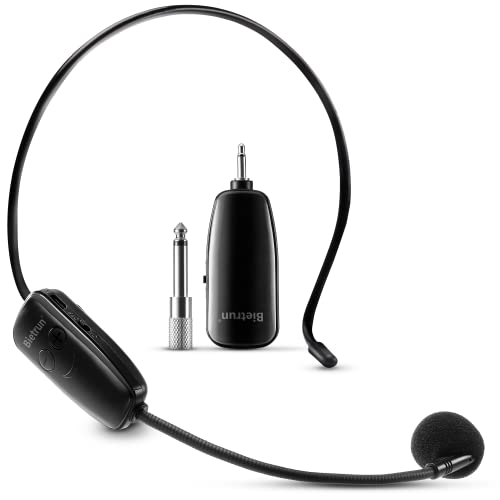
- Converts between headset and handheld modes
- 15 channels and 160 ft range
- USB charging with about 6 hours runtime
Best For: Classes, speaking, and voice amplifier users
Portable UHF Hands-Free Starter
TONOR 1-Bodypack Headset & Lavalier Kit

- Hands-free bodypack with headset and lavalier mics
- Rechargeable receiver with 200ft claimed range
- 15 frequency options for simpler interference management
Best For: Presenters, churches, and instructors needing a flexible starter kit
Metal Multi-Mic Pro Set
Phenyx Pro 1H1B Headset/Lapel System
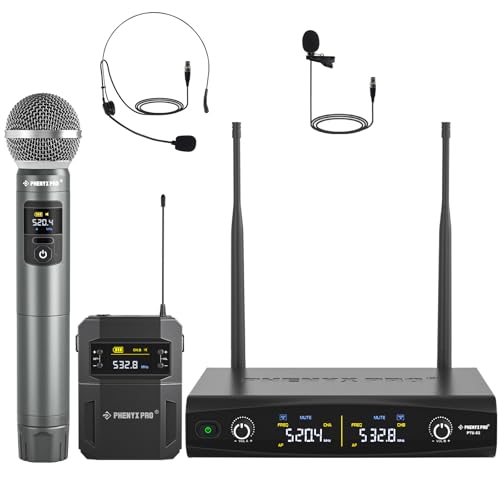
- Metal build with handheld, headset, lapel, and bodypack mics
- 30 tunable frequency groups with up to 3 units at once
- 2 XLR outputs plus mixed 1/4" output for flexible hookups
Best For: Karaoke, church, and events where durability and channel control matter
Four-User UHF Group System
TONOR 4-Pack Headset/Lavalier Kit

- Four-transmitter kit with headset, lavalier, and handheld mics
- 10 channels per unit with claimed support for 40 sets
- Automatic pairing and 200ft quoted operating range
Best For: Groups and venues that need multiple wireless mics in one package
Dual-Channel UHF Hands-Free Set – TONOR 2-Bodypack Conference Kit
This wireless headset microphone system is built for situations where two speakers need reliable hands-free audio and flexible mic options. With UHF transmission, two bodypacks, and both headset and lapel mics included, it works well for churches, meetings, classes, weddings, and other live presentations where movement matters.
Best For: Two-person speaking, worship, and event setups that need headset and lapel flexibility.
Pros:
- Includes 2 bodypacks, 2 headset mics, and 2 lapel mics for flexible use
- UHF system offers up to 200 ft / 60 m line-of-sight range
- Receiver is rechargeable and portable for easier setup
- 15 adjustable frequencies per mic help with channel selection
Cons:
- Bodypacks require 2 AA batteries, which are not included
- Uses a 1/4-inch mic output, so compatibility depends on your sound gear
Overall, this is a practical wireless headset microphone system if you want a two-user package with multiple wearing styles and simple receiver pairing. It is especially appealing for presenters who need freedom of movement without stepping up to a more complex rig.
Compact 2.4G Duo System – MICVISTA Two-Person Headset Kit
If you want a simple wireless headset microphone system for two speakers, this 2.4G kit focuses on easy pairing and basic plug-and-play use. It is designed for voice amplification in classrooms, fitness sessions, tours, and public speaking, with a compact transmitter setup and support for both 3.5 mm and 1/4-inch inputs.
Best For: Teachers, fitness instructors, and guides who need an easy two-person wireless headset setup.
Pros:
- Two-transmitter setup supports two people at the same time
- Easy pairing with simple power-on connection
- Supports both 3.5 mm and 1/4-inch audio jacks
- Lightweight and portable for on-the-go use
Cons:
- Not compatible with PC, iPhone, iPad, Mac, or smartphones
- 2.4G design is not Bluetooth, which may confuse some buyers
For straightforward voice amplification, this system keeps the feature set focused and easy to manage. It makes the most sense when you need a compact wireless headset microphone system for live speaking rather than a broad consumer audio solution.
Pro UHF Headset System – Shure BLX14/P31 H10 Band
For buyers who want a more professional wireless headset microphone system, this Shure package combines a trusted UHF receiver, bodypack transmitter, and cardioid headset mic. It is built for dependable speech pickup, long-range operation, and simple hands-free presentation in venues where reliability matters.
Best For: Presenters, instructors, and performers who want a professional-grade hands-free headset system.
Pros:
- Shure BLX receiver and PGA31 cardioid headset mic in one complete set
- Up to 300 ft / 100 m line-of-sight range
- Bodypack runs up to 14 hours on two AA batteries
- Cardioid headset design helps focus on speech
Cons:
- Uses the H10 frequency band, so regional authorization must be checked
- Single-channel design may be limiting for multi-speaker setups
This is the strongest option here if you want a polished, branded system with clear hands-free speech capture. It is a good fit when you prefer established wireless performance over budget-focused extras.
Auto-Scan Dual UHF Kit – Phenyx Pro PTU-71-2B
This wireless headset microphone system is aimed at users who want stronger channel management and dual-user flexibility. With auto scan, selectable UHF frequencies, and both headset and lapel mics included, it is suited to worship services, meetings, DJ work, and other demanding live environments.
Best For: Events and venues that need dual bodypacks, auto-scan frequency selection, and long-range coverage.
Pros:
- Auto scan helps find the least-interference frequency quickly
- 2 x 100 frequencies and PLL synthesis support flexible operation
- Long line-of-sight range of about 290 to 328 ft
- Includes both headset and lapel microphones for each bodypack
Cons:
- Setup is more involved than basic single-mic systems
- Uses AA batteries for the bodypacks, so ongoing battery management is required
Among these options, this model stands out for interference control and multi-system friendliness. If you need a wireless headset microphone system that can adapt to busier RF environments, it offers a strong feature set.
Dual-User 2.4G Value Pick – 2-Person Wireless Headset Mic System
If you want a wireless headset microphone system for two speakers, this 2.4G setup is built around simple plug-and-play use and hands-free movement. It pairs two headset mics to one receiver, offers up to 160 ft of range, and is aimed at practical use with karaoke speakers, PA systems, amplifiers, teaching, yoga, and live speaking.
Best For: Two-person teaching, presentations, fitness classes, and karaoke setups that need easy setup and cordless freedom.
Pros:
- Supports two users at the same time with one receiver.
- Up to 160 ft transmission range for flexible movement.
- Built-in rechargeable batteries with about 8 hours of runtime.
- Includes a 3.5 mm to 6.35 mm adapter for broader speaker compatibility.
Cons:
- Not supported with iPhone, PC, laptop, or Bluetooth speakers.
- Designed for devices with a microphone jack, not all audio inputs.
- Uses a 2.4G system with only one channel listed in the details.
This is a straightforward option if you mainly need a wireless headset microphone system for dual use and don’t need advanced app or device compatibility. It focuses on convenience, charging speed, and simple pairing rather than premium flexibility.
Pro UHF Split-Use System – Headset, Lapel, and Bodypack UHF System
This wireless headset microphone system is a stronger pick if you want more control, more channels, and more than one mic style in one package. It uses UHF digital circuitry, offers 15 tunable frequencies, and includes both a headset mic and a lapel/lavalier mic with a bodypack transmitter for flexible hands-free use.
Best For: Speakers, church services, weddings, and small performances that need reliable UHF audio with both headset and lapel options.
Pros:
- 15 tunable UHF frequencies help reduce crowding and support multi-set use.
- Includes both headset and lapel/lavalier microphones.
- Bodypack and receiver both charge via USB-C.
- Listed 160–200 ft line-of-sight range for mobile setups.
Cons:
- Requires line-of-sight for best range performance.
- More complex than a basic plug-and-play consumer system.
- Best suited to gear with a 1/4″ TS or supported adapter input.
For buyers who want a more polished wireless headset microphone system, this one stands out for its digital UHF design and included mic options. It is better suited to events and live use than a casual home-only setup.
Flexible 2-in-1 Budget Option – UHF Headset and Handheld Mic System
If you need a wireless headset microphone system for speech, fitness, or voice amplification, this UHF model focuses on simplicity and versatility. It uses a detachable design that can switch between headset and handheld style, supports 15 channels, and is built for devices with a mic jack rather than AUX-only inputs.
Best For: Budget-conscious users who want a headset mic that can also convert to handheld use for classes and speaking.
Pros:
- 2-in-1 detachable design switches between headset and handheld modes.
- Up to 160 ft range with UHF signal stability and anti-jamming features.
- Supports up to 15 channels for multiple-mic setups.
- About 6 hours of battery life with simultaneous USB charging.
Cons:
- Not supported with iPhone, Android phones, MacBooks, laptops, or Bluetooth speakers.
- Only works with mic jack inputs, not AUX jack inputs.
- Sound depends on correct channel switching when using multiple units.
This is a practical low-cost wireless headset microphone system for users who need basic movement freedom and an easy mode change between headset and handheld use. It is best for compatible PA-style gear rather than general consumer electronics.
Portable UHF Hands-Free Starter – TONOR 1-Bodypack Headset & Lavalier Kit
If you want a wireless headset microphone system that keeps setup simple, this TONOR UHF kit is a practical pick. It offers a hands-free bodypack with both headset and lavalier options, a rechargeable receiver, and a quoted 200ft range for speech, worship, teaching, and other live-use situations.
Best For: Presenters, church speakers, and fitness instructors who want a flexible starter system with headset and lavalier options.
Pros:
- Includes a bodypack, headset mic, and lapel mic for hands-free use
- Receiver is rechargeable and portable, with about 6-8 hours of use per charge
- 15 adjustable frequencies help when you need to switch away from interference
- Works with mixers, speakers, karaoke machines, and power amplifiers through 1/4″ output
Cons:
- Requires 2 AA batteries for the bodypack, and they are not included
- Not compatible with Bluetooth, soundbars, TVs, or other receivers
- Must be used with external audio gear; it has no built-in speaker
This is a straightforward wireless headset microphone system for users who need mobility more than advanced features. The rechargeable receiver and multiple mic styles add convenience, but buyers should check compatibility with their PA or mixer before ordering.
Metal Multi-Mic Pro Set – Phenyx Pro 1H1B Headset/Lapel System
This wireless headset microphone system is built for users who want more flexibility and a sturdier feel. The Phenyx Pro set combines a metal receiver and bodypack with headset, lapel, and handheld mic options, plus up to 200ft line-of-sight range and 30 tunable frequency groups.
Best For: Karaoke hosts, churches, and event users who want a durable multi-mic system with strong frequency control.
Pros:
- Metal construction is designed for heavy use and long-term reliability
- Includes handheld, bodypack, headset, and lapel mics for different speaking styles
- 30 tunable frequency groups help reduce interference, with support for up to 3 units at once
- Receiver offers 2 XLR outputs plus 1 mixed 1/4″ output for broad compatibility
Cons:
- Uses AA batteries, so you’ll need to keep spares on hand
- More features and mic options may be more than casual users need
- The system is still limited to the stated 200ft open-space line-of-sight range
For buyers who value build quality and flexible mic choices, this system stands out as a versatile step up. It is especially appealing if you need a wireless headset microphone system that can also handle shared-use scenarios and multiple output connections.
Four-User UHF Group System – TONOR 4-Pack Headset/Lavalier Kit
If you need a wireless headset microphone system for multiple speakers, this TONOR 4-mic kit is built around shared use. It includes two handhelds, two bodypacks, two headset mics, and two lavalier mics, with a quoted 200ft range and 10 channels on each microphone or bodypack.
Best For: Groups, classrooms, church teams, and karaoke setups that need several wireless mics in one package.
Pros:
- Large package includes four transmitters plus headset and lavalier options
- 10 channels on each mic/bodypack support up to 40 simultaneous sets without interference
- Automatic pairing keeps setup quick and easy
- Works with mixers, karaoke machines, amplifiers, and powered speakers via 1/4″ audio cable
Cons:
- Each microphone or bodypack needs 2 AA batteries, which are not included
- Bulkier kit may be more than a solo presenter needs
- Like most systems in this class, it depends on external speakers or a PA
This is the most practical choice in the group if you need coverage for multiple people instead of a single speaker. It gives you the hands-free headset microphone system format along with extra handhelds, making it better suited to group events and rotating presenters.
How We Picked the Best Wireless Headset Microphone System
We looked for a Wireless Headset Microphone System that delivers stable transmission, practical battery life, easy pairing, and enough flexibility for common uses like teaching, church services, fitness instruction, meetings, and small-stage events. We also favored systems with clear documentation, usable range claims, and accessories that help you get started quickly.
Quick Comparison
As you compare options, start with channel count, frequency band, and the number of microphones included. Single-user kits are usually simpler and cheaper, while dual and multi-mic systems are better for co-presenters, instructors, or events where more than one person needs hands-free audio. If you plan to move around a lot, prioritize stronger range and a dependable bodypack design.
Key Buying Factors for a Wireless Headset Microphone System
Compatibility
Check that the receiver connections match your speaker, mixer, PA system, camera adapter, or amplifier. The most versatile systems include multiple output options.
Frequency and Interference
UHF systems often offer better flexibility in crowded environments, while 2.4G models can be easy to use for simple plug-and-play setups. If you work in venues with lots of wireless gear, channel selection matters.
Mic Comfort and Fit
A headset that stays secure and feels comfortable during long sessions is essential. Look for adjustable frames, lightweight materials, and a mic boom that sits consistently near the mouth.
Battery and Runtime
Rechargeable packs reduce operating cost, but runtime should still match your longest session. For touring, classrooms, or worship services, longer battery life can matter more than extra features.
Range and Signal Stability
Manufacturer range claims are only part of the story. Walls, bodies, and wireless congestion can reduce real-world performance, so choose a system with some headroom beyond your normal operating distance.
Who Should Buy Which Wireless Headset Microphone System?
If you need the simplest setup for one speaker, a single-channel Wireless Headset Microphone System is usually the best fit. For teachers, fitness instructors, and co-presenters, dual systems offer more flexibility without much extra complexity. If you want broader versatility for events or mixed use, look for kits that include headset and lavalier options, multiple output adapters, and reliable UHF performance. Budget buyers can focus on value and ease of use, while frequent users should prioritize build quality, clean audio, and dependable signal consistency over the lowest price.