The best wearable metronomes help musicians keep time without competing with an instrument, ensemble, or backing track. Wrist-worn vibration models are especially useful for silent practice, while compact digital metronomes remain practical when you need an audible click and detailed controls.
Our roundup covers both formats, from dedicated vibrating watches to versatile clip-on and handheld options. Use the guide below to compare timing control, comfort, visibility, battery needs, and the features that matter most for your practice routine.
Best 10 Wearable Metronomes Picks for 2026
Best Overall

- Strong vibrations with synchronized LED lights
- App supports presets, accents, and subdivisions
- Wear on wrist, arm, ankle, or optional body strap
Best For: Musicians wanting extensive controls and flexible wearing options
Best Budget-Style Watch
Adjustable Vibrating Metronome Watch

- 40–240 BPM adjustable tempo range
- Supports rock and jazz rhythm patterns
- Adds an exercise mode and detachable strap
Best For: Beginners wanting a simple wearable with fitness use
Best Traditional Alternative

- Visual practice assistance and odd-time support
- Headphone jack and automatic power-off
- Portable, rugged design with play-along patterns
Best For: Players preferring a conventional standalone metronome
Best With LCD Display
Wearable Vibrating Metronome Watch

- LCD display with simple on-device controls
- 40–240 BPM with varied meters and patterns
- Detachable strap plus music and exercise modes
Best For: Users wanting visible settings with tactile timing cues
Reliable Practice Pick

- Approximately 400-hour alkaline battery life
- Large display and louder electronic buzzer
- Tap tempo, timer, and sound-out modes
Best For: Orchestral practice and extended audible rhythm training
Best Wearable Silence

- Silent wrist vibration for discreet practice
- 40–240 BPM with six rhythm styles
- USB rechargeable and app-supported
Best For: Hands-free practice in quiet or shared spaces
Classic-Style Sound Pick

- Mechanical-metronome-inspired digital design
- Eight sounds, including a mechanical sound
- Supports 19 beat patterns
Best For: Traditional-style audible practice with flexible beat patterns
Classic-Style Digital Metronome
Adjustable Tempo Practice Companion

- 40–208 BPM with tap tempo
- 9 rhythms and 10 beat options
- AAA or USB-C power
Best For: Flexible practice across multiple instruments
Headphone-Ready Rechargeable Metronome
Quiet Practice and Live Monitoring
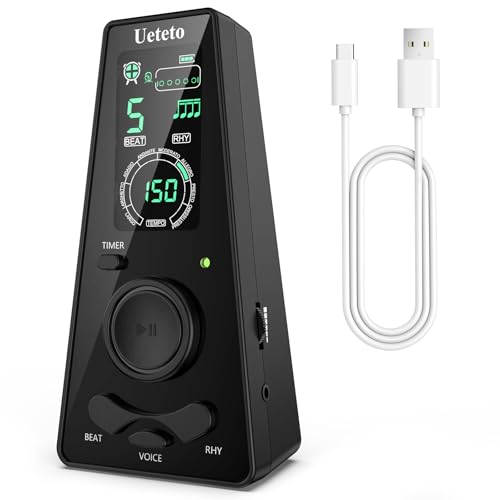
- 3.5mm headphone output
- Up to 16 hours of use
- LCD and flashing LED cues
Best For: Drummers and private practice
Fast-Adjust Rechargeable Metronome
Vocal Counting and Wide BPM Range

- 30–250 BPM scroll-wheel control
- Vocal counting and three tones
- USB-C rechargeable with headphone jack
Best For: Precise tempo work and music lessons
Best Overall – Soundbrenner Pulse
The Soundbrenner Pulse is a feature-rich choice for musicians comparing wearable metronomes. Its strong vibrations, synced LED lights, app controls, and flexible wearing options make it useful when an audible click is distracting or impractical.
Best For: Musicians who want deep customization, strong tactile feedback, and multi-player syncing.
Pros:
- Vibrations are described as seven times stronger than an average smartphone.
- Companion app supports time signatures, subdivisions, accents, presets, setlists, and added sounds.
- Can be worn on the wrist, arm, or ankle, with optional body-strap placement.
- Supports connections for up to five wearables and offers over six hours of metronome playback.
Cons:
- Requires a compatible iOS or Android device for the app-based features.
- It is not water resistant.
- Battery life is listed as 6+ hours, so extended sessions may require recharging.
Among these wearable metronomes, the Pulse stands out for its ecosystem and placement flexibility. It is the strongest fit for players who value app-based control and collaborative practice over a simple standalone design.
Best Budget-Style Watch – Adjustable Vibrating Metronome Watch
This adjustable vibrating metronome watch offers a straightforward wearable approach for musicians who need tactile tempo cues. It covers 40 to 240 BPM, includes selectable beat types and rhythm patterns, and adds an exercise mode for breathing and workout pacing.
Best For: Beginners and active users seeking a compact watch-style metronome with basic tempo flexibility.
Pros:
- Provides vibrations described as five times stronger than traditional devices.
- Tempo range spans 40 to 240 BPM.
- Includes beat types and patterns such as rock and jazz.
- Comes with a USB charging cable and instruction manual.
Cons:
- The supplied notes do not specify included components beyond the watch, cable, and manual.
- Warranty coverage is listed as 90 days.
- Detailed app, connectivity, and battery-runtime information is not provided.
This model focuses on accessible vibration-based timing rather than advanced connectivity. Its exercise mode and detachable strap broaden its use beyond music practice, though the available specifications are less detailed than those of more established options.
Best Traditional Alternative – BOSS Dr. Beat DB-30
The BOSS Dr. Beat DB-30 is a portable conventional metronome rather than one of the fully wearable metronomes in this roundup. It suits musicians who prefer visual practice assistance, play-along patterns, odd-time support, and a rugged standalone unit.
Best For: Players who want a portable, traditional metronome with visual guidance and practice-oriented features.
Pros:
- Provides visual practice assistance.
- Supports odd time signatures.
- Includes a headphone jack and automatic power-off function.
- Portable, ruggedly built, and equipped with play-along patterns.
Cons:
- It is not described as a wearable or vibration-based metronome.
- Its listed dimensions make it less wrist-friendly than watch-style options.
- It uses a battery rather than the USB charging described for the wearable watches.
The DB-30 is a sensible comparison point for shoppers who are not committed to wearable timing. Choose it for conventional visual and audio practice support; choose a vibrating watch when feeling the beat discreetly is the priority.
Best With LCD Display – Wearable Vibrating Metronome Watch
This wearable vibrating metronome watch combines tactile timing with an LCD display and simple controls. It offers 40 to 240 BPM settings, multiple beat types and rhythm patterns, plus an exercise mode for users who want one compact device for music and fitness.
Best For: Musicians who want visible settings alongside vibration cues in a lightweight watch format.
Pros:
- Vibration intensity is described as up to five times that of a regular smartphone.
- Supports 40 to 240 BPM, multiple meters, and patterns including rock, jazz, and classical.
- Includes an exercise mode with adjustable vibration frequency for breathing and endurance work.
- Compact ABS body, detachable silicone strap, LCD display, and USB connector support practical use.
Cons:
- The supplied notes do not provide battery-runtime information.
- No app or wireless connectivity is specified.
- Its 3.35-ounce listed weight may be more noticeable than some lighter wearables.
For shoppers prioritizing on-device visibility, this watch has an advantage over products without a display. It keeps the core wearable metronome functions accessible through the watch itself while adding useful rhythm-pattern and exercise settings.
Reliable Practice Pick – Korg MA-2 Digital Metronome
The Korg MA-2 is a practical alternative to wearable metronomes when you want a clear audible beat, flexible rhythm settings, and long battery life. Its larger display, tap tempo, timer, and sound-out modes make it well suited to structured instrument practice.
Best For: Orchestral musicians and players who prefer a loud, versatile metronome for extended practice sessions.
Pros:
- Up to approximately 400 hours of continuous alkaline-battery operation.
- Louder electronic buzzer and 30% larger display with beat visuals.
- Supports pendulum, full-step, and tap-tempo settings, plus 0–9 beats and eight rhythm types.
- Includes useful timer and sound-out modes.
Cons:
- Uses an audible buzzer rather than silent wrist vibration.
- Requires alkaline batteries instead of USB charging.
Choose the MA-2 if visibility, volume, and dependable battery life matter more to you than hands-free wearable operation. It offers broad rhythm-training flexibility in a compact format.
Best Wearable Silence – Vibration Metronome Watch
This vibration metronome watch is the most direct choice for shoppers seeking wearable metronomes. Its wrist-based, silent-beat design leaves your hands free while offering app-supported controls for tempo, vibration intensity, and display brightness.
Best For: Quiet practice, lessons, rehearsals, performances, and musicians who need a hands-free beat.
Pros:
- Wrist-worn vibration provides a discreet beat without disturbing others.
- Metronome mode covers 40–240 BPM, 0–9 beats, and six rhythm styles.
- Rechargeable USB design supports daily practice and includes a sport mode and time mode.
- App control can adjust vibration intensity and screen brightness.
Cons:
- A slight mechanical sound may occur during vibration.
- Requires charging, and the manufacturer notes it may need charging before first use.
- Includes a 6-month warranty.
If you specifically want wearable metronomes for quiet or mobile practice, this watch offers the clearest feature match. Confirm that its vibration feel and rechargeable setup suit your routine.
Classic-Style Sound Pick – Korg KDM3WH Digital Metronome
The Korg KDM3WH is a compact digital option for players who like the look and sound associated with traditional mechanical metronomes. While it is not wearable, its one-touch operation, readable display, and broad beat-pattern support make it a straightforward practice companion.
Best For: Musicians who want classic metronome styling with digital controls and varied sound options.
Pros:
- Mechanical-metronome-inspired design in a digital unit.
- Offers eight metronome sounds, including a mechanical metronome sound.
- Supports 19 beat patterns for music across different genres.
- Easy one-touch operation and an easily readable display.
Cons:
- Not a wearable or vibration-based metronome.
- Uses a CR2 battery rather than USB charging.
- Its audible sound may be less suitable for quiet shared spaces.
The KDM3WH is a good fit when sound variety and traditional styling matter more than wrist-based convenience. It provides simple operation and extensive beat-pattern support for everyday practice.
Classic-Style Digital Metronome – Adjustable Tempo Practice Companion
This compact electronic metronome is a practical option for musicians who want broad tempo control and multiple beat patterns without giving up a familiar mechanical-metronome look. It suits a wide range of instruments and can work well as a straightforward choice among wearable metronomes alternatives for portable practice.
Best For: Students and multi-instrumentalists who want adjustable tempo, rhythm patterns, and flexible power options.
Pros:
- Offers 40–208 BPM, tap tempo, 10 beat selections, and 9 rhythm patterns.
- Supports instruments including piano, guitar, violin, ukulele, bass, and drums.
- Includes adjustable volume, vocal or electronic beat sounds, timer settings, and a USB-C cable.
- Runs on included AAA batteries or USB-C power.
Cons:
- Uses three AAA batteries, which may be less convenient than a built-in rechargeable battery.
- It is a standalone metronome rather than a wearable device.
Its clear display, loud adjustable sound, and broad settings make it a versatile practice tool. Choose it if you value instrument compatibility and classic styling more than wearable convenience.
Headphone-Ready Rechargeable Metronome – Quiet Practice and Live Monitoring
Ueteto’s digital metronome combines a readable LCD, visual flashing LED, rechargeable power, and headphone output. For shoppers comparing wearable metronomes, it is a compact alternative for practice situations where private monitoring or a visible tempo reference matters.
Best For: Drummers, live performers, and musicians who want headphone monitoring and rechargeable portability.
Pros:
- Provides 40–208 BPM, 9 rhythm patterns, 10 beat settings, volume control, and timers.
- A 3.5mm headphone jack supports silent practice and monitoring.
- Rechargeable battery offers up to 16 hours of continuous use after about two hours of charging.
- LCD display and flashing LED provide both audible and visual tempo cues.
Cons:
- The listed operating range starts at 40 BPM, rather than covering slower tempos.
- It is pocket-sized rather than wearable or body-mounted.
The headphone jack and long claimed battery life give this model a useful edge for drummers and rehearsals. Its center wheel and compact body also make frequent tempo adjustments convenient.
Fast-Adjust Rechargeable Metronome – Vocal Counting and Wide BPM Range
This rechargeable digital metronome emphasizes quick tempo changes, vocal counting, and clear visual feedback. While not a wearable metronome, its compact design and built-in stand make it a practical portable choice for piano, guitar, drum, and violin practice.
Best For: Students and teachers who need vocal counting, precise scroll-wheel adjustment, and multiple sound options.
Pros:
- Covers a broad 30–250 BPM range with smooth scroll-wheel adjustment.
- Offers human vocal counting plus woodblock, electronic, and percussion tones.
- Supports common time signatures including 1/4, 2/4, 3/4, 4/4, 3/8, and 6/8.
- Includes a loud adjustable speaker, headphone jack, USB-C charging, and up to eight hours of use.
Cons:
- Its stated battery life is shorter than some rechargeable alternatives.
- It is a tabletop or stand-mounted unit, not a wearable model.
The scroll wheel and 30–250 BPM range make this the most flexible option here for rapid tempo work. Vocal counting and the large display may be especially helpful when learning new rhythms or reading sheet music.
How We Picked the Best Wearable Metronomes
We evaluated these metronomes around the needs of working musicians and serious practice: dependable tempo adjustment, readable displays, useful beat subdivisions, portability, and ease of operation. For wearable models, we also considered wrist comfort, vibration strength, silent operation, battery or charging requirements, and whether controls are easy to use while playing.
Because a vibrating wrist metronome serves a different purpose from a traditional audible unit, this selection includes both wearable and compact digital designs. That gives you practical alternatives if you want tactile timing, a louder click, or a flexible metronome for multiple instruments.
Quick Comparison
| Type | Best for | Main advantage | Potential trade-off |
|---|---|---|---|
| Vibrating wrist metronome | Silent practice and performance | Private tactile timing | May need frequent charging or battery replacement |
| Handheld digital metronome | General practice and lessons | Clear controls and audible volume | Must be placed nearby |
| Clip-on or compact unit | Portable instrument practice | Small size and convenient placement | Features and speaker size can vary |
Key Buying Factors for Wearable Metronomes
Vibration Strength and Timing
A vibration should be distinct enough to feel while playing, but not so intense that it becomes distracting. Look for adjustable intensity or multiple vibration modes when available. Confirm that the unit supports the tempos and beat patterns you regularly use, including subdivisions or accents if your practice requires them.
Comfort, Fit, and Visibility
Since you may wear the device for an entire session, prioritize a secure, adjustable strap and a light body. A readable screen helps when setting tempo, although many performers will rely mainly on tactile feedback. Consider whether the display remains visible in your practice environment and whether buttons are easy to operate quickly.
Battery, Charging, and Connectivity
Check whether the metronome uses replaceable batteries or USB charging, and look for realistic runtime information. App control can make programming easier, but it also introduces phone dependence and potential connectivity issues. A simple standalone model may be more reliable for lessons, rehearsals, or travel.
Audible Options and Practice Features
If you sometimes need to hear the beat, choose a model with adjustable volume, a clear speaker, headphone support, or an optional sound mode. Tap tempo, tempo memory, beat accents, and visual indicators are useful extras, but they should not replace accurate timing and straightforward controls.
Who Should Buy Which Wearable Metronomes?
Choose a Vibrating Wrist Model If:
You practice in shared spaces, perform with amplified instruments, or need a private pulse that does not interfere with your sound. These are particularly helpful for drummers, guitarists, pianists, and ensemble players who can feel the beat without adding another audible layer.
Choose a Compact Digital Metronome If:
You are learning an instrument, teaching students, or want a reliable all-purpose unit with visible tempo information and an audible click. Handheld models are often the simplest choice for home practice and provide more immediate feedback than vibration alone.
Choose a Feature-Rich Model If:
You work across several instruments or practice advanced rhythms. Prioritize broad tempo ranges, subdivisions, memory settings, tap tempo, and flexible volume controls. Whichever style you choose, the best Wearable Metronomes are the ones you will comfortably use every day and can read, feel, or hear without interrupting your playing.