Choosing among the best synthesizers for recording depends on more than key count or vintage-inspired styling. Your workflow, software setup, need for onboard sounds, and available studio space all affect which instrument will be most useful.
This roundup covers ten practical options, including true synthesizers, MIDI controllers, a sampler, and an audio interface that can help build a flexible recording setup.
Best 10 Synthesizers for Recording Picks for 2026
Premium Analog Powerhouse

- Two wavefolding VCOs plus sub-oscillator
- 32 full-size keys with velocity and aftertouch
- Sequencer, CV, MIDI, and USB-C connectivity
Best For: Expressive mono analog studio parts and performance
Compact DAW Controller

- 25 velocity-sensitive slim keys
- RGB pads, encoders, faders, and display
- Includes Ableton Live Lite and instrument software
Best For: Portable computer-based music production
Acid Bass Specialist

- Fully analog one-VCO bass synthesis
- 128 patterns and Song Mode
- Saturation, delay, MIDI, Sync, and USB-C
Best For: Acid bass lines and pattern-based electronic production
Flexible Hybrid Control

- 37-key controller across three octaves
- CV/Gate and MIDI I/O for external gear
- 64-step sequencer, pads, knobs, and DAW controls
Best For: DAW production with hardware and modular integration
Retro Pocket Pick

- Warm, iconic analog-style retro sound
- Three octaves with optional vibrato
- Pocket-sized and recordable via 3.5mm connection
Best For: Portable retro textures and beginner-friendly experimentation
Standalone Sampling Hub

- Battery-powered sampler with built-in microphone and speaker
- 16 pads plus chopping, resampling, and timestretch tools
- USB-C, line, headphone, MIDI, and microSD support
Best For: Portable beatmaking and DAWless sampling workflows
DAW Control Center
Arturia KeyLab Essential mk3 49

- 49 velocity-sensitive synth-action keys
- Pads, faders, encoders, display, and DAW integration
- Includes Analog Lab V with 2,000 presets
Best For: Computer-based recording with virtual instruments
Best Recording Interface
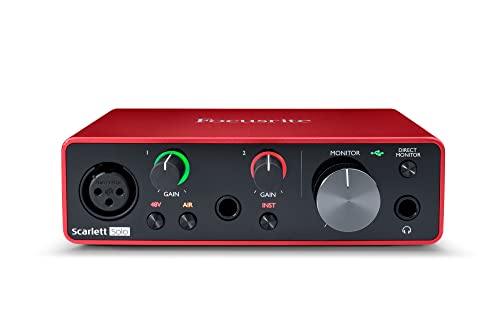
- One mic input and one Hi-Z instrument input
- 24-bit/192kHz recording with Air mode
- Includes recording software and plug-ins
Best For: Home producers recording vocals, instruments, or hardware synths
Best Compact Controller

- 25 velocity-sensitive mini keys with arpeggiator
- Eight MPC pads and eight assignable knobs
- Includes MPC Beats and virtual instruments
Best For: Portable control of software synths and DAW instruments
Best Standalone Mini Controller

- Over 100 built-in drum and instrument sounds
- Built-in speaker and battery-powered operation
- USB MIDI, pads, arpeggiator, and encoder knobs
Best For: Portable songwriting and beat making with or without a computer
Premium Analog Powerhouse – MOOG Messenger
The MOOG Messenger is a strong choice for musicians and producers looking for synthesizers for recording with a classic analog character and hands-on control. Its two wavefolding VCOs, flexible ladder filter, full-size keys, and extensive modulation tools cover basses, leads, and evolving mono parts.
Best For: Studio producers and performers who want a premium, expressive monophonic analog synthesizer.
Pros:
- Two continuously variable-shape oscillators, sync, frequency modulation, and a sub-oscillator provide broad analog sound design.
- 32 velocity- and aftertouch-sensitive full-size keys support expressive performance.
- Integrated 64-step sequencer, arpeggiator, 256 presets, and MIDI, USB-C, and CV connectivity suit studio workflows.
Cons:
- Its monophonic design is intended for one-note parts rather than polyphonic chords.
- The larger full-size-key format may be less convenient for compact setups.
Choose the Messenger when tactile control, expressive keys, and deep analog modulation matter more than a small footprint or polyphony. The sequencer and broad connectivity also make it flexible beyond basic bass duties.
Compact DAW Controller – Arturia MiniLab 3
The Arturia MiniLab 3 is a compact way to add hands-on control to a recording setup. As one of the more accessible synthesizers for recording workflows, it provides a 25-key velocity-sensitive keyboard, pads, encoders, an arpeggiator, and bundled software for controlling computer-based instruments.
Best For: Home producers who primarily use software instruments and need a compact USB MIDI controller.
Pros:
- 25 velocity-sensitive slim keys offer a portable keyboard for melodies, bass lines, and chords.
- Eight RGB pads, eight rotary encoders, faders, and a display provide hands-on DAW and instrument control.
- Includes Ableton Live Lite, Analog Lab Intro, and UVI Model D software.
Cons:
- It is a MIDI controller, not a standalone synthesizer with its own sound engine.
- USB is the listed connection, so hardware-focused setups may need additional MIDI equipment.
The MiniLab 3 makes sense when your sounds come from a computer and you want more immediate control than a mouse provides. Its small footprint and included software make it a practical starting point for a software-based recording rig.
Acid Bass Specialist – Donner Essential B1
The Donner Essential B1 focuses on warm, low-end-focused analog bass lines, making it a practical option among synthesizers for recording acid-style parts. Its straightforward one-VCO, one-VCF, and one-VCA signal path is paired with a step sequencer, pattern memory, saturation, delay, and hardware-friendly connectivity.
Best For: Producers creating classic acid bass lines and pattern-based electronic music.
Pros:
- Fully analog signal path delivers a warm sound with emphasized lower frequencies.
- 128 pattern memories, Song Mode, and an intuitive step sequencer support idea storage and arrangement.
- Built-in analog saturation and delay add character, while USB-C, MIDI, and Sync I/O support integration.
Cons:
- The one-oscillator architecture is more focused than a multi-oscillator synthesizer.
- Its design is centered on bass and acid patterns rather than broad polyphonic duties.
The Essential B1 is a focused choice for producers who want immediate acid sequencing without a complicated interface. Its pattern storage and onboard effects make it particularly useful for building repeatable bass ideas during recording sessions.
Flexible Hybrid Control – Akai MPK Mini Plus
The Akai MPK Mini Plus is a 37-key USB MIDI controller for producers who want to play and record software instruments while also connecting to external hardware. Its CV/Gate and MIDI I/O, pads, knobs, transport controls, and built-in sequencer make it a versatile control center for a recording setup using synthesizers for recording.
Best For: Producers who need a compact controller for DAW instruments, external synthesizers, and modular gear.
Pros:
- 37 keys span three octaves for more comfortable melodic and harmonic performance than smaller controllers.
- CV/Gate and MIDI I/O connect modular gear, sound modules, and synthesizers.
- Built-in 64-step sequencer, MPC pads, transport controls, and assignable knobs support computer-free and DAW-based workflows.
Cons:
- It is a controller and does not generate sounds independently.
- Its plastic construction may feel less substantial than a metal-bodied synthesizer.
The MPK Mini Plus is a good fit when one compact keyboard needs to cover both software and hardware instruments. Its extra octave range and CV/Gate connectivity give it more routing flexibility than a basic USB-only controller.
Retro Pocket Pick – Stylophone Original
The Stylophone Original is a compact, battery-powered option for adding distinctive character to recordings. Its touch-sensitive metal surface, three-octave range, vibrato effect, and warm retro tone make it an approachable choice among synthesizers for recording, especially when portability matters.
Best For: Beginners, experimental producers, and musicians seeking quirky vintage-style sounds in a pocket-sized instrument.
Pros:
- Iconic analog sound with three octaves and optional vibrato.
- Very portable, with a built-in speaker and headphone socket.
- Can connect to a computer or other gear through a 3.5mm stereo cable for recording.
Cons:
- Its compact stylus-based interface is less conventional than a standard keyboard.
- Requires three AA batteries.
- Offers a relatively focused sound and control set compared with larger synthesizers.
The Stylophone is best viewed as a character instrument rather than a full production workstation. It is easy to carry and can bring recognizable retro color to sketches, hooks, and sound-design experiments.
Standalone Sampling Hub – Akai MPC Sample
The Akai MPC Sample is a portable sampler, sequencer, and effects processor for producers who want to record and shape sounds without relying on a computer. With a built-in microphone, speaker, rechargeable battery, microSD storage, sampling tools, and MPC pads, it is a versatile entry in synthesizers for recording and mobile beat production.
Best For: Beatmakers, DAWless creators, live performers, and producers who want hands-on sampling and sequencing away from a computer.
Pros:
- Standalone operation with rechargeable battery, speaker, microphone, and microSD storage.
- Includes 16 responsive pads, sample chopping, timestretching, repitching, resampling, and onboard effects.
- Offers line, headphone, MIDI, sync, and USB-C audio/MIDI connectivity.
- Comes with more than 100 factory kits and 60 effect types.
Cons:
- The MIDI DIN adapter is not included.
- Its sampling-focused workflow may be more than needed for simple recording tasks.
- At nearly 9.3 inches wide, it is portable but less pocketable than a mini instrument.
The MPC Sample stands out when recording means capturing, chopping, processing, and arranging audio in one device. Its standalone design supports quick ideas and mobile sessions while its connectivity lets it fit into a larger studio setup.
DAW Control Center – Arturia KeyLab Essential mk3 49
The Arturia KeyLab Essential mk3 is a 49-key USB MIDI controller designed to connect a computer-based studio with hands-on performance and mixing controls. Its synth-action keys, pads, faders, encoders, display, DAW integration, and included Analog Lab V software make it a practical controller for recording synth parts and arranging virtual instruments.
Best For: Home-studio musicians, songwriters, and producers using Ableton Live, Logic Pro, FL Studio, Cubase, Bitwig Studio, or other compatible software.
Pros:
- Provides 49 velocity-sensitive synth-action keys for expressive playing.
- Includes eight velocity- and pressure-sensitive pads, nine faders, and nine encoders.
- Scale Mode, Chord Mode, and an arpeggiator support composition and beat-making.
- Includes Analog Lab V with 2,000 presets plus additional piano, Loopcloud, and Melodics content.
Cons:
- It is a USB MIDI controller, not a standalone synthesizer with built-in sounds.
- Requires a compatible computer and software for sound generation.
- Its 49-key format takes more desk space than a compact controller.
The KeyLab Essential mk3 is a strong choice when your recording setup is centered on virtual instruments. It combines a playable keyboard with software control and a substantial preset bundle, making it useful for both recording parts and shaping a DAW session.
Best Recording Interface – Scarlett Solo 3rd Gen
For synthesizers for recording, the Focusrite Scarlett Solo 3rd Gen is a practical way to connect a microphone or instrument to a computer. It offers a dedicated Hi-Z input, a mic preamp with switchable Air mode, and recording up to 24-bit/192kHz.
Best For: Home producers recording vocals, guitars, bass, or hardware synthesizers through a computer.
Pros:
- Includes one XLR mic input and one high-headroom instrument input.
- Records at up to 24-bit/192kHz with low-noise balanced outputs.
- Includes Ableton Live Lite, Pro Tools Intro+, Cubase LE, and additional software.
- Compact USB-C interface compatible with Mac, Windows, and iPadOS.
Cons:
- Provides only two input channels, limiting larger multi-device setups.
- It is an audio interface rather than a synthesizer or keyboard controller.
The Solo is a strong foundation for a computer-based recording rig, especially when you need clean conversion and flexible microphone or instrument connectivity without a large interface.
Best Compact Controller – MPK Mini MK3
For synthesizers for recording, the Akai Professional MPK Mini MK3 provides hands-on control of virtual instruments and effects in a compact USB controller. Its mini keys, pads, knobs, joystick, and arpeggiator cover melody, beat-making, and synth programming duties.
Best For: Home-studio producers who want portable control over software synthesizers, drum instruments, and DAW functions.
Pros:
- Includes 25 velocity-sensitive mini keys and a built-in arpeggiator.
- Eight velocity-sensitive MPC pads support drums, samples, and Note Repeat.
- Eight assignable knobs and a four-way thumbstick provide tactile synth control.
- Includes MPC Beats, virtual instruments, sound content, and two months of Splice.
Cons:
- It has 25 mini keys rather than a full-size keyboard.
- It requires a USB-compatible computer or device and does not include built-in sounds.
The MPK Mini MK3 is a versatile entry point for software-based recording setups, combining keyboard performance, pad programming, and parameter control in a travel-friendly design.
Best Standalone Mini Controller – MPK Mini Play MK3
For synthesizers for recording, the Akai Professional MPK Mini Play MK3 stands out by combining USB MIDI control with built-in sounds and a speaker. It can control computer-based instruments while also offering internal drum, piano, and synthesizer sounds for sketching ideas away from the studio.
Best For: Songwriters and beat makers who want portable synth sounds, pads, and keyboard control with or without a computer.
Pros:
- Includes over 100 internal drum and instrument sounds.
- Features a built-in speaker and battery-powered operation for portable use.
- Combines 25 dynamic keys, eight MPC pads, an arpeggiator, and four encoder knobs.
- Includes MPC Beats, AIR Music Tech instruments, Melodics lessons, and two months of Splice.
Cons:
- Batteries are not included.
- The 25-key mini format may be limiting for two-handed or extended performances.
- Its compact controls provide less space than a larger keyboard controller.
The Mini Play MK3 is a flexible choice when portability matters: use its internal sounds for quick ideas, then connect it by USB to expand the setup with computer-based recording tools.
How We Picked These Synthesizers for Recording
We selected products based on how effectively they support real recording workflows, including sound creation, MIDI control, sequencing, sampling, and connection to a computer or audio interface. We also considered portability, hands-on controls, keyboard size, onboard features, software integration, and value for different experience levels.
Because “synthesizer” can describe several types of studio tools, this list includes both self-contained instruments and controllers that generate sounds through a DAW or bundled software. Check each product’s role before buying: a MIDI keyboard does not produce sound on its own, while a hardware synth can often be played without a computer.
Quick Comparison
| Best For | Recommended Type | What to Look For |
|---|---|---|
| Hands-on analog sound design | Monophonic hardware synth | Oscillators, filter, sequencer, and performance controls |
| DAW-based production | MIDI controller | Key feel, pads, knobs, software mapping, and bundled instruments |
| Bass lines and sequencing | Bass synthesizer | Pattern memory, effects, step sequencing, and dedicated controls |
| Portable beat making | Sampler or standalone controller | Battery options, storage, pads, and fast song-building features |
| Recording instruments into a computer | Audio interface | Inputs, preamps, monitoring, drivers, and low-latency performance |
Key Buying Factors for Synthesizers for Recording
Sound Generation and Workflow
Decide whether you want internal synthesis, software instruments, or both. Analog and standalone digital synths provide immediate sound and tactile control. MIDI controllers offer broader software access but require a computer, tablet, or sound module. Sequencers, arpeggiators, pads, and onboard effects can speed up idea generation.
Keyboard Size and Playability
Compact 25-key models are convenient for desks and travel, while 37- and 49-key controllers give melodies, chords, and bass lines more physical room. Consider velocity sensitivity, aftertouch, mini versus full-size keys, and whether you need octave controls for wider parts.
Connectivity and Recording Setup
Confirm the available USB, MIDI, audio, and headphone connections. Hardware synths may need an audio interface to record their sound cleanly. A controller generally sends MIDI rather than audio, so it must be paired with software or external hardware. An interface such as a compact two-channel model can also improve monitoring and microphone or instrument recording.
Space, Budget, and Software
Measure your desk and account for cables, stands, and monitoring equipment. Review included software carefully, since a controller’s value may depend on its virtual instruments and DAW integration. If you are building a first setup, prioritize a reliable workflow over features you are unlikely to use.
Who Should Buy Which Synthesizers for Recording?
Choose a monophonic analog instrument if you want immediate knob-per-function control and distinctive bass or lead sounds. A dedicated bass synth is a better fit for producers who rely on patterns and sequenced low-end parts.
Choose a compact MIDI controller for a small desk, travel rig, or software-focused studio. Move to a 37- or 49-key controller if you regularly play chords with both hands. A sampler or portable production device suits beat makers who want to sketch ideas away from a full DAW setup. Finally, add an audio interface when you need to record hardware audio, vocals, guitars, or other external sources with dependable monitoring.