A great standalone groovebox lets you sketch ideas, build full tracks, and perform without depending on a laptop. That makes it one of the most flexible tools for modern beatmakers.
Below, we focus on portable, self-contained options for different workflows, from sample-based production to synth-driven jamming and live sequencing.
Best 10 Standalone Groovebox Picks for 2026
Portable DAWless Power
Novation Circuit Tracks Standalone Groovebox

- 2 synth tracks, 4 drum tracks, 2 MIDI tracks
- 32-step sequencer with chaining, microtiming, and mutate
- Battery-powered with USB and full-size MIDI I/O
Best For: DAWless producers and live jammers who need portable sequencing
Chord-First Idea Machine
AlphaTheta Chordcat 8-Track Groovebox
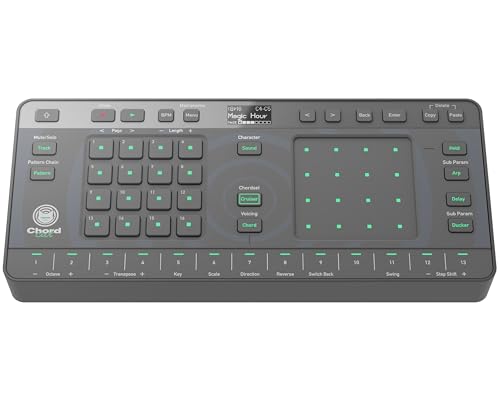
- Up to 110,000 chord combinations
- 4×4 step patterns with one-button directional playback
- 145 presets, 16 drum kits, and MIDI/USB-C connectivity
Best For: Songwriters and beatmakers who build tracks from chord ideas
Portable Sampling Hub
Akai MPC Sample Standalone Portable Sampler

- Battery-powered with built-in speaker and microphone
- 16 pads, 2.4-inch color display, and MPC workflow
- 4 FX processors with 60 effect types for sound shaping
Best For: Beatmakers and sample-based producers who want portable MPC workflow
Bass-and-Drum Creator
Sonicware Liven BASS&BEATS Groove Box

- Wavetable bass engine with PCM drums
- 350+ rhythm sounds and 100+ SE/SFX sounds
- Built-in speakers and 16 control knobs
Best For: Electronic musicians who want bass-led grooves in a compact box
Standalone Sampler Groovebox
Novation Circuit Rhythm Bundle

- Records and resamples samples directly on the unit
- Eight sample tracks for layered beat building
- Includes headphones, 32GB card, and MIDI cables
Best For: Sample-based beatmakers and live performers
FM Groove Box

- Three FM engines for synth-focused beat creation
- 4-track sequencer with 64 steps and 128 patterns
- Battery powered with built-in speaker and MIDI I/O
Best For: Portable FM sequencing and sound design
Pad Controller Groovebox

- 16 backlit pads with up to 48 assignable pad slots
- Adds faders, knobs, and button controls
- Requires DAW software; not a standalone sound source
Best For: DAW users who want a hands-on drum pad controller
Standalone Sampling Power
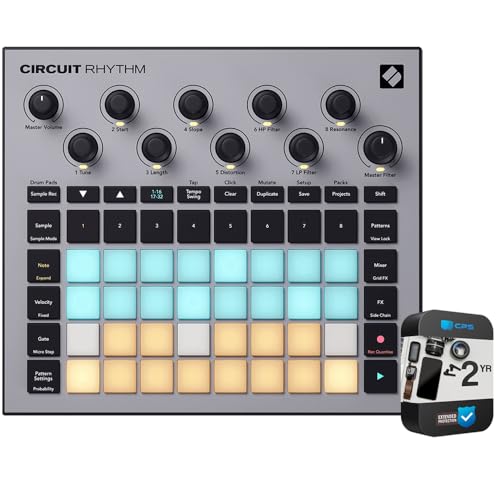
- 8 sample tracks for drums, basslines, and loops
- Standalone recording, slicing, reverse, loop, and resample
- Built-in FX and up to 4 hours of battery life
Best For: portable sample-based beat making and live performance
Clip-Driven MIDI Hub
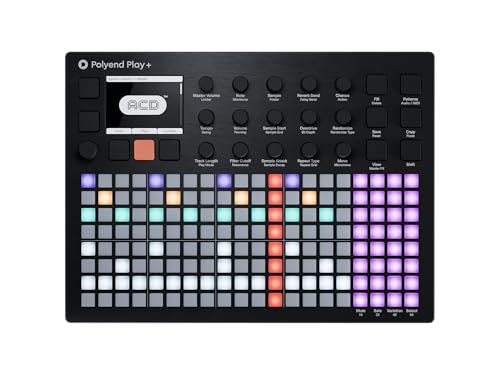
- 16 stereo tracks for layered arrangements
- 5000+ onboard samples with 16GB microSD support
- Backlit pads for performance and clip launching
Best For: track-heavy sequencing and sample-based sketching
Ultra-Portable Beat Machine

- TR-style drums plus TB-303 bass in a compact unit
- 64 user patterns and up to 32 steps per pattern
- USB-C audio/MIDI and about 4.5 hours of battery life
Best For: portable rhythm and bass jamming
Portable DAWless Power – Novation Circuit Tracks Standalone Groovebox
If you want a standalone groovebox that stays quick and hands-on, the Novation Circuit Tracks is built for fast beatmaking and sketching ideas without a computer. It combines two synth tracks, four drum tracks, and two MIDI tracks with a 32-step sequencer, microtiming, probability, and pattern mutate for evolving sequences.
Best For: DAWless producers and performers who want an all-in-one groovebox for drums, synths, and external MIDI gear.
Pros:
- Two polyphonic digital synth tracks plus four drum tracks for layered patterns
- Two dedicated MIDI tracks with notes and CC automation for external gear
- 32-step patterns can chain up to 256 steps per track
- Battery-powered with USB and full-size MIDI I/O for flexible setups
Cons:
- Best suited to pattern-based workflow rather than detailed song editing
- Sample use is limited to loading premade artist samples or your own samples
Overall, Circuit Tracks is a practical standalone groovebox for people who value immediacy, portability, and deep control over compact hardware. Its mix of sequencing tools and MIDI integration makes it easy to build ideas quickly and expand them into a larger rig.
Chord-First Idea Machine – AlphaTheta Chordcat 8-Track Groovebox
The AlphaTheta Chordcat is a standalone groovebox geared toward fast songwriting and chord exploration. It focuses on generating progressions, shaping 4×4 step-sequenced patterns, and moving between 145 sound presets and 16 drum kits to spark ideas quickly.
Best For: Songwriters and beatmakers who want a chord-driven groovebox for fast idea generation.
Pros:
- Generates up to 110,000 chord combinations for progression building
- Directional playback lets you change pattern direction with one button
- 145 sound presets and 16 drum kits cover a wide range of styles
- MIDI OUT/THRU, MIDI IN, and USB-C make external integration straightforward
Cons:
- Its workflow is centered on chords and patterns more than deep sound design
- Fewer tracks than larger groovebox options if you need more layering
Chordcat stands out as a creative standalone groovebox for quickly finding musical starting points. If you like building tracks from chord ideas first and arranging later, its focused feature set should feel fast and inspiring.
Portable Sampling Hub – Akai MPC Sample Standalone Portable Sampler
If your ideal standalone groovebox is more about sampling than synthesis, the Akai MPC Sample keeps the classic MPC workflow in a compact, battery-powered format. It combines a sampler, sequencer, and effects processor with built-in speaker, internal microphone, microSD storage, and hands-on controls for creating anywhere.
Best For: Beatmakers, sample-based producers, and DAWless creators who want a portable MPC-style groovebox.
Pros:
- Complete standalone operation with rechargeable battery and built-in speaker
- Internal microphone and sampling tools make capture and chopping easy
- 16 responsive MPC pads plus a 2.4-inch color display for hands-on control
- Four FX processors and 60 effect types support flexible sound shaping
Cons:
- MIDI DIN requires a separate 1/8-inch to MIDI adapter, which is not included
- More focused on sampling workflow than traditional synth-based grooveboxing
Akai’s MPC Sample is a strong pick if you want a standalone groovebox centered on chopping, sequencing, and finishing beats without a computer. It offers a lot of mobility and enough connectivity to fit into both home and live setups.
Bass-and-Drum Creator – Sonicware Liven BASS&BEATS Groove Box
Sonicware Liven BASS&BEATS [Wavetable Bass Synthesizer and Drum Machine] Groove Box
Check Price On AmazonThe Sonicware Liven BASS&BEATS is a standalone groovebox built around wavetable bass and rhythm creation. With a monophonic bass engine, a PCM drum section, built-in speakers, and physical knobs, it gives you a focused hands-on setup for building bass-heavy patterns and grooves.
Best For: Electronic musicians who want a compact groovebox centered on bass lines and drum programming.
Pros:
- Wavetable bass engine with sub, noise, and monophonic rhythm engine
- 350+ rhythm sounds and 100+ SE/SFX sounds for variation
- 16 physical control knobs for tactile sound shaping
- Built-in speakers plus battery or DC power options for mobility
Cons:
- Only 6 total voices, so it is not built for dense polyphonic arrangements
- Focused sound engine may feel specialized compared with broader grooveboxes
As a standalone groovebox, BASS&BEATS is best when you want bass and drums to drive the track. Its simple, tactile layout and built-in playback make it a good fit for quick groove creation and portable jamming.
Standalone Sampler Groovebox – Novation Circuit Rhythm Bundle
If you want a standalone groovebox for hands-on beat building, the Novation Circuit Rhythm centers on sampling, slicing, sculpting, and resampling. It records samples directly in and lets you build up layered performances across eight sample tracks, with quantized or off-grid groove capture for more flexible sequencing.
Best For: Producers and performers who want a sample-based standalone groovebox with performance FX and bundled accessories.
Pros:
- Records samples directly into the unit for quick beat creation
- Supports slicing, sculpting, and resampling for detailed sample work
- Eight sample tracks help build layered arrangements
- Includes monitor headphones, a 32GB memory card, and MIDI cables
Cons:
- Sampler-focused design may not suit users wanting synth engines
- Bundle extras add value, but the core appeal is still sample-based workflow
The Circuit Rhythm is a strong pick if your priority is a standalone groovebox built around sampling and live performance control. It offers a practical feature set for beatmakers who want to record, reshape, and play back sounds without relying on a computer.
FM Groove Box – Sonicware Liven XFM
Sonicware Liven XFM [FM Synthesizer Groove Box] 3 new FM engines with 4-track sequencer
Check Price On AmazonThe Sonicware Liven XFM is a standalone groovebox built around FM sound design, with three new FM engines and a 4-track sequencer. It also adds 64 steps, 128 patterns, MIDI and sync I/O, plus line input and output, so it can work as a compact self-contained sketchpad or a hub in a small setup.
Best For: Players who want an FM-based standalone groovebox with battery power and built-in monitoring.
Pros:
- Three FM engines provide a focused sound-design approach
- 4-track sequencer with 64 steps and 128 patterns
- Battery operated with a built-in speaker for portable use
- MIDI, sync, and line connections support flexible integration
Cons:
- Sequencer is limited to 4 tracks compared with larger workstations
- FM workflow may appeal more to sound designers than sample-based beatmakers
This is a practical choice if you want a standalone groovebox that emphasizes FM synthesis rather than sampling. The combination of portable power, built-in speaker, and simple sequencing makes it easy to create ideas anywhere.
Pad Controller Groovebox – Donner STARRYPAD Beat Maker
The Donner STARRYPAD is aimed at beat triggering and controller-style production rather than self-contained sound generation, so it fits more as a computer-based standalone groovebox companion. Its 16 backlit pads, adjustable velocity curves, faders, knobs, and button controls give you plenty of hands-on access for triggering drums, samples, effects, and other virtual instruments.
Best For: Producers who want a pad-based groove control surface for DAW-driven beat making.
Pros:
- 16 backlit pads with three banks for up to 48 assignable pads
- Includes 2 faders, 2 knobs, and 3 buttons for extra control
- Class-compliant USB-C connectivity for plug-and-play use
- Includes MIDI in/out, Melodics courses, and Cubase LE software kit
Cons:
- Needs DAW software to make sound and does not operate standalone
- Not a self-contained groovebox or sound engine on its own
If you need tactile pad performance and software integration, the STARRYPAD is a capable controller. Just keep in mind that it depends on external software, so it is best viewed as a groove-making companion rather than a true standalone groovebox.
Standalone Sampling Power – Novation Circuit Rhythm
If you want a standalone groovebox built around sampling and hands-on beat making, the Novation Circuit Rhythm keeps the workflow fast and computer-free. It lets you record, slice, reverse, loop, resample, and play chromatically directly on the hardware, with eight sample tracks and a screenless step sequencer for quick pattern editing and live performance tweaks.
Best For: Producers who want a portable standalone groovebox for sample-based beat creation and live manipulation.
Pros:
- Eight flexible sample tracks for drums, basslines, melodic loops, and chopped samples.
- Standalone sampling features like record, slice, reverse, loop, and resample without a computer.
- Built-in Grid FX and studio-style processing including filters, distortion, sidechain compression, and master effects.
- Portable design with up to four hours of battery life for music-making anywhere.
Cons:
- Battery life is limited to about four hours.
- Screenless workflow may take some adjustment if you prefer a visual display.
- Focused on sampling and drum-machine style production rather than full synth coverage.
As a standalone groovebox, Circuit Rhythm is strongest when you want a compact, performance-friendly sampler that encourages quick ideas and tactile editing. Its combination of portability, effects, and deep sample manipulation makes it a practical pick for mobile beatmakers.
Clip-Driven MIDI Hub – Polyend Play+
The Polyend Play+ is a standalone groovebox aimed at fast sequencing, sampling, and MIDI-based music building. With 16 stereo tracks, backlit performance pads, 5000+ onboard samples, and a 16GB microSD card and slot, it gives you a broad palette for sketching tracks and triggering parts without needing to rely on a laptop.
Best For: Producers who want a standalone groovebox with lots of tracks, onboard samples, and a performance-pad workflow.
Pros:
- 16 stereo tracks provide plenty of room for layered arrangements.
- 5000+ onboard samples plus 16GB microSD storage expand the sound pool.
- Backlit performance pads make finger drumming and clip launching easier to manage.
- USB connectivity and MIDI workstation design support flexible studio integration.
Cons:
- Headphone output is listed at 3.5mm, which may not suit every setup.
- Best suited to workflow-driven production rather than deep synthesis details in the supplied specs.
- Windows/Ableton Live compatibility is mentioned, so some users may want to confirm fit with their system.
For buyers comparing a standalone groovebox, Play+ stands out for its track count and sample-ready workflow. It looks like a strong option when you want a hands-on workstation that can build complete ideas from clips, pads, and onboard content.
Ultra-Portable Beat Machine – Roland AIRA Compact T-8
If you need a standalone groovebox you can carry anywhere, the Roland AIRA Compact T-8 is built for quick rhythm and bass creation in a very small format. It combines TR-style drum sounds with TB-303 bass, a 16-step sequencer, onboard effects, and USB-C audio/MIDI so you can jam, sequence, and record with minimal setup.
Best For: Beatmakers who want an ultra-portable standalone groovebox for drums, bass, and fast idea building.
Pros:
- Pristine TR-808, TR-909, and TR-606-inspired drum sounds plus TB-303 bass.
- TR-REC sequencing with 64 user patterns and up to 32 steps per pattern.
- Performance-friendly tools like probability, step loop, mute, fill, reload, and pattern shift.
- USB-C audio/MIDI, audio and sync I/O, and about 4.5 hours of battery life.
Cons:
- Six drum tracks and bass focus may feel limited for users wanting a broader production palette.
- Battery life is solid but not especially long for extended sessions.
- Its compact size favors quick ideas over a larger hands-on arrangement surface.
The T-8 is a strong standalone groovebox choice when portability and instant rhythm-making matter most. Its classic Roland sound set and deep sequencing tools make it especially appealing for acid lines, beat sketches, and mobile jamming.
How We Picked These Standalone Grooveboxes
We prioritized self-contained instruments that can generate ideas quickly and support real music-making without a computer. The strongest picks balance sequencing depth, sound design, portability, and workflow speed. We also looked for practical features such as battery power, USB connectivity, track count, sampler flexibility, and performance controls.
Quick Comparison of the 10 Picks
Some models lean toward synthesis and pattern-based composition, while others focus on sampling or hybrid production. If you want fast drum programming and basslines, compact rhythm machines are appealing. If you need broader song-building tools, workstation-style devices with more tracks and sample management offer more room to grow. The best choice depends on whether you value immediacy, sound shaping, or full-track arrangement.
Key Buying Factors for a Standalone Groovebox
Sound Engine and Workflow
Choose a unit that matches how you like to create. A synth-focused groovebox works well for original tones and basslines, while a sampler is better if you build tracks from chops, loops, and one-shots. Hybrid devices offer the most flexibility, but they can also take longer to master.
Track Count and Sequencing Depth
Track count matters if you want to layer drums, bass, melodies, and effects without constant bouncing. More tracks can make arranging easier, but a simpler layout may be faster for live jamming. Look for step sequencing, per-track control, and performance-friendly pattern switching.
Portability and Power
If you plan to travel or jam away from the studio, battery operation and compact size become important. A lighter Standalone Groovebox is easier to carry, but make sure it still offers enough controls and connectivity for your needs.
Connectivity and Expansion
MIDI I/O, USB-C, audio outputs, and memory expansion can make a big difference. These features help integrate hardware synths, external controllers, and recording setups, while also protecting your workflow as your studio grows.
Who Should Buy Which Standalone Groovebox?
Beginners should look for an intuitive layout and quick pattern creation. Producers who want to build entire songs on hardware should lean toward more advanced workstation-style options. Beatmakers who value portable sketching may prefer smaller rhythm boxes, while sampling-focused users should prioritize storage, pad response, and editing tools. If you want an all-purpose Standalone Groovebox, choose the model that best matches your preferred balance of immediacy, flexibility, and sound design.