Finding the right looper can make practice faster, songwriting easier, and live performances more flexible. The best single track loop stations balance simple control with dependable sound quality.
Below, we’ve narrowed the field to 10 strong options for players who want clean looping, intuitive workflow, and the right feature set for their setup.
Best 10 Single Track Loop Stations Picks for 2026
Dual-Track Powerhouse

- Dual-track looping with 13 hours of stereo record time
- 32-bit audio quality and onboard rhythm tracks
- USB import/export plus XLR and 1/4-inch inputs
Best For: Players who want advanced looping control and long recording time
Performance-Ready Multi-Mode

- Four looping modes including single, multi, sync, and song
- Stores up to 128 loops with 3+ hours of audio
- USB audio interface and battery-powered portability
Best For: Performers who want flexible modes and easy loop storage
Deep-Control Favorite

- Single-track mode with 13 hours of stereo recording time
- 32-bit processing and a color LCD for clear control
- 16 drum kits, 57 rhythms, MIDI, and USB file support
Best For: Live players who want pro sound quality and deep control
Budget-Friendly Simple Looper

- 9 loops with up to 40 minutes total record time
- Built-in tuner and unlimited overdubs
- USB import/export with simple one-button control
Best For: Beginners and budget-minded players who want easy looping
Compact Pro Looping

- 32-bit audio processing for clean loop quality
- 13 hours of stereo recording with 99 memories
- Compact pedal with MIDI, USB, and rhythm tools
Best For: Players wanting a compact single-track looper with premium sound and modern control
Tabletop Performance Hub
Boss RC-505 Mk2 Tabletop Looper

- Five stereo tracks for layered live looping
- Two XLR mic inputs with phantom power
- Rhythm generator and multiple line inputs
Best For: Live vocalists and performers who want a tabletop looper with multi-track control
Three-Track Stage Workhorse

- Three stereo tracks with dedicated footswitches
- Per-track faders and expression pedal control
- Up to 3 hours recording with 99 memories
Best For: Players who want a floor looper with more layering than a single-track unit
Simple Starter Looper

- User-friendly single track looper with clear mode indicator
- 12 minutes of stereo recording time and undo/redo support
- Works with guitar, bass, keyboards, and stereo instruments
Best For: Beginners and players who want a simple, dependable looping pedal
Bundle-Ready Looper

- RC-1 looper bundled with power adapter, cable, patch cable, and picks
- 24-segment LED indicator shows Rec/Overdub/Play status
- 12 minutes of stereo recording time with stereo I/O
Best For: Players who want a ready-to-use RC-1 bundle with accessories included
Memory-Focused Looper
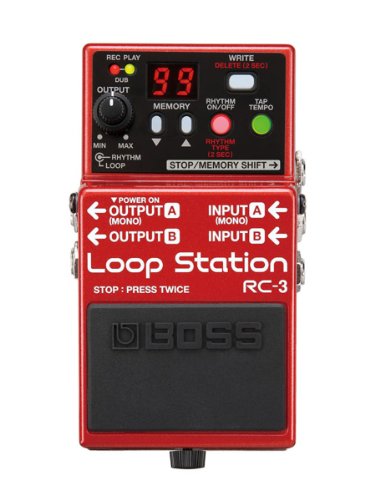
- Up to three hours of stereo recording time
- 99 onboard memories for storing loops
- USB import/export plus real-drum rhythm guide
Best For: Players who need more storage, longer recording time, and rhythm support
Dual-Track Powerhouse – BOSS RC-500 Loop Station
If you want one of the most capable single track loop stations for detailed live layering, the BOSS RC-500 brings studio-grade control in a pedalboard-friendly format. It offers dual-track looping, 32-bit audio quality, 13 hours of stereo record time, and onboard rhythms, so it suits players who need more than a basic looper.
Best For: Guitarists and performers who want deep looping control, long recording capacity, and reliable live rhythm support.
Pros:
- Dual-track looping with 13 hours of stereo record time
- 32-bit audio quality and onboard rhythm tracks
- XLR and 1/4-inch inputs for flexible connections
- USB import/export for loop management
Cons:
- More complex than a simple one-button looper
- Requires an AC adapter rather than battery power
Overall, this is a strong pick if you value advanced control, memory, and performance tools in a loop station that can handle serious live use.
Performance-Ready Multi-Mode – Sheeran Looper +
The Sheeran Looper + stands out among single track loop stations because it adds multiple looping workflows in one pedal, including single, multi, sync, and song modes. With 32-bit audio, a full-color display, RGB loop status ring, and internal storage for up to 128 loops, it is built for players who want flexibility on stage or in the studio.
Best For: Singers, guitarists, and multi-instrument performers who want flexible looping modes and easy loop storage.
Pros:
- Four looping modes: single, multi, sync, and song
- Stores up to 128 loops with over 3 hours of total audio
- USB audio interface for recording and streaming
- Runs on 4 AA batteries for portable use
Cons:
- Dual-track design may be more than a simple beginner looper needs
- Battery-powered operation may not suit every fixed rig
For users who want a loop station that can adapt to different performance styles, this model offers a lot of control without forcing you into a one-mode workflow.
Deep-Control Favorite – BOSS RC-500 Loop Station
The BOSS RC-500 is a serious option for anyone comparing single track loop stations but wanting advanced performance features. It delivers 32-bit AD/DA conversion, 32-bit floating-point processing, 13 hours of stereo recording time in single-track configuration, and a color LCD that helps you track loop status clearly on stage.
Best For: Live players who want pro-level sound quality, rhythm tools, and extensive control options.
Pros:
- Single-track mode with 13 hours of stereo recording time
- 32-bit audio processing for high-quality sound
- 16 drum kits and 57 preset rhythms
- Loop FX, reverse, MIDI, and USB file management
Cons:
- Feature-rich design may be overkill for simple looping
- Requires an external power supply
If you want a looper with serious memory, rhythm, and editing tools, this model is built to support more advanced live looping setups.
Budget-Friendly Simple Looper – LEKATO 9-Loop Pedal
For players shopping single track loop stations on a tighter budget, the LEKATO looper keeps things straightforward with 9 loops, up to 40 minutes total record time, and unlimited overdubs. It also adds a built-in tuner, USB import/export, and a simple one-button control layout that makes basic looping easy to manage.
Best For: Beginner and budget-minded guitar or bass players who want a compact, easy-to-use looper.
Pros:
- 9 loops with up to 40 minutes total recording time
- Built-in tuner for practical everyday use
- USB import/export for WAV loop files
- Simple one-button foot control and volume knob
Cons:
- Shorter total recording time than higher-end loop stations
- Fewer advanced performance features than premium models
This is a strong no-fuss option if you mainly want dependable looping, quick setup, and compact size without paying for extra complexity.
Compact Pro Looping – BOSS RC-5 Loop Station
If you want single track loop stations with modern sound quality in a small pedal format, the BOSS RC-5 is built for practical, high-end looping. It combines 32-bit AD/DA conversion, 32-bit floating-point processing, and up to 13 hours of stereo recording time, making it a strong fit for players who want detailed loops without a large footprint.
Best For: Guitarists and multi-instrumentalists who want a compact single-track looper with premium audio and deep control options.
Pros:
- 32-bit AD/DA and 32-bit floating-point processing for high-quality loop capture and playback
- 13 hours of stereo recording time with 99 phrase memories for storage and recall
- 57 rhythms with A/B variations and 7 drum kits for practice and performance support
- Compact pedalboard-friendly design with USB, MIDI I/O, and external control support
Cons:
- Single-track design may be limiting if you need multiple layered loop tracks
- Advanced features can take time to learn and set up
- Battery or adapter power is required for operation
For players focused on a single track loop station that still feels stage-ready, the RC-5 offers a lot in a small enclosure. Its combination of sound quality, rhythm tools, and control connectivity makes it a flexible choice for both practice and performance.
Tabletop Performance Hub – Boss RC-505 Mk2 Tabletop Looper
Among single track loop stations alternatives, the Boss RC-505 Mk2 stands out for performers who want a tabletop workflow and five stereo tracks to build layered arrangements. With XLR mic inputs, phantom power, stereo line inputs, and a rhythm generator, it is designed for vocalists, beatboxers, and loop-based solo performers who need hands-on control.
Best For: Live performers and vocal loop artists who want a tabletop looper with multiple tracks and microphone support.
Pros:
- Five stereo tracks for building complex live loops and arrangements
- Two XLR mic inputs with phantom power for vocal and mic-based setups
- Two stereo line input pairs for flexible external source connections
- Rhythm generator and physical controls for performance-oriented looping
Cons:
- Larger tabletop format is less portable than a compact pedal looper
- More elaborate setup than a simple single-track unit
- Designed around electric power rather than battery portability
If you need more than a basic looper and want a performance center with serious input options, the RC-505 Mk2 is a strong fit. It favors live creativity and hands-on control over minimalism, which makes it especially useful for on-the-fly arranging.
Three-Track Stage Workhorse – BOSS RC-300 Loop Station
If you’re comparing single track loop stations but realize you need more room to build songs, the BOSS RC-300 offers a more expanded three-track format. It provides dedicated footswitches, individual faders, and up to three hours of internal recording, making it a practical option for players who want a hands-on pedalboard looper with more than one layer.
Best For: Guitarists and solo performers who want a three-track pedal looper with direct foot control and real-time expression.
Pros:
- Three stereo tracks with dedicated footswitches for each track
- Dedicated fader per track for quick level balancing
- Expression pedal support for real-time effects control
- Up to three hours of internal recording and 99 onboard memories
Cons:
- Much larger than a compact single-track looper
- Uses a more involved pedalboard layout than a basic stompbox
- May be more looper than needed if you only want simple looping
The RC-300 is a strong choice when one track isn’t enough but you still want a floor-based workflow. Its dedicated controls make it easy to manage layered performances without leaving the pedalboard.
Simple Starter Looper – BOSS RC-1 Loop Station Pedal
If you want one of the most approachable single track loop stations, the BOSS RC-1 keeps the basics front and center. It records, overdubs, plays back, and lets you undo or redo loops, all in a compact stompbox built for guitar, bass, keyboard, and other stereo sources.
Best For: Players who want a simple, reliable first looper with easy controls and stereo I/O.
Pros:
- Very user-friendly layout with a clear Rec/Overdub/Play loop indicator.
- 12 minutes of stereo recording time is enough for extended phrases and practice loops.
- Works with guitar, bass, keyboards, and other stereo setups.
- Phrase memory is retained even after the pedal is turned off.
Cons:
- No built-in extras like rhythm tracks or onboard memory banks.
- Battery life is limited to about 4.5 hours on the included 9V battery.
The RC-1 is a strong fit if you want a straightforward looping pedal without a steep learning curve. It focuses on core looping functions and keeps the workflow simple, which makes it easy to use in practice, songwriting, or basic live looping.
Bundle-Ready Looper – Boss RC-1 Loop Station
Boss RC-1 Loop Station | Bundle with Gearlux Power Supply, Instrument Cable, Patch Cable, and Picks
Check Price On AmazonThis version of the BOSS RC-1 is a practical pick if you are shopping for single track loop stations and want the pedal plus useful extras in one box. You get the same core looping features as the standard RC-1, including record, overdub, play, and a circular 24-segment LED loop indicator, along with bundled accessories.
Best For: Buyers who want the RC-1 plus a power supply and cables for a ready-to-go setup.
Pros:
- Includes a power adapter, 10ft instrument cable, 6in patch cable, and picks.
- 24-segment circular LED makes loop status easy to read.
- 12 minutes of stereo recording time for longer phrases and ideas.
- Stereo in/out supports stereo instruments and effects.
Cons:
- Still a straightforward looper without the deeper memory features of larger loopers.
- Battery-powered operation is limited to about 4.5 hours on a single 9V battery.
This bundle adds convenience more than new looping capabilities, so it makes sense for players who want to start quickly without buying accessories separately. If you value simple operation and an included power setup, it is an easy choice.
Memory-Focused Looper – BOSS RC-3 Loop Station Pedal
Among single track loop stations, the BOSS RC-3 stands out if you want more storage than a basic looper. It offers up to three hours of stereo recording time, 99 onboard memories, USB connectivity for WAV import/export, and a rhythm guide with real drums.
Best For: Players who want a compact looper with significantly more memory and built-in rhythm support.
Pros:
- Up to three hours of stereo recording time is far beyond a basic looper.
- 99 onboard memories let you store and recall loops.
- USB 2.0 makes it easy to connect to a PC and move WAV audio.
- Rhythm guide with real drums adds a useful practice and jamming feature.
Cons:
- Larger and heavier than the simpler RC-1 style pedals.
- More features can mean a less immediate workflow for players who only need quick looping.
The RC-3 is a better fit when you need a compact pedal but do not want to run out of loop memory quickly. It adds practical storage and rhythm tools while staying in stompbox form, which makes it useful for practice, sketching ideas, and performance.
How We Picked the Best Single Track Loop Stations
We focused on loopers that are easy to use, reliable in real-world playing, and suited to common needs like home practice, rehearsal, and gigging. Priority went to sound quality, loop length, overdub behavior, foot control, and how quickly a player can start and stop recording without breaking the creative flow.
Quick Comparison
At a high level, the most important differences come down to track count, storage time, onboard controls, and whether the unit is better for pedalboard use or tabletop performance. Some Single Track Loop Stations are stripped-down and beginner-friendly, while others add advanced features like rhythm support, memory slots, or extended recording time.
Key Buying Factors for Single Track Loop Stations
Ease of Use
If you want to build loops quickly, choose a model with clear footswitch response, easy overdub control, and simple undo/redo behavior. The less time you spend learning menus, the more time you spend playing.
Sound Quality and Headroom
For clean guitar, bass, or vocal work, look for strong audio conversion and enough headroom to avoid compression or distortion when layering parts. Higher-quality recording matters more if you plan to use the looper for polished performances.
Recording Time and Memory
Longer record time helps if you create extended ambient layers, full-song arrangements, or practice sections without stopping. If you only need short practice loops, a smaller memory footprint may be fine.
Controls and Workflow
Single Track Loop Stations vary in how they handle stop, overdub, and erase functions. Make sure the control layout matches your playing style, especially if you perform live and need quick, mistake-resistant operation.
Form Factor
Pedalboard units are best for guitarists and bassists who want hands-free control. Tabletop units are often better for beatmaking, vocals, and multi-instrument layering from a desk or performance station.
Who Should Buy Which Single Track Loop Stations?
Beginners usually benefit from a straightforward pedal with minimal setup and clear one-button operation. Intermediate players may want memory slots, longer record time, and better sound quality for songwriting and rehearsals. Performers who need looping as part of a set should look for durable construction, reliable timing, and controls that are easy to hit accurately under pressure.
If you want the simplest path, choose a compact unit that gets the basics right. If you want more creative flexibility, prioritize storage, workflow, and live-ready control over raw feature count.