A great wireless rig should feel invisible on stage: fast, stable, and easy to trust. Whether you play guitar, bass, or multiple instruments, the best systems balance range, battery life, and simple setup.
In this roundup, we focus on 10 standout options for players who want a professional guitar wireless system that fits real-world gigs, rehearsals, and portable setups.
Best 10 Professional Guitar Wireless System Picks for 2026
Dual-Band Pedal System
Shure GLXD16+ Pro Digital Wireless for Guitar & Bass

- Dual-band 2.4GHz/5.8GHz scanning
- Up to 12 hours rechargeable battery life
- Pedal receiver with auto-pairing
Best For: Guitarists and bassists needing reliable pedalboard wireless
5.8GHz Charging-Case Kit
Xvive AC58 Wireless Guitar System with Charging Case

- 5.8GHz true diversity connection
- 24-bit/48kHz audio quality
- Charging case adds up to 2 full charges
Best For: Players wanting a compact rechargeable wireless kit
PA Speaker Transmitter
Bose Wireless 1/4" Instrument Transmitter

- Built for Bose S1 Pro+ integration
- Up to 30 feet wireless range
- Stores inside speaker for charging
Best For: S1 Pro+ owners wanting a cable-free instrument link
UHF Bodypack System
Shure BLX14 Wireless Guitar System
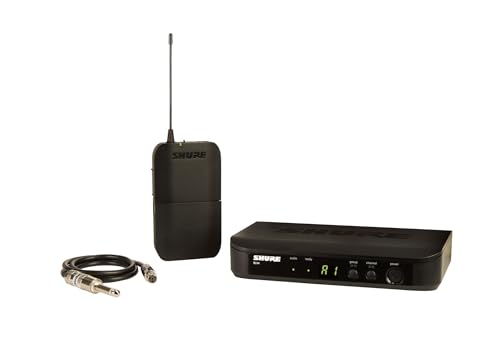
- Includes receiver, bodypack transmitter, and cable
- H10 band covers 542-572MHz
- Runs on 2 included AA batteries
Best For: Guitarists wanting a simple classic wireless setup
Fender Telepath Pick
5.8GHz Wireless with 4ms Latency

- 5.8GHz digital transmission avoids crowded 2.4GHz band
- 4ms latency for responsive playing
- Works with active/passive guitars, bass, and acoustic-electrics
Best For: Players who want a simple, reliable wireless setup for multiple instruments
Shure BLX14 Choice
H9 Band Guitar Wireless System

- BLX4 receiver and BLX1 bodypack included
- H9 band runs on 512-542MHz
- Uses two AA batteries, included
Best For: Guitarists who want a bodypack wireless system from a trusted pro brand
JOYO JW-06 Value Pick
5.8GHz Wireless with Charging Case

- Under-6ms latency with 48kHz/24-bit audio
- Charging case provides 18 hours total playtime
- Four channels support multiple simultaneous sets
Best For: Players who want rechargeable convenience and flexible channel options
Premium Dual-Band Pick
Dual-Band Guitar & Bass Wireless System

- Dual-band 2.4/5.8GHz helps reduce interference
- Up to 12 hours of battery life with quick charging
- Auto pairing and smart frequency management
Best For: Gigging guitarists and bassists who want dependable, license-free wireless audio
Portable Travel Pick
Compact 5.8GHz Wireless Guitar System

- 5.8GHz digital wireless with low interference
- Includes a portable charging case
- Auto-matching keeps setup fast and simple
Best For: Traveling musicians who want a compact, easy-to-charge wireless system
Rack-Mount Pro Pick
Rack-Mount Dual-Band Guitar Wireless System

- Rack-mount receiver for fixed or organized rigs
- Dual-band 2.4/5.8GHz automatic channel selection
- Includes antennas, cables, and mounting hardware
Best For: Players building a rack-based wireless setup for stage or install use
Dual-Band Pedal System – Shure GLXD16+ Pro Digital Wireless for Guitar & Bass
If you want a professional guitar wireless system that prioritizes clean signal and easy setup, the Shure GLXD16+ is built for stage use. Its dual-band operation scans 2.4GHz and 5.8GHz, then automatically selects the cleanest channel, which is a practical advantage when you need dependable wireless performance without frequent adjustments.
Best For: Guitarists and bassists who want a pedalboard-friendly wireless system with automatic frequency management and rechargeable power.
Pros:
- Dual-band 2.4GHz and 5.8GHz operation helps reduce interference and dropouts.
- Auto-pairing and continuous spectrum monitoring simplify setup and channel management.
- Up to 12 hours of runtime from the rechargeable SB904 battery.
- Pedal receiver format fits naturally into a guitar rig.
Cons:
- Frequency Manager GLXD+ FM is sold separately for running up to 16 systems.
- Higher-end feature set may be more than casual players need.
Overall, this is a strong choice if reliability and workflow matter more than having the simplest budget option. It offers the kind of wireless management that makes sense for serious performers who need a stable, license-free setup.
5.8GHz Charging-Case Kit – Xvive AC58 Wireless Guitar System with Charging Case
The Xvive AC58 is a practical professional guitar wireless system if you want compact hardware and a charging case in the box. It uses a 5.8GHz true diversity connection with 24-bit/48kHz audio, and the channel scan mode helps you quickly find a clean wireless channel before you match the transmitter manually.
Best For: Players who want a compact 5.8GHz wireless system with a charging case and support for both active and passive pickups.
Pros:
- 5.8GHz true diversity wireless connection is designed for reliable performance.
- 24-bit/48kHz audio and 20Hz to 20kHz range preserve sound quality.
- Supports both active and passive pickup modes.
- Charging case provides up to 2 full charges or multiple top-ups.
Cons:
- Channel scan requires a manual transmitter match after scanning.
- Wireless range and stage flexibility are not specified in the notes.
This is a sensible pick for guitarists and bassists who value portability and easy recharging. The active/passive mode support also makes it flexible for different instruments and pickup types.
PA Speaker Transmitter – Bose Wireless 1/4" Instrument Transmitter
The Bose Wireless 1/4" Instrument Transmitter is a streamlined option for anyone using the S1 Pro+ PA system as part of a wireless rig. It connects instruments over 2.4GHz, stays wirelessly connected up to 30 feet, and is designed to store inside the speaker so charging and transport stay simple.
Best For: Performers already using the Bose S1 Pro+ PA system who want a simple wireless transmitter for guitar or keys.
Pros:
- Designed specifically for the Bose S1 Pro+ PA speaker.
- Up to 30 feet of wireless range for short-run setups.
- 2.4GHz connection and integrated receiver pairing keep use straightforward.
- Built-in storage inside the speaker makes charging convenient.
Cons:
- Works with the S1 Pro+ PA system, so compatibility is limited.
- Battery life is up to 4 hours, which may be short for longer gigs.
This is best treated as a convenience-focused solution rather than a general-purpose wireless system. If you already own the compatible Bose speaker, it offers a clean, integrated setup for quick cable-free performances.
UHF Bodypack System – Shure BLX14 Wireless Guitar System
The Shure BLX14 is a straightforward professional guitar wireless system for players who want a proven UHF setup. It includes the BLX4 receiver, BLX1 bodypack transmitter, and WA302 guitar cable, giving you the core pieces needed for a wireless guitar rig without unnecessary extras.
Best For: Guitarists who want a classic bodypack wireless system with a simple receiver/transmitter layout.
Pros:
- Includes the BLX4 receiver, BLX1 bodypack transmitter, and WA302 guitar cable.
- H10 band operates in the 542-572MHz range.
- Battery-powered design uses 2 included AA batteries.
- Simple wireless format is easy to fit into a standard guitar setup.
Cons:
- No battery runtime or range details are listed in the supplied notes.
- Uses AA batteries rather than a rechargeable pack.
For players who prefer a familiar UHF-style wireless rig, this is a practical and uncomplicated choice. It focuses on core wireless functionality rather than advanced feature overload.
Fender Telepath Pick – 5.8GHz Wireless with 4ms Latency
If you want a professional guitar wireless system that aims for simple setup and consistent performance, the Fender Telepath is built around 5.8GHz digital transmission and a 4ms low-latency design. It’s made to avoid the crowded 2.4GHz band, and it supports active and passive guitars, bass, acoustic-electric instruments, and more.
Best For: Players who want a reliable, easy-to-use wireless option for guitars, bass, and acoustic-electrics.
Pros:
- 5.8GHz band helps reduce interference from crowded 2.4GHz wireless gear.
- 4ms latency is a strong fit for responsive live playing.
- Auto-pairing and multi-unit pairing make setup and instrument changes quick.
- Rechargeable battery lasts up to 8 hours from a 2-hour charge.
Cons:
- Battery life is shorter than some competing systems with longer run times.
- Range is listed at 70 feet, which may be limiting for larger stages.
Overall, the Telepath is a practical choice if you value straightforward operation, low latency, and broad instrument compatibility over extra-long battery life or maximum range.
Shure BLX14 Choice – H9 Band Guitar Wireless System
The Shure BLX14 is a classic professional guitar wireless system built around the BLX4 receiver, BLX1 bodypack transmitter, and WA302 guitar cable. It uses the H9 band (512-542MHz), which is a straightforward choice for players who want a traditional wireless setup for guitar performance.
Best For: Guitarists who prefer a bodypack-style wireless system from a well-known pro audio brand.
Pros:
- Includes the BLX4 receiver, BLX1 bodypack transmitter, and WA302 guitar cable.
- H9 band operation gives you a dedicated UHF wireless solution.
- Battery powered design uses two included AA batteries.
- Shure’s BLX series is designed for standard guitar use.
Cons:
- Relies on AA batteries rather than a rechargeable system.
- Heavier than compact plug-on wireless alternatives.
This is a practical pick if you want a proven, no-frills wireless guitar system with a bodypack format and the included cable needed to get started.
JOYO JW-06 Value Pick – 5.8GHz Wireless with Charging Case
The JOYO JW-06 is a professional guitar wireless system designed for players who want low-latency operation, flexible channel use, and long total battery life. Its 5.8GHz transmission, 48kHz/24-bit audio, and charging case make it especially practical for practice, rehearsals, worship, and smaller live gigs.
Best For: Guitarists and bass players who want a rechargeable wireless system with multiple channels and long total runtime.
Pros:
- 5.8GHz digital transmission with under-6ms latency supports responsive playing.
- Charging case extends total playtime to 18 hours.
- Four channels allow up to four sets simultaneously with no crosstalk.
- Wide compatibility with many electric guitars, basses, and acoustic-electrics.
Cons:
- Open-area range is best at 65-100 feet, but walls and obstructions can reduce it to 30-50 feet.
- Active pickups may need volume adjustment to avoid distortion.
- Not compatible with 18V active pickups or extremely high-output instruments.
For players who want a feature-rich wireless rig with rechargeable convenience and channel flexibility, the JW-06 offers a lot of value for small-stage and practice use.
Premium Dual-Band Pick – Dual-Band Guitar & Bass Wireless System
If you want a professional guitar wireless system that prioritizes clean signal and simple operation, the Shure GLXD14+ is built for exactly that job. Its dual-band design scans 2.4 and 5.8GHz to find a cleaner channel, while the automatic pairing and frequency management make setup straightforward for live use.
Best For: Players who want a reliable, license-free wireless setup with transparent digital audio and long battery life.
Pros:
- Dual-band 2.4/5.8GHz operation helps avoid interference.
- Up to 12 hours of runtime with smart rechargeability.
- Automatic pairing and spectrum monitoring simplify setup.
- Includes bodypack, instrument cable, receiver, battery, and carrying case.
Cons:
- Not backwards compatible with GLX-D or GLX-D Advanced.
- More advanced than a basic plug-and-play starter system.
Overall, this is a strong choice for players who need dependable digital wireless performance and want fewer worries about dropouts during a show. The included 100 ft range and license-free operation add practical value for gigging guitarists and bassists.
Portable Travel Pick – Compact 5.8GHz Wireless Guitar System
The NUX C-5RC is a practical professional guitar wireless system if you want something compact, simple, and easy to travel with. It uses 5.8GHz digital wireless for interference-resistant performance, and the included charging case makes it especially convenient for practice, rehearsals, and live setups on the move.
Best For: Players who want a lightweight wireless system with a charging case and easy auto-matching setup.
Pros:
- 5.8GHz wireless connection helps keep the signal clear.
- 24-bit digital audio preserves instrument dynamics.
- Includes a portable charging case for on-the-go use.
- Auto-matching makes setup quick and simple.
Cons:
- Rated range is up to 100 feet with clear line of sight.
- Best suited to players who value portability over rack-style features.
For players who want a straightforward wireless option that stays compact in the gig bag, the C-5RC makes a lot of sense. Its broad pickup compatibility and mute function add useful flexibility without complicating the setup.
Rack-Mount Pro Pick – Rack-Mount Dual-Band Guitar Wireless System
If you need a professional guitar wireless system for a more fixed rig, the Shure GLXD14R+ gives you the same dual-band GLX-D+ platform in a rack-mount receiver format. It automatically scans 2.4 and 5.8GHz bands, pairs with minimal effort, and adds the practical hardware you want for organized stage or install setups.
Best For: Rack-based players and installed rigs that need dependable wireless performance and clean cable management.
Pros:
- Dual-band operation automatically selects the cleanest channel.
- Rack-mount receiver suits more permanent setups.
- Up to 12 hours of runtime with smart rechargeability.
- Includes antennas, cables, mounting hardware, and zippered bag.
Cons:
- Less portable than tabletop or pedal receiver versions.
- Not backwards compatible with earlier GLX-D systems.
This model is a smart fit when you want Shure’s wireless reliability but prefer a rack-ready format. The included mounting accessories and automatic frequency management make it especially appealing for players building a more permanent wireless setup.
How We Picked the Best Professional Guitar Wireless System
We prioritized systems that deliver dependable signal stability, practical operating range, low latency, and battery performance that can handle a full rehearsal or set. We also looked at band compatibility, charging convenience, receiver format, and whether each unit is better suited to stage use, portable rigs, or multi-instrument flexibility.
Quick Comparison
At a glance, the strongest choices fall into a few clear categories: premium dual-band systems for players who want maximum reliability, compact 5.8GHz models for easy portability, and value-focused wireless sets that cover basic live and practice needs. If you need a Professional Guitar Wireless System for frequent gigs, prioritize consistency and latency over extra features.
Key Buying Factors for a Professional Guitar Wireless System
Range and Reliability
Published range is only part of the story. Real-world performance depends on venue size, crowd density, stage interference, and line-of-sight. Choose a system with enough headroom for your typical playing environment rather than the minimum you think you need.
Latency and Tone Feel
For lead guitar and fast rhythm playing, low latency matters. Look for systems designed to keep note attack and timing feeling natural, especially if you rely on tight pick dynamics or in-ear monitoring.
Battery and Charging
Rechargeable transmitters are convenient for regular use, while systems with longer rated battery life reduce mid-show anxiety. If you tour or gig often, charging cases and clear battery indicators can be a major advantage.
Instrument Compatibility
Some systems are optimized for passive pickups, active pickups, bass, acoustic-electric instruments, or multiple instrument types. Make sure the input mode and connector style match your main rig.
Receiver Style and Rig Setup
Pedalboard receivers, plug-in receivers, and rack-oriented formats each suit different setups. A pedal-style receiver integrates neatly into a board, while compact plug-in units favor simple grab-and-go rigs.
Who Should Buy Which Professional Guitar Wireless System?
Gigging players who want the most refined experience should lean toward higher-end dual-band systems. Traveling musicians and casual performers may prefer compact, rechargeable models that are easy to pack and set up. Bassists and multi-instrument players should verify input support before buying, while home users and smaller-stage performers can often save money with simpler systems that still deliver solid performance.
If your priority is dependable live use, start with the features that affect performance first: stability, latency, battery life, and fit with your instrument. The best wireless choice is the one that disappears into your playing and works consistently every time you step on stage.