Travel-friendly MIDI gear should be compact, dependable, and easy to connect when you arrive at a gig, rehearsal, or hotel setup. The best options balance portability with the ports, power, and latency control musicians actually need on the road.
In this roundup, we focus on MIDI interfaces for traveling musicians that are simple to pack, quick to deploy, and flexible enough for keyboards, controllers, laptops, and hybrid rigs.
Best 10 Midi Interfaces for Traveling Musicians Picks for 2026
Wireless MIDI Travel Pick
CME WIDI Uhost Bluetooth MIDI Host

- Adds Bluetooth MIDI to class-compliant USB gear
- 3 ms latency claim with sub-1 ms jitter
- Supports up to 5-device Bluetooth MIDI groups
Best For: Traveling musicians who want a compact wireless MIDI bridge
Minimal MIDI Cable Pick
Roland UM-ONE-MK2 Compact MIDI Interface

- One-in/one-out interface with low-latency FPT processing
- Bus-powered with integrated USB and MIDI cables
- Works with Mac, Windows, and iPad setups
Best For: Travel rigs that need a simple, compact MIDI cable interface
Portable Audio Backup
Behringer UMC22 Compact USB Audio Interface

- USB-powered 2x2 audio interface with direct monitoring
- Includes a Midas-designed mic preamp
- Compatible with popular DAWs on computer
Best For: Traveling players who need portable audio recording rather than MIDI
Hybrid Bridge Pick
CME H2MIDI Pro USB Host MIDI Interface

- USB host mode for class-compliant gear and DIN hardware
- USB-C support for major desktop and mobile systems
- Routing, filtering, mapping, and preset storage
Best For: Traveling musicians with mixed USB and 5-pin DIN MIDI setups
Portable Creator Dock
Synido A20 USB-C Audio Interface

- Pocket-sized USB-C design with built-in wire storage
- 24-bit/96kHz capture and adaptive gain control
- Supports phone charging during mobile live streaming
Best For: Traveling musicians who want a compact USB-C interface for mobile recording and practice
Multi-Port MIDI Hub
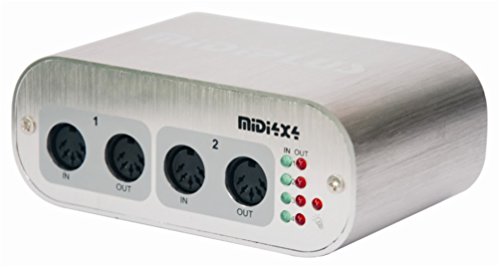
- 4-in/4-out MIDI routing with 64 channels
- USB powered and driver-free on Mac and Windows
- Compact design with port activity indicators
Best For: Musicians needing a simple portable MIDI router for laptop and hardware setups
Road-Ready Hybrid Interface
Yamaha URX22C USB-C Audio/MIDI Interface

- USB-C audio/MIDI interface with 2 combo inputs and MIDI I/O
- 32-bit/192kHz support with DSP-powered monitoring effects
- Full-metal housing and cross-platform compatibility
Best For: Traveling musicians who want a durable hybrid interface with onboard effects and MIDI
Portable Creator Pick
Arturia MiniFuse 1 compact USB audio/MIDI interface
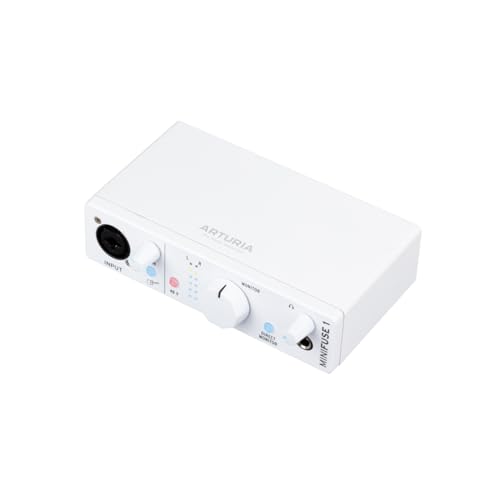
- 5-pin MIDI in/out for syncing external gear
- Compact plug-and-play design for quick setup
- 5-year warranty and extensive reliability testing
Best For: Traveling musicians who need a compact MIDI-capable interface for simple rigs.
Road-Ready Multi-Input
Behringer UMC404HD 4x4 USB audio/MIDI interface

- 4 inputs, 4 outputs, and 1x MIDI I/O
- 24-bit/192 kHz recording with MIDAS mic preamps
- Impact-resistant metal chassis for travel durability
Best For: Traveling musicians who need more I/O and MIDI for a bigger mobile rig.
Lightweight Mobile Option
Mackie Onyx Producer 2X2 bus-powered MIDI interface

- MIDI I/O in a compact 2x2 design
- Bus-powered for easier travel and packing
- Two Onyx preamps with zero-latency monitoring
Best For: Solo musicians who want a lightweight, bus-powered MIDI interface for travel.
Wireless MIDI Travel Pick – CME WIDI Uhost Bluetooth MIDI Host
If you need midi interfaces for traveling musicians, the CME WIDI Uhost is built to cut cable clutter and make compact rigs easier to manage. It adds Bluetooth MIDI to class-compliant USB MIDI gear, supports automatic pairing between WIDI devices, and is designed for low-latency performance on stage or in the studio.
Best For: Players who want a compact way to make USB MIDI gear wireless and keep mobile setups tidy.
Pros:
- Adds Bluetooth MIDI to class-compliant controllers and computers via USB.
- Supports auto pairing between WIDI devices and manual pairing for iOS, macOS, Windows 10/11, and Android.
- Claims 3 ms latency between two devices and sub-1 ms jitter for stable timing.
- Can create MIDI merge/split setups with up to 5 devices through Bluetooth MIDI groups.
Cons:
- General Bluetooth pairing does not work; setup follows specific WIDI instructions.
- Windows 10/11 may require the Korg BLE MIDI driver for full compatibility.
- Some non-Bluetooth MIDI software may need bridge apps to work properly.
For traveling musicians who value fewer cables and wireless flexibility, this is a smart specialty tool. It is most compelling when your gear is class-compliant and you want a small, modern MIDI bridge that can move between practice, stage, and mobile setups.
Minimal MIDI Cable Pick – Roland UM-ONE-MK2 Compact MIDI Interface
For musicians comparing midi interfaces for traveling musicians, the Roland UM-ONE-MK2 is a straightforward one-in/one-out cable interface with a compact, bus-powered design. It is aimed at low-latency MIDI work, offers data indicators for input and output, and keeps the setup simple when you do not need extra routing features.
Best For: Players who want a tiny, reliable MIDI cable interface for basic travel rigs.
Pros:
- Compact, integrated cable design with no extra adapters.
- Bus-powered over USB, so no external power supply is needed.
- Visual input and output indicators help monitor signal flow.
- Compatible with Mac, Windows, and iPad via Apple’s Camera Connection Kit.
Cons:
- Only provides one-in/one-out MIDI connectivity.
- Does not include advanced routing or multi-device features.
- Best suited to simple MIDI connections rather than more complex rigs.
This is the most stripped-down option in the group, which can be exactly what a traveling setup needs. If your priority is a small, powered-by-USB interface for one keyboard or module, it keeps things easy and portable.
Portable Audio Backup – Behringer UMC22 Compact USB Audio Interface
The Behringer UMC22 is not a dedicated MIDI device, but it can still make sense in a travel-oriented setup if you need a small USB audio interface alongside your computer-based music workflow. It offers a compact form factor, USB power, direct monitoring, and a Midas-designed mic preamp for recording microphones and instruments on the go.
Best For: Traveling musicians who need a tiny USB audio interface for recording, not MIDI connectivity.
Pros:
- Ultra-compact, USB-powered design for portable recording.
- Includes a Midas-designed mic preamp for mic and instrument capture.
- Direct monitor switch and status/clip LEDs help with practical tracking.
- Compatible with popular DAWs like Pro Tools, Ableton Live, and Cubase.
Cons:
- It is an audio interface, not a MIDI interface.
- Listed compatibility is primarily for laptops and personal computers.
- Does not address Bluetooth MIDI, routing, or DIN MIDI needs.
If your travel setup is focused on recording audio rather than connecting MIDI gear, the UMC22 is a compact and familiar choice. For pure MIDI jobs, though, you will want a different kind of interface.
Hybrid Bridge Pick – CME H2MIDI Pro USB Host MIDI Interface
If you want midi interfaces for traveling musicians that can bridge modern USB gear and older 5-pin DIN hardware, the CME H2MIDI Pro is built for that job. It works as a standalone USB host, supports computer connections over USB-C, and adds routing tools for setups that need filtering, mapping, or splitting on the move.
Best For: Musicians who need a compact bridge between USB MIDI devices and DIN MIDI hardware.
Pros:
- Standalone USB host mode connects class-compliant USB MIDI gear to 5-pin DIN hardware without a computer.
- USB-C client mode supports Mac, Windows, iOS, Android, Linux, and ChromeOS.
- Includes routing, filtering, mapping, and splitting via HxMIDI Tools.
- Can save up to 4 presets for quick changes during performance or production.
Cons:
- More feature-rich than a basic one-cable MIDI interface, so it may be more than some travelers need.
- Advanced setup may require learning the HxMIDI Tools workflow.
- USB host expansion depends on using a USB hub for additional ports.
This is the most flexible option here for mixed rigs, especially if you move between keyboards, controllers, synths, and legacy hardware. For traveling musicians who need both portability and serious MIDI management, it offers a lot in a very small package.
Portable Creator Dock – Synido A20 USB-C Audio Interface
If you need midi interfaces for traveling musicians that also handle quick recording and streaming duties, the Synido A20 is built around portability. Its pocket-sized USB-C design, built-in wire storage, and phone charging support make it easy to pack for rehearsals, hotel sessions, or mobile content creation.
Best For: Traveling musicians who want a compact USB-C interface for guitar, MIDI keyboard, and mobile recording setups.
Pros:
- Ultra-portable, pocket-sized body with integrated wire storage
- 24-bit/96kHz recording for detailed capture
- Adaptive gain control helps match different instruments
- USB-C connectivity works with phone or computer, plus charging passthrough for live streaming
Cons:
- Only 2 channels, so it is not built for larger studio rigs
- Best suited to creators who prioritize mobility over multi-I/O expansion
The A20 leans more toward a travel-friendly creator dock than a traditional rack-style interface, but that is exactly why it stands out here. For musicians who want a compact grab-and-go unit with direct phone or laptop support, it covers the basics cleanly.
Multi-Port MIDI Hub – MIDI 4×4 USB MIDI Interface
For traveling musicians who need reliable midi interfaces for traveling musicians setups, this MIDI 4×4 focuses on straightforward routing rather than extra bells and whistles. Its 4-in/4-out design, USB power, and driver-free operation make it easy to connect a laptop-based rig without carrying a bulky power supply.
Best For: Mobile players who need a compact 4-in/4-out MIDI router for Mac or Windows.
Pros:
- 4-in/4-out layout supports up to 64 MIDI channels
- USB powered, so no external power supply is required
- Driver-free setup simplifies use on Mac and Windows
- Port activity indicators help with quick troubleshooting on the road
Cons:
- Designed for MIDI only, not audio recording
- Uses USB-B connection to the computer, which may require an included cable and proper port setup
This is a practical choice if your travel rig already centers on hardware synths, controllers, and a laptop. It does not add studio polish or audio processing, but it does keep MIDI routing simple and portable.
Road-Ready Hybrid Interface – Yamaha URX22C USB-C Audio/MIDI Interface
If you want midi interfaces for traveling musicians that feel more like a full production tool, the Yamaha URX22C brings audio, MIDI I/O, and strong onboard monitoring into one rugged box. Its USB-C connection, full-metal housing, and support for mobile and desktop platforms make it a solid pick for players who move between rehearsal spaces, laptops, and iOS devices.
Best For: Traveling musicians who need a durable USB-C audio/MIDI interface with onboard DSP monitoring.
Pros:
- USB 3.0 USB-C interface with MIDI I/O and 2 analog inputs/outputs
- 32-bit/192kHz support for high-resolution recording
- DSP-powered monitoring with reverb, channel strip, and amp effects
- Full-metal housing adds durability for transport
Cons:
- Only 2 channels, so it is limited for larger input needs
- Best value depends on whether you will use the included software suite and DSP features
The URX22C is the most feature-rich option here for musicians who want an interface that can handle both audio and MIDI on the road. If you need built-in monitoring tools and cross-platform support, it offers a very complete travel-friendly package.
Portable Creator Pick – Arturia MiniFuse 1 compact USB audio/MIDI interface
If you want midi interfaces for traveling musicians that stay compact without feeling bare-bones, the Arturia MiniFuse 1 is a practical pick. It combines USB audio recording with 5-pin MIDI in and out, so you can connect synths, controllers, and drum machines while still handling vocals, guitar, and other sources on the road.
Best For: Traveling musicians who want a small, all-in-one interface for MIDI gear plus quick recording setup.
Pros:
- Includes 5-pin MIDI input and output for easy gear syncing.
- Compact USB interface with plug-and-play workflow for fast setup anywhere.
- Supports recording voice, guitar, synths, and more in one unit.
- Backed by a 5-year warranty and extensive reliability testing.
Cons:
- Only 1 audio channel, so it is not aimed at larger multi-input sessions.
- Fewer I/O options than 4×4 interfaces built for bigger rigs.
For mobile musicians, the MiniFuse 1 stands out more for convenience and durability than raw channel count. If your travel setup is centered on a few key instruments and MIDI hardware, it offers a tidy balance of portability, sound quality, and long-term confidence.
Road-Ready Multi-Input – Behringer UMC404HD 4×4 USB audio/MIDI interface
For traveling musicians who need more routing flexibility, the Behringer U-PHORIA UMC404HD is one of the stronger midi interfaces for traveling musicians in a compact but rugged format. It adds 1x MIDI I/O alongside 4 inputs and 4 outputs, making it useful when your road setup includes multiple microphones, instruments, and external MIDI hardware.
Best For: Players who travel with a larger recording setup and want more inputs, outputs, and MIDI connectivity.
Pros:
- 4×4 USB audio/MIDI interface with 1x MIDI I/O.
- 24-bit/192 kHz resolution for high-quality recording.
- Four MIDAS-designed mic preamps with +48V phantom power.
- Metal chassis built to handle tough transport and daily use.
Cons:
- Larger and heavier than ultra-compact travel interfaces.
- Windows compatibility is called out in the supplied details, which may matter for some buyers.
The UMC404HD makes sense when travel does not mean stripping your setup down to the minimum. If you want a sturdy interface that can handle more sources and still keep MIDI in the picture, this is a very capable road companion.
Lightweight Mobile Option – Mackie Onyx Producer 2X2 bus-powered MIDI interface
Mackie Audio Interface, Onyx Producer 2X2 USB Audio Interface with MIDI (Onyx Producer 2-2)
Check Price On AmazonThe Mackie Onyx Producer 2X2 is a compact choice for midi interfaces for traveling musicians who want a bus-powered interface they can carry easily. It offers MIDI I/O, two boutique-quality Onyx mic preamps, and zero-latency direct monitoring, making it well suited to simple mobile sessions and quick capture work.
Best For: Solo performers and mobile recordists who want a lightweight interface with MIDI I/O.
Pros:
- Includes MIDI I/O in a compact 2×2 interface.
- Bus-powered design means no power adapter is required.
- Two Onyx mic preamps with phantom power support.
- Zero-latency direct monitoring for practical tracking.
Cons:
- Only 2 inputs and 2 outputs, so it is best for smaller setups.
- Not as expandable as larger 4×4 interfaces.
If portability is the top priority, the Onyx Producer 2X2 keeps the footprint and power requirements low. It is a sensible travel interface for musicians who value easy packing and straightforward MIDI connectivity over larger channel counts.
How We Picked the Best Midi Interfaces for Traveling Musicians
For Midi Interfaces for Traveling Musicians, portability matters, but so do real-world connection options. We prioritized compact footprints, bus-powered or easy-to-power designs, stable drivers, low-latency performance, and enough MIDI or audio routing to cover common travel use cases.
We also looked for interfaces that fit different setups: pure MIDI control, combined audio/MIDI interfaces, USB-C convenience, USB host support for standalone controllers, and reliable build quality for frequent packing and unpacking.
Quick Comparison
Some buyers will want a simple one-in/one-out MIDI interface for a lightweight keyboard rig. Others need multiport routing for a larger stage setup, or an audio/MIDI interface that can handle recording, monitoring, and controller connections in one box.
If your priority is the smallest possible travel package, choose a compact MIDI-only unit. If you need one device to manage instruments, vocals, and controllers, a combined audio/MIDI interface is usually the better value.
Key Buying Factors for Midi Interfaces for Traveling Musicians
Size and Power
Smaller is usually better on the road, but confirm whether the interface is bus-powered, USB-C compatible, or requires external power. A unit that works cleanly from a laptop or tablet can save space in your bag.
Port Count and Routing
Match the interface to your rig. Solo players may only need basic in/out MIDI, while performers with multiple synths, controllers, or hardware sequencers may benefit from 4×4 or host-capable designs.
Compatibility and Drivers
Travel setups often change between computers, so broad OS support and stable class-compliant operation are important. If you use iPad, Mac, or Windows devices, check connectivity and software support before buying.
Audio Needs
If you record vocals, guitar, or backing tracks, a combined audio/MIDI interface can reduce the amount of gear you carry. If you only need control signals, a dedicated MIDI interface may be simpler and lighter.
Build Quality
Frequent travel means more wear on cables, jacks, and ports. Look for sturdy connectors, a compact chassis that can handle bag transport, and a layout that makes setup fast in low-light environments.
Who Should Buy Which Midi Interfaces for Traveling Musicians?
Choose a small MIDI-only interface if you want the lightest possible setup for controlling one or two devices. Choose a USB host or Bluetooth-capable model if you need to connect modern controllers or run a standalone travel rig without a computer.
If you need recording inputs as well as MIDI, a compact audio/MIDI interface is the best all-in-one option. For larger stage or studio-mobile rigs, a 4×4 interface offers more flexibility and room to expand without carrying a full-sized studio unit.