Loop stations with rhythm tracks can turn a simple guitar idea into a full performance, helping you stay in time while building layered parts. For practice, songwriting, or live looping, the right unit makes it easier to create groove-driven songs without extra gear.
In this roundup, we focus on models that balance usability, sound quality, timing features, and rhythm options so you can find the best fit for your setup and playing style.
Best 10 Loop Stations with Rhythm Tracks Picks for 2026
Editor’s Pick
BOSS RC-10R Rhythm Loop Station

- 280 preset rhythm styles with fills
- Two-track looping in a compact pedal
- 16 drum kits and 6 hours recording time
Best For: Players who want a compact, performance-ready looper with built-in rhythms
Value Choice

- 14 save slots and 140 minutes stereo recording
- 121 drum grooves across 11 genres
- Separate outputs for looper and drums
Best For: Guitarists who want a budget-friendly stereo looper with built-in grooves
Pro Performer

- Dual-track looping with 13 hours stereo recording
- 57 rhythms, 16 drum kits, and Loop FX
- Full MIDI I/O and extensive control support
Best For: Performers and songwriters who want deep control and strong rhythm options
Feature-Rich Upgrade
- 100 storage slots and 800 minutes total recording
- 220 drum rhythms with custom kit support
- Dual TRS MIDI and Bluetooth audio integration
Best For: Players who want a highly connected looper with large storage and custom drum options
Compact Rhythm Looper

- Single-track looper with 13 hours of stereo recording
- 57 rhythms, A/B variations, and 7 drum kits
- Compact pedal with USB, MIDI I/O, and external control
Best For: Players wanting a compact looper with built-in rhythm support
Dual-Track Rhythm Hub

- Two-track looper with onboard rhythm tracks
- 13 hours of stereo record time and USB import/export
- XLR and 1/4-inch inputs for flexible setups
Best For: Solo performers wanting dual-track looping and rhythm support
Six-Track Performance Station
Boss RC-600 Loop Station Looper Pedal
- Six stereo phrase tracks for advanced layering
- Rhythm guide plus 99 phrase memory presets
- Two XLR mic inputs with phantom power
Best For: Advanced performers needing a full-featured multi-track looper
Stage-Control 3-Track Looper
BOSS RC-300 Loop Station, Black

- Three stereo tracks with dedicated controls
- Dedicated faders and expression pedal support
- Up to 3 hours of internal recording and 99 memories
Best For: Players who want a hands-on multi-track looper for live layering
Tabletop Looping With Rhythm
Boss RC-505 Mk2 Loop Station Tabletop Looper

- Five stereo tracks and a rhythm generator
- Two XLR mic inputs with phantom power
- Two stereo line input pairs for flexible routing
Best For: Tabletop performers who want loops, rhythm, and vocal-ready inputs
Compact Beginner Looper

- User-friendly stompbox looper for core looping
- Stereo input/output with 12 minutes of recording
- Battery powered or optional AC adaptor
Best For: Beginners who want a compact, easy looper for guitar, bass, or keys
Editor’s Pick – BOSS RC-10R Rhythm Loop Station
If you want loop stations with rhythm tracks that feel built for real performance, the BOSS RC-10R is a strong fit. It combines song-based looping with dynamic rhythms in a compact pedal, giving you two-track operation, 280 preset styles, and 16 drum kits without taking up much board space.
Best For: Players who want a compact, performance-ready looper with built-in rhythms and simple control.
Pros:
- 280 preset rhythm styles with intro, ending, and transition fills
- Two-track looping for building layered song parts
- Sixteen versatile drum kits and six hours of recording time
- Compact footprint with intuitive LCD and loop/rhythm indicators
Cons:
- Some players may want more than two tracks for larger arrangements
- Uses a focused song-based workflow rather than a more open-ended looper layout
The RC-10R is a practical choice if you want rhythms that support your loop performance instead of distracting from it. Its combo of preset styles, onboard memories, and selectable output filtering makes it especially useful for players moving between amp and full-range setups.
Value Choice – MOOER Groove Looper X2
The MOOER Groove Loop X2 is a solid option if you want loop stations with rhythm tracks in a straightforward stereo pedal format. It pairs a looper with a drum machine, gives you 14 save slots, and offers 121 grooves across 11 genres for quick practice or songwriting sessions.
Best For: Guitarists who want a budget-friendly stereo looper with lots of built-in grooves and easy tempo control.
Pros:
- 14 save slots with up to 140 minutes of stereo recording time
- 121 drum grooves across 11 genres with direct genre and pattern knobs
- Three recording modes: count-in, automatic, and normal
- Separate routing for looper and drum machine audio
Cons:
- Requires editor software for file management and firmware updates
- Feature set is more streamlined than higher-end performance loop stations
For players who care most about usable rhythms and simple control, the Groove Loop X2 covers a lot of ground. Its time stretch, tap tempo support, and separate outputs make it especially handy for practice setups and compact live rigs.
Pro Performer – BOSS RC-500 Loop Station
For players looking for loop stations with rhythm tracks and deeper performance control, the BOSS RC-500 brings a more advanced dual-track layout. It includes onboard rhythms, 16 drum kits, 57 preset rhythms with A/B variations, and extensive control options for live use.
Best For: Performers and songwriters who want a dual-track looper with deep control, rhythm options, and strong memory storage.
Pros:
- Dual-track looping with 13 hours of stereo recording time
- 57 preset rhythms plus 16 drum kits and A/B variations
- Reverse and Loop FX like repeat, scatter, shift, and vinyl flick
- Full MIDI I/O and support for external footswitch or expression pedal control
Cons:
- More advanced controls may be more than casual users need
- Uses mini TRS MIDI connections, so some expanded control requires an adapter
The RC-500 is built for players who want to shape full performances, not just capture loops. Its multi-color display, phrase memory storage, and USB WAV management make it a strong hub for serious looping setups.
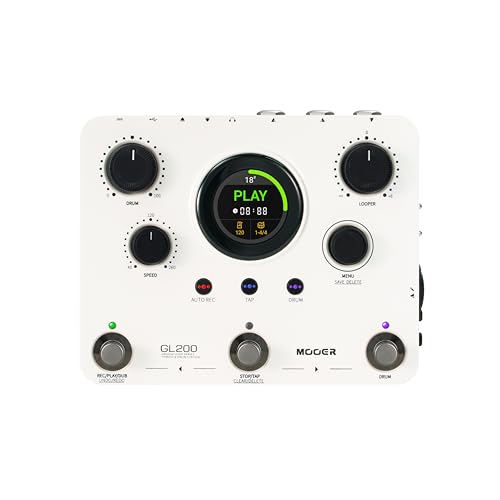
Feature-Rich Upgrade – MOOER GL200 Drum Looper
If you want loop stations with rhythm tracks plus modern connectivity, the MOOER GL200 stands out as a feature-heavy choice. It offers stereo looping, built-in drum machine functions, 100 storage slots, and up to 800 minutes of total recording time, along with Bluetooth audio integration and dual TRS MIDI I/O.
Best For: Players who want a highly connected looper with large storage, custom drum support, and flexible input options.
Pros:
- 100 storage slots and up to 800 minutes of recording time
- 220 drum rhythms with editor software for custom kits and MIDI rhythms
- Dual TRS MIDI ports for syncing with other MIDI gear
- Supports instruments, line-level sources, microphones, and Bluetooth audio input
Cons:
- Broad feature set may be more than players need for simple looping
- Touchscreen plus controls can feel more complex than basic pedals
The GL200 is best viewed as a flexible looping hub for players who want more than a standard pedal. With drum matching, time stretch, auto-rec, and broad I/O support, it is designed for users who want to build a more integrated practice or performance setup.
Compact Rhythm Looper – BOSS RC-5 Loop Station
The BOSS RC-5 is a strong pick if you want loop stations with rhythm tracks in a compact pedal that still feels fully featured. It pairs single-track looping with 57 onboard rhythms, A/B variations, and seven drum kits, giving you practical backing options for writing, practice, and live layering without taking up much pedalboard space.
Best For: Players who want a small, high-quality looper with built-in rhythm support for solo practice, songwriting, and compact live rigs.
Pros:
- 32-bit AD/DA conversion and 32-bit floating-point processing for high-quality loop capture and playback
- 57 rhythms with A/B variations plus 7 drum kits for flexible accompaniment
- 13 hours of stereo recording time and 99 phrase memories
- Compact design with USB, MIDI I/O, and external control support
Cons:
- Single-track looping only, so it is less expansive than multi-track units
- Requires an optional PSA adapter for standard powered use beyond battery operation
- Fewer performance tracks than larger flagship loop stations
The RC-5 is a practical middle ground for players who want polished sound, onboard rhythms, and a pedalboard-friendly footprint. If you do not need multiple stereo tracks, it offers a lot of control in a small package.
Dual-Track Rhythm Hub – BOSS RC-500 Loop Station
The BOSS RC-500 is built for players who want loop stations with rhythm tracks and more room to build layered performances. Its two-track design, onboard rhythm tracks, and 13 hours of stereo record time make it a capable choice for songwriting, practice, and stage use where you need more flexibility than a single-track looper.
Best For: Guitarists, singers, and solo performers who want dual-track looping with onboard rhythms and flexible I/O.
Pros:
- Two-track looper design for more arranging flexibility
- Onboard rhythm tracks for timing support and practice use
- XLR and 1/4-inch inputs for broader connection options
- 13 hours of stereo record time with USB import/export
Cons:
- Larger than compact loopers, so it takes more pedalboard space
- Runs on an AC adapter rather than battery power
- Less track capacity than the RC-600 flagship model
The RC-500 sits in a very useful middle zone: more flexible than a basic compact looper, but not as large as a full performance workstation. For players who want rhythm support and two independent tracks, it is a practical upgrade.
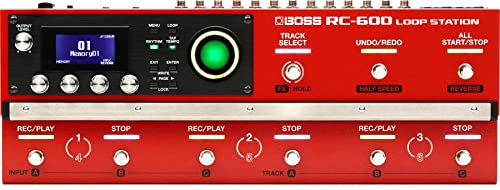
Six-Track Performance Station – Boss RC-600 Loop Station Looper Pedal
If you are shopping for loop stations with rhythm tracks and need a more advanced live setup, the Boss RC-600 is the most expansive option here. It offers six stereo phrase tracks, a rhythm guide, and extensive input options, making it a strong fit for complex layering, vocal performance, and full-band style solo rigs.
Best For: Advanced performers who need multiple stereo tracks, microphone inputs, and a feature-rich looper for live arranging.
Pros:
- Six stereo phrase tracks for deep looping arrangements
- Rhythm guide for keeping performances locked in time
- Two XLR microphone inputs with phantom power
- Two stereo instrument/line input pairs and 99 phrase memory presets
Cons:
- Larger and heavier than simpler loop stations
- More elaborate than many players need for basic looping
- Corded electric power only, so it is less portable
The RC-600 is clearly aimed at performers who want maximum control rather than minimal footprint. If you need multiple tracks, vocal connectivity, and built-in rhythm guidance, it is the most capable model in this group.
Stage-Control 3-Track Looper – BOSS RC-300 Loop Station, Black
If you want loop stations with rhythm tracks for building full arrangements live, the BOSS RC-300 is a strong fit. It gives you three stereo tracks with dedicated footswitches and faders, plus real-time expression control for shaping effects while you perform. With up to three hours of internal recording and 99 onboard memories, it’s built for players who need more than a basic looper.
Best For: Guitarists and multi-instrumental performers who want hands-on control over three stereo loop tracks and live effects shaping.
Pros:
- Three stereo tracks with dedicated footswitches and controls
- Dedicated fader per track for fast level balancing
- Expression pedal support for real-time effects control
- Up to three hours of internal recording with 99 onboard memories
Cons:
- More complex than a simple stompbox looper
- Requires external power via plug-in supply
- May be more pedalboard space than basic users need
The RC-300 is a practical choice if you need a performance-oriented looper that stays tactile and organized. Its three-track layout and onboard memory make it suitable for layered song building without losing control on stage.
Tabletop Looping With Rhythm – Boss RC-505 Mk2 Loop Station Tabletop Looper
The Boss RC-505 Mk2 is aimed at loop stations with rhythm tracks users who want a tabletop workflow and more input flexibility. It offers five stereo tracks, two XLR mic inputs with phantom power, and two stereo line input pairs, along with a rhythm generator for building backing parts. That mix makes it a solid option for vocalists, beatmakers, and solo performers who prefer hands-on desk-style control.
Best For: Vocalists, beatboxers, and tabletop performers who need five stereo tracks plus rhythm generation and mic inputs.
Pros:
- Five stereo tracks for more layered looping
- Rhythm generator for backing support
- Two XLR mic inputs with phantom power
- Two stereo line input pairs for flexible routing
Cons:
- Tabletop format is less pedalboard-friendly than a floor unit
- Needs AC power rather than battery operation
- May be more involved than a simple entry-level looper
Overall, the RC-505 Mk2 is best when you want looping, rhythm, and input flexibility in one tabletop unit. Its performance-focused layout makes it easier to manage complex sets without relying on footswitch-only control.
Compact Beginner Looper – BOSS RC-1 Loop Station Pedal
If you’re comparing loop stations with rhythm tracks but want a straightforward pedal first, the BOSS RC-1 keeps the focus on core looping. It lets you record, playback, overdub, and undo or redo loops in a compact stompbox, with stereo input and output support and up to 12 minutes of stereo recording time. The loop indicator also makes it easy to see your current mode at a glance.
Best For: Guitar, bass, and keyboard players who want an easy-to-use compact looper for basic looping workflows.
Pros:
- Very user-friendly for straightforward looping
- Record, playback, overdub, undo, and redo functions
- Compact stompbox design for simple setups
- Up to 12 minutes of stereo recording time
Cons:
- No built-in rhythm generator or drum tracks
- Fewer advanced controls than larger loop stations
- Optional AC adaptor sold separately
The RC-1 is a good entry point if you mainly want a reliable looper without extra complexity. It’s less about performance extras and more about making looping easy to learn and use.
How We Picked These Loop Stations with Rhythm Tracks
We looked for models that combine reliable looping with built-in rhythm support, strong timing tools, and enough flexibility for real-world use. Priority went to units with clear controls, useful tempo functions, solid recording capacity, and features that help players build parts naturally rather than fight the hardware.
We also considered whether a pedal is better suited to solo practice, band-style arranging, live performance, or studio-style layering. That matters because Loop Stations with Rhythm Tracks can vary a lot in track count, footswitch layout, memory, and control depth.
Quick Comparison: What to Expect
Compact pedals are best if you want a simple footprint and straightforward operation. Mid-tier units often add dual tracks, more memory, and deeper rhythm editing. Larger tabletop or multi-track stations are better for players who want song construction, complex overdubs, or hands-on control during performance.
If you mainly need a practice tool, choose an easier interface. If you want to arrange full songs, look for more tracks, better syncing, and stronger input/output flexibility.
Key Buying Factors for Loop Stations with Rhythm Tracks
Rhythm Quality and Style Options
Check how many drum patterns, styles, and kit sounds are included. The best Loop Stations with Rhythm Tracks offer useful grooves without sounding repetitive, and they should let you match the feel of the song you are building.
Timing, Sync, and Recording Workflow
Good timing tools matter more than raw feature count. Look for solid quantization, easy tempo tap-in, sync between loops and drums, and enough recording time for your typical use.
Foot Control and Live Usability
In live settings, button layout and display readability are critical. A pedal should make it easy to start, stop, overdub, and switch sections without breaking your performance flow.
Connections and Expansion
MIDI I/O, stereo inputs and outputs, and external control options can make a big difference if you use keyboards, drum machines, or a more advanced stage rig. Consider whether the unit will grow with your setup.
Who Should Buy Which Loop Stations with Rhythm Tracks?
Choose a compact unit if you want an easy practice companion or a portable songwriting tool. Step up to a dual-track or multi-track model if you need more arrangement control, longer recording time, or better live set flexibility. Tabletop loopers are ideal for players who like hands-on control and beat-building, while simpler pedals suit guitarists who want a fast, no-fuss way to add rhythm and loops.
If your main goal is making ideas feel complete, Loop Stations with Rhythm Tracks are a smart choice because they keep your parts locked to a beat while giving you room to experiment.