Transporting a keyboard between rehearsals, venues, and live shows requires more than basic dust protection. The right case should fit your instrument securely while making loading, carrying, and stage setup easier.
These 10 options cover rolling cases, backpack-style gig bags, padded designs, and compact cases for electronic gear, helping you match protection and portability to your performance routine.
Best 10 Keyboard Cases for Live Performances Picks for 2026
Best Rolling 88-Key Bag
Wheeled Keyboard Case with Stand Straps

- Wheels and multiple carry options
- Straps for a compatible folding stand
- Padded, water-resistant 600D construction
Best For: Slim 88-key keyboards used for gigs and rehearsals
Best Live Electronic Gear Case

- Removable lid becomes a performance surface
- Supports prewired live setups
- Lightweight aluminum case with included Velcro
Best For: Compact synth, sampler, mixer, and effects setups
Best Weather-Ready 88-Key Case
Rolling Gig Bag with Backpack Straps

- Three carry modes, including wheels and backpack straps
- 900D water-resistant Oxford fabric
- Large accessory pockets and internal mesh storage
Best For: Standard 88-key keyboards and flexible venue transport
Best Lightweight 88-Key Bag
Soft Case with Shoulder Straps
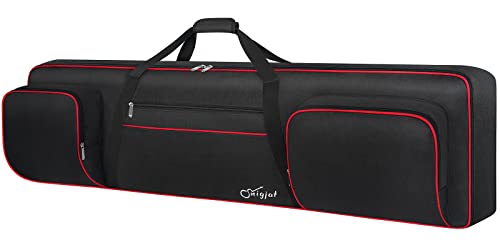
- Lightweight 3.91-pound design
- Adjustable padded backpack straps
- Three accessory pockets and interior security belts
Best For: Portable 88-key keyboard carrying without wheels
Rolling 61-Key Protection

- Wheels, handles, and backpack straps
- Thick padding with security belts
- Large storage pockets and dust cover
Best For: 61-key players needing versatile gig transport
Lightweight 61-Key Carry
Portable 61-Key Oxford Gig Bag

- 10 mm padded sides and bottom
- Waterproof 600D Oxford fabric
- Backpack straps and two storage pockets
Best For: Portable 61-key transport without wheels
Rolling 88-Key Travel Protection
AKOZLIN Padded 88-Key Keyboard Case

- Designed for slim 88-key keyboards
- Full 21/64-inch foam padding
- Wheels, backpack straps, and three pockets
Best For: 88-key performers transporting a full-size keyboard
Best Lightweight 76-Key Pick

- 10mm padding with an interior safety strap
- Backpack straps and reinforced carry handles
- Waterproof fabric with large accessory pocket
Best For: Portable 76-key setups and everyday gig travel
Best 88-Key Rolling Option
Padded 88-Key Keyboard Case with Wheels

- Two wheels with a reinforced pull handle
- Detachable padding and three securing straps
- Three exterior pockets for gig accessories
Best For: 88-key players who want rolling and backpack carry
Best Weather-Ready 76-Key Roller
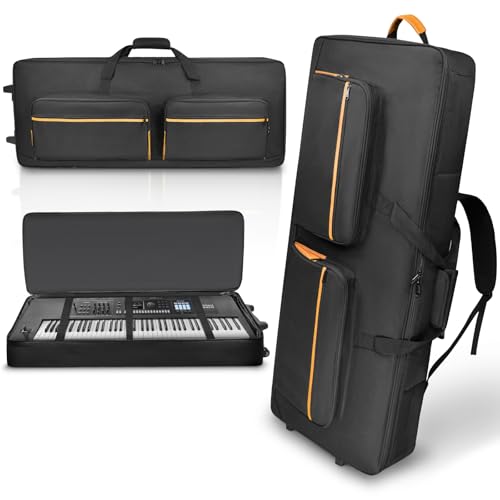
- In-line wheels for suitcase-style transport
- 900D/600D waterproof Oxford fabric
- Four pockets and three internal straps
Best For: 73/76-key performers traveling in variable weather
Best Rolling 88-Key Bag – Wheeled Keyboard Case with Stand Straps
For keyboard cases for live performances, this rolling 88-key bag is a practical choice when you need easy venue transport plus room for essential accessories. Its 52.4 x 13 x 6.3-inch interior fits many slim 88-key keyboards, but measure your instrument and remove the music rest before ordering.
Best For: Keyboardists who regularly roll a slim 88-key instrument to rehearsals, lessons, and gigs.
Pros:
- Smooth-rolling wheels, reinforced grab handle, side handle, and detachable shoulder strap offer flexible transport.
- Exterior straps can secure a compatible lightweight folding keyboard stand.
- Three zippered pockets hold pedals, adapters, sheet music, headphones, and cables.
- 600D water-resistant fabric, foam padding, and a soft lining help protect against dust, scuffs, and light bumps.
Cons:
- Designed for many slim 88-key keyboards rather than every 88-key model.
- The keyboard stand and accessories are not included.
- The six-inch interior depth may require careful sizing before purchase.
This bag stands out for gigging musicians who value rolling transport and stand-carrying straps. Confirm your keyboard dimensions first, especially if it has a removable music rest or a deeper chassis.
Best Live Electronic Gear Case – UNISON Performance Case
Among keyboard cases for live performances, the UNISON Performance Case is built for electronic musicians who want to keep a compact setup wired and ready. Its removable lid doubles as a performance surface, while included industrial-grade Velcro helps attach compatible gear to the ballistic nylon covering.
Best For: Live electronic performers using compact synths, samplers, mixers, drum machines, or effects pedals.
Pros:
- Removable lid can serve as a sturdy surface on a keyboard stand or table.
- Allows compatible gear to remain completely wired inside the case between setup and performance.
- Aluminum construction is described as lighter than traditional road cases.
- Fits a range of compact production tools, including the Arturia Keystep 37, Elektron Digitakt, Roland SP-404 MK2, and similar-size gear.
Cons:
- Its 25.9 x 15-inch interior is intended for electronic gear, not full-size keyboards.
- At 5.1 kg, it is not an ultra-light option despite its road-case-oriented design.
- Gear must be compatible with the hook-and-loop mounting approach; the case includes the case but not the listed equipment.
This is a specialized performance workstation rather than a conventional keyboard gig bag. Check both the interior dimensions and your mounting needs if you want a fast, prewired setup for live electronic performance.
Best Weather-Ready 88-Key Case – Rolling Gig Bag with Backpack Straps
This rolling gig bag is a versatile option for keyboard cases for live performances, combining wheels with hidden backpack straps and a hand-carry handle. The 53 x 14.5 x 7-inch interior is designed for many standard 88-key keyboards, so compare your instrument’s measurements before ordering.
Best For: Performers who need to switch between rolling, backpack, and hand-carry modes while transporting a standard 88-key keyboard.
Pros:
- Smooth wheels, a reinforced handle, backpack straps, and a padded carry handle provide three transport options.
- Thick padding and two adjustable internal straps help limit movement and impact.
- Front pockets and inner mesh pockets organize pedals, cables, sheet music, microphones, phones, tablets, and other accessories.
- High-density 900D water-resistant Oxford fabric helps shield the keyboard from moisture and dust.
Cons:
- Its 6.8-pound weight is higher than a basic soft shoulder bag.
- Fit depends on matching the 53 x 14.5 x 7-inch interior to your keyboard.
- The blue finish may not suit musicians seeking a black case.
The combination of wheels and backpack straps makes this a strong fit for performers navigating different venue surfaces and carrying conditions. Its larger pocket layout is useful when a single bag needs to hold both the keyboard and gig accessories.
Best Lightweight 88-Key Bag – Soft Case with Shoulder Straps
For musicians seeking lightweight keyboard cases for live performances, this soft 88-key bag emphasizes backpack-style carrying and accessory organization. Its 53.5 x 13.8 x 6.8-inch interior fits many popular 88-key models, but checking your keyboard’s dimensions is essential.
Best For: Keyboardists who want an affordable-feeling, lightweight carry option for gigs, practice sessions, and travel.
Pros:
- Adjustable padded shoulder straps support backpack carrying, while rugged handles allow hand carrying.
- Two interior security belts help keep the keyboard from shifting during transport.
- Three exterior zippered pockets hold smaller music stands, books, pedals, cables, iPads, and related accessories.
- 600D waterproof and scratch-resistant fabric includes a PVC waterproof lining and soft interior lining.
Cons:
- It has no wheels, so longer venue walks require carrying the instrument.
- The 6.8-inch interior depth may not accommodate deeper 88-key keyboards.
- Exterior storage is specified for music stands smaller than 16 inches.
At 3.91 pounds, this is the most carry-focused option in the group and avoids the bulk of a wheeled case. Choose it when backpack portability matters more than rolling convenience, and verify compatibility with your exact keyboard model.
Rolling 61-Key Protection – BOSSTIN 61-Key Keyboard Case
For musicians comparing keyboard cases for live performances, the BOSSTIN 61-key case combines padded protection with wheels, backpack straps, and useful accessory storage. Its 41.7″ x 14.5″ x 5.7″ interior is designed for most standard 61-key keyboards, but check your instrument’s measurements before ordering.
Best For: 61-key players who want multiple carrying options and easy rolling transport to gigs, rehearsals, or practice sessions.
Pros:
- Two wheels, handles, and concealable backpack straps provide three carrying options.
- Thick foam padding, adjustable security belts, and a velvet dust cover help protect the keyboard.
- Large front pockets and internal net pockets organize cables, pedals, music materials, and small essentials.
- Water-resistant, dustproof Oxford fabric supports use in changing travel conditions.
Cons:
- Designed for 61-key keyboards, so it is not suitable for 88-key instruments.
- At 3.54 kg, it is heavier than a basic soft gig bag.
- The listed manufacturer warranty is three months.
With wheels and backpack straps in addition to conventional handles, this is a flexible choice for local performance transport. Confirm the internal dimensions and allow for your keyboard’s controls and accessories when checking fit.
Lightweight 61-Key Carry – Portable 61-Key Oxford Gig Bag
This 61-key gig bag is a straightforward option for keyboard cases for live performances, offering a padded 600D Oxford-cloth shell, exterior storage, and backpack-style carrying. Its listed dimensions are approximately 40″ x 16″ x 6″, so compare them with your keyboard before purchase.
Best For: 61-key keyboard owners seeking a relatively light, waterproof bag for car transport, lessons, rehearsals, and local gigs.
Pros:
- 10 mm cotton padding on the bottom and sides helps guard against bumps and damage.
- Waterproof 600D Oxford fabric is described as durable and sturdy.
- Two exterior pockets hold items such as lesson books, a phone, pen, and power supply.
- Adjustable shoulder straps allow handbag or backpack carrying.
Cons:
- It has no wheels, so longer walks may require shoulder or backpack carrying.
- The soft case provides less rigid protection than a hard-shell case.
- Its fit is limited to most 61-key keyboards within the stated dimensions.
At about 2.5 pounds, this bag emphasizes portability without omitting basic padding and accessory storage. It is best suited to musicians who can carry their keyboard rather than roll it.
Rolling 88-Key Travel Protection – AKOZLIN Padded 88-Key Keyboard Case
For performers with a full-size instrument, the AKOZLIN is one of the larger keyboard cases for live performances, built for slim 88-key keyboards up to 54″ x 14.2″ x 6.3″. It adds wheels, backpack straps, full padding, and three exterior pockets for transporting a stage setup.
Best For: 88-key players who need rolling transport and room for music books, pedals, power supplies, and cables.
Pros:
- Fits slim 88-key keyboards up to the stated 54″ x 14.2″ x 6.3″ dimensions.
- 21/64-inch full padding helps protect against bumps, scratches, and other transport damage.
- Two wheels, two handles, and adjustable padded backpack straps offer several carrying methods.
- Three large exterior pockets provide space for common performance accessories.
Cons:
- It is intended for slim 88-key keyboards, so compatibility should be measured carefully.
- The rigid wheels may be less convenient on uneven surfaces than larger all-terrain wheels.
- The case is water resistant rather than described as fully waterproof.
The AKOZLIN offers a useful balance of capacity and transport flexibility for full-size keyboard players. Measure the keyboard carefully, especially its depth and height, before relying on the stated fit.
Best Lightweight 76-Key Pick – ORKELS 76-Key Keyboard Case
For musicians looking for keyboard cases for live performances, the ORKELS 76-Key Keyboard Case offers a lightweight way to carry a compatible instrument to rehearsals or gigs. Its 10mm padding, waterproof 600D fabric, backpack straps, and accessory storage balance portability with everyday protection.
Best For: 76-key keyboard players who prioritize backpack portability and organized accessory storage.
Pros:
- Adjustable backpack straps and reinforced handles support multiple carrying options.
- 10mm sponge padding and an interior safety strap help limit movement and impact.
- Large zippered storage accommodates pedals, cables, sheet music, and power cords.
- Waterproof 600D fabric helps resist scratches and moisture.
Cons:
- It is designed for 76-key keyboards, so compatibility should be checked carefully.
- It has no wheels, making hand or shoulder carrying necessary.
At 2.1 pounds, this soft case is a practical choice when low carry weight matters more than rolling transport or heavy-duty structural protection.
Best 88-Key Rolling Option – Padded 88-Key Keyboard Case with Wheels
Among keyboard cases for live performances, this 88-key rolling case is built for musicians who need several ways to move a full-size keyboard. Its padded interior, detachable foam sections, backpack straps, handles, and two wheels support transport to gigs, rehearsals, and lessons.
Best For: 88-key keyboard owners who want rolling transport plus backpack and hand-carry options.
Pros:
- Two wheels and a pull handle allow suitcase-style transport.
- Three thickened Velcro straps, detachable padding, and a removable 2cm foam layer help secure the keyboard.
- Three exterior zippered pockets provide space for pedals, cables, adapters, and music sheets.
- Water-resistant, scratch-resistant fabric helps shield the instrument from moisture and dust.
Cons:
- The stated interior dimensions are 56.5 x 16.2 x 6.8 inches, so model fit is not universal.
- Its rolling design may be less convenient on stairs or uneven surfaces.
This is a versatile choice for heavier 88-key instruments, especially when the option to roll the case can reduce carrying strain.
Best Weather-Ready 76-Key Roller – ORKELS Rolling Keyboard Case
For keyboard cases for live performances that emphasize rolling convenience and weather resistance, the ORKELS 73/76-key case combines in-line skate wheels with thick foam padding. Its four zippered pockets and three interior straps are useful for keeping a performance setup together during travel.
Best For: 73- or 76-key keyboard players who need rolling transport and substantial accessory capacity.
Pros:
- Two wheels let you roll the case like a suitcase and reduce the carrying load.
- 900D/600D Oxford waterproof fabric helps resist moisture, dust, scratches, and bumps.
- Three adjustable internal straps help stabilize the keyboard during transit.
- Four zippered pockets hold items such as pedals, cables, books, and music stands.
Cons:
- The listed 48.2 x 19.1 x 6.5-inch interior should be compared with the keyboard before purchase.
- Its soft-shell design does not provide the rigid protection of a hard case.
With wheels, versatile handles, weather-resistant materials, and generous storage, this case is well suited to performers who regularly move a 73- or 76-key setup between locations.
How We Picked These Keyboard Cases for Live Performances
We focused on practical features that matter during regular transport: instrument-size compatibility, padding, durable exterior materials, carrying flexibility, storage, and ease of movement. The selection includes 61-, 73-, 76-, and 88-key formats, along with a dedicated case for smaller electronic gear.
Because product specifications can vary, confirm your keyboard’s exterior dimensions—not only its key count—before ordering. Allow room for controls, end panels, and any attached accessories.
Quick Comparison
| Case type | Best for | Features to prioritize |
|---|---|---|
| Rolling 88-key case | Full-size keyboards and frequent gigging | Wheels, reinforced handles, thick padding |
| Soft 88-key gig bag | Budget-conscious musicians | Adjustable straps, fit, accessory storage |
| 61-key case | Portable stage keyboards | Compact dimensions, waterproof fabric, padding |
| 73/76-key case | Intermediate-size instruments | Accurate interior length, wheels, pockets |
| Electronic-gear case | Compact controllers and equipment | Interior layout, protection, portability |
Key Buying Factors for Keyboard Cases for Live Performances
Fit and Interior Dimensions
A snug fit reduces movement that can damage keys, knobs, and wheels during transport. Measure the keyboard’s full length, depth, and height, then compare those figures with the listed interior size.
Padding and Construction
Look for substantial padding, reinforced seams, reliable zippers, and a base that can tolerate contact with floors and vehicle cargo areas. Soft cases are convenient, but they offer less impact protection than hard-shell models.
Wheels, Handles, and Straps
Wheels are valuable for heavy 88-key instruments, especially across parking lots and venues. Backpack or shoulder straps help with stairs and crowded spaces. Multiple reinforced carry points make loading safer and more comfortable.
Storage and Weather Resistance
Accessory pockets should accommodate cables, pedals, power supplies, and music accessories without pressing against the keyboard. Water-resistant or waterproof fabric can help during short trips outdoors, but it should not be treated as complete weather protection.
Who Should Buy Which Keyboard Cases for Live Performances?
- Choose a rolling 88-key case if you regularly transport a full-size keyboard and want to reduce lifting.
- Choose a padded shoulder-strap case if you carry your instrument up stairs or need a lighter, more flexible setup.
- Choose a 61-key case for compact keyboards and performers who prioritize easier storage and portability.
- Choose a 73- or 76-key case when a 61-key bag is too short but a full 88-key case is unnecessarily large.
- Choose an electronic-gear case for controllers, compact instruments, and performance equipment that does not require a traditional piano-keyboard bag.
For most performers, the best choice balances a precise fit with enough padding and a transport system suited to the venue. Prioritize dimensions first, then select wheels, straps, and storage based on how you travel to shows.