Need to feed multiple headphones from one source without killing volume or clarity? The best headphone distribution amplifiers for home use make it easy to share music, gaming audio, podcasts, or studio playback with clean, controlled output.
Below, we focus on practical options that balance channel count, input flexibility, and enough headroom for everyday home listening setups.
Best 10 Headphone Distribution Amplifiers for Home Use Picks for 2026
Pro Multi-Channel Hub
Behringer HA8000 V2 8-Channel Headphone Amp

- 8 channels support up to 16 headphones
- Per-channel meters and input switching
- Rack-mountable for organized studio setups
Best For: Home studios needing multiple mixes and lots of output capacity
Compact Four-Listener Pick
ART HeadAMP4 Eight Output Stereo Headphone Amplifier

- Stereo amp with 8 outputs across 4 channels
- 1/8-inch and 1/4-inch connections supported
- Compact stackable metal case for small studios
Best For: Simple home or project studios needing compact stereo headphone sharing
Desk-Friendly Budget Pick
Mackie HM-4 4-Channel Headphone Amplifier

- Four independent outputs with volume control
- Accepts 1/4-inch or 1/8-inch sources
- Compact metal build for desk or rack use
Best For: Small home setups that want simple, plug-and-play headphone splitting
Ultra-Compact Value Choice
FIFINE N6 4-Channel Metal Headphone Amp
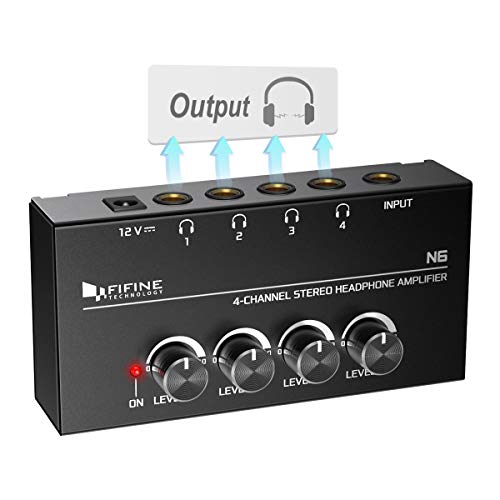
- Four outputs with separate volume knobs
- Low-noise, low-distortion design
- Compact metal build with included power adapter
Best For: Up to four listeners in a small home studio or shared listening setup
Best Compact 4-Channel Pick
4-channel low-noise home headphone amp
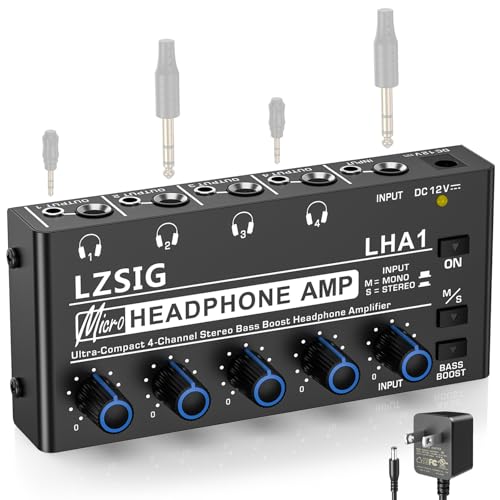
- Independent volume on all 4 channels
- 3.5mm and 6.35mm headphone support
- Bass boost and mono/stereo switching
Best For: Small home studios and shared listening
Best Large-Scale Monitoring Pick
8-channel rack headphone distribution amp

- 8 channels and 16 headphone outputs
- Mono/stereo modes with flexible input routing
- LED meters and independent volume control
Best For: Large home studios and multi-listener monitoring
Best High-Output Pick
16-output high-power headphone amp

- Drives headphones up to 250Ω
- 16 outputs in 3.5mm and 6.35mm formats
- Mono/stereo switch for flexible monitoring
Best For: Higher-impedance headphones and shared monitoring
Six-Channel Home Monitoring

- 6 outputs with independent volume control
- Supports 3.5mm and 6.35mm headphones
- Bass boost and stereo/mono switching
Best For: Home studios and shared monitoring with multiple headphones
Flexible Input Splitter

- RCA, 3.5mm, and 6.35mm inputs
- Four independent volume knobs
- Eight outputs total across two jack sizes
Best For: Compact home studios needing flexible source connections
Simple Four-Listener Monitor Amp
Pyle PHA40 Black 4-Channel Amp

- Powers up to four headphones
- Independent volume control for each output
- Compact design for desk or travel use
Best For: Small home recording and simple mixer monitoring
Pro Multi-Channel Hub – Behringer HA8000 V2 8-Channel Headphone Amp
If you need headphone distribution amplifiers for home use but want something built like a small studio hub, the Behringer HA8000 V2 is aimed at sessions where multiple listeners need their own monitoring paths. It offers eight high-power amplifier sections, support for up to 16 pairs of headphones, and per-channel controls that make it practical for larger home recording setups.
Best For: Home studios that need multiple headphone mixes and a rack-mountable distribution amp.
Pros:
- 8 discrete channels with the ability to connect up to 16 sets of headphones
- Per-channel LED output meters and Main In 1/Main In 2 selection
- Stereo/mono or dual-mono switching for flexible monitoring
- Rack-mountable design helps keep a home studio organized
Cons:
- More feature-rich than many casual home users need
- Rack format may be unnecessary if you want a tiny desktop unit
For home users who want serious routing capacity, the HA8000 V2 stands out as a high-output distribution option rather than a simple splitter. Its extra inputs, multiple outputs, and channel controls make it better suited to bigger project studios and multi-person tracking sessions.
Compact Four-Listener Pick – ART HeadAMP4 Eight Output Stereo Headphone Amplifier
For headphone distribution amplifiers for home use, the ART HeadAMP4 is a straightforward choice when you want to feed several listeners from one source without a complicated setup. Its stereo design, 1/8-inch and 1/4-inch I/O, and compact stackable metal case make it easy to fit into a home or project studio.
Best For: Small home studios that want a simple, compact stereo headphone amp.
Pros:
- 8 output, 4-channel stereo headphone amp design
- Supports both 1/8-inch and 1/4-inch inputs and outputs
- Lower noise and lower distortion are highlighted in the product notes
- Stackable metal case suits tight studio spaces
Cons:
- Less channel flexibility than larger multi-output units
- Best suited to simple stereo distribution rather than complex routing
The HeadAMP4 keeps the focus on simple headphone sharing instead of advanced mixing features. If you mainly need a durable, low-profile unit for a home studio table, it offers the basics in a compact metal package.
Desk-Friendly Budget Pick – Mackie HM-4 4-Channel Headphone Amplifier
If you’re comparing headphone distribution amplifiers for home use, the Mackie HM-4 is an easy desk-sized option for quick sessions and rehearsals. It drives four headphones from a 1/4-inch or 1/8-inch source, and each listener gets an independent volume control for simple shared monitoring.
Best For: Small home setups that need a compact, plug-and-play 4-way headphone splitter.
Pros:
- Drives four headphones from either 1/4-inch or 1/8-inch output sources
- Four independent outputs with per-listener level control
- Very compact metal build can sit on a desk or attach to gear
- Plug-and-play design with no power-supply hassles
Cons:
- Only four outputs, so it is not meant for larger groups
- Focused on splitting and level control rather than advanced routing
The HM-4 is a practical pick when simplicity matters more than extra features. For home users who just want reliable four-person headphone distribution in a small footprint, it keeps the setup lean and convenient.
Ultra-Compact Value Choice – FIFINE N6 4-Channel Metal Headphone Amp
The FIFINE N6 fits the headphone distribution amplifiers for home use category when you want a compact 4-channel unit with individual volume knobs. It is designed to share one stereo source across up to four outputs, with the product notes emphasizing low noise, minimal distortion at high volume, and a rugged metal build.
Best For: Home monitoring, TV listening, or small tracking sessions with up to four headphones.
Pros:
- 4-channel design with separate volume control for each output
- Low-noise operation with minimal distortion at higher volumes
- Compact all-metal construction for portable or desktop use
- 12V DC power adapter is included
Cons:
- Not a mixer; it is a 1-in/4-out headphone amplifier
- TRS/TS cables are not included
- Input and output ports are 6.35mm only
For basic home distribution, the N6 offers a straightforward path to four-way monitoring without adding unnecessary complexity. It makes sense for users who want a small, durable amp for shared listening and simple studio tasks.
Best Compact 4-Channel Pick – 4-channel low-noise home headphone amp
If you want headphone distribution amplifiers for home use that keep a small studio or shared listening space tidy, this 4-channel unit is a practical pick. It gives each listener independent volume control, supports both 3.5mm and 6.35mm headphones, and is built for low-noise monitoring from a single source.
Best For: Home studio users, podcasters, or families sharing one audio source across up to four headphones.
Pros:
- 4 independent channels with separate volume control for each output
- Supports up to 4 pairs of 32~100Ω headphones
- Works with 3.5mm and 6.35mm headphones without an adapter
- Metal chassis and durable knobs make it suitable for regular desk use
Cons:
- Not a mixer, so it is limited to distribution and monitoring duties
- Bass boost changes the sound, which may not suit pure reference listening
This is a straightforward choice if you mainly need clean headphone sharing with simple controls. Its ultra-low-noise design and mono/stereo switching make it flexible enough for home studio sessions and casual use alike.
Best Large-Scale Monitoring Pick – 8-channel rack headphone distribution amp
Among headphone distribution amplifiers for home use, this rack-mount model is the most ambitious option here. It is built for multi-person monitoring, with 8 channels, 16 headphone outputs, rear-panel input routing, and LED meters that help you keep levels under control.
Best For: Larger home studios, rehearsal spaces, and users who need to feed many listeners from multiple mixes.
Pros:
- 8 high-power amplifier channels with up to 16 headphone outputs
- Mono/stereo modes plus per-channel input switching for flexible routing
- 6-segment LED meters on all 8 channels for quick level checks
- 1U rack-mount design makes it easy to integrate into studio setups
Cons:
- More hardware than a typical casual home setup needs
- Designed for 1/4" headphone outputs rather than mixed plug sizes
If you need a serious distribution amp rather than a simple splitter, this unit is built for that job. The combination of independent channel control, multiple outputs, and real-time metering makes it a strong fit for organized monitoring workflows.
Best High-Output Pick – 16-output high-power headphone amp
If your priority is driving demanding headphones, this is one of the stronger headphone distribution amplifiers for home use in the group. The PH800 is rated to handle up to 250Ω headphones and offers 16 outputs across 3.5mm and 6.35mm connections, making it useful when several people need a clean feed.
Best For: Home studios, band rehearsals, and monitoring setups using higher-impedance headphones.
Pros:
- Can drive headphones up to 250Ω
- 16 outputs split across 8×3.5mm and 8×6.35mm jacks
- Mono/stereo switching supports both live and playback monitoring
- Metal housing and 12V/2A power supply support stable operation
Cons:
- Only one power level, so there is no per-channel amplification control detail listed
- The LED ring is visual feedback, but not a level meter
This model makes sense when you need output count and drive strength more than extra studio features. Its mix of plug formats and high-impedance support gives it broad usefulness for shared home monitoring.
Six-Channel Home Monitoring – LZSIG 6-Channel Headphone Amp
If you need headphone distribution amplifiers for home use that can serve a small group without adding noise, the LZSIG 6-channel unit is built for exactly that kind of shared listening. It supports up to six pairs of 32~100Ω headphones, offers independent volume control per channel, and includes stereo/mono switching plus a bass boost option for adjusting the listening experience.
Best For: Home studios, shared monitoring, and users who want six headphone outputs with independent level control.
Pros:
- Supports up to 6 pairs of headphones with 3.5mm and 6.35mm compatibility
- Independent volume control on each channel helps tailor levels for every listener
- Bass boost and stereo/mono switching add flexibility for different sources
- Metal chassis and heavy-duty knobs are better suited to regular desk or portable use
Cons:
- Designed around 32~100Ω headphones, so it may not suit every headphone type
- Best value comes when you actually need multiple outputs
This is a practical option if your priority is distributing one source to several headphones with low noise and simple per-channel control. The feature set is especially useful for home studio monitoring, casual group listening, or desktop setups where durability matters.
Flexible Input Splitter – 4-Channel Headphone Amp Mixer
For headphone distribution amplifiers for home use, this 4-channel splitter is a versatile pick when you need several input options and straightforward control. It accepts RCA, 3.5mm, and 6.35mm inputs, then sends audio to four 3.5mm and four 6.35mm outputs, with individual volume knobs for each channel and separate mute switches for the inputs.
Best For: Small home studios, desktop recording setups, and users who want flexible input/output options in a compact unit.
Pros:
- Multiple input choices: RCA, 3.5mm, and 6.35mm
- Four independent volume controls for listening adjustments
- Eight total outputs across 3.5mm and 6.35mm connections
- Metal build and included power adapter support stable use
Cons:
- More geared toward compact setups than large multi-listener systems
- Best suited to users who need its input flexibility rather than simple plug-and-play minimalism
Overall, this model stands out for flexibility: it is designed to accept common home-audio and studio sources without extra adapters, while still giving each listener their own level control. If your setup mixes different source types, it is an easy amplifier/splitter to work into a desk or recording corner.
Simple Four-Listener Monitor Amp – Pyle PHA40 Black 4-Channel Amp
If you want headphone distribution amplifiers for home use that keep a simple monitoring workflow, the Pyle PHA40 is a compact four-output solution. It powers up to four headphones at once, gives each listener an independent volume control, and uses a 1/4″ TRS input with 1/4″ TRS output jacks for straightforward connection to a mixer or similar source.
Best For: Small home recording setups and users who need a compact four-headphone monitor amp.
Pros:
- Powers up to four headphones at the same time
- Independent volume controls for each listener
- 1/4″ TRS source input and 1/4″ TRS output jacks suit mixer-based setups
- Compact size makes it easy to place on a desk or take on the road
Cons:
- Limited to four headphone outputs
- Uses 1/4″ TRS connections, so it may be less convenient for small-plug headphone setups without adapters
This is a straightforward choice when you want a basic, low-noise headphone monitor distribution system without extra features. Its strength is simplicity: four users, their own level controls, and a compact footprint for home or mobile use.
How We Picked the Best Headphone Distribution Amplifiers for Home Use
For Headphone Distribution Amplifiers for Home Use, the most important factors are usable output power, number of listening positions, input compatibility, and how cleanly the unit handles multiple pairs at once. We also looked for models that make sense in real homes, not just studios: simple controls, compact footprints, and enough flexibility for TVs, mixers, PCs, and AV gear.
Quick Comparison
If you need the simplest shared listening setup, a compact 4-channel unit is usually enough for a desk, gaming room, or small family media area. If you expect to connect several listeners regularly, 8-channel and multi-output designs offer more breathing room and fewer compromises. Models with both 3.5mm and 6.35mm outputs are especially convenient when your household uses a mix of consumer headphones and pro-style headphones.
Key Buying Factors for Headphone Distribution Amplifiers for Home Use
Channel Count and Output Layout
Start by matching the number of outputs to how many people will listen at the same time. A 4-channel amp suits most small homes, while larger gatherings, shared recording spaces, or multimedia setups may benefit from 8 channels or more. Check whether each channel has its own dedicated jack or whether the unit uses split outputs.
Power and Headroom
More power helps the amp drive high-impedance headphones without sounding thin or strained. If you use demanding over-ear headphones, look for stronger output specs and make sure the amp is designed to maintain volume across multiple connected pairs.
Inputs and Compatibility
Choose an amplifier that matches your source gear. RCA is common for TVs and home audio components, 3.5mm works well with laptops and phones, and 6.35mm/TRS is useful for mixers and audio interfaces. The best Headphone Distribution Amplifiers for Home Use support more than one input type so you can adapt as your setup changes.
Mono, Stereo, and Monitoring Features
Stereo support is essential for music, movies, and gaming. Mono mode can be useful for monitoring a shared voice signal or simplifying certain media setups. Bass boost or tone shaping can help, but only if it improves your listening without adding distortion.
Who Should Buy Which Headphone Distribution Amplifiers for Home Use?
If you want a compact everyday solution for two to four listeners, choose a straightforward 4-channel amplifier. If your setup is closer to a shared home studio or entertainment hub, an 8-channel model gives you more flexibility and better long-term value. Budget buyers should prioritize stable output and the right input jacks over extra features they may not use. For mixed-use homes, the most versatile pick is usually the one with multiple input options, both 3.5mm and 6.35mm outputs, and enough power to handle your hardest-to-drive headphones.