The best drum machines for church musicians make it easier to build steady, musical grooves without relying on a full live rhythm section. The right model can support worship rehearsals, small services, songwriting, and live performance while keeping operation simple and dependable.
This roundup compares 10 options across pedal-style beat makers, compact sequencers, analog drum machines, and advanced performance workstations. Consider your setup, required control method, sound flexibility, and need for hands-free operation before choosing.
Best 10 Drum Machines for Church Musicians Picks for 2026
Pro Production Pick

- Classic TR-808, 909, 707, 727, 606, and CR-78 sounds
- Imports custom samples and supports extensive effects
- Stores complete performance-ready kit settings
Best For: Worship teams needing deep sound design and flexible live kits
Portable Pattern Maker

- Compact design with built-in speaker
- Six-part DSP engine creates diverse synthesized percussion
- Active Step, Slice, accent, and randomize functions add variety
Best For: Portable rhythm sketching and creative electronic worship patterns
Grab-and-Go Beat Machine

- Combines TR drums with TB-303 bass
- Supports patterns up to 32 steps with advanced sequencing tools
- USB-C audio/MIDI plus audio, MIDI, and sync connectivity
Best For: Beginners and mobile musicians building drum-and-bass ideas
Hands-Free Live Companion

- Foot-controlled operation for live song parts and fills
- Includes 200-plus songs, 23 genres, and 13 HD drum kits
- LCD visual metronome supports timing and complex meters
Best For: Solo performers and worship leaders needing hands-free accompaniment
Analog Worship Rhythms

- Analog drum machine with 11 sounds
- Ten individual outputs for flexible routing
- MIDI and trigger outputs for expanded control
Best For: Live or studio setups requiring hands-on control and extensive connectivity
Portable Classic Sounds
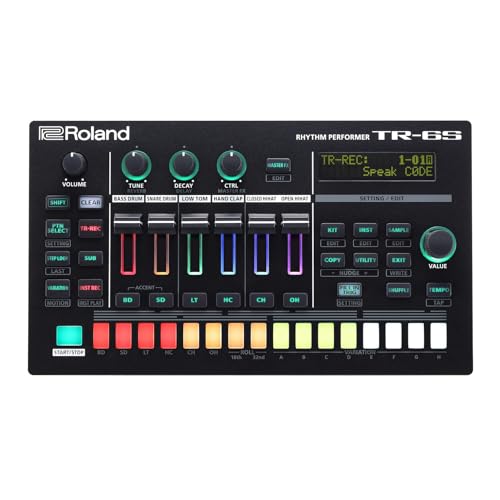
- Six tracks with classic TR drum sounds
- Battery-powered and compact for mobile use
- Supports samples, FM tones, and advanced sequencing
Best For: Portable worship rigs needing versatile sounds and sequencing
Hands-Free Worship Beats

- Pedal-based drum machine for hands-free control
- 200 songs with fills and transitions
- Compact 10.6-ounce pedalboard-friendly design
Best For: Solo instrumentalists needing immediate live rhythm control
Expressive Analog Rhythms

- Individual drum accent controls
- Song mode chains patterns
- Color shaping on most instruments
Best For: Hands-on analog rhythm programming
Foot-Controlled Groove Variety

- 121 grooves in 11 styles
- Tap tempo and fill functions
- Dual footswitch groove control
Best For: Guitarists and bassists needing live drum accompaniment
Classic Preset Simplicity

- 15 classic drum sounds
- 34 rhythm presets
- 16-step sequencer
Best For: Accessible beat programming and live performance
Pro Production Pick – Roland TR-8S Rhythm Performer
For church musicians who need flexible drum machines for church musicians, the Roland TR-8S combines classic Roland rhythms with extensive sound-design and performance options. Its TR-808, TR-909, TR-707, TR-727, TR-606, and CR-78 sounds can support contemporary worship, electronic textures, and more traditional rhythmic parts.
Best For: Worship teams and producers who want deep kit customization, sample importing, and performance-ready storage.
Pros:
- Includes detailed classic Roland TR drum sounds through ACB technology.
- Combines TR sounds with imported mono or stereo samples.
- Offers extensive effects, including delay, reverb, filters, and overdrive.
- Saves instrument and master-effect settings with each kit for reliable performances.
Cons:
- Its advanced editing and effects workflow may be more involved than a simple beat box.
- Sample importing requires an SD card.
The TR-8S is the strongest choice here for musicians who want a full production workstation rather than a basic accompaniment device. It makes the most sense when detailed programming and repeatable live setups matter.
Portable Pattern Maker – Korg Volca Drum
Korg Volca Drum Digital Percussion Synthesizer w/ 16-step Sequencer and Active Step
Check Price On AmazonThe Korg Volca Drum is a compact option among drum machines for church musicians, especially when portability and hands-on pattern creation are priorities. Its six-part DSP engine, 16-step sequencer, and built-in speaker make it useful for developing rhythmic ideas during rehearsal, travel, or small setup sessions.
Best For: Musicians who want an affordable, portable unit for creating distinctive patterns and compact live setups.
Pros:
- Compact design includes a built-in speaker for convenient practice and idea generation.
- Six-part DSP synthesis and a waveguide resonator create varied drum textures.
- Active Step, Slice, randomize, and accent functions encourage rhythmic experimentation.
- Choke grouping can help organize parts in a streamlined setup.
Cons:
- Its 16-step sequencer is less expansive than the longer pattern capabilities of some larger units.
- The sound engine focuses on synthesized percussion rather than supplied acoustic drum kits.
The Volca Drum is a practical choice for building unusual electronic grooves without taking much space. It is particularly appealing for creative worship arrangements and musicians who value experimentation over preset realism.
Grab-and-Go Beat Machine – Roland AIRA Compact T-8
The Roland AIRA Compact T-8 is a convenient entry point into drum machines for church musicians who need rhythm and bass in a small package. It pairs TR-808, TR-909, and TR-606 sounds with TB-303 bass, a hands-on sequencer, built-in effects, and USB-C audio and MIDI connectivity.
Best For: Beginner and mobile musicians who want a compact rhythm-and-bass unit for rehearsals, songwriting, and live experimentation.
Pros:
- Provides authentic Roland-style TR drums plus a TB-303 bass synthesizer.
- Supports up to 64 user patterns and patterns of up to 32 steps.
- Includes probability, sub-step, last-step, velocity, mute, fill, and pattern-shift tools.
- Offers audio, MIDI, sync I/O, and driver-free USB-C audio and MIDI.
Cons:
- Its miniature format provides less physical space for control than a larger drum machine.
- The included sound focus is centered on classic TR rhythms and TB-303 bass rather than broad sample libraries.
The T-8 is well suited to musicians who want immediate results and easy transport. Its combined drum-and-bass design is useful for sketching modern worship grooves, though larger teams may prefer a unit with more extensive kit and sample management.
Hands-Free Live Companion – Singular Sound BeatBuddy 2
The Singular Sound BeatBuddy 2 takes a different approach to drum machines for church musicians: it is a foot-controlled pedal designed for real-time live use. Its song parts, fills, transitions, and studio-quality drum sounds can help solo performers and small worship setups maintain a steady, responsive groove without hands-on sequencing.
Best For: Guitarists, solo worship leaders, loopers, and live musicians who need hands-free control of song sections and fills.
Pros:
- Footswitch control allows live operation without reaching for a tabletop unit.
- Includes 200-plus songs across 23 genres and 13 HD drum kits.
- Supports fills, transitions, song parts, and real-time performance control.
- LCD visual metronome can help with timing and complex time signatures.
Cons:
- Its pedal format is focused on live song control rather than detailed step sequencing.
- It requires 9V power and uses a 1/4-inch audio interface.
The BeatBuddy 2 is the most practical option for hands-free accompaniment. Choose it when live control and natural drum-kit-style playback are more important than designing every individual hit or importing custom samples.
Analog Worship Rhythms – Behringer RD-9
For church musicians who want hands-on control and classic drum-machine character, the Behringer RD-9 combines analog sounds with a flexible sequencing setup. Its 11 sounds, individual outputs, MIDI connectivity, and trigger outs make it a practical choice for studio or live rig integration.
Best For: Church musicians building detailed live or studio rhythm setups with external routing and MIDI control.
Pros:
- Analog drum machine design with 11 sounds.
- Ten individual outputs support flexible mixing and routing.
- MIDI In/Out/Thru and three trigger outputs expand control options.
- Includes filter, wave designer, and effects features.
Cons:
- Its 21.3-inch width and 8.3-pound weight make it less portable than compact alternatives.
- Its extensive connections may be more than needed for a simple worship setup.
The RD-9 is the strongest fit here for musicians who prioritize hands-on sequencing, analog-style drum sounds, and connection flexibility over minimal size.
Portable Classic Sounds – Roland TR-6S Rhythm Performer
The Roland TR-6S is a compact option for church musicians seeking recognizable classic drum-machine sounds in a portable format. It offers six tracks, battery operation, editable FM sounds, samples, and an advanced sequencer for developing varied rhythm parts.
Best For: Mobile worship musicians and producers who need versatile sequencing, classic sounds, and compact USB connectivity.
Pros:
- Includes detailed models of TR-808, TR-909, TR-606, TR-707, and other classic sounds.
- Supports custom user samples and a large preset sample library.
- Advanced sequencer includes sub-steps, flam, step-loop, and motion recording.
- Can function as a USB audio/MIDI interface and runs on four AA batteries.
Cons:
- Six tracks may be limiting for arrangements requiring more independent drum parts.
- The plastic body may feel less substantial than a larger metal-bodied unit.
With its broad sound palette and portable design, the TR-6S is a flexible choice when a church musician needs both traditional rhythm tones and modern sample-based options.
Hands-Free Worship Beats – BeatBuddy MINI 2
The BeatBuddy MINI 2 puts drum-machine control into a compact guitar-pedal format, making it especially useful for church musicians who play while managing their own accompaniment. Its oversized footswitch lets you trigger fills, transitions, and stops without taking your hands off your instrument.
Best For: Solo guitarists and instrumentalists who need simple, hands-free rhythm control during worship or practice.
Pros:
- Hands-free pedal operation provides control while playing.
- Includes 200 songs across a range of genres, with parts, fills, transitions, and intros/outros.
- Oversized footswitch is easier to hit, including for barefoot use.
- Compact 10.6-ounce design fits easily on a pedalboard.
Cons:
- Its pedal format is less suited to detailed sound design or extensive sequencing.
- It uses a 1/4-inch audio connection rather than the broader MIDI and trigger connectivity of larger machines.
The MINI 2 is the most straightforward choice for hands-free accompaniment, particularly when immediate song structure control matters more than deep programming.
Expressive Analog Rhythms – Arturia DrumBrute Impact
The Arturia DrumBrute Impact is a practical choice for church musicians who want hands-on analog drum programming. Its separate accent controls, pattern chaining, and optional Color sound-shaping provide useful flexibility for building and arranging rhythmic parts.
Best For: Church musicians who want tactile control and customizable analog-style rhythms for rehearsal, production, or live use.
Pros:
- Separate accent control for each drum adds expressive dynamic options.
- Song mode supports chaining patterns into longer arrangements.
- Optional Color sound-shaping is available on nearly all instruments.
- Metal alloy-steel construction and a two-year manufacturer warranty support regular use.
Cons:
- Color sound-shaping does not apply to the Cowbell.
- Its 2.4 kg weight may be less convenient for highly portable setups.
Choose the DrumBrute Impact if direct performance controls and pattern arrangement matter more than a large library of preset rhythms. It is especially suited to musicians who prefer shaping grooves manually.
Foot-Controlled Groove Variety – MOOER Drummer X2
The MOOER Drummer X2 is a useful option for church musicians who need ready-made rhythms in a pedal format. With 121 grooves across 11 styles, customizable song banks, tap tempo, and a fill function, it is designed for quick control during playing.
Best For: Guitarists and bassists who want footswitch-accessible drum grooves for practice, performance, or worship arrangements.
Pros:
- Includes 121 grooves across 11 musical styles and 11 variations per genre.
- Seven rhythm slots are available in each of 11 customizable song banks.
- Fill and tap-tempo functions support on-the-fly performance changes.
- Dual footswitches enable groove scrolling without menu navigation.
Cons:
- Its pedal format may offer less programming depth than a dedicated tabletop drum machine.
- The unit requires a 9V DC, 300mA center-negative power supply, though an adapter is included.
- Editor software is needed for deeper customization and preset management.
The Drummer X2 stands out when immediate foot control is a priority. Its broad groove selection and fill function make it a convenient accompaniment tool, particularly for players already working with pedal-based rigs.
Classic Preset Simplicity – Behringer RD-78
The Behringer RD-78 offers church musicians a straightforward way to create classic-style rhythmic parts. Its 15 drum sounds, 34 rhythm presets, and 16-step sequencer provide a simple foundation for programming beats in production or live performance settings.
Best For: Musicians who want an accessible drum machine with preset rhythms and basic step sequencing.
Pros:
- Provides 15 drum sounds for varied rhythmic arrangements.
- Includes 34 rhythm presets to help start ideas quickly.
- Its 16-step sequencer supports straightforward beat programming.
- Compact alloy-steel construction is suited to studio and live use.
Cons:
- The supplied notes do not specify separate per-drum accent controls or pattern chaining.
- Its feature set may be less suitable for musicians seeking extensive sound-shaping options.
The RD-78 is a sensible pick for buyers who value a simple interface and quick access to preset rhythms. It focuses on approachable sequencing rather than a long list of advanced controls.
How We Picked the Best Drum Machines for Church Musicians
We focused on the features that matter most in worship and church music settings: dependable timing, usable sounds, straightforward controls, flexible tempo management, and the ability to transition smoothly between sections. We also considered whether each unit works best for live performance, rehearsal, songwriting, or integrated music production.
The selection includes dedicated drum pedals for guitarists and worship leaders, compact beat machines for portable rigs, and deeper grooveboxes for musicians who need sequencing and sound-design flexibility. Product suitability depends on the player’s instrument, preferred workflow, and the complexity of the arrangement.
Quick Comparison
| Best For | Recommended Type | Why It Stands Out |
|---|---|---|
| Hands-free live accompaniment | BeatBuddy 2 or BeatBuddy MINI 2 | Footswitch control and performance-friendly operation |
| Portable worship rigs | Roland AIRA Compact T-8 or TR-6S | Compact size with useful rhythm and sequencing tools |
| Deep sound and pattern control | Roland TR-8S | Extensive sounds, effects, and performance features |
| Analog character | Behringer RD-9 or Arturia DrumBrute Impact | Hands-on controls and punchy analog-style tones |
| Simple guitar or bass accompaniment | MOOER Drum Machine Pedal | Accessible grooves, fills, and tap-tempo control |
Key Buying Factors for Drum Machines for Church Musicians
Control and Hands-Free Operation
Pedal-style units are often the easiest choice for guitarists, bassists, and worship leaders who need to start, stop, change sections, or trigger fills without reaching for a tabletop device. Grooveboxes offer more control but may require a stand, desk space, or an additional foot controller.
Pattern Changes and Arrangement Flow
Look for verse, chorus, fill, intro, and ending control if you plan to perform live. Basic pattern sequencers work well for rehearsals and steady backing, while performance-oriented units are better when songs need dynamic transitions.
Sound Quality and Style Coverage
Choose sounds that suit your repertoire. Electronic and analog machines can add energy to contemporary worship, while broader preset libraries may be more useful for pop, rock, gospel, and acoustic-oriented arrangements. Check whether the unit supports custom kits or imported sounds if variety is important.
Connections, Power, and Reliability
Confirm the available audio outputs, MIDI or USB support, power requirements, and compatibility with your mixer or pedalboard. For church use, simple connections and predictable startup behavior can matter more than advanced synthesis features.
Who Should Buy Which Drum Machines for Church Musicians?
Choose the BeatBuddy 2 if live, hands-free song control is your priority and you want a dedicated performance pedal. The BeatBuddy MINI 2 is a simpler alternative for players who need dependable accompaniment without as much control depth.
Pick the Roland TR-8S for the broadest performance and programming toolkit. The Roland TR-6S is a better fit when you want many of those Roland-style rhythms in a smaller, more portable format. The AIRA Compact T-8 suits musicians who value a small footprint and quick beat creation.
Choose the Behringer RD-9 or Arturia DrumBrute Impact for hands-on analog drum-machine control. The Behringer RD-78 is worth considering for classic rhythm-machine character, while the Korg Volca Drum favors experimental digital percussion and compact sequencing. For straightforward guitar or bass accompaniment, the MOOER Drum Machine Pedal keeps the setup focused and accessible.