The best DJ mixer with effects can add energy, control, and flexibility to live sets, broadcasts, and home recordings. The right choice depends on whether you prioritize hands-on mixing, onboard effects, controller software, or versatile audio routing.
We compared 10 options across channel count, effect controls, connectivity, portability, and beginner-friendly features to help you find a mixer that fits your setup and budget.
Best 10 Dj Mixer with Effects Picks for 2026
Studio Mixing Choice

- 10 channels with USB and SPX effects
- D-PRE preamps, EQ, filters, and compressors
- Rugged metal chassis for studio or live use
Best For: Musicians and small live or home-studio setups
Beginner DJ Pick
AlphaTheta Pioneer DJ DDJ-FLX2

- Smart Fader assists with beatmatching
- Lightweight USB-C bus-powered design
- Works with rekordbox, djay, and Serato DJ Lite
Best For: First-time DJs learning on phones, tablets, or computers
Creator Effects Bundle
TENLAMP G10 Audio Mixer with Microphone

- Includes mixer, condenser microphone, and accessories
- Voice changer, reverb, pitch, and sound effects
- Works with PC, phone, and tablet without drivers
Best For: Streaming, podcasting, singing, and voice content
Performance FX Controller

- Six effects with dual paddle triggers
- Six-inch jog wheels for scratching and cueing
- Two-deck Serato DJ Lite controller with performance pads
Best For: Hands-on DJ performance, scratching, looping, and effects
Best All-Around Connectivity
6-Channel DJ Mixer with 99 Effects

- 99 built-in DSP reverb and delay effects
- Bluetooth, USB playback, and recording
- XLR inputs with 48V phantom power
Best For: Flexible home, podcast, and small live setups
Best for Larger Setups
GF12 PRO 12-Channel Effects Mixer
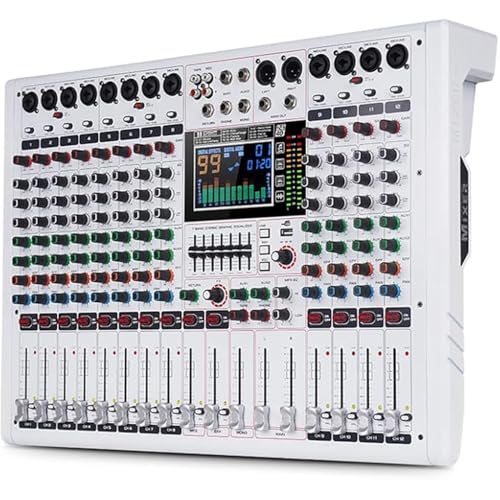
- 12 channels with independent channel controls
- 99 DSP effects and seven-stage equalizer
- Bluetooth, USB, and color LCD display
Best For: Small-to-medium performances and karaoke venues
Best Traditional DJ Controls
Behringer DJX750 5-Channel Mixer

- Dual auto-BPM counter with beat-sync display
- Advanced effects with parameter control
- VCA-controlled crossfader and XPQ surround effect
Best For: Live DJs focused on beat-matched transitions
Compact Creator Pick

- USB recording and live-streaming interface
- Bluetooth input and USB MP3 playback
- Compact design with 48V phantom power
Best For: Podcasts, karaoke, home recording, and small events
Effects Control Pick

- 10-band EQ for detailed sound shaping
- Echo, delay, repeat, and digital effects
- Rackmount design with two mic inputs
Best For: Fixed DJ rigs, event sound, and voice announcements
Hands-On Mixing Pick

- Crossfader and channel faders for transitions
- Cue Mix supports headphone track preview
- Bluetooth, USB, EQ, and microphone inputs
Best For: Mobile DJs, parties, karaoke, and home practice
Studio Mixing Choice – Yamaha MG10XU
The Yamaha MG10XU is a practical choice when you want a dj mixer with effects that also handles microphones, instruments, and recording connections. Its 10-channel layout, USB connectivity, SPX digital effects, three-band EQ, high-pass filters, and one-knob compressors provide useful control for rehearsals, small performances, and home studios.
Best For: Musicians, small live setups, and home recording environments that need flexible input options and built-in effects.
Pros:
- 10-channel design with USB connectivity and SPX digital effects
- Studio-grade D-PRE preamps and three-band EQ for detailed sound shaping
- One-knob compressors simplify control of vocals and instruments
- Rugged, impact-resistant metal chassis
Cons:
- At 7.7 pounds, it is less portable than compact DJ controllers
- Its traditional mixer layout may require more setup knowledge than beginner-focused controllers
The MG10XU is best viewed as a versatile audio mixer rather than a dedicated deck-style DJ controller. Choose it if input flexibility, sound shaping, and durable construction matter more than jog wheels and DJ performance controls.
Beginner DJ Pick – AlphaTheta Pioneer DJ DDJ-FLX2
The AlphaTheta Pioneer DJ DDJ-FLX2 is a compact entry point for anyone seeking a dj mixer with effects-style control in a dedicated DJ controller. Smart Fader helps match volume, BPM, and bass while moving the crossfader, and USB-C bus power makes it easy to use with a phone, tablet, or computer.
Best For: New DJs who want a lightweight controller for learning mixes with rekordbox, djay, or Serato DJ Lite.
Pros:
- Smart Fader assists with volume, BPM, and bass matching
- Compact 2-channel design weighs 2.7 pounds
- Supports music through compatible services including Apple Music, Spotify, and Tidal
- Can connect to headphones, external speakers, or a device’s built-in speaker
Cons:
- Its beginner-oriented automation may offer less manual control for advanced users
- It depends on compatible software and a phone, tablet, or computer for operation
The DDJ-FLX2 prioritizes accessibility and portability over a large mixer section or extensive standalone effects. It is a strong fit for first-time DJs who want to start quickly and practice across multiple devices.
Creator Effects Bundle – TENLAMP G10 Audio Mixer with Microphone
The TENLAMP G10 Creator Audio Mixer Bundle combines a two-channel mixer, condenser microphone, and accessories for creators who want a dj mixer with effects-like vocal processing. Built-in voice styles, sound effects, reverb, pitch, bass, treble, and noise reduction support streaming, podcasting, gaming, singing, and voice recording.
Best For: Beginners building an all-in-one streaming, podcast, singing, or voice-content setup.
Pros:
- Includes a mixer, condenser microphone, and essential accessories
- Offers voice changer functions, sound effects, reverb, pitch, bass, and treble controls
- Supports PC, phone, and tablet use without drivers
- Provides Bluetooth, USB, auxiliary, and OTG/Type-C connectivity
Cons:
- Two-channel capacity is more limited than larger production mixers
- Its creator-focused effects are not a substitute for full DJ deck controls
- Battery-powered operation may require attention to charging during longer sessions
The G10 is designed around interactive content rather than traditional DJ mixing. Its included microphone and real-time vocal effects make it convenient for creators who want a ready-to-use setup with minimal extra equipment.
Performance FX Controller – Numark Mixtrack Pro FX
The Numark Mixtrack Pro FX is a dedicated two-deck option for shoppers comparing a dj mixer with effects and hands-on performance control. It includes six quick-launch effects with dual paddle triggers, large six-inch capacitive jog wheels, performance pads, looping controls, and a built-in 24-bit audio interface for Serato DJ Lite.
Best For: DJs who want tactile scratching, beatmatching, looping, and effect control in a USB-powered controller.
Pros:
- Six effects with dual paddle triggers for quick performance changes
- Large six-inch jog wheels support scratching and cue placement
- Eight performance pads per deck provide cues, loops, samples, and fader cuts
- Includes microphone, headphone, and RCA outputs plus mixer-style EQ controls
Cons:
- Designed for computer use with Serato DJ Lite rather than standalone operation
- At 5.06 pounds, it is less compact than ultra-portable beginner controllers
The Mixtrack Pro FX offers a more traditional hands-on DJ workflow than the other compact or creator-focused choices here. It is particularly appealing if physical jog wheels, performance pads, and dedicated effects are central to how you want to mix.
Best All-Around Connectivity – 6-Channel DJ Mixer with 99 Effects
If you want a versatile dj mixer with effects, the Jiayete JM6 combines six channels with 99 built-in DSP effects, Bluetooth streaming, USB playback, and recording. Its XLR inputs with 48V phantom power also make it suitable for condenser microphones, instruments, and vocal setups.
Best For: Home studios, podcasts, live performances, and small PA setups needing flexible inputs and built-in effects.
Pros:
- Includes 99 digital effects, including reverb and delay.
- Supports Bluetooth streaming from phones, tablets, and MP3 players.
- Offers USB playback and recording for MP3, WAV, and WMA files.
- Provides XLR inputs with 48V phantom power for compatible condenser microphones.
Cons:
- Has six channels, which may be limiting for larger stage setups.
- Its listed power source is battery powered, so power planning may require attention.
The JM6 is a practical choice when effects, wireless playback, and recording matter as much as basic mixing. It offers broad connectivity in a relatively compact 2.44 kg design.
Best for Larger Setups – GF12 PRO 12-Channel Effects Mixer
The GF12 PRO is a strong option for shoppers seeking a dj mixer with effects and more channel capacity. It provides 12 channels, individual gain, balance, EQ, effects-send, and volume controls, plus 99 DSP effects, Bluetooth, USB playback, and a color LCD screen.
Best For: Small-to-medium concerts, karaoke venues, studios, radio work, and other performance-focused audio setups.
Pros:
- Offers 12 channels for handling more microphones and audio sources.
- Includes 99 selectable DSP effects for different performance situations.
- Provides individual channel controls for gain, balance, EQ, effects send, and volume.
- Combines Bluetooth and USB connectivity with a large LCD color display.
Cons:
- Its larger 23.8-inch depth may require substantial desk or rack space.
- The listed warranty is a 30-day return and exchange policy.
With twice the channel count of a basic six-channel mixer, the GF12 PRO is geared toward more involved performances. Its independent controls and seven-stage equalizer offer added hands-on adjustment for complex mixes.
Best Traditional DJ Controls – Behringer DJX750 5-Channel Mixer
The Behringer PRO MIXER DJX750 is designed for DJs who want a dedicated dj mixer with effects, beat-focused monitoring, and a familiar five-channel layout. Its advanced digital effects, adjustable XPQ stereo surround effect, dual auto-BPM counter, and VCA-controlled crossfader target performance-oriented mixing.
Best For: DJs who prioritize BPM awareness, crossfader control, and dedicated digital effects during live mixing.
Pros:
- Includes a dual auto-BPM counter with time and beat-sync display.
- Offers advanced digital effects with adjustable parameter control.
- Features an adjustable XPQ stereo surround effect.
- Uses a VCA-controlled crossfader for smooth, reliable audio performance.
Cons:
- Provides five channels, fewer than the GF12 PRO’s 12 channels.
- Its listed noise level is 15 dB.
- It does not list Bluetooth connectivity in the supplied specifications.
The DJX750 is the most DJ-specific option in this group, emphasizing beat synchronization and crossfader performance rather than general-purpose streaming features. It suits users who want dedicated controls for live transitions and effects.
Compact Creator Pick – 4-Channel Bluetooth Mixer
This compact 4-channel option is a practical dj mixer with effects for home recording, podcasting, karaoke, and small events. It combines Bluetooth input, USB MP3 playback and recording, microphone and instrument connections, plus 48V phantom power in a portable design.
Best For: Mobile podcasting, live streaming, home recording, karaoke, and small-party DJ setups.
Pros:
- USB audio interface supports plug-and-play recording and live streaming.
- Bluetooth input, USB MP3 playback, XLR, and 6.35mm connections offer flexible source options.
- 48V phantom power supports compatible condenser microphones.
- Compact 7.87-by-6.7-by-1.57-inch design is easy to transport.
Cons:
- Bluetooth supports input only, not wireless output.
- Its compact control layout may be less suitable for complex club mixing.
This mixer is a strong fit when portability and versatile connections matter more than an extensive performance-effects section. It is especially useful for creators and small-event users who want recording, streaming, and basic DJ functionality in one board.
Effects Control Pick – Pyle 6-Channel DJ Controller
For shoppers seeking a dj mixer with effects and hands-on controls, the Pyle PYD1964B.5 emphasizes traditional slider-and-dial mixing. Its six channels, 10-band graphic equalizer, echo, delay, repeat, Bluetooth, and microphone controls give DJs and announcers broad control over the output.
Best For: Rack-mounted DJ setups, event sound, voice announcements, and users who prefer physical controls.
Pros:
- Six channels support varied source configurations and flexible routing.
- 10-band graphic equalizer provides detailed overall sound shaping.
- Includes echo, delay, repeat, and digital sound effects.
- Two microphone inputs include bass, mid, high, and kill-switch controls.
Cons:
- The 5U rackmount chassis is substantially larger and heavier than compact mixers.
- Its Bluetooth connectivity is listed, but the supplied notes do not specify Bluetooth output behavior.
The Pyle is the most effects-focused choice of the three for users who want classic DJ-style controls and extensive voice adjustment. Its rackmount format makes it better suited to a fixed setup than mobile creators.
Hands-On Mixing Pick – DJ-M4 4-Channel Mixer
The DJ-M4 is a practical dj mixer with effects for parties, karaoke, clubs, and home studios where quick transitions and headphone cueing are priorities. It pairs four channels with Bluetooth and USB playback, per-channel gain and 3-band EQ, a crossfader, and a Cue Mix monitor system.
Best For: Mobile DJs, party mixing, karaoke, and beginners learning channel transitions.
Pros:
- Independent gain and 3-band EQ controls support track-by-track adjustments.
- Crossfader and channel faders enable quick cuts and smooth transitions.
- Cue Mix lets DJs preview the next track through headphones.
- Bluetooth, USB MP3 playback, and two microphone inputs add practical flexibility.
Cons:
- The supplied notes do not list dedicated built-in echo, delay, or other digital effects.
- The 30-day return and exchange policy is shorter than the one-year warranties listed for the other products.
This is a straightforward choice for DJs who value tactile mixing and pre-listening over a large effects library. The crossfader, cue controls, and compact four-channel layout make it approachable for parties and home practice.
How We Picked the Best Dj Mixer with Effects
We evaluated these mixers and DJ controllers by looking at the features that matter most during real-world use: channel layout, effect availability, EQ and gain controls, cue monitoring, connectivity, construction, and ease of setup. We also considered different use cases, including club-style mixing, live bands, streaming, karaoke, content creation, and home practice.
Not every product is a traditional standalone DJ mixer. Some are DJ controllers designed to work with software, while others are compact audio mixers with Bluetooth, USB playback, microphone inputs, and built-in digital effects. That distinction is important because the best fit depends on how you plan to create and route sound.
Quick Comparison
- For club-style mixing: Look for multiple input channels, a crossfader, cue controls, BPM-synchronized effects, and dedicated EQ sections.
- For software DJing: A controller such as the DDJ-FLX2 or Mixtrack Pro FX may offer more performance control than a basic analog mixer.
- For streaming and creators: Compact mixers with USB, Bluetooth, microphone inputs, and simple effect controls are often easier to manage.
- For live audio: A multi-channel mixer with phantom power, flexible outputs, and independent channel controls is usually more useful.
Key Buying Factors for a Dj Mixer with Effects
Effects and Control Layout
Check whether effects are built into the mixer, controlled by dedicated knobs, or handled through connected software. Look for the effect types you will actually use, such as echo, reverb, delay, filter, flanger, and distortion. A large preset count is less valuable if the controls are difficult to reach while performing.
Channels and Inputs
Count the sources you need now and leave room for future expansion. Turntables, media players, microphones, instruments, phones, and computers may require different input types. XLR microphone inputs, line inputs, USB audio, and Bluetooth each serve different purposes.
Monitoring and Output Options
A dedicated headphone cue section helps you preview tracks before sending them to the audience. Also verify the main output connectors, booth or monitor outputs, USB recording support, and whether the mixer supports balanced connections for longer cable runs.
Software, Power, and Portability
DJ controllers generally require a computer or compatible device, while standalone mixers may work without one. Confirm software compatibility, USB-C or USB support, power requirements, and available desk space before buying. A compact unit is easier to transport, but larger mixers typically provide more tactile control and routing flexibility.
Who Should Buy Which Dj Mixer with Effects?
Beginners and casual DJs should prioritize intuitive controls, built-in effects, headphone cueing, and reliable software support. Streamers and content creators will benefit from USB connectivity, microphone inputs, Bluetooth, and simple monitoring controls. Live performers and small venues should focus on channel count, durable construction, phantom power when needed, and flexible outputs. Experienced DJs may prefer a controller or mixer with dedicated effect sections, responsive faders, multiple channels, and more precise performance controls.
Before choosing, match the mixer’s connections and workflow to your existing equipment. The most feature-rich option is not automatically the best one; a straightforward layout that suits your setup will usually deliver better results.