The best DJ controllers with performance pads make it easier to trigger hot cues, samples, loops, stems, and remix effects without losing control of the mix. The right choice depends on your software, preferred layout, performance style, and budget.
We’ve selected 10 standout controllers and pad-focused options for beginners, scratch DJs, open-format performers, and producers who want more tactile control.
Best 10 Dj Controllers with Performance Pads Picks for 2026
Add-On Pad Power

- 32 pads for cues, loops, samples, and effects
- Works with rekordbox and Serato DJ Pro
- USB bus powered and portable
Best For: Expanding an existing DJ setup with dedicated pad control
Accessible Two-Deck Mixing

- Two-deck Serato DJ Lite system
- Eight performance pads per deck
- Large six-inch capacitive jog wheels
Best For: Beginners learning mixing, scratching, and performance effects
Professional Four-Channel Control

- Four-channel layout with club-style workflow
- Track Separation for vocals, drums, and instruments
- Works with rekordbox and Serato DJ Pro
Best For: Experienced DJs performing complex mixes and live remixes
Practical Two-Deck Performance
Hercules DJControl Inpulse 500

- 16 backlit RGB performance pads
- Touch-detecting jog wheels and vinyl function
- Built-in audio interface and input mixer
Best For: Home DJs building skills with pads, loops, and scratching
Best Beginner All-Rounder
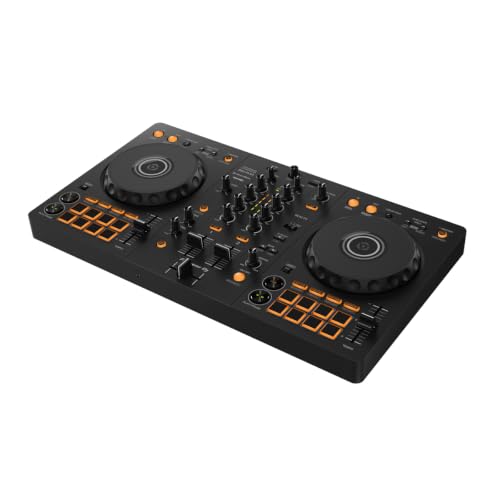
- 16 pads for cues, effects, beat jumps, and samples
- Smart Fader helps simplify beginner mixing
- Portable, streaming-ready two-channel design
Best For: Beginners learning DJ basics and streaming mixes
Best for Guided Skill Building

- Light guides assist with manual beatmatching
- Two-deck, full-featured controller layout
- Works with Serato, DJUCED, and listed streaming services
Best For: Learners practicing manual beatmatching
Best Scratch-Style Upgrade

- Battle-style layout with full-size jog wheels
- On-jog displays show playback position
- Pads trigger samples and hot cues
Best For: Scratch and open-format performance
Expressive Pad Production

- 16 velocity- and pressure-sensitive RGB pads
- Includes Studio One Artist and Ableton Live Lite
- 20 assignable buttons and four rotary encoders
Best For: Music production and expressive sample performance
Battle-Style DJ Control

- Open battle-style layout for two-deck control
- Serato DJ Lite access included
- Tall pitch faders and Tracking Scratch feature
Best For: Beginners learning scratch and open-format DJing
Serato Sample Performance

- Dedicated Serato DJ USB pad controller
- Eight modes supporting up to four decks
- Flip mode and smart linking for expanded control
Best For: Serato sample triggering and multi-deck pad performance
Add-On Pad Power – Pioneer DJ DDJ-XP2
The Pioneer DJ DDJ-XP2 is a focused choice for DJs who want more hands-on control from their existing setup. As one of the more specialized dj controllers with performance pads, it adds 32 pads for triggering cues, loops, samples, and effects while working with rekordbox and Serato DJ Pro.
Best For: DJs expanding a CDJ, laptop, or all-in-one setup with dedicated pad control.
Pros:
- Provides 32 performance pads with three pad mode banks.
- Supports rekordbox and Serato DJ Pro.
- USB bus powered with a plug-and-play setup.
- Slim, portable design fits alongside existing gear.
Cons:
- It is an add-on controller rather than a complete standalone DJ system.
- Its usefulness depends on having compatible main equipment and software.
The DDJ-XP2 makes sense when your current rig already handles mixing but lacks tactile pad access. Its compact footprint and broad software support make it a practical creative extension.
Accessible Two-Deck Mixing – Numark Mixtrack Pro FX
The Numark Mixtrack Pro FX is a complete two-deck controller for Serato DJ Lite, pairing large jog wheels with performance pads and built-in audio connectivity. It is a straightforward option for DJs looking for dj controllers with performance pads, dedicated effects, and familiar mixer controls.
Best For: Beginners and developing DJs who want an all-in-one two-deck Serato system.
Pros:
- Includes Serato DJ Lite and offers plug-and-play USB connectivity.
- Provides eight performance pads per deck for cues, loops, cuts, and samples.
- Large six-inch capacitive jog wheels support scratching and beatmatching.
- Includes six effects, loop controls, microphone input, headphone output, and RCA output.
Cons:
- It is limited to a two-deck layout.
- Serato DJ Lite is the included software.
With its integrated audio interface and clearly separated controls, the Mixtrack Pro FX covers the essentials without requiring a separate mixer or sound card. It is especially approachable for home practice and early live sets.
Professional Four-Channel Control – Pioneer DJ DDJ-FLX10
The Pioneer DJ DDJ-FLX10 is a four-channel performance controller aimed at serious hobbyists, mobile DJs, and professionals. Among dj controllers with performance pads, it stands out for track separation, large jog displays, rekordbox and Serato DJ Pro support, and a workflow designed to translate to club-standard equipment.
Best For: Experienced DJs who need four-channel control, live remixing, and a professional-style layout.
Pros:
- Offers a four-channel layout with club-oriented workflow and pro effects.
- Track Separation enables live control of vocals, drums, and instruments.
- Multicolor on-jog displays show waveforms, artwork, and playing parts.
- Supports rekordbox, Serato DJ Pro, and DMX lighting output.
Cons:
- Its 14.8-pound weight makes it less portable than compact controllers.
- The advanced feature set may be more than casual DJs need.
The DDJ-FLX10 is built for performance flexibility rather than minimalism. Its four-channel architecture and remix-oriented features make it a strong bridge between computer DJing and a professional booth workflow.
Practical Two-Deck Performance – Hercules DJControl Inpulse 500
The Hercules DJControl Inpulse 500 combines two-deck mixing with 16 backlit RGB pads, touch-sensitive jog wheels, and a built-in audio interface. It is a practical pick among dj controllers with performance pads, particularly for DJs who want Serato or DJUCED compatibility and useful hardware controls in a sturdy layout.
Best For: Home DJs and developing performers who want pad features, scratching controls, and flexible audio connections.
Pros:
- Includes 16 backlit RGB pads for performance control.
- Offers vinyl function, loop in/out buttons, and touch-detecting jog wheels.
- Includes a built-in audio interface and hardware input mixer.
- Retractable feet raise the controller above a surface.
Cons:
- It is a two-deck controller rather than a four-channel system.
- The supplied notes do not specify the included software tier or detailed output connections.
The Inpulse 500 balances performance features with practical setup details. Its RGB pads, jog wheels, filter/FX area, and elevated footprint make it a versatile option for learning and small-scale performance.
Best Beginner All-Rounder – DDJ-FLX4
The Pioneer DJ DDJ-FLX4 is a practical starting point among DJ controllers with performance pads. Its straightforward two-channel layout, Smart Fader, and 16 pads give beginners room to learn while supporting hot cues, effects, beat jumps, and samples.
Best For: Beginners who want an approachable controller for learning, streaming, and gradual skill development.
Pros:
- Simple layout modeled after Pioneer DJ gear
- 16 performance pads support hot cues, Pad FX, Beat Jump, and sampling
- Smart Fader can help blend tracks without manual beatmatching
- Works with computers, mobile devices, and supported streaming services
Cons:
- Limited to two channels and two-deck control
- Its beginner-focused workflow may be less suitable for advanced setups
The DDJ-FLX4 stands out as a flexible, portable choice for first mixes and home streaming. It offers useful pad control without making the overall interface intimidating.
Best for Guided Skill Building – DJControl Inpulse 300 MK2
The Hercules DJControl Inpulse 300 MK2 is a full-featured two-deck option for learners comparing DJ controllers with performance pads. Built-in light guides support manual beatmatching, while Serato and DJUCED compatibility gives new DJs a structured way to practice.
Best For: Beginners who want visual guidance while developing manual beatmatching and two-deck mixing skills.
Pros:
- Two-deck controller with a full-featured layout
- Built-in light guides assist with manual beatmatching
- Supports Serato and DJUCED
- Can mix music from a computer or listed streaming services
Cons:
- The supplied notes do not specify the number or functions of its performance pads
- Its two-deck design may not suit DJs seeking a larger multi-channel setup
The Inpulse 300 MK2 focuses on technique development rather than simply automating the mix. Its visual beatmatching guidance makes it a sensible training-oriented alternative.
Best Scratch-Style Upgrade – DDJ-REV5
The Pioneer DJ DDJ-REV5 is aimed at DJs who want a more performance-focused option among DJ controllers with performance pads. Its battle-style two-channel layout, full-size jog wheels, on-jog displays, and pads for samples and hot cues support scratch and open-format workflows.
Best For: Scratch-focused and open-format DJs who want a battle-style layout with club-inspired controls.
Pros:
- Battle-style layout with full-size jog wheels
- On-jog displays show playback position
- Includes rekordbox and Serato DJ Pro support
- Performance pads trigger samples and hot cues
Cons:
- Scratch-oriented layout may feel less familiar to traditional mixer users
- Its 14-pound weight makes it less portable than lightweight controllers
The DDJ-REV5 is the most performance-oriented choice here, especially for scratch techniques and open-format sets. Choose it when tactile jog-wheel control and pad-triggered samples matter more than beginner simplicity.
Expressive Pad Production – PreSonus ATOM
The PreSonus ATOM is a compact option for anyone seeking dj controllers with performance pads alongside music-production features. Its 16 full-size RGB pads support velocity and pressure sensitivity, while assignable controls help you trigger samples, loops, effects, and virtual instruments from compatible software.
Best For: Producers and performers who want expressive pads with Studio One Artist and Ableton Live integration.
Pros:
- Includes 16 velocity- and pressure-sensitive RGB pads with eight assignable pad banks.
- Works with Studio One Artist, Ableton Live Lite, and most music-production software via USB.
- Offers 20 assignable buttons, four endless rotary encoders, and customizable pad response.
- Includes the Studio Magic Plug-In Suite and MVP Loops content.
Cons:
- It is a pad controller rather than a complete two-deck DJ controller.
- Its feature set depends on compatible computer or mobile software.
Choose the ATOM when pad expression and production flexibility matter more than traditional DJ decks. Its included software and customizable response make it a versatile USB centerpiece for beat-making and performance.
Battle-Style DJ Control – Pioneer DJ DDJ-REV1
The Pioneer DJ DDJ-REV1 is a practical entry point for shoppers comparing dj controllers with performance pads for scratch and open-format sets. Its battle-style two-deck layout, tall pitch faders, quick effects controls, and Serato DJ Lite support are designed to get beginners performing quickly.
Best For: Beginners learning scratch techniques, hip-hop mixing, and open-format performance.
Pros:
- Battle-style layout mirrors a classic turntable and mixer setup.
- Includes access to Serato DJ Lite for immediate computer-based performance.
- Tall pitch faders and accessible effects controls support scratch techniques.
- Tracking Scratch can trigger scratch routines with a single motion.
Cons:
- It is designed for PC and Mac use rather than standalone operation.
- Its compact, budget-focused design may be less suited to advanced users.
- The supplied notes do not specify dedicated performance-pad features.
The DDJ-REV1 makes the most sense for a first controller focused on battle-style mixing. Select it for its approachable layout and scratch-oriented tools, while keeping in mind that its strengths are traditional DJ control rather than pad-heavy production.
Serato Sample Performance – Reloop AMS-NEON
The Reloop AMS-NEON is a dedicated USB pad controller for Serato DJ users who want hands-on sample control. Its backlit, velocity-sensitive pads support Serato SP6 performance, multiple power modes, up to four decks, and on-the-fly recording and playback through Flip mode.
Best For: Serato DJ performers who prioritize sample triggering, effects, and multi-deck pad control.
Pros:
- Designed specifically for Serato DJ and described as an extensive Serato SP6 sample controller.
- Provides eight power modes with access to up to four decks.
- Flip mode supports recording and playing back performances on the fly.
- Two Neon controllers can be connected using the smart link function.
Cons:
- It is a modular pad controller, not a full DJ deck and mixer.
- Its feature set is centered on Serato DJ compatibility.
- Using multiple units requires an additional Neon controller.
The AMS-NEON is a focused choice for DJs who want to expand a Serato setup with dedicated performance pads. It is especially compelling for sample-heavy sets, though users needing full deck control will need separate equipment.
How We Picked the Best Dj Controllers with Performance Pads
We focused on pad functionality, layout, software compatibility, deck control, performance features, and suitability for different experience levels. The selection includes traditional two- and four-channel DJ controllers, scratch-oriented models, and dedicated pad controllers that can expand an existing setup.
We also considered whether each product supports practical performance tasks such as cue triggering, loop creation, sample playback, beat slicing, stems control, and remixing. Compatibility matters, so check the included or supported software before buying.
Quick Comparison
| Best For | What to Look For |
|---|---|
| Beginners | Clear controls, guided software, approachable two-deck layout |
| Scratch DJs | Responsive jog wheels, crossfader-focused layout, scratch modes |
| Open-format performance | Multiple pad modes, hot cues, samples, loops, and stems controls |
| Advanced mixing | Four-channel control, track separation, flexible routing |
| Pad expansion | Dedicated performance pads that complement an existing controller |
| Music production | MIDI pad mapping, velocity sensitivity, and DAW compatibility |
Key Buying Factors for Dj Controllers with Performance Pads
Pad Layout and Modes
Look for pads that are large enough to hit accurately and offer the modes you actually use. Hot cues are essential for quick transitions, while loop, sampler, slicer, and stems modes are valuable for creative sets. A dedicated pad controller may provide more triggering space than an all-in-one unit.
Software Compatibility
Confirm whether the controller is designed for rekordbox, Serato DJ, DJUCED, Ableton Live, Studio One, or another platform. Some features, including stems and advanced pad mappings, may require specific software editions or upgrades.
Deck Control and Mixing Workflow
Consider whether two decks are sufficient or whether you need four-channel mixing. Jog-wheel size, channel-strip layout, EQ controls, looping access, and crossfader feel can have a greater effect on usability than the pad count alone.
Connectivity and Portability
Check for laptop, USB, microphone, headphone, and booth outputs, along with the controller’s dimensions and power requirements. A compact model is convenient for travel, while a larger unit may offer better spacing and more connections.
Who Should Buy Which Dj Controllers with Performance Pads?
Choose an entry-level two-deck controller if you are learning to mix and want an integrated, straightforward setup. These models typically provide the essential pads and controls without an intimidating layout.
Choose a scratch-focused controller if turntablism, jog-wheel response, and crossfader technique are central to your sets. Look for scratch-specific features and enough room for fast hand movements.
Choose a four-channel controller if you mix multiple decks, layer acapellas, use stems, or want room to grow. It is usually the better long-term investment for advanced performers.
Choose a dedicated pad controller if you already own a DJ setup but need more cue, sample, loop, or remix triggers. For producers, prioritize MIDI mapping, velocity response, and DAW support over traditional deck controls.