Choosing a compact MIDI keyboard controller comes down to feel, features, and how well it fits your workflow. The right model can make beat-making, sketching melodies, and controlling your DAW much faster.
Below, we focus on portable options that balance size with useful creative tools, so you can pick the best fit for your studio, travel setup, or first music-production rig.
Best 10 Compact Midi Keyboard Controller Picks for 2026
Studio Beatmaker Pick
Akai MPK Mini MK3 25-Key Controller

- 25 velocity-sensitive mini keys
- 8 MPC-style backlit pads and 8 knobs
- Built-in arpeggiator and thumbstick control
Best For: Bedroom producers and beat makers who want a portable controller with pads and bundled software
Ultra-Slim Portable Pick
Korg nanoKEY2 25-Key Controller

- Low-profile 25-key USB-MIDI design
- Velocity-sensitive keys with wider spacing
- Sustain button for piano parts
Best For: Laptop musicians who want an ultra-thin controller for basic note entry and portable setup
Hybrid Control Pick
Akai MPK Mini Plus 37-Key Controller

- 37 mini keys with 3 full octaves
- 64-step sequencer for standalone ideas
- MIDI/CV/Gate I/O for external gear
Best For: Producers who want a portable keyboard with more range, sequencing, and hardware connectivity
Modern Minimal Pick
Arturia MicroLab Mk3 Compact Controller

- USB-C powered and lightweight
- 25 velocity-sensitive keys with slim keybed
- Pitch/mod touch strips and sustain input
Best For: Mobile creators and small-studio users who want a simple, lightweight controller with modern connectivity
Novice-Friendly Creation Hub
Donner DMK 25 Pro Black with lessons and scale tools

- 25-key USB-C mini controller
- 16 smart scales and performance modes
- 40 teaching courses included
Best For: Beginners who want software-guided music creation
FL Studio Shortcut Controller
Novation FLkey Mini for FL Studio beat-making
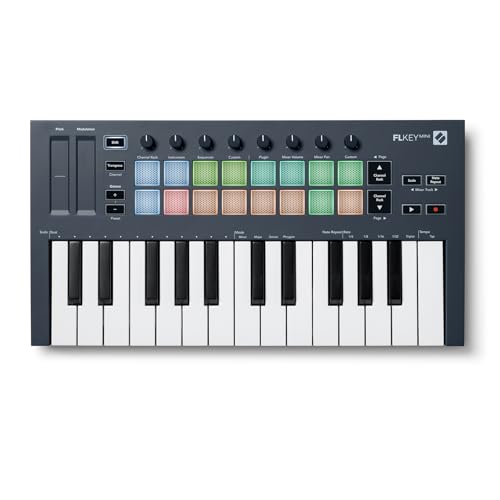
- Built for FL Studio mixer and channel rack control
- 16 pads with 8 encoders for sequencing
- Scale and chord modes keep ideas musical
Best For: FL Studio users who want a streamlined production controller
Portable Sound-On-Board Pick
Akai MPK Mini Play MK3 with built-in speaker

- Built-in speaker with 100+ internal sounds
- 25-key keybed plus 8 MPC pads
- Runs on batteries or USB power
Best For: Musicians who want standalone sound in a compact controller
Compact Starter Pick
Akai Professional LPK25 USB MIDI Keyboard Controller

- 25 responsive mini keys in a slim 25-key layout
- Octave buttons, sustain, and arpeggiator add flexibility
- USB-powered plug-and-play setup for Mac or PC
Best For: Writers and mobile producers who want a simple, portable key-only controller
Modern Control Pick
Akai Professional MPK Mini IV USB-C MIDI Keyboard Controller

- 25 mini keys plus 8 RGB MPC pads for playing and beat making
- 8 assignable knobs and a color screen for hands-on workflow
- USB-C, MIDI Out, and DAW integration support flexible setups
Best For: Beginners and producers who want a portable, feature-packed controller
Value Performance Pick
Akai Professional MPK Mini MK3 25 Key USB MIDI Keyboard Controller

- 25 mini velocity-sensitive keys with a compact footprint
- 8 backlit pads, 8 knobs, and thumbstick for hands-on control
- Includes NKS support plus starter production software
Best For: Producers who want a compact controller with pads, knobs, and broad software support
Studio Beatmaker Pick – Akai MPK Mini MK3 25-Key Controller
If you want a compact midi keyboard controller that still feels geared toward full music production, the Akai Professional MPK Mini MK3 is built for that job. It combines 25 velocity-sensitive mini keys, 8 backlit MPC-style pads, 8 assignable knobs, and a 4-way thumbstick, so it can handle melodies, drums, and basic control in a very small footprint.
Best For: Bedroom producers and beat makers who want a portable controller with pads, knobs, and bundled software.
Pros:
- 25 velocity-sensitive mini keys in a truly portable USB-powered format
- 8 backlit MPC-style pads with Note Repeat and Full Level for beat programming
- 8 assignable 360-degree knobs for hands-on control of plugins and mixing
- Built-in arpeggiator plus 4-way thumbstick for pitch and modulation control
Cons:
- Mini-key format may feel limiting for players used to full-size keys
- Best suited to DAW-based workflows rather than standalone use
Overall, the MPK Mini MK3 is a strong compact midi keyboard controller for producers who value pad control and software-ready workflow in a lightweight design. Its feature set is broad for the size, making it a practical pick for sketches, beats, and travel setups.
Ultra-Slim Portable Pick – Korg nanoKEY2 25-Key Controller
The Korg nanoKEY2 is a very slim compact midi keyboard controller designed for simple laptop-based music entry. Its 25 low-profile USB-MIDI keys and velocity-sensitive response make it easy to sketch parts in tight spaces, and the sustain button adds a useful touch for playing piano-style lines.
Best For: Laptop musicians who want an ultra-thin controller for basic note entry and portable setup.
Pros:
- Extremely slim, low-profile design that fits easily beside a laptop
- 25 velocity-sensitive keys with improved key width and spacing
- Sustain button helps when entering piano parts
- USB-powered simplicity for quick mobile use
Cons:
- Very minimal control layout compared with pad-equipped controllers
- More limited for hands-on production and performance tasks
The nanoKEY2 is a practical choice if you mainly need a lightweight keyboard for note input rather than a feature-heavy controller. For streamlined sessions and travel-friendly setups, it keeps the focus on portability and basic playing accuracy.
Hybrid Control Pick – Akai MPK Mini Plus 37-Key Controller
If your compact midi keyboard controller needs to do more than basic note entry, the Akai Professional MPK Mini Plus adds extra reach and connectivity. It steps up to 37 mini keys, includes 8 RGB MPC pads and 8 assignable knobs, and adds MIDI/CV/Gate I/O plus a built-in 64-step sequencer for working with both software and external gear.
Best For: Producers who want a portable keyboard with more range, sequencing, and hardware connectivity.
Pros:
- 37 mini keys provide 3 full octaves for more melodic range
- Built-in 64-step sequencer supports computer-free composition
- MIDI/CV/Gate I/O expands control over synths and modular gear
- 8 RGB MPC pads, transport controls, and 8 knobs support DAW workflow
Cons:
- Larger than a typical 25-key compact controller
- May be more controller than needed for simple note input
Compared with smaller models, the MPK Mini Plus is aimed at users who want a portable controller with deeper production features and broader hardware integration. It is a smart fit if you need extra keys and sequencing without moving to a full-size keyboard.
Modern Minimal Pick – Arturia MicroLab Mk3 Compact Controller
The Arturia MicroLab Mk3 is a compact midi keyboard controller built for fast setup and mobile production. It uses 25 velocity-sensitive keys, USB-C power, pitch and mod touch strips, and a sustain pedal input, while also bundling Analog Lab Intro and Ableton Live Lite to help you start making music quickly.
Best For: Mobile creators and small-studio users who want a simple, lightweight controller with modern connectivity.
Pros:
- USB-C powered and lightweight for easy mobile use
- 25 velocity-sensitive keys with an upgraded slim keybed
- Pitch and mod touch strips plus sustain pedal input
- Includes Analog Lab Intro presets and Ableton Live Lite
Cons:
- Minimal control surface compared with pad- and knob-heavy controllers
- Better for simple, immediate workflows than deep hardware control
For buyers who want a streamlined compact midi keyboard controller with a modern feel, the MicroLab Mk3 keeps the setup clean and practical. Its focus is on portability, key feel, and immediate software access rather than extra performance controls.
Novice-Friendly Creation Hub – Donner DMK 25 Pro Black with lessons and scale tools
If you want a compact midi keyboard controller that feels focused on learning and fast idea capture, the Donner DMK 25 Pro Black gives you a 25-key portable layout with drum pads, an OLED display, and hands-on controls for scales, arpeggios, note repeat, and chord playback. It is designed to work with a phone, tablet, or computer DAW rather than make sound on its own, so it fits best when you already plan to produce through software.
Best For: Beginners and mobile producers who want a small controller with guided lessons and easy scale-based creativity.
Pros:
- 16 smart scale tones help you move across different musical styles.
- Includes arpeggio, note repeat, and chord functions for quick clip building.
- Comes with 40 teaching courses plus 4 DAW software options.
- USB-C connectivity and mobile compatibility support portable setups.
Cons:
- Does not produce sound by itself and must be connected to software.
- Mobile use may require a compatible OTG adapter sold separately.
Overall, this is a practical starter pick if you want guided learning plus compact performance controls in one portable controller. Its strongest appeal is how much included software and instruction it brings to a small footprint.
FL Studio Shortcut Controller – Novation FLkey Mini for FL Studio beat-making
The Novation FLkey Mini is a compact midi keyboard controller built specifically for FL Studio users who want hands-on access without spending time mapping controls manually. With 25 mini keys, 16 pads, 8 encoders, touch strips, and scale and chord modes, it is aimed at faster beat-making and easier channel rack or step sequencer control.
Best For: FL Studio producers who want tight software integration in a small, portable layout.
Pros:
- Designed for FL Studio with mixer and channel rack control.
- Eight knobs and pads make step sequencing and volume/pan tweaks easy.
- Scale mode and chord modes help keep melodies in key.
- Bus-powered USB-C design suits simple desktop or laptop setups.
Cons:
- Its strongest integration is centered on FL Studio rather than broad general-purpose control.
- Mini keys may feel cramped if you prefer larger keybeds.
If FL Studio is your main DAW, this controller offers a very direct workflow for programming drums, sketching melodies, and shaping beats. It is especially appealing for users who value streamlined software integration over extra standalone features.
Portable Sound-On-Board Pick – Akai MPK Mini Play MK3 with built-in speaker
The Akai Professional MPK Mini Play MK3 stands out in the compact midi keyboard controller category because it can work as both a USB MIDI controller and a standalone mini keyboard with built-in speaker and internal sounds. It combines a 25-key dynamic keybed, 8 velocity-sensitive MPC pads, an OLED display, four encoder knobs, arpeggiator, and note repeat, making it a flexible option for sketching ideas anywhere.
Best For: Players who want a small controller that can also make sound without a computer.
Pros:
- Built-in speaker and 100+ internal drum and instrument sounds.
- 25-key dynamic keybed with 8 backlit velocity-sensitive pads.
- Arpeggiator, note repeat, and four encoder knobs add creative control.
- Can run on batteries or USB power for portable use.
Cons:
- Batteries are not included if you want untethered use.
- The mixer control section is limited compared with larger controllers.
For musicians who want a controller that can travel easily and still produce sound on its own, this is the most self-contained option here. It is especially useful for quick songwriting, practice, and beat ideas when you do not want to rely entirely on a DAW.
Compact Starter Pick – Akai Professional LPK25 USB MIDI Keyboard Controller
If you want a compact midi keyboard controller that keeps the footprint small without feeling stripped down, the Akai Professional LPK25 is a straightforward choice. Its 25 responsive mini keys, octave controls, sustain button, and built-in arpeggiator make it useful for sketching melodies, bass lines, and quick ideas in a very portable setup.
Best For: Writers, beat makers, and mobile producers who want a simple 25-key controller with basic performance controls and easy USB setup.
Pros:
- 25 responsive mini keys support expressive playing and compact setups.
- Octave up/down buttons and sustain add useful range and flexibility.
- Built-in arpeggiator and clock expand creative options for software instruments.
- USB-powered plug-and-play operation works with Mac or PC.
Cons:
- No drum pads or knobs for hands-on control of plugins.
- Best suited to keyboard entry rather than deep beat programming.
The LPK25 is a practical buy if you mainly need portability and key-focused input. It keeps the workflow simple, which is ideal when you want to spend less time setting up and more time writing.
Modern Control Pick – Akai Professional MPK Mini IV USB-C MIDI Keyboard Controller
The Akai Professional MPK Mini IV is a strong compact midi keyboard controller if you want a small footprint with more hands-on control than a basic mini board. Along with 25 mini velocity-sensitive keys, it adds RGB MPC pads, assignable 360-degree knobs, a color screen, and deep DAW integration for a more complete production workflow.
Best For: Beginners and producers who want a portable controller with pads, knobs, a display, and modern USB-C connectivity.
Pros:
- 25 velocity-sensitive mini keys are paired with 8 MPC pads for beat work.
- 8 assignable 360-degree knobs and a full-color screen improve hands-on control.
- Arpeggiator, chord, and scale modes help generate ideas quickly.
- USB-C, full-size MIDI Out, and plug-and-play support add setup flexibility.
Cons:
- More features may be unnecessary if you only need a simple keyboard surface.
- Advanced controls can take longer to learn than a bare-bones controller.
This model is the most feature-rich of the group, so it suits users who want a compact controller that can handle both playing and navigation. It is a good fit when portability matters, but you still want modern production tools close at hand.
Value Performance Pick – Akai Professional MPK Mini MK3 25 Key USB MIDI Keyboard Controller
The Akai Professional MPK Mini MK3 remains a popular compact midi keyboard controller for producers who want a lot of functionality in a very small format. Its 25 velocity-sensitive keys, 8 backlit MPC-style pads, 8 knobs, thumbstick control, and arpeggiator make it well suited to beat production, virtual instrument control, and quick sketching.
Best For: Producers who want a compact, affordable-feeling controller with pads, knobs, and broad software support.
Pros:
- 25 velocity-sensitive mini keys keep the layout compact and portable.
- 8 backlit pads and 8 knobs give you strong control over drums and plugins.
- 4-way thumbstick adds pitch and modulation control in a small footprint.
- NKS integration and included software make it easy to start producing.
Cons:
- USB 2.0 Type B feels less modern than newer USB-C designs.
- Mini keys may feel tight for players who prefer larger keyboards.
For buyers who want a proven all-rounder, the MPK Mini MK3 offers a balanced mix of playability and control. It is especially appealing if you want a compact controller that still feels ready for full production tasks.
How We Picked These Compact Midi Keyboard Controller Options
We prioritized portability, key response, DAW compatibility, pad and knob count, and overall value. We also favored controllers that offer enough hands-on control to speed up writing and beat production without taking up much desk space.
Quick Comparison
For the smallest footprint, simple two-octave models are easiest to travel with. If you want more performance control, look for extra pads, encoders, scale/chord modes, or a sequencer. Some compact designs also add USB-C power, pitch/mod controls, or built-in sound sources for standalone practice.
Key Buying Factors for a Compact Midi Keyboard Controller
Key Size and Feel
Mini keys save space, but the best option still needs a response that suits your playing style. Beginners may prefer a lightweight action, while finger-drummers and melodic players often want more expressive velocity sensitivity.
Controls and Workflow
Pads, knobs, transport buttons, and touch strips can reduce mouse use and improve speed in a DAW. If you produce beats, pad quality matters. If you mix or automate frequently, knobs and transport control may matter more than extra keys.
Portability and Power
USB-powered and bus-powered controllers are the easiest to move between desk, laptop, and live setups. If you travel often, consider weight, build quality, and whether the controller uses USB-C for simpler cable management.
Software and Compatibility
Most compact controllers work with major DAWs, but bundled software can add real value for new buyers. Check whether the included mapping or templates match the software you actually use.
Who Should Buy Which Compact Midi Keyboard Controller?
Beginners usually do best with a straightforward Compact Midi Keyboard Controller that includes pads, knobs, and easy software setup. Beatmakers should lean toward models with strong drum-pad layouts and performance features. Producers who prioritize melody writing may prefer a more playable keybed, while mobile users should focus on the lightest, most durable USB-C option available.
If you want one controller to handle sketching ideas, triggering drums, and basic mixing, choose a well-rounded model. If your setup is minimal, a simpler controller can be the smarter buy because it keeps the workflow clean and easy to learn.