The best compact drum machines make it easier to sketch rhythms, build tracks, and perform without carrying a full studio setup. The models in this roundup range from pocket-sized grooveboxes to compact analog and digital rhythm machines.
Use this guide to compare sequencing, sound design, sampling, portability, connectivity, and workflow so you can choose a drum machine that fits the way you actually make music.
Best 10 Compact Drum Machines Picks for 2026
Roland AIRA T-8
Portable TR Drum and Bass Machine

- TR-808, TR-909, and TR-606 drums
- TB-303-style bass with ACB modeling
- USB-C audio and MIDI connectivity
Best For: Portable acid jams, live beatmaking, and Roland-style sounds
Korg Volca Drum
Digital Percussion Synthesizer

- Six-part DSP drum synthesis engine
- Waveguide resonator for rich textures
- Active Step and Slice pattern tools
Best For: Experimental percussion and portable pattern creation
Akai MPC Sample

- Standalone battery-powered sampler
- 16 MPC pads and built-in microphone
- Sampling, sequencing, and onboard effects
Best For: DAWless beatmaking, sample chopping, and mobile production
Pocket Operator PO-12
Ultra-Portable Rhythm Sequencer

- Synthesized and sampled drum sounds
- 16 punch-in effects and pattern chains
- Battery powered with speaker and line out
Best For: Pocket-sized beat sketches and beginner-friendly rhythm making
Portable Practice Pick

- 16 velocity-sensitive pads for expressive playing
- 126 patterns plus 14 user preset slots
- Battery-powered with built-in speaker and metronome
Best For: Portable practice and accessible finger drumming
Analog Performance Choice

- Separate accent controls for each drum
- Song mode chains patterns
- Color sound-shaping on most instruments
Best For: Hands-on pattern performance and studio setups
Sample-Based Sequencing Pick
- 8-voice polyphony with 16-step sequencing
- Pattern chain mode and expanded sample memory
- Battery-powered with speaker and headphone output
Best For: Portable sample-based beat making
Best Stylus Pick

- Four drum kits and four bass sounds
- Records layers and multiple patterns
- Built-in speaker, headphone output, and battery power
Best For: Portable beat-making and beginner-friendly practice
Best Pad-Controlled Option

- 16 touch-sensitive finger pads
- 48 drum kits and 100 preset patterns
- USB-C or battery power with included foot pedal
Best For: Pad performance and hands-free rhythm control
Best Analog-Style Choice

- 15 classic analog drum sounds
- 34 rhythm presets and a 16-step sequencer
- Alloy-steel build for studio or live use
Best For: Analog-style beat programming and live performance
Roland AIRA T-8 – Portable TR Drum and Bass Machine
The Roland AIRA Compact T-8 is a strong choice if you want compact drum machines with authentic classic rhythm sounds and a built-in bass machine. Its TR-808, TR-909, and TR-606 drum sounds, plus TB-303-style bass, make it especially useful for portable jamming, acid lines, and hands-on beat programming.
Best For: Beginners, live performers, and producers who want genuine Roland-inspired drums and bass in a highly portable format.
Pros:
- Includes TR-808, TR-909, and TR-606 drum sounds with TB-303 bass.
- Offers a 16-step sequencer with probability, sub step, last step, and velocity controls.
- Built-in delay, reverb, overdrive, and sidechain compression add performance flexibility.
- USB-C provides class-compliant audio and MIDI connectivity without drivers.
Cons:
- Its compact controls may be less comfortable for highly detailed programming.
- The design focuses on drums and bass rather than broad multi-instrument production.
The T-8 stands out among compact drum machines for combining recognizable Roland sounds, performance effects, and useful sequencing tools in a 1.3-pound unit. It is a particularly practical pick for quick idea generation and mobile electronic music setups.
Korg Volca Drum – Digital Percussion Synthesizer
Korg Volca Drum Digital Percussion Synthesizer w/ 16-step Sequencer and Active Step
Check Price On AmazonThe Korg Volca Drum is one of the more approachable compact drum machines for creating unusual digital percussion. Its six-part DSP synth engine, waveguide resonator, and pattern-randomizing tools make it a good fit when you want sounds beyond standard sample-based beats.
Best For: Producers and performers seeking experimental percussion, portable sequencing, and an immediate hands-on workflow.
Pros:
- Six-part DSP synthesis engine delivers a broad range of distinctive drum sounds.
- Waveguide resonator adds rich resonance and tonal character.
- Active Step, Slice, and randomize functions help generate evolving patterns.
- Built-in speaker supports convenient on-the-go music creation.
Cons:
- Its Auxiliary connector setup may require additional equipment for some rigs.
- The digital synthesis approach may not suit buyers specifically seeking realistic acoustic drum samples.
With accent, choke, slicing, and active-step features, the Volca Drum offers more rhythmic variation than its small footprint suggests. Choose it if sound design and pattern experimentation matter more to you than traditional drum-machine realism.
Akai MPC Sample – Portable Sampling Beatmaker
The Akai MPC Sample broadens the idea of compact drum machines by combining MPC pads, sampling, sequencing, effects, and standalone operation. Its rechargeable battery, speaker, microphone, microSD storage, and built-in display make it a flexible option for making sample-based beats away from a computer.
Best For: Beatmakers, finger drummers, DAWless creators, and beginners who want portable sampling alongside drum sequencing.
Pros:
- Standalone, battery-powered design includes a speaker, microphone, and rechargeable battery.
- Sixteen MPC pads and a 2.4-inch color display support hands-on beatmaking.
- Includes sample chopping, timestretching, repitching, resampling, and over 100 factory kits.
- Offers four internal effects processors with 60 effect types.
Cons:
- The MIDI adapter is not included and is needed for MIDI DIN connections.
- Its broader sampling workflow may be more involved than a dedicated drum machine.
The MPC Sample is the most production-oriented choice here, especially for users who want to record and manipulate their own sounds. It remains compact while adding enough storage, connectivity, and effects for a portable production hub.
Pocket Operator PO-12 – Ultra-Portable Rhythm Sequencer
The teenage engineering PO-12 is an exceptionally small option among compact drum machines, offering synthesized and sampled drum sounds in a pocket-sized format. Its 16 punch-in effects, pattern chaining, built-in speaker, and battery operation make it well suited to spontaneous beat creation.
Best For: Beginners, mobile musicians, and producers who want an inexpensive, ultra-portable rhythm sketchpad.
Pros:
- Combines synthesized and sampled drum sounds in a very compact device.
- Includes 16 punch-in effects for quick sound manipulation.
- Supports pattern chains for arranging beats into longer tracks.
- Runs on two AAA batteries and includes a built-in speaker and 3.5mm line output.
Cons:
- The tiny form factor provides less physical control space than larger machines.
- It is focused on rhythm creation rather than full standalone music production.
- Its battery-powered design uses replaceable AAA batteries rather than a rechargeable battery.
The PO-12 is ideal when portability and immediacy matter most. It offers a surprisingly capable sequencing and effects workflow for its size, though users wanting sampling, extensive connectivity, or broader production features should consider a larger device.
Portable Practice Pick – Korg KR-11 Compact Rhythm Box
The Korg KR-11 is a straightforward choice among compact drum machines for practice, finger drumming, and portable rhythm playback. Its 16 velocity-sensitive pads, built-in speaker, metronome, and battery operation make it easy to use at home or on the go.
Best For: Portable practice, beginner-friendly beat making, and hands-on finger drumming.
Pros:
- 16 velocity-sensitive pads support expressive finger drumming.
- Includes 126 patterns across genres plus 14 user preset slots.
- Built-in speaker, headphone/line output, metronome, and battery operation support flexible practice.
- Optional pedal switch enables start/stop, pattern changes, and fill-ins.
Cons:
- Its 126 preset patterns and 14 user slots may offer less programming depth than larger machines.
- The compact body and built-in speaker prioritize portability over an expansive control layout.
The KR-11 stands out when simplicity and portability matter most. It is a practical rhythm companion rather than a deeply featured production workstation.
Analog Performance Choice – Arturia DrumBrute Impact
The Arturia DrumBrute Impact is one of the more performance-focused compact drum machines in this group. Separate accent controls, Song mode, and Color sound-shaping give hands-on users useful tools for building and chaining patterns.
Best For: Hands-on pattern performance and users who want analog drum-machine workflow with dedicated sound shaping.
Pros:
- Provides a separate accent for each drum.
- Song mode supports chaining patterns into longer arrangements.
- Optional Color sound-shaping is available on all instruments except the Cowbell.
- Metal construction and a 1/4-inch TRS connector suit a studio-oriented setup.
Cons:
- Color sound-shaping does not apply to the Cowbell.
- At 2.4 kg, it is less lightweight than the battery-powered portable options here.
- The supplied notes identify fewer built-in portability features than the other listed machines.
The DrumBrute Impact is a strong fit for users who value tactile control and arrangement features. Its heavier metal build makes it better suited to a dedicated setup than casual travel.
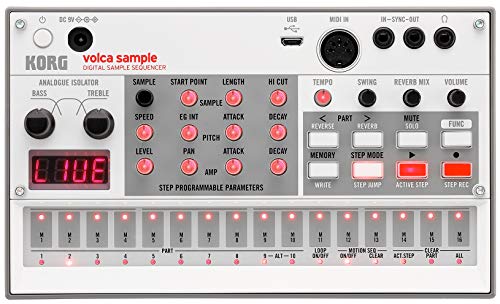
Sample-Based Sequencing Pick – Korg Volca Sample 2
Korg Volca Sample 2 Digital Sample Sequencer Drum Machine w/Pattern Chain Mode and 16-step Sequencer
Check Price On AmazonThe Korg Volca Sample 2 is a compact drum machine for sample-based beat making, with an 8-voice polyphonic engine and a 16-step sequencer. Pattern chaining, expanded memory, digital reverb, and computer connectivity make it especially useful for modern production workflows.
Best For: Sample-driven genres such as Future Bass, Trap, and Lo-Fi Hip Hop, especially in portable setups.
Pros:
- Offers 8-voice polyphony and a 16-step sequencer with pattern chain mode.
- Has double the memory of previous models for more samples and longer recordings.
- Includes digital reverb, a double filter, and dedicated Librarian software.
- Runs on six AA batteries or an AC adapter and includes a speaker and headphone output.
Cons:
- Its 16-step sequencing format may be limiting for users seeking longer pattern lengths without chaining.
- Sample management relies on computer connectivity and dedicated Librarian software.
- The supplied warranty information directs buyers to contact the seller or manufacturer.
The Volca Sample 2 is the most sample-oriented option here, balancing portability with useful sequencing and sound-shaping tools. It is a compelling choice when computer-assisted sample management is part of the workflow.
Best Stylus Pick – Stylophone Beat
The Stylophone Beat is a particularly compact drum machine for casual beat-making, layering rhythms, and portable practice. Its stylus interface combines four drum kits and four bass sounds with pattern recording, a click track, and tempo lock.
Best For: Portable beat-making, beginners, and headphone-based practice.
Pros:
- Compact 7.09 x 4.8 x 1.5-inch design with a built-in speaker.
- Four drum kits and four bass sounds provide a straightforward starting palette.
- Supports layered recording, multiple patterns, sound muting, click track, and tempo lock.
- Works with wired headphones and runs on three AA batteries.
Cons:
- AA batteries are required and not included.
- Only wired headphones are supported.
- Its plastic body may feel less rugged than metal-bodied alternatives.
Choose this model if small size and immediate, hands-on operation matter more than an extensive sound library. It offers useful sequencing features while remaining easy to carry.
Best Pad-Controlled Option – Medeli MR101S
The Medeli MR101S is a portable drum machine for players who prefer touch-sensitive finger pads and a broad selection of built-in rhythms. It includes 48 drum kits, 100 preset patterns, hands-free control through the included foot pedal, and USB-C or battery power.
Best For: Finger-pad performance, hands-free playing, and users wanting many preset rhythms.
Pros:
- Sixteen touch-sensitive finger pads support hands-on performance.
- Offers 48 drum kits and 100 preset drum patterns.
- Included foot pedal enables hands-free flexibility.
- Supports USB-C or battery power for portable use.
Cons:
- At 1.87 pounds, it is heavier than the Stylophone Beat.
- The supplied notes do not specify the included battery type or battery life.
- Its larger package dimensions may take more space in a portable setup.
The MR101S is a strong fit when preset variety and responsive pad control are higher priorities than the smallest possible footprint. The foot pedal adds useful flexibility for performance.
Best Analog-Style Choice – Behringer RD-78
The Behringer RD-78 brings classic analog drum-machine styling to a compact production and live-performance format. Its 15 drum sounds, 34 rhythm presets, and 16-step sequencer make it suited to programming beats with a direct, intuitive interface.
Best For: Music production, live performance, and users seeking classic analog drum sounds.
Pros:
- Includes 15 analog drum sounds and 34 rhythm presets.
- Sixteen-step sequencing supports programmed beat creation.
- Simple interface is designed for immediate use by beginners and experienced users.
- Alloy-steel construction is compact and intended for studio or live use.
Cons:
- Its 15.5-inch width makes it less compact than the other listed models.
- The supplied notes do not list battery operation.
- Its sound selection is smaller numerically than the Medeli MR101S’s kit library.
The RD-78 makes the most sense for users who value analog-style sounds, physical sequencing, and a durable build. It is portable enough for setups, though not the smallest option here.
How We Picked the Best Compact Drum Machines
We focused on machines that offer a genuinely portable footprint while still providing useful rhythm-making tools. The selection covers several approaches, including analog synthesis, digital percussion, sample sequencing, preset-based beatmaking, and performance-oriented pattern control.
We also considered sequencing depth, hands-on controls, sound variety, portability, connectivity, and learning curve. A compact unit should be more than small; it should provide a practical reason to use it in a studio, on stage, during travel, or as a quick songwriting tool.
Quick Comparison
| Best For | What to Prioritize |
|---|---|
| Portable sketching | Battery operation, built-in speaker, compact controls |
| Live performance | Pattern switching, effects, tactile pads or step controls |
| Sound design | Sound synthesis, parameter editing, sequencing flexibility |
| Sample-based production | Sample memory, sample transfer, pattern chaining |
| Beginners | Clear controls, accessible presets, fast pattern creation |
Key Buying Factors for Compact Drum Machines
Sound Engine
Decide whether you want synthesized drum sounds, samples, or both. Analog machines can deliver a focused and characterful palette, while digital instruments may offer greater variety and more unusual percussion textures. Sample-based models are useful when you want to work with recognizable kits or imported sounds.
Sequencing and Performance Controls
Look for the workflow that matches your habits. A straightforward 16-step sequencer is quick to learn, while parameter locks, active steps, effects, pattern chaining, and real-time recording add expressive control. If you perform live, prioritize controls that remain easy to reach while a pattern is playing.
Portability and Connections
Check dimensions, weight, power options, speaker availability, and headphone output before buying. MIDI, USB, and sync connections matter if you plan to integrate the unit with a DAW, keyboard, groovebox, or other hardware. Compact products can vary widely in how well they function away from a desk.
Workflow and Expandability
A small drum machine should encourage frequent use. Consider whether its interface feels immediate, whether patterns can be saved and chained, and whether sounds or samples can be expanded. Extra features are only valuable if they support your preferred way of working.
Who Should Buy Which Compact Drum Machines?
Choose a pocket-sized model if portability and spontaneous beatmaking are your top priorities. A digital percussion synthesizer is a strong fit for producers who want deeper sound shaping in a small format. Sample-focused machines suit users who prefer working from recorded or imported material.
For hands-on analog character, look toward a dedicated analog drum machine. If you want a simple rhythm box for practice, quick demos, or casual playing, prioritize immediate controls and built-in sounds over extensive editing. Producers building a broader hardware setup should give extra weight to MIDI, sync, pattern storage, and compatibility with their existing gear.