Finding the right materials for developing cellists means balancing technical progress with music that keeps practice interesting. This roundup brings together method books, solo collections, and duet arrangements for intermediate students.
Whether you are working on shifting, preparing a recital, or playing with another musician, these selections offer practical ways to build confidence and expand your repertoire.
Best 10 Cellos for Intermediate Players Picks for 2026
Structured Skill Builder
Essential Elements Cello Book 2

- Progressive technique and tone lessons
- EEi audio, videos, and assessments
- Suitable for lessons or home study
Best For: Students advancing beyond Book 1
Collaborative Repertoire Pick
Wicked Duets for Intermediate Cellos

- 13 duets for two cellists
- Classical favorites and original works
- Written around Grade 4–6+
Best For: Intermediate players practicing with a partner
Technique Progression Choice
Essential Elements Cello Book 3

- Exercises, studies, and scale routines
- EEi includes 150+ video demonstrations
- Continues the earlier series
Best For: Students extending the Essential Elements method
Classical Repertoire Sampler
Fifty Famous Classical Themes for Cello

- 50 easy and intermediate solos
- Recognizable classical melodies
- Chord changes for accompaniment
Best For: Students expanding classical solo repertoire
Technique Builder
Essential Technique for Strings: Cello

- Targets shifting, positions, scales, and bowing.
- Progressive studies support orchestra preparation.
- Works for lessons or self-guided practice.
Best For: Intermediate players strengthening core technique
Recital Repertoire

- Includes 17 graded classical solo pieces.
- Adds fingerings, bowings, and piano parts.
- Designed for recitals, contests, and study.
Best For: Intermediate players building performance repertoire
Position Study
The ABCs of Cello for the Intermediate, Book 2

- Introduces second position and finger placement.
- Combines exercises, melodies, scales, and arpeggios.
- Includes downloadable performances and piano parts.
Best For: Book 1 students expanding position and bowing skills
Best for Mixed-Instrument Practice
Intermediate Classic Duets for Violin and Cello

- 22 classical and traditional violin-cello duets
- Mostly easy keys with many first-position passages
- Melodies alternate between both players
Best For: Intermediate cellists who play with a violinist
Best for Broadway Repertoire
The Phantom of the Opera Cello Sheet Music

- Nine solo cello arrangements from the musical
- Designed for developing intermediate players
- Emphasizes expressive themes and tone control
Best For: Intermediate cellists who enjoy musical theater
Best for Two-Cello Ensembles
Intermediate Classic Duets for Two Cellos
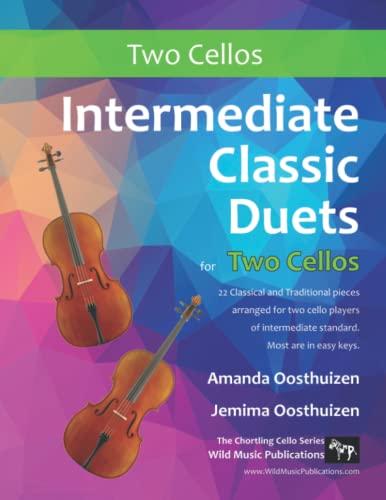
- 22 arrangements written for two cellos
- Mostly easy keys for Grade 4-plus players
- Melodies move between parts for balanced participation
Best For: Intermediate cellists performing with another cellist
Structured Skill Builder – Essential Elements Cello Book 2
For cellos for intermediate players, Essential Elements for Strings Cello Book 2 offers a clearly sequenced path beyond Book 1. It focuses on bow control, tone production, rhythmic precision, finger placement, and musical expression, making it practical for lessons, classroom work, or home practice.
Best For: Advancing students who want structured technique work with digital practice support.
Pros:
- Builds core skills through guided exercises, melodies, and technical studies.
- Includes EEi access with play-along audio, instructional videos, and self-assessment tools.
- Works for classroom instruction, private lessons, and independent study.
Cons:
- Designed as a method book rather than a broad collection of performance repertoire.
- Its 48-page format may be best used alongside continued teacher guidance.
Choose this volume when the student is progressing from Book 1 and needs a familiar, methodical system for improving tone, accuracy, and confidence.
Collaborative Repertoire Pick – Wicked Duets for Intermediate Cellos
Wicked Duets for Intermediate Cellos: 13 freakily fun duets arranged for two intermediate cellists
Check Price On AmazonAmong cellos for intermediate players, Wicked Duets stands out as a social, performance-focused option. It provides 13 arrangements for two cellists around Grade 4–6+, combining recognizable classical favorites with original pieces and a range of technical demands.
Best For: Intermediate cellists who want engaging duet practice with a partner.
Pros:
- Includes 13 pieces with varied difficulty, rhythms, melodies, and moods.
- Features works associated with Mozart, Chopin, Satie, Tchaikovsky, Bach, and others.
- Encourages ensemble playing and shared performance.
Cons:
- Requires two cellists, so it is less suitable for solo practice.
- Some selections may be challenging for players below the stated Grade 4–6+ range.
This is a lively complement to a traditional method book, especially for students motivated by recognizable tunes and the musical interaction of playing with another cellist.
Technique Progression Choice – Essential Elements Cello Book 3
Cellos for intermediate players can benefit from a more focused technical sequence, and Essential Elements Cello Book 3 continues the progression established in earlier volumes. Its exercises, musical studies, and scale routines address bow control, intonation, vibrato, shifting, expression, and ensemble development.
Best For: Students ready to continue the Essential Elements approach while deepening cello-specific technique.
Pros:
- Provides targeted exercises and scale routines for advancing technique.
- Includes EEi access with more than 150 video demonstrations, assignments, and assessments.
- Connects smoothly with the earlier Essential Elements books.
Cons:
- Its structured approach may feel less repertoire-oriented than a solo collection.
- Most useful for students already familiar with the Essential Elements sequence.
Select Book 3 when the player wants continuity with Books 1 and 2 and needs organized work on intonation, shifting, vibrato, and ensemble readiness.
Classical Repertoire Sampler – Fifty Famous Classical Themes for Cello
Fifty Famous Classical Themes for Cello: Easy and Intermediate Solos for the Advancing Cello Player
Check Price On AmazonFor cellos for intermediate players who want recognizable music, Fifty Famous Classical Themes for Cello offers 50 easy and intermediate solos. The collection spans well-known composers and works, with clear sheet music and chord changes for teacher-provided accompaniments.
Best For: Advancing students building a varied classical solo repertoire.
Pros:
- Offers 50 familiar themes in one compact collection.
- Includes arrangements suitable for easy and intermediate players.
- Chord changes support accompaniment supplied by a teacher.
Cons:
- Accompaniment is not described as included, so players may need a teacher or partner.
- The broad theme collection may provide less systematic technique instruction than a method book.
This book is a useful repertoire supplement for students who stay motivated by recognizable classical melodies and want variety beyond sequential technical exercises.
Technique Builder – Essential Technique for Strings: Cello
For cellos for intermediate players who want stronger fundamentals, Essential Technique for Strings: Cello provides graded studies focused on the skills used in orchestra performance. Its flexible sequence lets students work on shifting, higher positions, scales, keys, bowings, and special techniques at a suitable pace.
Best For: Intermediate students building technical control for classroom, private-lesson, or self-guided practice.
Pros:
- Focuses on shifting, positions, scales, bowings, and special techniques.
- Progressive studies balance technical development with musical expression.
- Useful for orchestra preparation, lessons, and independent practice.
Cons:
- Primarily a technique and study book rather than a recital-repertoire collection.
- Contains 48 pages, so advanced players may eventually need additional material.
This is a practical choice for players ready to move beyond beginner exercises and organize their technical practice. Its structured approach makes it especially useful when orchestra skills and consistent fundamentals are the priority.
Recital Repertoire – Solos for the Cello Player
For cellos for intermediate players needing performance material, Solos for the Cello Player offers 17 classical pieces arranged in order of difficulty. The collection includes cello parts with standard notation, fingerings, bowings, and piano accompaniment, making it suitable for guided study, recitals, and contests.
Best For: Intermediate cellists preparing classical selections for recitals, contests, or expressive practice.
Pros:
- Includes 17 pieces spanning a range of stylistic periods.
- Selections are arranged by increasing difficulty.
- Provides fingerings, bowings, and full piano accompaniment.
Cons:
- The accompaniment CD is available separately.
- Its focus is classical solo repertoire rather than technical exercises.
This volume is a strong repertoire-centered complement to a method book. The graded selections give intermediate players concrete performance goals while supporting tone, phrasing, reading, and musical confidence.
Position Study – The ABCs of Cello for the Intermediate, Book 2
For cellos for intermediate players progressing into second position, The ABCs of Cello for the Intermediate, Book 2 combines melodies, warm-ups, study pieces, scales, and arpeggios. It also adds slurred bowing techniques, new rhythms, key and time signatures, plus downloadable performance tracks and piano accompaniments.
Best For: Students continuing from Book 1 who want structured second-position practice with audio support.
Pros:
- Focuses specifically on learning second position and finger placement.
- Includes warm-ups, melodies, study pieces, scales, and arpeggios.
- Provides access to 84 MP3 tracks and downloadable piano-accompaniment PDFs.
Cons:
- Downloads require registration with an email address and password.
- As a continuation of Book 1, it may be less suitable for students without that foundation.
This is a focused progression book for students ready to expand left-hand range and rhythmic vocabulary. The audio and accompaniment materials can make home practice more guided and musical, provided the learner is prepared to work through the registration process.
Best for Mixed-Instrument Practice – Intermediate Classic Duets for Violin and Cello
For cellos for intermediate players who enjoy ensemble work, this 35-page collection pairs cello with violin in 22 classical and traditional arrangements. Written for players of a similar level, around Grade 4 and above, it offers mostly easy keys, many first-position passages, and melodies that move between both parts.
Best For: Intermediate cellists who regularly play with a violinist in lessons, at home, or for informal performances.
Pros:
- Includes 22 classical and traditional pieces in varied styles and tempos.
- Most selections use easy keys and are playable in first position.
- Both players get opportunities to play the tune, encouraging active listening.
- Includes recognizable works by Beethoven, Saint-Saëns, Dvořák, Holst, Elgar, and others.
Cons:
- Some pieces are described as tricky for the intended intermediate level.
- It requires access to a violinist at a comparable standard.
- Several arrangements extend to two or three pages rather than one.
This is a practical choice when duet playing matters more than solo repertoire. Its mix of familiar melodies, traditional tunes, and gradually more challenging selections gives intermediate partners material to play immediately and continue developing.
Best for Broadway Repertoire – The Phantom of the Opera Cello Sheet Music
Cellos for intermediate players can become more engaging when the repertoire reflects their musical interests. This 16-page collection presents nine instrumental cello solos from The Phantom of the Opera, with arrangements intended for developing players and focused on expressive melodies, tone control, and recital-friendly performance.
Best For: Intermediate cellists who enjoy musical theater and want recognizable solo pieces for practice, lessons, or recitals.
Pros:
- Features nine songs from Andrew Lloyd Webber’s musical.
- Provides solo cello arrangements rather than requiring an ensemble partner.
- Includes expressive themes such as “The Music of the Night” and “All I Ask of You.”
- Can serve as a teacher resource, practice book, or gift for theater-loving cellists.
Cons:
- The collection is relatively short at 16 pages.
- Its repertoire is limited to one musical and may not suit players seeking classical variety.
- The notes do not specify accompaniment materials or technical progression.
Choose this edition for motivation and performance appeal rather than broad repertoire coverage. Its familiar theatrical themes provide a focused way for an intermediate cellist to work on musical expression and tone.
Best for Two-Cello Ensembles – Intermediate Classic Duets for Two Cellos
For cellos for intermediate players seeking dedicated ensemble material, this book offers 22 arrangements specifically for two cellists of a similar standard. The repertoire is aimed at around Grade 4 and above, uses mostly easy keys, and lets the melody move between parts so both players remain musically involved.
Best For: Intermediate cellists looking for accessible two-cello music for lessons, practice partners, family performances, or friends.
Pros:
- Written specifically for two cellos rather than mixed instruments.
- Includes 22 classical and traditional selections from Bach, Beethoven, Mozart, Brahms, Tchaikovsky, and others.
- Mostly easy keys support approachable ensemble playing.
- Alternating melodies encourage listening and give both parts musical interest.
Cons:
- Some pieces are identified as tricky even for the intermediate audience.
- It is most useful when two cellists of a similar level are available.
- The 35-page book focuses on duet repertoire rather than solo studies or technique exercises.
This is the strongest fit of the three for a dedicated cello-cello partnership. Its recognizable repertoire and shared melodic responsibility make it suitable for players who want ensemble practice that remains approachable but not entirely effortless.
How We Picked These Cellos for Intermediate Players
These are cello books and sheet-music collections selected for players who have moved beyond beginner fundamentals but are still developing consistency, shifting, intonation, tone, and musical interpretation. We considered the balance of instruction and repertoire, the usefulness of accompanying resources, and whether each title supports independent practice, lessons, recitals, or ensemble playing.
The list includes progressive method books, technical studies, classical solos, popular arrangements, and duets. Because students advance at different rates, difficulty labels should be treated as general guidance rather than a substitute for advice from a teacher.
Quick Comparison
- For structured progression: Essential Elements for Strings Books 2 and 3, or Essential Technique for Strings.
- For solo performance: Solos for the Cello Player, Fifty Famous Classical Themes, or The ABCs of Cello for the Intermediate.
- For enjoyable practice: Wicked Duets or The Phantom of the Opera arrangements.
- For playing with others: The two-cello and violin-and-cello classic duet collections.
Key Buying Factors for Cellos for Intermediate Players
Difficulty and Progression
Look for material that introduces manageable challenges rather than overwhelming jumps. A good next book may include shifting, more demanding rhythms, higher positions, or longer musical phrases while still offering pieces you can play accurately.
Technique Coverage
Method and exercise books are useful when you need a systematic approach to shifting, bow control, intonation, scales, and ensemble skills. Repertoire books can reinforce those skills, but they may not provide enough structured instruction on their own.
Solo, Duet, or Accompaniment Format
Check whether the book is intended for solo cello, cello with piano, two equal cellists, or mixed violin-and-cello parts. Some collections may require a pianist, a second cellist, or access to recordings and digital resources.
Practice Support
Online audio, MP3 files, PDFs, and play-along resources can help students hear phrasing and maintain tempo. Confirm that included digital access is compatible with your device and still available with the edition you purchase.
Performance Goals
For auditions, contests, or recitals, prioritize polished solo arrangements and pieces that suit the player’s current range. For casual practice, popular themes and duets may provide stronger motivation.
Who Should Buy Which Cellos for Intermediate Players?
Students needing a clear curriculum should start with a progressive method such as Essential Elements or Essential Technique. Players preparing performances may prefer the solo collections, which offer multiple recital-ready options. Classical music fans should consider the famous-theme and classic duet books. Players who practice with friends will get the most value from the two-cello or violin-and-cello arrangements. Musical-theater fans may find the Phantom of the Opera collection especially motivating.
When choosing among these Cellos for Intermediate Players, match the book to the student’s immediate goal and support it with regular teacher feedback. A well-chosen collection should be challenging enough to encourage growth while remaining playable enough to make consistent practice rewarding.