Choosing the right sound system management processor can make a bigger difference than swapping speakers. The best units help you tune crossover points, smooth the response, protect drivers, and keep your system consistent from room to room.
Below, we focus on practical options for live sound, installed systems, and advanced DIY rigs, with an eye on control, processing depth, and ease of setup.
Best 10 Sound System Management Processor Picks for 2026
Automated PA Controller
dbx DriveRack PA2 2x6 Loudspeaker Management System

- 2-in/6-out PA management processor
- AutoEQ and AFS for fast setup
- App control from mobile and desktop devices
Best For: DJs and venues needing automated loudspeaker tuning
Precision Crossover Manager
Behringer ULTRADRIVE DCX2496LE Loudspeaker Management System

- 2 inputs and 6 outputs for flexible routing
- 24-bit/96 kHz converters with 113 dB dynamic range
- Dynamic EQ plus parametric EQ on inputs and outputs
Best For: Flexible multi-output systems needing detailed digital control
Calibration Bundle
dbx DriveRack PA2 Bundle with RTA-M Mic and Cables

- Includes PA2 processor and RTA-M measurement mic
- Ships with a 50 ft. XLR cable and 8 more XLR cables
- Bundled with a one-year extended warranty
Best For: Complete PA setup with calibration mic and cables included
Digital EQ Processor
31-Band Dual Channel Digital Equalizer with PC Tuning

- 31-band dual-channel EQ with PC software tuning
- 10 presets plus EQ bypass for quick comparisons
- 7-band noise reduction for cleaner output
Best For: Detailed EQ control for stereo, studio, or live audio
Compact Venue Control
dbx DriveRack VENU360 Complete Loudspeaker Management System
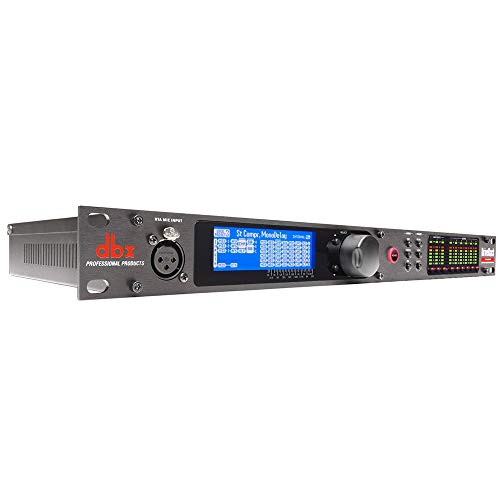
- Backlit LCD supports easier setup and monitoring.
- Stores up to 75 user presets.
- AutoEQ Wizards help with speaker leveling and room EQ.
Best For: Live sound teams and venues needing guided tuning and flexible I/O
FIR DSP Processor
Sound Town MODE Audio MDX-48 4x8 FIR DSP Processor
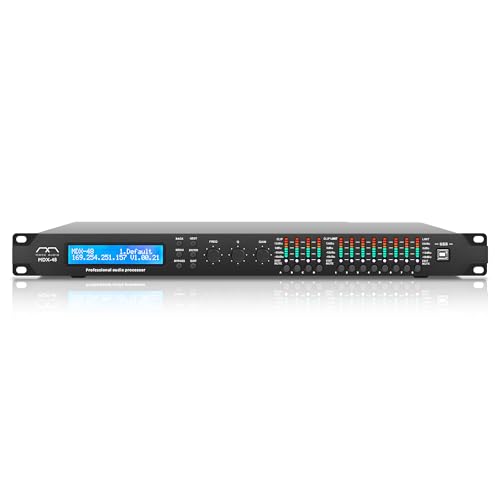
- 96kHz, 24-bit DSP with FIR filtering.
- 4-in/8-out design with Dante, AES, Ethernet, and USB.
- Front-panel LCD plus Windows Mconsole control.
Best For: PA systems and line arrays needing FIR DSP and Dante integration
All-in-One Rack Control
dbx DriveRack 260 2x6 Loudspeaker Management System

- 2x6 processing with crossover, EQ, compression, and limiting.
- Advanced Feedback Suppression helps reduce feedback.
- Setup wizard and DriveWare GUI simplify configuration.
Best For: FOH engineers and installs needing dependable rack-mounted speaker management
Premium DSP Management
Peavey VSX 26e Loudspeaker Processor

- Balanced inputs with linked stereo operation.
- PEQ, shelving, and all-pass filter types.
- Butterworth, Bessel, and Linkwitz-Riley crossovers.
Best For: Stereo PA users needing flexible DSP filtering.
Value Rack Processor
Graphic Equalizer Driver Rack PA2 Processor

- Graphic LCD display for easier setup.
- Stereo limiter, delay, and pink noise generator.
- 24-bit A/D conversion with over 110 dB dynamic range.
Best For: Basic PA tuning and speaker alignment.
Advanced Matrix DSP
DP-26 2-In/6-Out Digital Audio Processor

- All-in-one crossover, EQ, limiter, and delay processing.
- PC control with USB, RS485, and RS232 interfaces.
- 12 user programs plus 96kHz, 32-bit DSP.
Best For: Complex line array systems and detailed DSP control.
Automated PA Controller – dbx DriveRack PA2 2×6 Loudspeaker Management System
If you’re shopping for a sound system management processor for live PA use, the dbx DriveRack PA2 is built around speed, automation, and remote control. It combines 2-in/6-out processing with AutoEQ, AFS feedback suppression, and app-based setup tools, making it a practical option for dialing in speaker systems without a slow manual workflow.
Best For: DJs, venues, and PA operators who want automated tuning and mobile control.
Pros:
- AutoEQ is designed to set speaker levels and room EQ automatically in seconds.
- AFS feedback suppression is built to act quickly without altering the system’s tone.
- Ethernet app control works with Android, iOS, Mac, and Windows devices.
- Setup wizards help guide level balancing and speaker tuning.
Cons:
- Designed specifically for PA and loudspeaker management rather than casual home audio.
- Requires some setup familiarity if you want to get the most from the processing tools.
Overall, the DriveRack PA2 stands out as a modern sound system management processor for users who value guided setup and remote adjustment. Its combination of AutoEQ, feedback control, and built-in tuning support makes it a strong fit for practical live sound management.
Precision Crossover Manager – Behringer ULTRADRIVE DCX2496LE Loudspeaker Management System
The Behringer ULTRADRIVE DCX2496LE is a sound system management processor focused on precise crossover, EQ, and output routing control. With 2 analog inputs, 6 outputs, and 24-bit/96 kHz conversion, it suits users who want a flexible digital management unit for serious speaker setups.
Best For: Audio users who want flexible multi-output processing and high-resolution signal handling.
Pros:
- 2 analog inputs and 6 analog outputs offer broad routing flexibility.
- 24-bit/96 kHz A/D and D/A converters support high signal integrity.
- Dynamic EQ and parametric EQ options are available for inputs and outputs.
- 113 dB dynamic range helps maintain clean, detailed audio.
Cons:
- Does not include the app-based convenience found on some newer processors.
- Best suited to users comfortable working with dedicated pro-audio hardware.
This model is a solid choice when the priority is precision rather than automation. If you need a dependable sound system management processor with serious output flexibility and high-resolution conversion, the DCX2496LE fits that brief well.
Calibration Bundle – dbx DriveRack PA2 Bundle with RTA-M Mic and Cables
dbx DriveRack PA2 PA Management System w/ RTA-M Measurement Microphone, Cables Bundle
Check Price On AmazonThis bundle packages the dbx DriveRack PA2 with the RTA-M measurement microphone and the cables needed to connect and calibrate a complete PA setup. For buyers looking for a sound system management processor with the right accessories included, it simplifies the path from unboxing to system tuning.
Best For: Users who want the DriveRack PA2 plus calibration mic and cabling in one package.
Pros:
- Includes the DriveRack PA2 processor plus the RTA-M measurement microphone.
- Comes with a 50 ft. XLR cable for mic placement anywhere in the venue.
- Includes 8 additional 20 ft. XLR cables for mixer, processor, and amplifier connections.
- Sold as a specially priced package with an extended warranty noted in the bundle details.
Cons:
- Bundle is tailored to PA calibration and wiring needs, so it may be more than a simple processor-only purchase.
- Best value depends on whether you actually need the included cables and measurement mic.
If you’re setting up a live sound rig from scratch, this bundle removes a lot of guesswork from processor calibration. It is especially useful when you want the same sound system management processor as the standalone unit, but with measurement and connection accessories included.
Digital EQ Processor – 31-Band Dual Channel Digital Equalizer with PC Tuning
While not a full loudspeaker controller, this digital equalizer still fits the broader sound system management processor category for users who need detailed tonal shaping. It offers a 31-band dual-channel layout, PC tuning, preset modes, and noise reduction, making it practical for system voicing and signal cleanup in pro-style audio chains.
Best For: Home stereo, studio, and live audio users who need detailed EQ control with PC adjustment.
Pros:
- 31-band digital EQ gives fine control over treble, midrange, and bass.
- PC software tuning makes adjustment more approachable and flexible.
- 10 preset EQ modes plus EQ bypass support easy comparison and quick setup.
- 7-band noise suppression can help reduce background noise in demanding environments.
Cons:
- It is an equalizer, not a full loudspeaker management processor with crossover-style output processing.
- Best suited to users who specifically need EQ and noise reduction rather than full PA routing control.
For buyers focused on tonal shaping rather than complete speaker management, this unit offers a lot of control in a compact package. Its PC tuning, presets, and balanced I/O make it a useful option for audio systems that need detailed EQ work.
Compact Venue Control – dbx DriveRack VENU360 Complete Loudspeaker Management System
If you need a sound system management processor that makes setup faster and monitoring easier, the dbx DriveRack VENU360 is built for practical live use. Its backlit LCD, AutoEQ Wizards, and stored presets help streamline tuning for venues where repeatable setup matters.
Best For: Live sound teams, installers, and venues that want easy system tuning with flexible connectivity.
Pros:
- Backlit LCD makes setup and monitoring easier in dark rooms.
- Stores up to 75 user configurations for repeat venues or systems.
- AutoEQ and Level Assist Wizards simplify speaker leveling and room EQ.
- Balanced XLR analog/AES digital inputs with configurable balanced outputs.
Cons:
- Designed for pro audio users, so it may be more processor than casual setups need.
- Best results depend on using the RTA mic and setup wizards correctly.
Overall, the VENU360 stands out as a flexible management hub for systems that need reliable control, presets, and guided tuning. It is a strong fit when ease of setup and connectivity are as important as sound shaping.
FIR DSP Processor – Sound Town MODE Audio MDX-48 4×8 FIR DSP Processor
For buyers comparing a modern sound system management processor, the Sound Town MODE Audio MDX-48 brings 4-in/8-out DSP control with FIR filtering and high-resolution processing. It is aimed at full PA management, with networked audio options and PC control for more detailed routing and tuning.
Best For: PA systems, line array management, and users who want FIR-based DSP with Dante support.
Pros:
- 96kHz, 24-bit DSP processing for detailed speaker tuning.
- FIR filter support provides linear phase response and precise filtering.
- Includes balanced XLR analog/AES inputs, 8 outputs, Dante I/O, Ethernet, RS-232, and USB.
- Front-panel LCD, channel buttons, and Windows Mconsole software improve control.
Cons:
- Advanced feature set may be more complex than basic system processors.
- Dante and software control will be most useful to users with networked audio workflows.
The MDX-48 is a strong choice when your rack needs flexible routing, FIR processing, and multiple control paths. It feels especially well-suited to professional PA environments where precision and integration matter.
All-in-One Rack Control – dbx DriveRack 260 2×6 Loudspeaker Management System
The dbx DriveRack 260 is a classic sound system management processor for users who want crossover, EQ, compression, and limiting in one rack unit. It is built to simplify speaker management while adding tools like feedback suppression, delay, and Auto-EQ for more controlled system tuning.
Best For: FOH engineers, contractors, and installed systems that need broad processing in a simple rack format.
Pros:
- 2×6 architecture provides full bandpass, crossover, EQ, compression, and limiting.
- Advanced Feedback Suppression helps reduce feedback in live environments.
- Includes 28-band graphic EQ, subharmonic synthesizer, and feedback eliminator.
- Setup wizard and DriveWare GUI simplify configuration and soundchecks.
Cons:
- Uses XLR connectivity only, so it is less flexible than networked processors.
- No wireless features or modern digital networking options listed.
For teams that want dependable speaker management without extra complexity, the DriveRack 260 covers the essentials very well. It remains a practical pick when the goal is solid control, protection, and straightforward tuning.
Premium DSP Management – Peavey VSX 26e Loudspeaker Processor
If you need a sound system management processor with flexible filtering and straightforward stereo setup, the Peavey VSX 26e is built for practical loudspeaker control. It combines balanced inputs, multiple EQ filter types, and selectable crossover alignments to help you shape a system around the room and speakers you’re using.
Best For: Stereo PA setups and users who want versatile DSP filtering with simple linked-channel operation.
Pros:
- Offers PEQ, shelving, low-pass, high-pass, and all-pass filter options.
- Supports Butterworth, Bessel, and Linkwitz-Riley crossover alignments from 1st to 8th order.
- Includes a signal generator with sine, white noise, and pink noise.
- Channels can be linked for simplified stereo operation.
Cons:
- Feature set is focused on processing rather than onboard display details or modern control extras.
- Best suited to users who already know their loudspeaker management needs.
The VSX 26e stands out for flexible DSP tuning and a clear pro-audio feature set. For buyers comparing a sound system management processor, it’s a strong fit when crossover choice and system alignment matter more than flashy controls.
Value Rack Processor – Graphic Equalizer Driver Rack PA2 Processor
This sound system management processor is aimed at users who want core loudspeaker control features without unnecessary complexity. The Driver Rack PA2-style unit includes graphic LCD control, stereo output limiting, speaker fine-tuning delay, and a pink noise generator for setup and calibration.
Best For: Basic PA tuning and loudspeaker management where an LCD interface and built-in test tools are useful.
Pros:
- Graphic LCD display makes front-panel setup easier to follow.
- Includes stereo output limiter for output control.
- Speaker fine-tuning delay helps with alignment.
- Pink noise generator supports system tuning.
Cons:
- Specifications are more limited in the supplied notes than the higher-end processors.
- Not positioned with the deep crossover and filter detail of more advanced units.
This is a sensible pick if you want a straightforward processor for practical PA setup tasks. It covers the essentials well, especially for users who value simple tuning tools and a clear display over advanced programming depth.
Advanced Matrix DSP – DP-26 2-In/6-Out Digital Audio Processor
For buyers comparing a more configurable sound system management processor, the DP-26 packs crossover, EQ, limiter, delay, mixer, and effect processing into a single 1U rack unit. It adds PC software control plus front-panel adjustment, making it a flexible choice when you need detailed system setup and repeatable presets.
Best For: Line array and multi-speaker systems that need advanced routing, EQ, and delay control.
Pros:
- Combines crossover, equalizer, limiter, delayer, mixer, and filter functions in one unit.
- Supports PC control, RS485, RS232, and USB connectivity.
- Stores 12 user programs for quick recall.
- Offers 96kHz sampling, 32-bit DSP, and 24-bit A/D and D/A conversion.
Cons:
- Feature depth may be more than casual users need.
- Setup is likely best for users comfortable with DSP menus or computer control software.
The DP-26 is the most feature-rich option in this group and is built for users who need detailed control over system behavior. Its combination of multiband EQ, delay flexibility, and multiple control methods makes it especially practical for complex installs and line array work.
How We Picked the Best Sound System Management Processor
We prioritized processors that offer core loudspeaker management tools such as crossover control, EQ, delay, limiting, and flexible routing. We also looked at usability, control options, channel count, and whether the unit suits portable PA, installed audio, or more demanding system design.
Because a Sound System Management Processor should do more than add features, we emphasized models that help users solve real-world issues: feedback control, time alignment, speaker protection, and dependable fine-tuning.
Quick Comparison
If you want simple PA tuning and remote app control, a streamlined 2×6 processor is often the easiest fit. If you need more routing depth, matrix control, or integration with larger arrays, step up to a more advanced DSP platform with extra outputs and networking features. Budget-friendly equalizers can help in basic stereo setups, but they do not replace a true loudspeaker management processor.
Key Buying Factors for a Sound System Management Processor
I/O Count and System Size
Match the input and output count to your system before anything else. Small stereo or 2-way rigs can work well with 2-in/6-out designs, while larger line arrays, subs-plus-tops setups, and complex installs may need 4×8 or matrix-style routing.
Processing Tools
Look for the essentials: crossover filters, parametric and graphic EQ, delay, polarity control, auto-EQ or RTA support, and limiters. These are the tools that shape tonal balance and protect loudspeakers in the real world.
Control and Setup
App control, front-panel access, display quality, and software tuning all affect how easy the unit is to live with. If multiple operators will use the system, clarity and quick recall matter as much as raw feature count.
Integration and Connectivity
For installed systems, check whether the processor supports digital inputs, networking, or protocols like Dante or AES. For mobile use, reliable analog connections and straightforward presets may be more valuable than advanced networking.
Who Should Buy Which Sound System Management Processor?
Mobile DJs, bands, and small PA owners usually benefit from a simpler processor with easy setup and strong limiting. Installers and system integrators should favor models with more routing flexibility, networking, and recall options. Home enthusiasts or budget buyers may start with a basic EQ or processor-style unit, but anyone aiming for speaker protection and consistent tuning should choose a true Sound System Management Processor over a standard equalizer.
If you want the best long-term value, buy for your system’s size today plus a little headroom for future expansion.