A professional in-ear monitor system can make the difference between a chaotic stage mix and confident, consistent performance. The right setup helps singers and players hear themselves clearly without relying on loud wedges.
Below, we focus on practical buying factors that matter most for live sound, rehearsal spaces, and touring bands, so you can choose a system that fits your workflow and budget.
Best 10 Professional in Ear Monitor System Picks for 2026
Editor’s Pick
Phenyx Pro PTM-10 Stereo UHF IEM

- True stereo/mono monitoring with onboard balance control.
- 900MHz UHF system with 89 frequencies and up to 5-system operation.
- Rack-mountable metal transmitter with limiter, EQ, PAD, and lock functions.
Best For: Users who want stereo monitoring, solid UHF reliability, and rack-friendly setup.
Low-Latency Choice

- 5.8GHz wireless with auto channel scan for easier setup.
- Less than 5ms latency for responsive live monitoring.
- Up to 100 ft. range with rechargeable transmitter and receiver.
Best For: Musicians and traveling performers who want quick pairing and very low latency.
Multi-Receiver Pick
Phenyx Pro PTM-33-4B 4-Pack IEM

- One transmitter with 4 bodypacks and 4 in-ear earphones.
- 4x25 UHF frequencies and up to 140-164 ft. line-of-sight range.
- Rack-mountable with loop outputs for easier mixer integration.
Best For: Bands, churches, and live teams that need four wireless bodypacks from one transmitter.
Budget Stereo Option
LEKATO MS-1 2.4GHz Wireless IEM
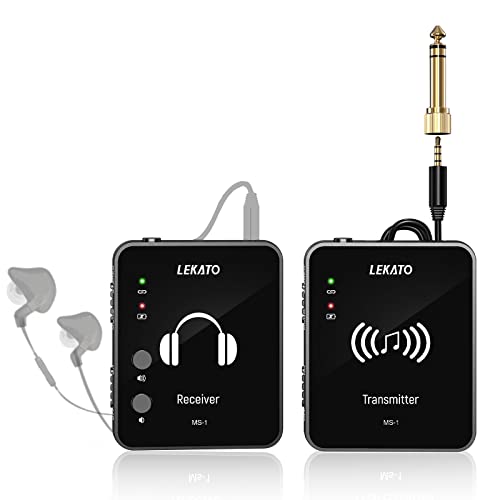
- True stereo transmission with one-key stereo/mono switching.
- Auto-pairing and 2.4GHz low-noise, low-latency operation.
- More than 5 hours of battery life with up to 100 ft. range.
Best For: Small bands, rehearsal spaces, and churches that want an easy stereo wireless IEM.
Mono Rack-Mount IEM for Bands & Worship
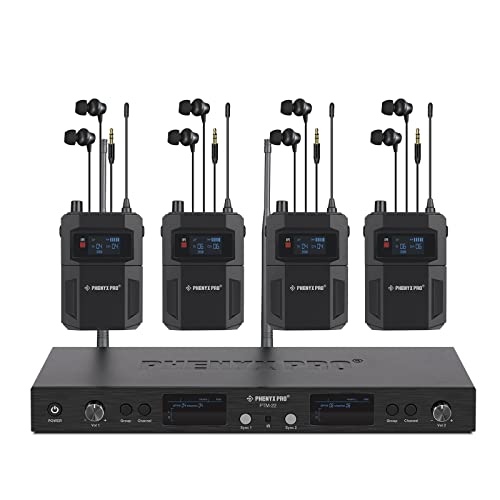
- Mono monitoring reduces phase issues and keeps the mix clear.
- Two-channel UHF system offers 2x50 frequencies and 164 ft range.
- Includes 4 bodypacks, rack kit, antennas, and carry case.
Best For: churches, bands, broadcasters, and conference monitoring
Stereo 2.4G IEM With Color Screen

- 192kHz audio and less than 6 ms latency.
- Mono/stereo switching with a color screen receiver.
- Rechargeable design offers up to 10 hours of use.
Best For: band rehearsal, live performance, and studio monitoring
Long-Range Mono IEM for Larger Stages

- PLL UHF system aims for stable, low-interference monitoring.
- 330 ft range and 6 bodypacks fit larger setups.
- Built-in limiter and IR sync simplify use and protection.
Best For: larger bands, church teams, and stage monitoring
Stage-Cue Ready Pick
SWIFF AUDIO WX520 Wireless in Ear Monitor System

- Cue mic support for stage communication
- 5.8GHz wireless with 4 channels
- Sub-9.2ms latency and stereo/mono switching
Best For: Bands and live teams that need cue talkback and flexible monitoring
Reliable RF Pick
Xvive U45 Wireless in Ear Monitor System

- True diversity 5.8 GHz wireless link
- Channel Scan Mode simplifies setup
- 24-bit/48kHz audio with USB-C charging
Best For: Players who want dependable wireless monitoring with easy channel scanning
Compact Multi-RX Pick
LEKATO MS-02 Wireless in Ear Monitor System

- Up to 4.5ms latency in mono mode
- One transmitter supports up to 4 receivers
- 6-8 hour battery with mono/stereo switching
Best For: Small bands, churches, and rehearsal setups needing one-to-many monitoring
Editor’s Pick – Phenyx Pro PTM-10 Stereo UHF IEM
If you want a professional in ear monitor system with true stereo monitoring and stage-ready flexibility, the Phenyx Pro PTM-10 is built for that job. Its 900MHz UHF design, selectable frequencies, and rack-mountable transmitter make it a practical choice for performers who need dependable monitoring in live, studio, worship, lecture, or exhibit settings.
Best For: Performers and presenters who want stereo monitoring, solid UHF reliability, and rack-friendly setup.
Pros:
- True stereo/mono mode selection for different monitoring needs.
- 900MHz band with 89 tunable frequencies and support for up to 5 systems.
- Up to 160 ft. range with limiter, EQ, balance, PAD, and lock functions.
- Metal transmitter, rackmount kit, and carrying case add professional convenience.
Cons:
- Only one bodypack receiver is included.
- Range is stated at up to 160 ft., so real-world results will vary by environment.
- Best suited to users who can take advantage of the stereo features and onboard controls.
Overall, the PTM-10 stands out as a versatile wireless IEM for users who want more control over their monitor mix. It combines practical pro-audio features with a setup that fits both stage and install work.
Low-Latency Choice – Xvive U45 5.8GHz Wireless IEM
The Xvive U45 is a streamlined professional in ear monitor system for players who want simple setup and low-latency performance. With 5.8GHz wireless, auto channel scan, and less than 5ms latency, it is designed for clear monitoring when you need fast response and a compact setup.
Best For: Musicians and traveling performers who want quick pairing and very low latency.
Pros:
- 5.8GHz wireless design helps reduce interference.
- Auto channel scan simplifies setup and connection stability.
- Less than 5ms latency suits live performance monitoring.
- Up to 100 ft. range and about 5 hours of battery life on both units.
Cons:
- Battery life is around 5 hours, so longer gigs may require planning.
- Includes one transmitter and one receiver only.
- Plastic enclosure may feel less rugged than metal alternatives.
The U45 is a clean option for users who care most about low latency, quick setup, and dependable short-range monitoring. It keeps the feature set focused without adding extra complexity.
Multi-Receiver Pick – Phenyx Pro PTM-33-4B 4-Pack IEM
If you need a professional in ear monitor system for a four-person band or worship team, the Phenyx Pro PTM-33-4B is built around multi-user monitoring. It provides one transmitter and four bodypacks with UHF mono wireless operation, making it a strong fit for groups that want separate monitoring without crowding the stage.
Best For: Bands, churches, and live teams that need four wireless bodypacks from one transmitter.
Pros:
- Includes 4 bodypack receivers and 4 in-ear earphones.
- 4×25 UHF frequencies help reduce interference in mono monitoring.
- Up to 140-164 ft. line-of-sight range supports larger stages.
- Rack-mountable design and loop outputs simplify integration with mixers.
Cons:
- Mono monitoring only, so it is not a stereo IEM solution.
- Thick walls, glass, and metal blocks can reduce effective range.
- More complex than a single-receiver system if you only need one performer monitored.
This model makes sense when the goal is to feed multiple performers from one central monitor station. It is less about portability and more about providing stable, workable monitoring for a small group.
Budget Stereo Option – LEKATO MS-1 2.4GHz Wireless IEM
The LEKATO MS-1 is a simple professional in ear monitor system for smaller gigs, rehearsals, and studio use. Its 2.4GHz wireless design, auto-pairing, and true stereo support make it a practical pick when you want an easy-to-use monitor setup without a complicated menu system.
Best For: Small bands, rehearsal spaces, and churches that want an easy stereo wireless IEM.
Pros:
- Supports true stereo transmission with one-key stereo/mono switching.
- Auto-pairing keeps setup straightforward.
- 2.4GHz system offers low noise, low latency, and 24-bit/48kbps resolution.
- More than 5 hours of battery life and up to 100 ft. range in open areas.
Cons:
- 2.4GHz wireless can be less ideal in crowded RF environments than UHF options.
- Range is specified for open areas, so obstacles can reduce performance.
- Best suited to small and medium-sized performances rather than larger pro rigs.
The MS-1 offers a useful mix of stereo support and ease of use for everyday monitoring. It is a good match when portability and simple operation matter more than advanced rack-style features.
Mono Rack-Mount IEM for Bands & Worship – Phenyx Pro PTM-22B 4-Pack
If you need a professional in ear monitor system for church, conference, or stage use, this Phenyx Pro setup focuses on stable mono monitoring and simple shared signal routing. Its UHF wireless design, 2×50 selectable frequencies, and 164 ft range make it a practical option when you want clearer monitoring with less stage clutter.
Best For: Musicians, church pastors, conference hosts, broadcasters, and live performers who need reliable mono monitoring for multiple users.
Pros:
- Mono monitoring helps avoid phase issues and keeps the mix focused.
- Dual-channel transmitter with loop out supports daisy-chaining to other channels.
- UHF operation offers 2×50 frequencies and up to 164 ft coverage.
- Rack-mountable metal build and carry case suit installed or mobile rigs.
Cons:
- Mono-only monitoring may not suit users who want stereo imaging.
- Uses AA batteries for the bodypacks instead of built-in rechargeables.
- Best suited to structured monitoring setups rather than ultra-compact travel rigs.
Overall, this is a solid choice if your priority is dependable multi-user monitoring with a straightforward setup. The included four bodypacks make it especially useful when several performers or speakers need the same clear feed.
Stereo 2.4G IEM With Color Screen – Donner CV-3
This professional in ear monitor system is built for players who want a compact wireless monitor with stereo flexibility and fast setup. Donner’s CV-3 uses a 2.4 GHz link, less than 6 ms latency, and a color screen receiver to make rehearsal and live monitoring easier to manage.
Best For: Band rehearsals, live performance, and studio monitoring when you want a lightweight rechargeable stereo IEM.
Pros:
- 192kHz sampling and 24-bit depth are designed for clear, detailed audio.
- Less than 6 ms latency supports tight real-time monitoring.
- Mono/stereo switching adds flexibility for different sources.
- Built-in rechargeable battery offers up to 10 hours of use.
Cons:
- 2.4 GHz systems can be more environment-dependent than some UHF options.
- 100 ft range is shorter than longer-reach stage-focused systems.
- Single receiver package may not fit larger multi-performer setups.
For users who value portability and easy operation, the CV-3 brings a lot of convenience in a small package. It’s a smart fit when you want a lighter monitor system with rechargeable power and flexible input compatibility.
Long-Range Mono IEM for Larger Stages – IME-6000 6-Pack
When you need a professional in ear monitor system for a bigger stage or studio setup, this mono UHF package gives you expanded receiver capacity and long operating range. The IME-6000 uses PLL technology, a built-in limiter, and 2×40 preset frequencies to help keep monitoring stable and clean in demanding environments.
Best For: Larger bands, stage crews, church teams, sound engineers, and MCs needing six bodypacks and long-range mono monitoring.
Pros:
- UHF PLL design is built to reduce frequency drops and interference.
- 330 ft open-space range supports freer movement on bigger stages.
- Includes 6 bodypacks and 6 earphones for multi-user monitoring.
- Metal transmitter and status indicators add durability and easier operation.
Cons:
- Mono monitoring won’t appeal to users looking for stereo IEM sound.
- Performance notes caution against thick walls, glass, and metal blocks at distance.
- Larger system may be more than needed for small personal rigs.
This is a practical pick if you need more receivers and longer reach than typical entry-level systems provide. Its combination of mono clarity, IR sync, and rugged hardware makes it well suited to serious live-use monitoring.
Stage-Cue Ready Pick – SWIFF AUDIO WX520 Wireless in Ear Monitor System
If you want a professional in ear monitor system that adds cue talkback and flexible monitoring to a live rig, the SWIFF AUDIO WX520 is built for that workflow. It supports stereo/mono switching, 5.8GHz transmission, and multi-user monitoring, making it practical for bands, studio use, and worship setups.
Best For: Performers and teams that need cue communication, multiple receivers, and flexible live monitoring.
Pros:
- Built-in cue mic support for external dynamic microphones
- 5.8GHz wireless platform with 4 selectable channels
- Latency under 9.2ms for real-time monitoring
- Transmitter supports XLR, 1/4-inch, and 1/8-inch inputs
Cons:
- Receiver battery life is listed at up to 5 hours
- Best results depend on matching the right input and mode settings
Overall, the WX520 stands out if you value communication as much as monitoring. Its cue function and versatile connections make it a strong fit for organized stage setups where coordination matters.
Reliable RF Pick – Xvive U45 Wireless in Ear Monitor System
The Xvive U45 is a professional in ear monitor system aimed at reliable wireless monitoring for studio, rehearsal, and live performance use. Its 5.8 GHz true diversity design, channel scan mode, and compact bodypack setup make it a straightforward option for performers who want stable audio and simple channel selection.
Best For: Musicians and audio users who want dependable 5.8 GHz monitoring with easy channel setup.
Pros:
- True diversity 5.8 GHz wireless connection
- Channel Scan Mode helps find the best available channel
- 20Hz-20kHz response with high-resolution 24-bit/48kHz audio
- USB-C charging with up to 5 hours of battery life
Cons:
- Battery life is limited to about 5 hours
- Designed for audio monitoring rather than extra stage features
For users who prioritize a clean RF link and clear sound, the U45 keeps the feature set focused. It is a practical pick when you need wireless monitoring that is easy to deploy and consistent in everyday performance settings.
Compact Multi-RX Pick – LEKATO MS-02 Wireless in Ear Monitor System
The LEKATO MS-02 is a professional in ear monitor system built around compact 2.4G wireless monitoring and simple pairing. With low latency, one transmitter to multiple receivers, and a lightweight beltpack-style receiver, it is well suited to rehearsals, church stages, and smaller performance setups.
Best For: Small-to-medium groups that need an affordable one-to-many monitoring setup.
Pros:
- Upgraded mono mode latency under 4.5ms
- Supports one transmitter to up to 4 receivers
- 6-8 hours of continuous operation with LED battery/volume indicators
- Mono/stereo switching and 100 ft open-area wireless range
Cons:
- Earbuds are not included and must be purchased separately
- 2.4GHz systems may be less specialized than higher-end monitoring rigs
If you want a compact monitoring system that scales to multiple performers, the MS-02 covers the basics well. Its low latency, easy pairing, and portable design make it a solid choice for everyday live and practice use.
How We Picked the Best Professional in Ear Monitor System
We prioritized systems that balance sound quality, wireless stability, range, channel flexibility, and stage usability. For a professional in-ear monitor system, those are the features that most directly affect real-world performance. We also looked for options that suit different use cases, from small rehearsal rooms to larger stages and multi-performer setups.
Quick Comparison: What Matters Most
Some buyers need stereo monitoring for more immersive mixes, while others prefer mono systems for simplicity and easier setup. UHF systems often appeal to users who want robust stage-ready performance, while 2.4GHz and 5.8GHz models can be attractive for convenience, portability, and simpler operation. The best choice depends on how many performers need monitor feeds, how much range you need, and how much control you want over your mix.
Key Buying Factors for a Professional In-Ear Monitor System
Signal Stability and Range
Wireless reliability should come first. Check stated operating range, frequency options, and whether the system is designed to handle crowded RF environments. If you perform on larger stages or in venues with lots of wireless gear, a more robust wireless platform can be worth it.
Mono Vs. Stereo
Stereo systems can provide better placement and separation, which many singers and instrumentalists prefer. Mono systems are often simpler to run and can be easier for teams that need multiple mixes without added complexity.
Number of Mixes and Bodypacks
If you are monitoring for a full band, pay attention to how many receivers or bodypacks are included and whether the transmitter supports one-to-many operation. A professional in-ear monitor system for group use should match the number of performers who need independent monitoring.
Latency and Audio Clarity
Low latency is essential so the sound in your ears feels natural and stays aligned with what you see and play. Clear mids and controlled highs help vocals, click tracks, and instruments remain easy to distinguish in a live mix.
Build Quality and Stage Convenience
Look for durable receivers, practical controls, readable displays, and rack-mountable transmitters when relevant. Features like charging cases, cue mics, and beltpack design can improve daily usability, especially for rehearsals and frequent gigs.
Who Should Buy Which Professional in Ear Monitor System?
Solo performers and worship leaders may prefer a compact system that is easy to deploy and carry. Bands that need multiple feeds should look for systems with more receivers or expanded channel options. Touring acts and demanding live users should lean toward setups with stronger wireless flexibility, better build quality, and more predictable performance across venues.
In short, the best professional in-ear monitor system is the one that matches your stage size, monitoring style, and number of performers without adding unnecessary complexity.