Choosing the right monitors can make every mix decision easier, from EQ moves to low-end balance. The best professional studio monitor speakers give you a clearer, more honest picture of your audio.
Below, we’ve narrowed the field to ten strong options for different room sizes, budgets, and studio setups, so you can match the right pair to your workflow.
Best 10 Professional Studio Monitor Speakers Picks for 2026
Studio Imaging Pick

- Wide sweet spot from Image Control Waveguide
- Dual 41W Class-D amps with 112W max output
- Boundary EQ and HF Trim for room tuning
Best For: Creators who want accurate imaging and flexible room adjustment
Neutral Reference Pick

- Sonic-purity tuning with minimal coloration
- 70W bi-amplified 2-way design
- XLR and TRS balanced/unbalanced inputs
Best For: Music production and studio monitoring with a neutral sound
Value Detail Pick
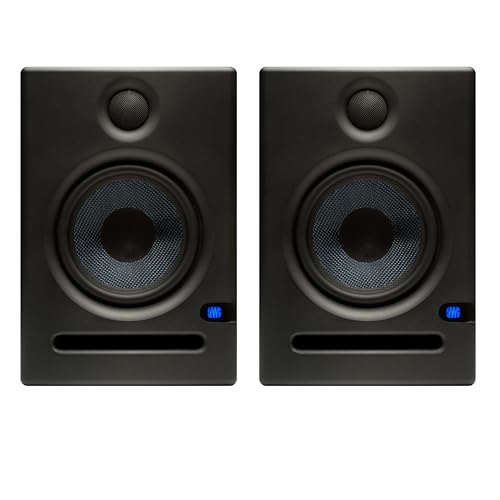
- 5.25-inch woofer with low bass distortion
- 80W Class AB bi-amplification with headroom
- XLR, TRS, and RCA inputs plus tuning controls
Best For: Home studio users who want flexible inputs and room tuning
Modern DSP Pick

- DSP-driven room tuning and app control
- Class D amps with low operating temperature
- XLR and 1/4-inch TRS combo inputs
Best For: Producers and engineers who want DSP tools and flexible inputs
Neutral Mix Ready
JBL 306P MkII 6.5" Studio Monitoring Speakers

- Wide sweet spot for more consistent off-axis listening
- Boundary EQ helps near walls or on a work surface
- Updated drivers improve bass and transient response
Best For: Producers and content creators needing a mix-focused stereo pair
Compact Reference Pair
Yamaha HS3 Powered Studio Monitor

- Small tabletop pair with a compact footprint
- Room control and high trim help tune the sound
- Includes XLR/TRS, RCA, and stereo mini inputs
Best For: Small desks and desktop studio setups
Flexible Desktop Sound
Mackie CR3.5 Creative Reference Powered Studio Monitors

- Tone knob shifts from neutral to boosted sound
- Location switch supports desktop or bookshelf placement
- Multiple inputs plus headphone output add convenience
Best For: Desktop users who also want gaming and casual listening
Classic 5 Pair Bundle
KRK Classic 5 Powered Studio Monitors
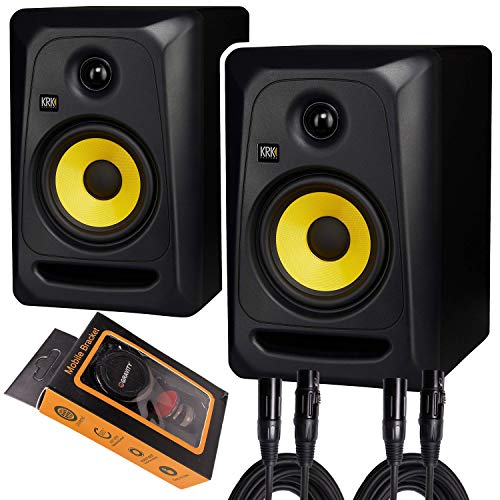
- 5-inch nearfield powered monitor pair
- Soft-dome tweeter and glass-aramid woofer
- Flat low-frequency adjustment plus bass boost
Best For: Home studios needing flexible nearfield monitoring
MR5 3-Way Active

- 3-way active design with woofer, mid, and tweeter
- Room compensation via knobs or app
- XLR, TRS, RCA, AUX, and Bluetooth 6.0
Best For: Desktop studios needing flexible connectivity and tuning
Eris 3.5 Desktop Pair
PreSonus Eris 3.5 Powered Monitors

- Compact 3.5-inch powered stereo pair
- High/low frequency tuning controls
- TRS, RCA, aux, and headphone jack
Best For: Small desks and compact near-field setups
Studio Imaging Pick – JBL 305P MkII Pair
If you want professional studio monitor speakers with a wide sweet spot and clean stereo imaging, the JBL 305P MkII pair is built for practical nearfield work. The Image Control Waveguide helps keep the sound precise, while the 5-inch woofer and Slip Stream port give these monitors enough low-end support for production, editing, and content creation.
Best For: Producers, podcasters, and creators who want accurate imaging and flexible room adjustment.
Pros:
- Patented Image Control Waveguide for precise imaging and a wide listening area
- Dual 41-watt Class-D amps deliver 112 watts maximum output power
- Boundary EQ and HF Trim help tailor the sound to your room
- XLR/TRS inputs add flexible wired connectivity
Cons:
- 5-inch woofer may not satisfy buyers who want very deep bass without a subwoofer
- Best suited to studio-style listening rather than portable use
Overall, the JBL 305P MkII is a strong all-around choice if you want controlled, detailed monitoring with room-tuning options. It leans practical and accurate, which is exactly what many studio setups need.
Neutral Reference Pick – Yamaha HS5 Pair
The Yamaha HS5 pair is a straightforward option if you want professional studio monitor speakers that emphasize sonic purity over hype. With a 5-inch cone woofer, 1-inch dome tweeter, and balanced XLR/TRS inputs, these monitors are designed for nearfield mixing where honest sound matters more than added color.
Best For: Music production and studio monitoring where accuracy and a neutral presentation are priorities.
Pros:
- Designed to emphasize sonic purity without coloring the original sound
- Bi-amplified 70-watt system provides dedicated LF and HF power
- Wide 54 Hz to 30 kHz frequency response
- XLR and TRS inputs support balanced or unbalanced signals
Cons:
- 5-inch design is compact, so low-end output is naturally limited compared with larger monitors
- Best used in a studio or desktop monitoring setup rather than casual listening
In practice, the HS5 pair is a familiar pick for users who want a clear reference point for mixing decisions. If neutrality is the goal, these monitors stay focused on that job.
Value Detail Pick – PreSonus Eris E5 Pair
The PreSonus Eris E5 pair is aimed at buyers who want professional studio monitor speakers with strong detail and easy connection options. Its 5.25-inch woven composite woofer, silk-dome tweeter, and front-firing acoustic port are built to deliver balanced monitoring and usable low-end support in a home or project studio.
Best For: Home studio users and mixers who want flexible inputs and tuning controls.
Pros:
- 5.25-inch woofer with minimal bass distortion
- 80-watt Class AB bi-amplification with plenty of headroom
- Balanced XLR and 1/4-inch inputs plus unbalanced RCA inputs
- Acoustic tuning controls help adapt to your room
Cons:
- Front-firing port and tuning controls still depend on sensible placement and setup
- Not the largest monitor here if you need heavier low-end output
As a practical monitoring option, the Eris E5 pair focuses on translation, connectivity, and control. That makes it a sensible fit for users building a capable mixing space without overcomplicating the setup.
Modern DSP Pick – KRK ROKIT 5 G5 Pair
The KRK RP5G5 ROKIT 5 Generation Five pair is a smart pick if you want professional studio monitor speakers with modern tuning features. It combines Class D amplification, a new 1-inch silk dome tweeter, and DSP-driven room tuning to help you shape the sound for music production, mixing, and audio engineering.
Best For: Producers and engineers who want DSP tools, isolation pads, and flexible analog input compatibility.
Pros:
- DSP-driven room tuning helps adapt the monitors to your space
- Class D amplification is designed for better audio integrity and lower operating temperature
- Low-diffraction baffle design supports better stereo imaging and lower distortion
- XLR and 1/4-inch TRS combo inputs offer broad compatibility
Cons:
- App-based control may be unnecessary for users who want a simpler monitor setup
- As with most 5-inch monitors, very deep bass is not the main strength
For buyers who want a more feature-rich studio monitor, the KRK pair stands out for its tuning tools and isolation accessories. It is built to be adaptable, which is useful in small and changing production spaces.
Neutral Mix Ready – JBL 306P MkII 6.5" Studio Monitoring Speakers
If you want professional studio monitor speakers that give you a wide listening sweet spot and a balanced low end, the JBL 306P MkII is built for exactly that kind of work. Its updated HF and LF transducers are designed for better transient response and lower harmonic distortion, while the new boundary EQ helps keep the response more neutral when the monitors sit near walls or on a work surface.
Best For: Producers and content creators who want a clear, mix-friendly pair with flexible placement.
Pros:
- Broad sweet spot makes off-axis listening more consistent while you fine-tune a mix.
- Boundary EQ helps restore neutral low-frequency response in common desktop or wall-adjacent setups.
- Updated transducers are tuned for deeper bass and lower harmonic distortion.
- 6.5-inch two-way powered design offers a studio-oriented stereo monitoring setup.
Cons:
- Wired XLR connectivity means it is aimed more at studio setups than casual wireless use.
- At 13.4 pounds per speaker, it is less compact than small desktop monitors.
Overall, the JBL 306P MkII is a strong option if your priority is dependable monitoring accuracy rather than added color or convenience features. It is especially appealing for desktop studios where placement can be tricky and you still want a neutral reference.
Compact Reference Pair – Yamaha HS3 Powered Studio Monitor
The Yamaha HS3 is a compact choice for professional studio monitor speakers when you need a small footprint without giving up standard studio connectivity. This powered pair uses a 3.5-inch woofer and 0.75-inch dome tweeter, plus room control and high trim controls to help you adapt the sound to your space.
Best For: Small desks, desktop production setups, and studio users who need easy placement.
Pros:
- Compact tabletop design fits smaller workspaces well.
- Room control and high trim controls help tailor the response to the room.
- Includes XLR/TRS combo, RCA, and stereo mini inputs for broad compatibility.
- Pair package comes with cables and anti-slip pads included.
Cons:
- 3.5-inch woofer and 26 W output are more limited than larger studio monitors.
- Frequency response starts at 70 Hz, so deeper bass extension is modest.
For buyers who need a small, practical monitoring solution, the HS3 is easy to recommend. It is more about placement flexibility and straightforward studio use than big-room output or heavy bass.
Flexible Desktop Sound – Mackie CR3.5 Creative Reference Powered Studio Monitors
The Mackie CR3.5 is a flexible pick if you want professional studio monitor speakers that can also handle casual listening, gaming, and desktop use. It starts with a transparent studio-style response, then adds a tone knob for more bass and treble, plus a location switch to optimize the sound for desktop or bookshelf placement.
Best For: Desktop users who want one compact speaker pair for music production, gaming, and everyday listening.
Pros:
- Tone knob lets you move from neutral monitoring to a more boosted sound.
- Location switch helps adapt the speakers for close-up desktop use or farther bookshelf placement.
- TRS, RCA, and 3.5 mm input options make it easy to connect many devices.
- Built-in headphone output adds convenience for private listening.
Cons:
- 3.5-inch woofer size is geared more toward compact setups than larger studio rooms.
- Enhanced bass depends on the settings and optional subwoofer support, not the speakers alone.
The CR3.5 stands out for versatility more than strict monitor purism. If you want a compact pair that can shift between production work and entertainment without much hassle, it offers a practical middle ground.
Classic 5 Pair Bundle – KRK Classic 5 Powered Studio Monitors
If you want professional studio monitor speakers with a proven nearfield tuning, the KRK Classic 5 pair is built for everyday mix work and casual reference listening. The 5-inch glass-aramid woofers and soft-dome tweeters aim for clear mids, tight bass, and smooth highs, while the flat low-frequency adjustment helps you adapt the sound to your room.
Best For: Home studios and creators who want an accurate 5-inch powered monitor pair with flexible low-end control.
Pros:
- Soft-dome tweeter with waveguide for smooth, articulate high frequencies up to 35kHz
- Glass-aramid composite woofer delivers clear midrange and tight bass
- Flat low-frequency adjustment adds useful mix versatility
- Includes a +2dB KRK bass boost option for more low-end when desired
Cons:
- 5-inch monitors are best suited to nearfield use rather than larger rooms
- Wired XLR connectivity only, so no wireless playback option
Overall, this bundle makes sense if you want a straightforward powered monitor setup with KRK’s familiar tuning and a little extra flexibility for different listening spaces. The included accessories add convenience, but the core value is still the monitor pair itself.
MR5 3-Way Active – Edifier MR5 Studio Monitors
For buyers comparing professional studio monitor speakers in a compact desktop-friendly format, the Edifier MR5 stands out for its 3-way active design and broad connectivity. With a 5-inch woofer, dedicated mid driver, and silk-dome tweeter, it is designed to deliver detailed sound, while room compensation tools help tailor the response to your space.
Best For: Desktop studios and mixed-use setups that need accurate sound, app control, and flexible input options.
Pros:
- 3-way active crossover with separate woofer, mid driver, and tweeter for detailed playback
- Room tuning via rear knobs or the EDIFIER ConneX app
- Multiple inputs including XLR, TRS, RCA, AUX, and Bluetooth 6.0
- 110W RMS output with a compact MDF cabinet design
Cons:
- Wireless features may be unnecessary if you only need a purely wired studio setup
- Compact size is good for desks, but less ideal if you want larger-room output from the start
In practice, the MR5 is a strong pick if you want studio monitor speakers that can connect to almost anything and be tuned for your room. Its feature set is especially appealing for creators who move between music, content, and general listening.
Eris 3.5 Desktop Pair – PreSonus Eris 3.5 Powered Monitors
If you need professional studio monitor speakers for a desk, the PreSonus Eris 3.5 pair is built around compact near-field use and straightforward setup. The 3.5-inch woven-composite woofers, silk-dome tweeters, and onboard acoustic controls are aimed at giving you clean, balanced monitoring for music production, gaming, streaming, and general listening.
Best For: Small desks and budget-conscious buyers who want compact powered monitors with basic tuning controls.
Pros:
- Compact 3.5-inch powered stereo pair fits easily on a desk
- High- and low-frequency controls help adjust sound for the room
- Balanced TRS, RCA, and front aux input support common sources
- Front headphone jack adds convenient private listening
Cons:
- 3.5-inch drivers and 50W output are better suited to smaller spaces
- Frequency response tops out at 20kHz, so it is not the most extended option here
The Eris 3.5 is a practical choice when desk space matters more than raw output. It offers the core benefits many people want from studio monitor speakers without adding complexity, making it easy to recommend for compact setups.
How We Picked These Professional Studio Monitor Speakers
We focused on models that are widely used for music production and critical listening, with an emphasis on accuracy, clarity, and practical studio features. Selection also considered driver size, amplifier design, connectivity, room-placement flexibility, and value across different budgets.
Quick Comparison
If you’re deciding fast, think in terms of room size and listening distance. Smaller 3.5-inch and 5-inch monitors are usually best for compact desks and nearfield setups, while 6.5-inch options can offer more low-end reach in larger rooms. Some models also add room compensation or tonal controls, which can help tailor the sound to your space.
Key Buying Factors for Professional Studio Monitor Speakers
Size and Room Match
Driver size matters because it affects bass extension, output, and placement needs. In a small bedroom studio, oversized monitors can exaggerate room problems, while smaller speakers may be easier to place and easier to trust.
Accuracy Over Hype
For mix work, look for a neutral sound profile rather than boosted bass or overly bright treble. Professional Studio Monitor Speakers should reveal flaws, not disguise them.
Connectivity and Inputs
Check whether you need balanced XLR or TRS inputs, unbalanced RCA, or simple desktop connections. Balanced inputs are usually preferable for cleaner signal transfer in studio environments.
Controls and Room Tuning
Features like high-frequency trim, room response switches, or boundary compensation can be valuable if your monitors must sit close to walls or on a desk.
Who Should Buy Which Professional Studio Monitor Speakers?
If you’re building a first setup, smaller and more affordable models are often the smartest starting point. If you mix regularly, prioritize more accurate 5-inch or 6.5-inch monitors with better control over placement and response. Producers working in tighter rooms may benefit from compact options, while anyone wanting more low-end authority should look at larger drivers or models with extra tuning controls.
The best choice is the one that fits your room, your interface, and the kind of work you do most often. That balance matters more than headline wattage or brand reputation alone.