Choosing the right studio monitors can make a bigger difference than almost any plugin or interface upgrade. For home recording, mixing, and everyday playback, accuracy and placement matter just as much as power.
This roundup of the best studio monitors for home studio use in 2026 focuses on practical buying decisions: sound quality, size, connectivity, and value for real-world rooms.
Best 10 Studio Monitors for Home Studio Picks for 2026
Compact Imaging Pick

- Wide sweet spot with Image Control Waveguide
- Boundary EQ and HF Trim for room tuning
- Dual 41W Class-D amps with XLR/TRS inputs
Best For: Home studios, podcasting, and accurate nearfield mixing
Neutral Reference Choice

- Uncolored sound aimed at mix accuracy
- Bi-amped 70W design with 5-inch woofer
- XLR/TRS inputs for studio gear
Best For: Mix-focused home studios needing a clean reference
Desktop Multitasker

- Compact 3.5-inch drivers for small desks
- Wired zero-latency monitoring and headphone out
- RCA, 1/4-inch, and 1/8-inch inputs
Best For: Small home desks, streaming, and multimedia monitoring
Small-Space Studio Pick

- 4.5-inch powered pair for compact desks
- Room control and high trim for tuning
- XLR/TRS, RCA, and stereo mini inputs
Best For: Bedroom studios and tight DAW workspaces
Compact Desktop Flexibility
Mackie CR3.5 Creative Reference Monitors

- Tone knob shapes the sound from flat to bass-boosted
- Desktop and bookshelf modes adapt to different listening distances
- TRS, RCA, 3.5 mm, and headphone output add flexibility
Best For: Compact home studio desks and mixed-use listening
Detailed Near-Field Monitoring

- U-ART tweeter and HPS waveguide emphasize detail
- Rear port plus shelf filters help with room placement
- 5-inch woofer and 70W output suit near-field use
Best For: Critical mixing and production in a home studio
Budget-Friendly Flat Reference
Edifier MR4 Powered Studio Monitors
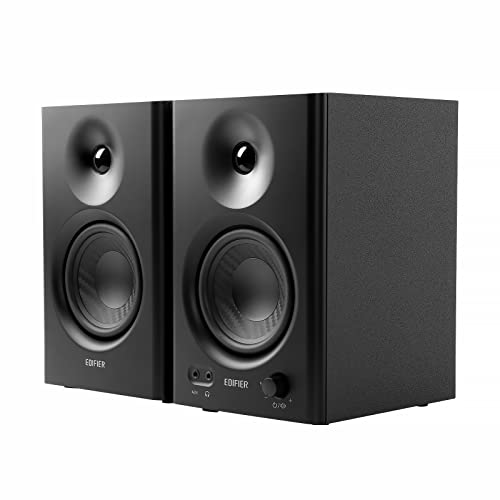
- Almost-flat tuning supports basic monitoring tasks
- TRS, RCA, AUX, and headphone output improve compatibility
- Dual monitor/music mode adds everyday convenience
Best For: Entry-level home studios and small desk setups
Desktop Starter Pick
PreSonus Eris 3.5 Powered Studio Monitors

- 50W powered stereo pair
- TRS, RCA, and front aux inputs
- Acoustic tuning controls plus headphone jack
Best For: Small desks and beginner home studios
Hi-Res Value Pick
Edifier MR3 Powered Studio Monitor Speakers

- Hi-Res Audio certified with flat response
- TRS, RCA, AUX, Bluetooth, and headphone output
- Music, Monitor, and Custom modes
Best For: Home studios and flexible desktop listening
Feature-Rich Wireless Pick
Ortizan C7 Dual-Mode Studio Monitors

- Bluetooth 5.3 plus USB DAC support
- Balanced TRS, RCA, AUX, and headphone output
- 3.5-inch woofer and 0.75-inch silk tweeter
Best For: Compact setups that need lots of connection options
Compact Imaging Pick – JBL 305P MkII 5" Pair
If you want studio monitors for home studio use that prioritize clear imaging and a wide sweet spot, the JBL 305P MkII pair is a strong starting point. The 5-inch design, dual 41-watt Class-D amplification, and Slip Stream port aim for balanced monitoring with enough low-end support for everyday production work.
Best For: Producers, podcasters, and creators who want precise stereo imaging and room-friendly controls.
Pros:
- Patented Image Control Waveguide for a wide, accurate listening area
- Boundary EQ and HF Trim help tune the monitors to your room
- XLR/TRS inputs support common studio connections
- 5-inch woofer and ported design offer fuller bass than tiny desktop speakers
Cons:
- 5-inch monitors are still limited for deep bass without a subwoofer
- Best performance depends on careful placement and room setup
Overall, the JBL 305P MkII is a practical pick if you want a compact powered monitor pair with useful calibration features and a reputation for clean, focused monitoring.
Neutral Reference Choice – Yamaha HS5 Pair
The Yamaha HS5 pair is built for listeners who want studio monitors for home studio work with a straightforward, uncolored presentation. With 5-inch woofers, 1-inch dome tweeters, and bi-amplified power, these monitors are aimed at music production and studio monitoring rather than hype or heavy coloration.
Best For: Mixers and producers who prefer a clean reference sound and balanced XLR/TRS connectivity.
Pros:
- Designed to emphasize sonic purity without altering the source
- Bi-amplified 70-watt system supports reliable nearfield monitoring
- XLR and TRS inputs accept balanced or unbalanced signals
- 5-inch woofer and 1-inch tweeter fit a compact studio setup
Cons:
- 5-inch monitors may not deliver the deepest bass for bass-heavy genres
- More reference-oriented than flattering for casual listening
For a home studio that needs honest playback and simple connectivity, the HS5 remains a familiar, no-frills option that keeps the focus on mix decisions.
Desktop Multitasker – M-AUDIO BX3 Pair
The M-Audio BX3 pair is a budget-friendly way to get studio monitors for home studio desks, gaming setups, and multimedia use. Its 3.5-inch Kevlar woofers, silk dome tweeters, and front-panel headphone access make it especially convenient when you want powered monitors that can handle recording, streaming, and everyday playback.
Best For: Desktop creators who need compact monitors for recording, streaming, gaming, and casual production.
Pros:
- Zero-latency wired monitoring suits live streaming and studio tracking
- Compact 3.5-inch drivers fit smaller desks and tight spaces
- Rear EQ controls let you adjust the sound profile
- Multiple inputs, including RCA, 1/4-inch, and 1/8-inch, add flexibility
Cons:
- Small drivers are not ideal for full-range bass monitoring
- More of a desktop multimedia solution than a larger studio reference monitor
If your home studio setup lives on a desk and needs broad compatibility, the BX3 pair offers a practical mix of monitor features and everyday convenience.
Small-Space Studio Pick – Yamaha HS4 Pair
The Yamaha HS4 pair is aimed at home studio users who want compact studio monitors without giving up proper monitor-style connections and room controls. With 4.5-inch woofers, a 1-inch dome tweeter, and room control plus high trim settings, these powered speakers are built for tight desktop setups and DAW workstations.
Best For: Bedroom producers and editors who need compact monitors with flexible inputs and basic room tuning.
Pros:
- Compact footprint works well on smaller tables and workstations
- Room control and high trim help adapt the sound to your space
- XLR/TRS combo, RCA, and stereo mini inputs provide broad compatibility
- Included cables and anti-slip pads make setup easier
Cons:
- 4.5-inch woofer size limits low-end reach compared with larger monitors
- 26-watt output is modest for bigger rooms
For a compact home studio, the HS4 is the most space-saving option here while still offering the kind of controls and connectivity that matter for practical monitoring.
Compact Desktop Flexibility – Mackie CR3.5 Creative Reference Monitors
If you want studio monitors for home studio use that also work as everyday desktop speakers, the Mackie CR3.5 is built around flexibility. The 3.5-inch woven woofer and silk dome tweeter aim for a clean, articulate sound, while the tone knob and location switch let you tailor the presentation to your space and listening distance.
Best For: Home studio users who also want gaming, casual listening, and compact desktop monitoring.
Pros:
- Tone knob lets you move from transparent monitoring to boosted bass and sparkle.
- Location switch supports desktop mode for close listening or bookshelf mode for farther seating.
- Multiple inputs include TRS, RCA, and 3.5 mm, plus a built-in headphone output.
- Compact size makes it easy to fit into a small home studio or desk setup.
Cons:
- 3.5-inch drivers are best for near-field use rather than large-room playback.
- Subwoofer is optional and sold separately if you want deeper bass.
Overall, the CR3.5 is a practical pick if you want an affordable, adaptable monitoring setup that can double as a general-purpose speaker system. It leans more toward convenience and versatility than pure studio-scale output.
Detailed Near-Field Monitoring – ADAM Audio T5V Studio Monitor
The ADAM Audio T5V is a strong studio monitors for home studio option if you want revealing detail for recording, mixing, or production work. Its 5-inch woofer, U-ART tweeter, and HPS waveguide are designed to deliver a high-resolution response, while the rear bass reflex port and shelf filters help it adapt to challenging rooms.
Best For: Producers and home studio creators who want detailed monitoring and room-adjustment options.
Pros:
- U-ART tweeter and HPS waveguide are aimed at detailed high-frequency reproduction.
- Rear bass reflex port and high-/low-shelf filters help with placement and room tuning.
- Multiple analog inputs support easy connection to soundcards and home audio gear.
- 5-inch woofer and 70W output suit near-field studio use with solid low-end extension.
Cons:
- Designed as a studio monitor, so it is less about casual speaker extras and more about accuracy.
- Best performance may require some room setup and placement care.
For home studios focused on mixing decisions and detailed listening, the T5V offers the most monitoring-oriented profile in this group. It is the pick here that most clearly targets critical production work.
Budget-Friendly Flat Reference – Edifier MR4 Powered Studio Monitors
The Edifier MR4 is a straightforward choice if you want studio monitors for home studio work without overcomplicating your setup. Tuned to an almost flat response, these 4-inch powered near-field speakers include balanced and unbalanced inputs plus front-panel controls for volume and sound mode adjustments.
Best For: Beginners and budget-minded home studio users who want simple near-field reference speakers.
Pros:
- Professionally tuned to an almost flat curve for monitoring and creation.
- Flexible inputs include 1/4-inch TRS, RCA, and AUX for broad compatibility.
- Front headphone output is convenient for quick private listening.
- Dual mode design lets you switch between monitor and music listening.
Cons:
- 4-inch woofer size limits low-end output compared with larger monitors.
- Most useful as a near-field desktop setup rather than a larger-room solution.
The MR4 focuses on practical monitoring basics: a neutral-ish tuning, easy hookups, and simple controls. If you want an entry-level reference speaker pair for a small room or desk, it keeps the essentials in reach.
Desktop Starter Pick – PreSonus Eris 3.5 Powered Studio Monitors
If you want studio monitors for home studio use without taking over your desk, the PreSonus Eris 3.5 is a compact, practical option. This powered pair is built for near-field listening, with balanced TRS, RCA, and front aux connectivity that makes it easy to plug into a computer, interface, mixer, console, or phone.
Best For: Small desks, beginner home studios, and mixed-use setups for music production, gaming, and everyday audio.
Pros:
- 50W built-in amplification delivers clear, distortion-free sound.
- 3.5-inch woven-composite woofers and 1-inch silk-dome tweeters aim for balanced detail.
- High- and low-frequency tuning controls help adapt the sound to your room.
- Front headphone jack adds convenient private listening.
Cons:
- Small 3.5-inch drivers are best suited to compact spaces.
- Not designed for deep bass-heavy monitoring.
Overall, the Eris 3.5 is a straightforward entry point for home studio monitoring when space, simplicity, and flexible input options matter most. It offers the core features many first-time buyers need without adding unnecessary complexity.
Hi-Res Value Pick – Edifier MR3 Powered Studio Monitor Speakers
The Edifier MR3 is a strong pick if you want studio monitors for home studio work with a bit more refinement and control. It is Hi-Res Audio certified, offers balanced TRS, RCA, and AUX connections, and adds Bluetooth with multi-point support for flexible desktop use.
Best For: Home studios, video editing, guitar practice, and users who want flexible wired and wireless playback.
Pros:
- Hi-Res Audio certification with a flat 52Hz to 40kHz response.
- Balanced TRS, RCA, AUX, Bluetooth, and headphone output cover many setups.
- Music, Monitor, and Custom modes add useful sound tailoring.
- MDF cabinet is designed to reduce distortion.
Cons:
- Only 18W x 2 RMS output, so it is not the most powerful option.
- More feature-rich than minimal setups may need.
For buyers who want a monitor pair that handles both creative work and casual listening, the MR3 brings a useful mix of accuracy, app control, and connectivity. It is especially appealing if you want one speaker set for a home studio and a desktop entertainment setup.
Feature-Rich Wireless Pick – Ortizan C7 Dual-Mode Studio Monitors
The Ortizan C7 is aimed at buyers who want studio monitors for home studio tasks with lots of connection options. It combines RCA, Bluetooth 5.3, 3.5mm AUX, USB via a built-in 24-bit DAC, and a balanced 6.35mm TRS input, making it easy to connect both consumer devices and compact pro gear.
Best For: Small music-production setups, Bluetooth-enabled desktop use, and users who want a compact monitor with broad connectivity.
Pros:
- Built-in 24-bit DAC helps preserve digital audio quality over USB.
- Balanced 6.35mm TRS input supports mixers and other pro gear.
- 3.5-inch carbon fiber woofer and 0.75-inch silk dome tweeter are tuned for clear mids and highs.
- Front headphone output adds easy monitoring flexibility.
Cons:
- 3.5-inch drivers keep the system compact rather than bass-heavy.
- Feature list is broad, but the setup is still geared toward smaller spaces.
The C7 makes sense if you want a home studio monitor pair that can switch between wireless convenience and wired production use. Its mix of balanced input, USB DAC support, and multiple analog options gives it a lot of versatility for a compact desktop system.
How We Picked the Best Studio Monitors for Home Studio
We focused on Studio Monitors for Home Studio use that offer a strong balance of accuracy, build quality, and value. Priority went to models with useful connectivity, proven near-field performance, and sizes that fit common desks, shelves, and small untreated rooms. We also considered whether each pair makes sense for mixing, content creation, and everyday listening.
Quick Comparison
In a home studio, the biggest differences usually come down to woofer size, room footprint, and how much low-end extension you actually need. Smaller 3.5-inch and 4-inch models are easier to place and work well for compact desks, while 5-inch monitors usually provide a fuller, more balanced low end for music production. If you need flexibility, look for rear-panel EQ controls, XLR/RCA inputs, and easy gain adjustment.
Key Buying Factors for Studio Monitors for Home Studio
Size and Room Fit
Start with the room, not the spec sheet. Large speakers in a small untreated room can exaggerate bass and blur detail. For tight spaces, compact monitors are often the smarter choice.
Accuracy Over Hype
The goal is a truthful sound that helps you make better mix decisions. Slightly brighter speakers can reveal detail, but overly colored tuning can lead to poor translation outside your studio.
Connectivity and Workflow
Make sure the inputs match your audio interface, computer, or controller. Balanced connections are preferable when available, but many budget-friendly monitors also support RCA or 3.5mm inputs for casual setups.
Room Controls and Placement
Simple EQ switches can help tame reflections or desk placement issues. Even the best Studio Monitors for Home Studio use will sound better with proper stands, isolation pads, and an equilateral triangle listening position.
Listening Goals
If you mainly mix and record, prioritize neutral tuning and cleaner imaging. If you also want gaming, streaming, or casual music playback, a more versatile monitor with extra bass warmth or Bluetooth may be a better fit.
Who Should Buy Which Studio Monitors for Home Studio?
Choose 3.5-inch monitors if you need an affordable desktop setup for editing, podcasting, or very small spaces. Move to 4-inch models if you want a better middle ground between compact size and usable low end. Pick 5-inch monitors if you are mixing music seriously and want a more complete picture without adding a subwoofer right away.
If your setup is primarily creative but not strictly mixing-focused, features like Bluetooth, tone controls, and flexible inputs can add convenience without sacrificing too much practicality. For the most accurate work, stick with wired monitors and use room treatment whenever possible.