If you want more expression from your setup, a midi keyboard with aftertouch can add real musical control without changing your workflow. It lets you shape sound after the initial key press, which is especially useful for pads, leads, and performance work.
In this roundup, we focused on models that balance feel, control layout, and practical studio features so you can find the right fit faster.
Best 10 Midi Keyboard with Aftertouch Picks for 2026
Expressive Studio Controller

- 61 semi-weighted keys with aftertouch
- 12 pads, 9 encoders, and faders
- Analog Lab Pro and screen included
Best For: Producers wanting hands-on control and expressive keys
Performance-Focused Controller

- Polyphonic and channel aftertouch
- MPE-compatible 49-key semi-weighted keybed
- OLED screens, arpeggiator, and chord modes
Best For: Performers who want expressive control and live workflow tools
Standalone Sound Explorer

- 37 slim keys with aftertouch
- 1,800+ onboard presets included
- 8 encoders, chord/scale, and arpeggiator
Best For: Portable players who want standalone sounds and expressive keys
Budget-Friendly DAW Controller

- 49 full-size velocity-sensitive keys
- Pitch/mod wheels and assignable controls
- Plug-and-play USB with software bundle
Best For: Beginners wanting simple MIDI control and bundled software
Expressive Compact Controller
Arturia KeyStep mk2 32-Key Controller & Sequencer
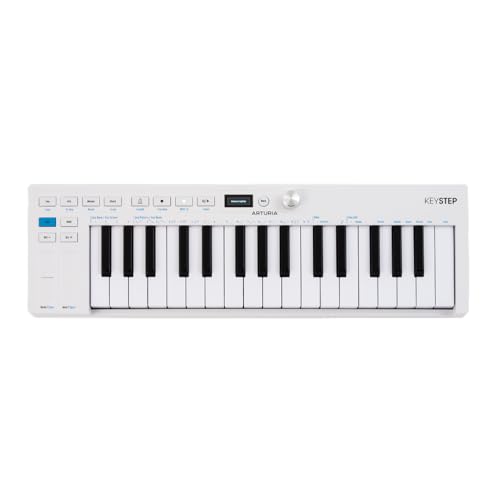
- 32 slim velocity-sensitive keys with aftertouch
- Polyphonic sequencer and 16-mode arpeggiator
- USB-C, MIDI DIN, sync I/O, and 4 CV outputs
Best For: compact studios, travel rigs, and modular control
Hands-On Production Board
M-AUDIO Oxygen Pro 49 USB MIDI Keyboard Controller

- 49 semi-weighted keys with aftertouch and zones
- 16 pads plus knobs, buttons, and faders
- NKS integration and included production software
Best For: beatmakers and producers needing deep DAW control
Weighted Studio Performer
STUDIOLOGIC SL73 MK2 73-Key Weighted Master Keyboard
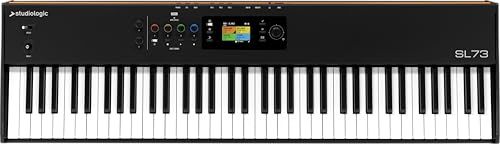
- 73 weighted hammer-action keys with aftertouch
- USB-C, MIDI 2.0, and integrated audio interface
- Transport controls and Numa Player integration
Best For: pianists and studio players wanting weighted aftertouch
Creative Starter Controller
Arturia KeyLab Essential mk3 49-Key MIDI Controller

- 49 keys with aftertouch
- 8 pads, 9 faders, 9 encoders
- Includes Analog Lab V and extras
Best For: Beginners and hobby producers
Performance DAW Controller
Novation Launchkey 61 MK4 with Aftertouch Pads

- 61 semi-weighted keys
- 16 pads with polyphonic aftertouch
- Strong DAW integration and creative modes
Best For: Producers wanting a versatile 61-key controller
Piano-Feel Studio Controller
Arturia KeyLab 88 MkII Weighted MIDI Keyboard

- 88-key hammer-action keybed
- Aftertouch with velocity sensitivity
- 16 pads plus 9 faders and 9 knobs
Best For: Pianists and studio musicians
Expressive Studio Controller – Arturia KeyLab 61 mk3 Black
If you want a midi keyboard with aftertouch that feels built for hands-on production, the Arturia KeyLab 61 mk3 is aimed squarely at that job. Its 61 semi-weighted keys with aftertouch, 12 pressure-sensitive pads, and a full set of encoders and faders make it a practical fit for playing parts, shaping instruments, and controlling software without constant mouse use.
Best For: Producers and keyboard players who want a feature-rich 61-key controller with expressive key feel and deep DAW control.
Pros:
- 61 semi-weighted keys with aftertouch for expressive playing
- 12 pressure-sensitive performance pads plus 9 encoders
- 3.5-inch color screen helps with navigation and control
- Includes Analog Lab Pro and other bundled software
Cons:
- Larger 61-key footprint may be less ideal for tight spaces
- At 18.7 pounds, it is not the lightest travel option
The KeyLab 61 mk3 stands out if you want a controller that can handle both expressive performance and practical studio workflow. It combines aftertouch, pads, faders, and software support in one setup-friendly package.
Performance-Focused Controller – Korg Keystage 49
The Korg Keystage 49 is a strong pick if your search for a midi keyboard with aftertouch is really about expressive performance and modern integration. Its 49-key semi-weighted keybed adds polyphonic and channel aftertouch with MPE compatibility, while the dedicated OLED screens, arpeggiator, and chord modes support fast creative work in the studio or on stage.
Best For: Players who want polyphonic aftertouch, MPE support, and performance tools in a compact 49-key controller.
Pros:
- Polyphonic and channel aftertouch with MPE compatibility
- Dedicated OLED screens provide quick visual feedback
- Arpeggiator and chord modes support creative performance
- Built-in audio interface with direct stereo output
Cons:
- 49 keys may feel limited for players wanting a wider range
- Designed around Ableton Live integration, so workflow emphasis is specific
Overall, the Keystage 49 is best viewed as a performance controller first. It offers expressive playing features and useful live-oriented tools in a compact format that stays focused on fast interaction.
Standalone Sound Explorer – Arturia AstroLab 37 White
The Arturia AstroLab 37 is a compelling midi keyboard with aftertouch if you want a compact board that is also built to stand on its own. Its 37-note velocity-sensitive slim keybed includes aftertouch, and the onboard library of 1,800+ presets gives you immediate access to a broad sound set without relying entirely on a computer.
Best For: Players who want a portable aftertouch keyboard with standalone sounds and a performance-first interface.
Pros:
- 37 slim keys with aftertouch in a portable layout
- 1,800+ onboard presets across many instrument types
- 8 macro encoders plus chord, scale, and arpeggiator tools
- Hybrid hardware/software workflow with desktop and mobile support
Cons:
- 37 keys may be too small for players who want a larger range
- Best value depends on whether you will use the standalone sound library
This model makes the most sense for musicians who want portability and immediate sound access alongside expressive keys. It is less of a bare controller and more of a compact creative instrument.
Budget-Friendly DAW Controller – M-AUDIO Keystation 49 MK3
If you are shopping for a midi keyboard with aftertouch, the M-AUDIO Keystation 49 MK3 is not that kind of controller; instead, it focuses on simple, dependable MIDI control at a very accessible level. Its full-size velocity-sensitive keys, assignable controls, pitch and mod wheels, and plug-and-play USB setup make it a straightforward choice for basic studio work.
Best For: Beginners or value-focused buyers who want a simple 49-key MIDI controller without advanced keybed features.
Pros:
- 49 full-size velocity-sensitive keys for natural playing feel
- Pitch and modulation wheels plus transport and directional buttons
- Plug-and-play USB connection with no driver or power supply needed
- Includes software and lesson bundles for getting started
Cons:
- No aftertouch, so it is less expressive than premium controllers
- Fewer advanced performance features than the other options here
The Keystation 49 MK3 is best treated as a no-fuss MIDI controller for everyday use. It delivers the essentials cleanly, but players specifically seeking aftertouch should look to a more expressive model.
Expressive Compact Controller – Arturia KeyStep mk2 32-Key Controller & Sequencer
If you want a midi keyboard with aftertouch that stays compact but still feels musical, the Arturia KeyStep mk2 is built for exactly that. Its 32 slim, velocity-sensitive keys add expressive control, while the sequencer, arpeggiator, and creative tools make it useful for both performance and idea building.
Best For: Players who want a small, travel-ready controller that can also drive sequenced and modular setups.
Pros:
- 32 slim keys with aftertouch for expressive playing in a compact footprint
- Polyphonic step sequencer, 16-mode arpeggiator, and pattern chaining for building ideas quickly
- USB-C, MIDI DIN, sync I/O, pedal input, and 4 CV outputs for broad hardware integration
- Configurable Mod 2 output can handle velocity, aftertouch, mod wheel, and more
Cons:
- 32 keys may feel limited if you want a larger playing range
- Focused more on control and sequencing than on full piano-style performance
The KeyStep mk2 stands out if you value mobility, expressive control, and hardware connectivity over key count. It is a practical pick for compact studios and live rigs where aftertouch and sequencing matter just as much as the keys themselves.
Hands-On Production Board – M-AUDIO Oxygen Pro 49 USB MIDI Keyboard Controller
The M-AUDIO Oxygen Pro 49 is a strong midi keyboard with aftertouch for producers who want hands-on control without giving up a playable keybed. Its semi-weighted 49-key layout, pads, faders, and auto-mapping tools make it a flexible centerpiece for software instruments, beat making, and DAW work.
Best For: Music producers who want a feature-packed controller for virtual instruments, beat production, and DAW control.
Pros:
- 49 semi-weighted, velocity-sensitive keys with aftertouch and assignable zones
- 16 RGB drum pads, 8 knobs, 8 buttons, and 9 faders for tactile control
- Smart Chord, Smart Scale, arpeggiator, pitch/mod wheels, and sustain pedal input
- NKS integration plus included software bundle for production out of the box
Cons:
- Bulkier than compact controllers if you need a small desk footprint
- Best suited to production workflows rather than minimalist playing setups
Overall, the Oxygen Pro 49 is aimed at users who want one controller to cover playing, beat creation, and software control. If you need aftertouch along with lots of physical controls, it is one of the more versatile options here.
Weighted Studio Performer – STUDIOLOGIC SL73 MK2 73-Key Weighted Master Keyboard
If your priority is a piano-like midi keyboard with aftertouch, the STUDIOLOGIC SL73 MK2 is the most performance-focused option in this group. Its 73 weighted hammer-action keys, color display, and DAW controls are aimed at players who want a serious master keyboard for studio work and expressive parts.
Best For: Keyboard players who want a weighted 73-key master controller with modern studio integration.
Pros:
- 73 weighted hammer-action keys with aftertouch for authentic feel and dynamic expression
- USB-C power, MIDI 2.0 support, and an integrated audio interface for streamlined setup
- Dedicated transport controls plus support for Ableton Live, Logic Pro, and Cubase
- SL Link integration with Numa Player and access to downloadable sound libraries
Cons:
- Much larger and heavier than compact controllers
- Less focused on pads and beat-making controls than production-oriented boards
The SL73 MK2 makes sense when feel comes first and you want aftertouch in a fully weighted format. It is the strongest choice for players who treat their controller like a primary keyboard rather than a portable sketchpad.
Creative Starter Controller – Arturia KeyLab Essential mk3 49-Key MIDI Controller
If you want a MIDI keyboard with aftertouch that doubles as a compact production hub, the KeyLab Essential mk3 is built for hands-on songwriting and beat-making. Its 49 velocity-sensitive keys, pressure-sensitive pads, faders, encoders, and included software make it a practical choice for learning and sketching ideas quickly.
Best For: Beginners and hobby producers who want an affordable, integrated controller for composing, beat-making, and DAW control.
Pros:
- 49 velocity-sensitive keys with aftertouch for more expressive playing.
- Includes 8 RGB pads, 9 faders, 9 encoders, and a bright 2.5″ LCD for workflow control.
- Scale Mode, Chord Mode, and arpeggiator help speed up composition.
- Comes with Analog Lab V plus extra software and sound packs.
Cons:
- 49 keys may feel limiting for larger piano parts.
- Plastic build is less substantial than higher-end controllers.
The KeyLab Essential mk3 stands out if you want expressive key action and plenty of production controls in one unit. It is especially appealing when you want software support and DAW integration without stepping up to a larger or more expensive controller.
Performance DAW Controller – Novation Launchkey 61 MK4 with Aftertouch Pads
The Launchkey 61 MK4 is a strong pick if you want a MIDI keyboard with aftertouch-focused performance features and deep DAW control. It combines 61 semi-weighted keys, 16 FSR pads with polyphonic aftertouch, and scale, chord, and arpeggiator tools for faster writing and live-style control.
Best For: Producers who want a versatile 61-key controller for DAW integration, pad performance, and creative composing tools.
Pros:
- 61 semi-weighted keys provide a more substantial playing feel.
- 16 FSR pads with polyphonic aftertouch add expressive finger drumming and triggering.
- Works with major DAWs and includes Scale Mode, Chord Mode, and an arpeggiator.
- Includes a software bundle with Ableton Live Lite, Cubase LE, and additional sounds.
Cons:
- It is larger and heavier than 49-key controllers.
- Its stronger focus on DAW workflows may be more than casual users need.
For players who want performance-oriented pads and broad DAW support, the Launchkey 61 MK4 offers a very complete control surface. It is one of the more capable options here if your workflow blends keyboard parts, pad programming, and software integration.
Piano-Feel Studio Controller – Arturia KeyLab 88 MkII Weighted MIDI Keyboard
If you need a MIDI keyboard with aftertouch and a true piano-style response, the KeyLab 88 MkII is the most performance-focused option in this group. Its 88-note Fatar TP/100LR hammer-action keybed, velocity sensitivity, aftertouch, and full control section make it well suited to players who want a weighted controller for serious studio work.
Best For: Pianists and studio musicians who want an 88-key weighted controller with expressive aftertouch and hands-on mixing controls.
Pros:
- 88-note hammer-action keybed delivers a piano feel.
- Aftertouch and velocity sensitivity support expressive playing.
- Includes 16 RGB-backlit pads plus 9 faders and 9 knobs for control.
- Comes with Analog Lab V and additional Arturia software instruments.
Cons:
- Large size and 15 kg weight make it less portable.
- Its full-size layout will take up significant desk or stand space.
This model makes the most sense when keyboard feel matters as much as controller features. If you want weighted action, aftertouch, and a broad control surface in one instrument, the KeyLab 88 MkII is the most complete studio-oriented choice here.
How We Picked the Best Midi Keyboard with Aftertouch
We prioritized models that offer reliable aftertouch, strong build quality, and useful performance controls such as pads, knobs, faders, DAW integration, and pitch/mod wheels. We also considered keybed type, USB connectivity, software bundles, and whether the layout suits studio production or live playing.
Quick Comparison: What Stands Out
Not every Midi Keyboard with Aftertouch serves the same player. Some are compact controllers for portable setups, while others are full-size, weighted instruments aimed at pianists and producers who want a more expressive feel. In this group, you’ll find options ranging from slim 32-key controllers to 88-key hammer-action boards, plus models with polyphonic aftertouch and deeper DAW control.
Key Buying Factors for a Midi Keyboard with Aftertouch
Type of Aftertouch
Channel aftertouch applies one pressure signal across the keyboard, while polyphonic aftertouch can respond per note. Poly aftertouch is more expressive, but it is less common and usually costs more.
Key Action and Size
Choose semi-weighted keys for a balanced playing feel, synth-action keys for speed and portability, or hammer-action keys if you want a piano-like response. The right size depends on your space, travel needs, and whether you record complex two-handed parts.
Control Layout
If you use software instruments or a DAW, look for pads, encoders, faders, transport controls, and good DAW mapping. These extras can matter as much as aftertouch for day-to-day workflow.
Connectivity and Compatibility
USB-MIDI is standard, but some users may also want MIDI DIN, CV/Gate, or standalone operation. Make sure the keyboard supports your computer, mobile rig, or hardware setup.
Who Should Buy Which Midi Keyboard with Aftertouch?
Producers who want deep control and expressive playing should look at larger controllers with strong software integration. Pianists and composers are usually better served by weighted or hammer-action models. If portability matters most, compact 32-key or 49-key options can still deliver a useful Midi Keyboard with Aftertouch without taking over your desk. Players who want the most expressive option for synth lines and orchestral parts should prioritize polyphonic aftertouch when available, while general studio users can often get everything they need from a well-designed channel-aftertouch controller.
For most buyers, the best choice comes down to your key feel preference, how much control you want on the surface, and whether aftertouch is a bonus or a core part of your playing style.