Photographers often need a practical way to access multiple SATA drives without installing them inside a desktop. The right docking station can simplify image transfers, archive management, drive cloning, and off-site backup workflows.
This roundup compares 10 hard drive docking stations for photo storage, from compact single-drive readers to multi-bay enclosures with USB-C connectivity. Consider drive compatibility, transfer speed, cooling, capacity, and cloning features before choosing.
Best 10 Hard Drive Docking Stations for Photo Storage Picks for 2026
Best Dual-Bay Clone Dock

- Two-bay access for 2.5-inch and 3.5-inch SATA drives
- Offline cloning without a computer
- USB 3.0 and broad OS compatibility
Best For: Photographers managing or duplicating multiple SATA photo-storage drives
Best High-Capacity Enclosure
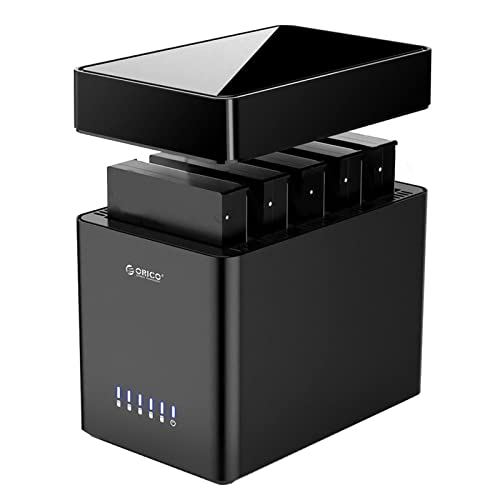
- Five bays for a large SATA-based photo archive
- Stated capacity up to 110TB
- Fan cooling and multiple protection features
Best For: Desktop photo-storage expansion and multi-drive backup setups
Best Simple Single-Drive Dock

- Tool-free access to one bare SATA drive
- Hot-swap support with USB 3.0
- Compact design and included 12V adapter
Best For: Occasional photo transfers from a single 2.5-inch or 3.5-inch SATA drive
Best USB-C Multi-Bay Option

- Four SATA bays with stated capacity up to 128TB
- USB 3.2 Type-C supports up to 10Gbps
- Cooling fans, hot-swap support, and HDMI output
Best For: USB-C photo workstations handling large multi-drive libraries
Best Cloning Value

- Dual bays for 2.5-inch and 3.5-inch SATA drives
- Offline cloning without a computer
- USB 3.0 transfers up to 5Gbps
Best For: Straightforward photo-drive backups and cloning
Best Multifunction Dock

- Built-in SD and TF card readers
- Two extra USB 3.0 ports
- Offline cloning and cross-platform support
Best For: Photo workstations handling cards and SATA drives
Best for Hot-Swapping
StarTech.com Dual-Bay SATA Dock

- Two tool-less bays for SATA HDDs and SSDs
- Independent power controls for hot-swapping
- Two-year warranty with technical support
Best For: Frequent drive swaps and photo archive transfers
High-Capacity Cloner

- Supports 2.5- and 3.5-inch SATA HDDs and SSDs
- Offline cloning with progress indicators
- Three USB 3.0 hub ports
Best For: High-capacity photo backup and drive cloning
USB-C Workflow Pick

- Dual-bay access for 2.5- and 3.5-inch drives
- USB-C with UASP and up to 5Gbps
- Offline cloning and 18-month warranty
Best For: USB-C photo backup and drive migration
Protected Drive Access

- Supports SATA I/II/III drives up to 2x20TB
- Fixed bezels improve drive stability
- Offline cloning with UASP support
Best For: Protected dual-bay access to photo archive drives
Best Dual-Bay Clone Dock – FIDECO Dual-Bay SATA Dock
For photographers who need flexible hard drive docking stations for photo storage, the FIDECO dual-bay dock provides quick access to two bare SATA drives. USB 3.0 connectivity, plug-and-play operation, and offline cloning make it useful for organizing, duplicating, or moving photo libraries.
Best For: Photographers who want to access two 2.5-inch or 3.5-inch SATA HDDs or SSDs and clone drives without a computer.
Pros:
- Supports two 2.5-inch or 3.5-inch SATA HDDs or SSDs simultaneously.
- Offers offline cloning without requiring a computer.
- USB 3.0 supports transfer rates up to 5Gbps and requires no driver installation.
- Works with Windows, macOS, and Linux.
Cons:
- Supports SATA drives only, not IDE or other drive interfaces.
- New drives must be initialized before the computer can recognize them.
The FIDECO is a practical choice when a photo workflow involves swapping drives or maintaining a duplicate archive. Its dual-bay design adds convenience, while the included power adapter supports larger 3.5-inch drives.
Best High-Capacity Enclosure – ORICO 5-Bay HDD Enclosure
The ORICO 5-bay enclosure is designed for photographers building a large external archive. It accepts multiple 2.5-inch or 3.5-inch SATA drives, offers up to 110TB of stated capacity, and includes active cooling for extended storage and backup workloads.
Best For: Users expanding a desktop photo library across several SATA HDDs or SSDs for family photos, high-resolution images, and video backups.
Pros:
- Five bays support 2.5-inch and 3.5-inch SATA drives up to 110TB total, according to the supplied specifications.
- Tool-free magnetic cover simplifies drive installation.
- A 60mm fan and honeycomb ventilation help with heat dissipation.
- Includes multiple protection features and drive-status indicator lights.
Cons:
- Its relatively large desktop enclosure is less portable than a single-drive dock.
- On Linux, only one hard drive can be read at a time, according to the product notes.
- USB 3.0 transfer speeds are shared with the limitations of the connected drives.
For a growing photo archive, the ORICO offers substantially more drive capacity than a basic docking station. The fan and protection features are useful for an always-connected storage setup, although its size makes it better suited to a permanent workspace.
Best Simple Single-Drive Dock – SABRENT SATA Docking Station
If you need a straightforward way to read or swap one drive, the SABRENT is a compact option among hard drive docking stations for photo storage. Its tool-free lay-flat design supports SATA HDDs and SSDs, with USB 3.0 connectivity, hot-swapping, and an included 12V adapter for 3.5-inch drives.
Best For: Photographers who periodically access one bare 2.5-inch or 3.5-inch SATA drive for importing, editing, or backup.
Pros:
- Supports SATA I, II, and III 2.5-inch and 3.5-inch HDDs and SSDs.
- Tool-free, plug-and-play design supports hot-swapping without rebooting.
- Compact lay-flat form factor is easy to keep beside a computer.
- Includes a 12V/2A adapter required for stable 3.5-inch drive operation.
Cons:
- Only supports one drive at a time.
- Uses a USB Type-A host cable rather than a native USB-C connection.
- Does not support IDE/PATA, M.2 NVMe, M.2 SATA, or SAS drives.
The SABRENT is a sensible pick for occasional drive access and straightforward photo transfers. Its limitations are clear: it is SATA-only, single-bay, and requires an adapter for computers that provide only USB-C ports.
Best USB-C Multi-Bay Option – WAVLINK 4-Bay USB-C Enclosure
The WAVLINK 4-bay enclosure combines high-capacity photo storage with faster USB-C connectivity. It supports four SATA drives, offers a stated maximum capacity of up to 128TB, and adds temperature-controlled cooling, independent bay switches, and an HDMI output for compatible workstations.
Best For: Photographers and creative professionals who want a multi-drive desktop enclosure with USB-C 10Gbps connectivity and workstation-oriented extras.
Pros:
- Four SATA bays support 2.5-inch and 3.5-inch drives, with stated capacity up to 128TB.
- USB 3.2 Type-C supports transfer rates up to 10Gbps.
- Temperature-controlled fans activate at 48°C to help cool installed drives.
- Independent power switches enable flexible bay-by-bay operation and hot-swapping.
Cons:
- 2.5-inch drives require separate 2.5-to-3.5-inch mounting brackets, which are not included.
- HDMI output requires a host USB-C port that supports video output and a USB-C-to-C connection.
- Its multi-bay desktop design is larger and less portable than a single-drive dock.
The WAVLINK is the most feature-rich option here for a modern USB-C editing station. Its four bays and cooling system suit large photo libraries, but buyers should verify host video support and plan for mounting brackets when using 2.5-inch drives.
Best Cloning Value – SABRENT Dual-Bay HDD Dock
For photographers seeking hard drive docking stations for photo storage, the SABRENT EC-HD2B offers two bays for reading or cloning 2.5-inch and 3.5-inch SATA HDDs and SSDs. Its USB 3.0 connection supports transfer speeds up to 5Gbps, while plug-and-play setup avoids driver installation.
Best For: Photographers who need a straightforward dual-bay dock with offline cloning and support for large SATA drives.
Pros:
- Supports both 2.5-inch and 3.5-inch SATA HDDs and SSDs.
- Supports drives up to 10TB, with a listed total storage capacity of 20TB.
- Offline cloning works without a computer and supports speeds up to 60Mbps.
- Includes a power supply and USB 3.0 cable.
Cons:
- Limited to SATA drives rather than IDE drives or other interfaces.
- Offline cloning requires the target drive to have sufficient capacity.
The SABRENT is a practical choice for rotating backup drives or duplicating a photo archive. Choose it when dual-bay access and cloning matter more than extra card-reader or hub features.
Best Multifunction Dock – FIDECO USB 3.0 HDD Dock
The FIDECO docking station combines a SATA drive dock with SD and TF card readers and two USB 3.0 ports, making it useful among hard drive docking stations for photo storage. It supports 2.5-inch and 3.5-inch SATA HDDs and SSDs on Windows, Mac OS, and Linux without requiring drivers.
Best For: Photographers who want to move files from memory cards and external SATA drives through one compact workstation accessory.
Pros:
- Includes SD and TF card readers for photo-media transfers.
- Provides two additional USB 3.0 ports for peripherals or flash drives.
- Supports UASP USB 3.0 transfer speeds up to 5Gbps.
- Offers offline cloning and a stable aluminum-and-ABS design with non-slip feet.
Cons:
- Supports only 2.5-inch or 3.5-inch SATA HDDs and SSDs.
- The target drive must be equal to or larger than the source for offline cloning.
- Its listed memory storage capacity is 18TB.
With built-in card readers and USB expansion, the FIDECO is the most versatile option here for a photo-import desk. It is particularly appealing if you want to consolidate card and drive connectivity without adding separate readers.
Best for Hot-Swapping – StarTech.com Dual-Bay SATA Dock
The StarTech.com SDOCK2U33 is designed for quick access to two 2.5-inch or 3.5-inch SATA drives, making it a strong fit among hard drive docking stations for photo storage and backup workflows. Its tray-less, top-loading design supports tool-less drive changes over USB 3.2 Gen 1 at up to 5Gbps.
Best For: Photographers and technical users who frequently swap SATA drives for backups, transfers, or disk imaging.
Pros:
- Dual bays support 2.5-inch and 3.5-inch SATA I/II/III HDDs and SSDs.
- Independent power buttons allow an idle drive to be hot-swapped while the other bay remains in use.
- Tool-less, tray-less design includes eject buttons and activity LEDs.
- Backed by a two-year warranty and lifetime 24/5 multilingual technical assistance.
Cons:
- IDE drives require a separately sold adapter.
- The unit is made from plastic rather than aluminum.
- It does not list built-in SD or TF card readers.
The StarTech.com dock stands out for repeatable drive-swapping and clearly separated bay controls. It is a good match for photographers maintaining several SATA backup drives, especially when convenience and durability are priorities.
High-Capacity Cloner – MAIWO Dual-Bay SATA Dock
The MAIWO dual-bay dock is a practical choice among hard drive docking stations for photo storage, especially when you need to move, duplicate, or organize data across bare 2.5- and 3.5-inch SATA drives. Its offline cloning function and three USB 3.0 hub ports add flexibility for backup workflows.
Best For: Photographers and creators who need dual-bay SATA access, offline drive cloning, and extra USB-A connectivity.
Pros:
- Supports 2.5- and 3.5-inch SATA HDDs and SSDs, with up to 24TB per bay according to the product notes.
- Clones one drive to another without a computer, with LED indicators for 25%, 50%, 75%, and 100% progress.
- Includes three USB 3.0 Type-A hub ports, including one with 2.4A phone charging support.
- Uses a dedicated 12V/3A power adapter for stable operation.
Cons:
- It uses a USB 3.0 Type-B connection rather than USB-C.
- Offline cloning requires a target drive with sufficient capacity, as with comparable duplicators.
Choose this MAIWO model if high stated drive capacity and built-in USB expansion matter as much as basic photo backup. It is particularly useful for working with loose SATA drives rather than permanently enclosed storage.
USB-C Workflow Pick – BENFEI Dual-Bay Dock
The BENFEI dual-bay dock is a streamlined option among hard drive docking stations for photo storage, letting you read, write, and transfer data between two bare 2.5- or 3.5-inch drives. USB-C connectivity, UASP support, and a tool-free design suit frequent backup and drive-migration tasks.
Best For: Users who want USB-C connectivity, simultaneous two-drive access, and computer-free cloning for photo archives.
Pros:
- Works with two 2.5- or 3.5-inch HDDs or SSDs at the same time.
- Supports offline cloning without a PC, with indicator lights showing progress.
- USB 3.2 Gen 1 and UASP support provide transfers up to 5Gbps according to the supplied notes.
- Includes a dedicated 12V/2.5A adapter, power switch, and an 18-month warranty.
Cons:
- The target drive must be equal to or larger than the source drive for cloning.
- Users should switch the dock off before inserting or removing drives.
BENFEI is a strong fit for a modern desktop or laptop setup that uses USB-C and regularly handles two drives. Its protected power setup and warranty add reassurance for recurring photo-backup work.
Protected Drive Access – WAVLINK Dual-Bay SATA Dock
The WAVLINK dual-bay model provides a straightforward way to connect loose SATA drives for photo storage, backup, and file transfers. Its fixed bezels help stabilize and protect installed drives, while offline cloning supports duplication without a computer.
Best For: Photographers who want a protective dual-bay SATA dock with broad operating-system compatibility and offline cloning.
Pros:
- Supports SATA I, II, and III 2.5- and 3.5-inch HDDs and SSDs, up to two 20TB drives.
- Fixed bezels provide added stability and protection for inserted drives.
- Offline cloning starts from the dock’s Clone button without requiring a computer.
- Includes USB-A and USB-C connection options through the supplied cable and adapter, plus UASP support.
Cons:
- The product notes specify a SATA-interface-only warranty.
- Offline cloning requires the target drive to be equal to or larger than the source.
- The advertised capacity is lower than the MAIWO model’s stated total capacity.
Consider WAVLINK if drive stability and compatibility are priorities. The fixed bezels make it a sensible choice for repeated access to bare drives, while the dual-bay layout keeps source and backup storage available together.
How We Picked the Best Hard Drive Docking Stations for Photo Storage
We focused on docks and enclosures that support the SATA drives commonly used for photo archives: both 2.5-inch and 3.5-inch HDDs or SSDs. The selection includes single-bay, dual-bay, and multi-bay designs so photographers can match the hardware to their storage workflow.
We also considered connection standards, practical capacity claims, offline cloning, cooling, card-reader access, USB expansion, and ease of swapping bare drives. A docking station is only useful if it fits your computer, storage media, and backup habits, so advertised features should be checked against your operating system and drive requirements.
Quick Comparison
- For occasional drive access: Choose a compact single-bay dock such as the SABRENT EC-DFLT.
- For routine backups: A dual-bay model with offline cloning can copy one drive to another without a computer.
- For several active archives: Four- and five-bay enclosures offer more organized access, but usually require more desk space and stronger cooling.
- For faster modern connections: USB-C 3.2 models can be a better fit for newer computers, provided the host port supports the advertised speed.
- For memory-card workflows: A dock with SD or TF card readers can reduce the number of adapters needed at a workstation.
Key Buying Factors for Hard Drive Docking Stations for Photo Storage
Drive Size and Interface
Confirm that the dock supports both 2.5-inch and 3.5-inch SATA drives if your library uses different media. These products are generally for SATA drives, not M.2 NVMe SSDs or IDE/PATA disks. Check whether the bay has a stable bezel or guide for your preferred drive size.
Speed and Connection Type
USB 3.0 or USB 3.2 connectivity is usually sufficient for many HDD-based transfers, while USB-C models may provide better performance with compatible computers and SSDs. Real-world speeds also depend on the drive, cable, host port, file sizes, and thermal conditions.
Cloning and Backup Features
Offline cloning is useful when duplicating a drive without running cloning software, but the destination drive normally must be equal to or larger than the source. It is not a substitute for a verified, separate backup strategy.
Cooling, Power, and Reliability
Multi-bay units and 3.5-inch drives need external power. Look for stable power delivery, ventilation, and temperature-controlled fans when using several drives for long transfers. Safely eject drives before removing them to reduce the risk of file-system damage.
Who Should Buy Which Hard Drive Docking Stations for Photo Storage?
Choose a single-bay dock if you occasionally recover files, rotate archive drives, or need a simple way to connect a spare SSD. A dual-bay dock is better for photographers who regularly copy working projects to backup media or want offline cloning. Pick a four- or five-bay enclosure when multiple drives need to remain accessible at once and you have adequate desk space, power, and cooling.
For travel or a small editing setup, prioritize a compact tool-free design. For a studio archive, prioritize bay count, sustained cooling, and dependable connectivity over the smallest footprint. Whichever model you choose, maintain at least two copies of important photographs and keep one backup disconnected or stored separately.