The right capo makes it easier to change keys, simplify difficult chord shapes, and preserve clear intonation across your acoustic guitar’s neck. But clamp pressure, neck compatibility, one-handed operation, and build quality vary widely.
We compared 10 popular guitar capos for acoustic players, from trusted quick-change designs to adjustable and multi-pack options. Use the guide below to narrow your choices by playing style, fit, and budget.
Best 10 Guitar Capos for Acoustic Picks for 2026
Classic Set-and-Forget
Shubb C1 Standard Acoustic Capo

- Adjustable set-and-forget pressure
- Simple locking lever operation
- Rubber fingertip-style grip
Best For: Acoustic players wanting controlled, traditional capo performance
Fast One-Handed Changes

- Quick one-handed clamping
- Even pressure for clear notes
- Fits most neck profiles
Best For: Players who need fast key changes and adaptable neck fit
Quick-Change Acoustic Favorite

- Acoustic-optimized radius
- Aircraft-grade aluminum body
- Lifetime guarantee and headstock parking
Best For: 6-string acoustic players wanting fast, visible capo changes
Multi-Tool Value Pick
3-in-1 Metal Acoustic Guitar Capo

- Built-in pick holder and pin puller
- Includes four picks and carrying bag
- Fits several string instruments
Best For: Players wanting a versatile capo and accessory bundle
Editor's Pick
Kyser Quick-Change Rosewood Capo

- One-handed operation for quick key changes
- Lightweight aluminum with steel spring
- Made in the USA with a lifetime guarantee
Best For: Standard six-string acoustic guitar players wanting a trusted, durable capo
Most Versatile
Htaxepu Multi-Instrument Aluminum Capo

- Works with guitar, bass, mandolin, ukulele, and banjo
- Quick-clamp design for fast changes
- Lightweight aluminum and silicone construction
Best For: Players who need one capo across several stringed instruments
Best Value Set
WINGO Rosewood Capo with Picks
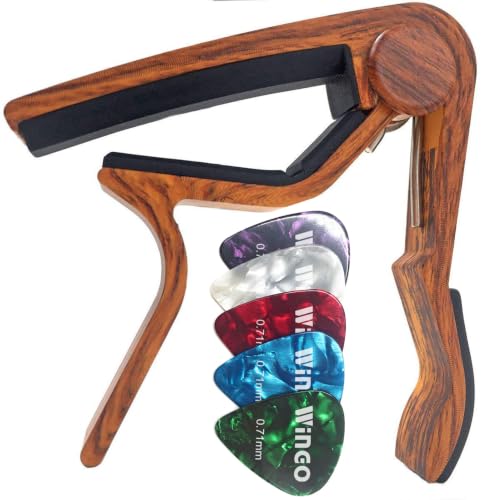
- Quick-release design for easy key changes
- Includes five 0.71 mm celluloid picks
- Works with several stringed instruments
Best For: Acoustic players wanting a capo-and-picks bundle
Best Adjustable Fit

- Adjustable spring tension
- Made for flatter-radius steel-string necks
- Silicone protection and included pin puller
Best For: Acoustic players who want customizable clamping pressure
Best Two-Pack Value

- Includes two aluminum capos
- Fits multiple guitar and stringed instruments
- Two protective carry pouches included
Best For: Players who want a versatile backup set for travel or gigs
Best Simple One-Hand Design

- Quick one-hand release and repositioning
- Fits guitar and several other instruments
- Protective rubber padding helps prevent scratches
Best For: Beginners and multi-instrument players needing an easy everyday capo
Classic Set-and-Forget – Shubb C1 Standard Acoustic Capo
For players comparing guitar capos for acoustic instruments, the Shubb C1 emphasizes controlled pressure and simple operation. Its adjustable design uses a custom rubber grip intended to act like a fingertip, helping hold strings securely without needing to reset the pressure each time.
Best For: Acoustic guitarists who want a traditional, adjustable capo with straightforward lever operation.
Pros:
- Set-and-forget pressure design avoids repeated adjustment.
- Lever locks and releases with a simple flip.
- Nickel-plated brass body with custom rubber grip.
- Lightweight 1.6-ounce construction.
Cons:
- Designed specifically for acoustic guitar rather than multiple instrument types.
- Its classic adjustable design may be less immediate than a quick-change capo.
The Shubb C1 is a practical choice when reliable pressure control matters more than extra features. Its established design and compact build suit regular acoustic practice and performance.
Fast One-Handed Changes – Martin One-Handed Guitar Capo
Among guitar capos for acoustic playing, this Martin model focuses on quick handling and even fretting. Its one-handed operation is useful for rapid key changes, while the flexible design is made to fit a range of neck shapes and thicknesses.
Best For: Players who prioritize quick one-handed changes, broad neck-profile compatibility, and a matte black finish.
Pros:
- Clamps and releases with one hand.
- Designed to apply even pressure across the strings.
- Fits most neck profiles according to the supplied product description.
- Compact silicone construction with a matte black finish.
Cons:
- The supplied details list the instrument as electric guitar, so acoustic-specific fit should be confirmed.
- Silicone construction may appeal less to players seeking a metal-bodied capo.
This Martin capo is aimed at convenience: quick changes, adaptable fit, and consistent fretting. It is worth considering for acoustic players who value one-handed use but want to verify compatibility with their specific neck.
Quick-Change Acoustic Favorite – Kyser Camo 2.0 Acoustic Capo
For guitar capos for acoustic use, the Kyser Quick-Change combines fast operation with an acoustic-focused radius. The aircraft-grade aluminum capo is made for 6-string acoustic guitars and can park on the headstock when it is not in use.
Best For: Acoustic guitarists who want quick key changes, a distinctive camo finish, and a lifetime-guaranteed design.
Pros:
- Optimized radius for acoustic guitar.
- Quick-change design supports fast key changes.
- Aircraft-grade aluminum construction is strong and lightweight.
- Can be stored on the headstock between uses.
Cons:
- Specified for 6-string acoustic guitars, limiting its stated application.
- The bold 80s-inspired camo pattern may not suit understated tastes.
The Kyser Camo 2.0 is a strong fit for players who want a recognizable quick-change capo with acoustic-oriented shaping. Its headstock parking feature also keeps it accessible during a set.
Multi-Tool Value Pick – 3-in-1 Metal Acoustic Guitar Capo
This 3-in-1 option stands out among guitar capos for acoustic instruments by combining capo functions with a pick holder and guitar pin puller. Its spring-and-silicone setup is designed for secure clamping, while the package includes four picks and a soft carrying bag.
Best For: Players who want an accessory bundle with a capo, pick holder, pin puller, picks, and broad string-instrument compatibility.
Pros:
- Combines a capo, guitar pin puller, and 360-degree pick holder.
- Fits acoustic and electric guitars, plus mandolin, ukulele, and banjo.
- Includes four picks in three thicknesses and a portable capo bag.
- Widened steel spring and rubber grip are designed to protect the instrument.
Cons:
- At 2.1 ounces, it is heavier than some lightweight capo-only designs.
- Includes a manufacturer warranty of 90 days from purchase.
- Its additional features may be unnecessary for players seeking a minimal capo.
The TANMUS set is best viewed as a convenience-focused accessory kit rather than a bare-bones capo. It offers useful extras for acoustic players who appreciate having picks and a pin puller integrated into one compact setup.
Editor's Pick – Kyser Quick-Change Rosewood Capo
For guitar capos for acoustic players who want a proven, straightforward design, the Kyser Quick-Change is a strong option for standard six-string guitars. Its one-handed operation makes key changes convenient, while the lightweight aluminum construction is designed for regular use.
Best For: Acoustic guitarists seeking a professional-quality, easy-to-use capo made in the USA.
Pros:
- One-handed Quick-Change design for fast key changes.
- Lightweight aluminum body with a steel spring.
- Can park on the guitar headstock when not in use.
- Made in the USA and guaranteed for life.
Cons:
- Designed specifically for standard six-string guitars.
- Its traditional clamp style may be less versatile than multi-instrument models.
The Kyser stands out as a dependable, purpose-built choice for acoustic guitar players who value quick handling, durable construction, and convenient storage on the instrument.
Most Versatile – Htaxepu Multi-Instrument Aluminum Capo
If you need guitar capos for acoustic as well as other stringed instruments, this compact Htaxepu model offers broad compatibility. Its quick single-clamp design is intended for fast changes, and the aluminum-and-silicone construction keeps the capo lightweight on the fretboard.
Best For: Players who use acoustic, electric, bass, mandolin, ukulele, or banjo and want one versatile capo.
Pros:
- Compatible with acoustic and electric guitars, bass, mandolin, ukulele, and banjo.
- Quick-clamp design supports fast key changes during a song.
- Lightweight aluminum alloy body weighs 1.44 ounces.
- Silicone grip helps protect the instrument, while the baked enamel finish resists oxidation and fading.
Cons:
- The six-month warranty is shorter than the lifetime guarantee offered by some capos.
- Its small size may require careful positioning on different instruments.
This is a practical pick for multi-instrument players who prioritize portability and compatibility over a guitar-only design.
Best Value Set – WINGO Rosewood Capo with Picks
For acoustic players shopping for guitar capos for acoustic performance plus a few useful extras, the WINGO combines a quick-release capo with five medium celluloid picks. Its aluminum alloy body and silicone pad are designed to provide balanced pressure while helping protect the guitar finish.
Best For: Acoustic guitarists who want a wood-look capo and included picks in one package.
Pros:
- Quick-release design makes changing keys easy.
- Suitable for steel-string acoustic and electric guitars, banjo, mandolin, and ukulele.
- Strong spring is designed to provide balanced pressure and clear tone.
- Includes five 0.71 mm medium celluloid picks.
Cons:
- The included picks are medium thickness, so they may not suit every playing style.
- The product is listed as a single-handed capo rather than a dedicated six-string-only model.
With its distinctive rosewood color, broad instrument compatibility, and included picks, the WINGO is a convenient starter-friendly package for players building or refreshing their accessory kit.
Best Adjustable Fit – Sondery Acoustic Pro Capo
If you need guitar capos for acoustic instruments with different neck profiles, the Sondery Adjustable Capo offers spring-tension control and a silicone-padded grip. It is designed for flatter-radius steel-string fingerboards and can be repositioned with one hand.
Best For: Acoustic guitarists who want adjustable pressure and a durable, aircraft-grade zinc-alloy capo.
Pros:
- Adjustable spring tension applies pressure evenly across the fret.
- Designed for flatter-radius steel-string acoustic guitar fingerboards.
- Silicone pads help protect strings and the guitar neck.
- Includes a guitar bridge pin puller and weighs about 0.09 kg.
Cons:
- Its stated fit is focused on six-string guitars, so it may be less suitable for wider or specialty necks.
- Only one capo is included.
The adjustable tension is the main advantage here, particularly if fixed-pressure capos do not sit comfortably on your acoustic guitar. Its zinc-alloy construction also makes it a practical choice for frequent use.
Best Two-Pack Value – Black and Silver Guitar Capos
For players comparing guitar capos for acoustic and other instruments, this two-pack provides a black and silver aluminum capo with protective pouches. The one-hand trigger design is suited to quick key changes during practice, performances, or travel.
Best For: Musicians who want a lightweight backup set that works across acoustic, electric, classical, and several other stringed instruments.
Pros:
- Includes two capos in black and silver.
- Compatible with acoustic, electric, classical, and 12-string guitars, plus ukulele, banjo, bass, and mandolin.
- Aircraft-grade aluminum construction resists bending and breaking.
- Silicone pads help protect the neck and strings; two carry pouches are included.
Cons:
- The two-pack may be unnecessary if you only need one capo.
- The supplied details do not specify adjustable spring tension.
This is the most versatile value option of the group. Two lightweight capos and two pouches make it convenient to keep one at home and one in a gig bag, while the broad instrument compatibility adds flexibility.
Best Simple One-Hand Design – Universal Black Guitar Capo
Guitar Capo, 6-String Acoustic & Electric Guitar Capo,Capo for acoustic guitar(Black)
Check Price On AmazonThis universal black capo is a straightforward option for shoppers seeking guitar capos for acoustic use without a complicated setup. Its spring-loaded clamp, rear release lever, and protective rubber padding support quick repositioning while helping maintain even pressure.
Best For: Beginners and multi-instrument players who want an easy-to-use capo for six-string acoustic or electric guitar and other compatible instruments.
Pros:
- Releases and repositions with one hand without disturbing tuning.
- Fits six-string acoustic and electric guitars, bass, ukulele, banjo, and mandolin.
- Silicone rubber padding helps protect the neck and supports a secure grip.
- Spring-loaded design is intended to reduce slipping, noise, and string buzz.
Cons:
- Only one capo is included.
- The supplied details do not list adjustable tension or a carry pouch.
Its appeal is simplicity: clamp it on, change keys, and release it from the rear lever. With broad instrument compatibility and a modest 1.58-ounce weight, it is a practical everyday capo for players who prefer a basic design.
How We Picked the Best Guitar Capos for Acoustic
We focused on the features that matter during real playing: secure grip, even string pressure, smooth operation, compatibility with common six-string acoustic necks, and a design that minimizes buzzing or unwanted sharp notes. We also considered material quality, portability, finish, included accessories, and overall value.
Because acoustic guitars can have different neck profiles and fretboard radiuses, no single capo is ideal for every player. Adjustable models can offer more control, while spring-loaded capos are usually faster to move between songs.
Quick Comparison
| Capo Type | Best For | Main Advantage |
|---|---|---|
| Quick-change spring clamp | Live players and beginners | Fast, one-handed placement |
| Adjustable screw or clamp | Players focused on intonation | More precise pressure control |
| Multi-function or 3-in-1 | Value-oriented buyers | Extra features in one tool |
| Two-pack or accessory bundle | Backup or multiple guitars | Convenient spare and added value |
Key Buying Factors for Guitar Capos for Acoustic Guitars
Fit and Neck Compatibility
Check that the capo is designed for six-string acoustic guitars and can accommodate your instrument’s neck width and profile. A capo that is too narrow may not sit securely, while one with excessive reach can feel bulky.
Pressure and Intonation
A capo should hold every string firmly without requiring excessive force. Too much pressure may pull notes sharp, especially near the lower frets. Adjustable tension is useful if your guitar is sensitive to tuning changes.
Ease of Use
Spring-loaded quick-change capos are convenient for performances and frequent key changes. One-handed operation is particularly helpful when you need to reposition the capo between verses or while standing.
Construction and Padding
Metal frames generally provide dependable durability, while padded contact surfaces help protect the neck and fretboard. Look for smooth edges and padding that will not mark the finish.
Portability and Value
A compact capo is easy to keep in a gig bag, but bundles and two-packs may be more practical for players who own multiple guitars or want a backup. Included picks or accessory features can add value, but they should not replace reliable fretting performance.
Who Should Buy Which Guitar Capos for Acoustic?
- For fast changes and live use: Choose a quick-change spring capo such as the Kyser or Martin-style options.
- For precise control: An adjustable design such as the Sondery is a strong choice when tuning stability is a priority.
- For traditional, dependable performance: The Shubb C1 suits players who prefer controlled pressure and a compact metal design.
- For budget-conscious beginners: A basic black capo or multi-pack can provide an affordable introduction to alternate keys.
- For multiple instruments or backups: Consider a two-pack or a versatile model rated for both acoustic and electric guitars.
Whichever style you choose, place the capo just behind the fret rather than directly over it, then check tuning before playing. This simple adjustment helps reduce buzzing and keeps chords sounding cleaner.