The best sampling drum pads let drummers trigger one-shot samples, loops, effects, and backing parts without carrying a full electronic kit. The right model can also serve as a compact practice instrument, MIDI controller, or live-performance hub.
This roundup compares 10 sampling drum pads across flagship performance features, built-in sounds, trigger expansion, portability, and practice value so you can choose a setup that fits your workflow.
Best 10 Sampling Drum Pads Picks for 2026
Flagship Choice

- Nine advanced pads with customizable LEDs
- Up to eight external trigger inputs
- Color display, effects, and balanced outputs
Best For: Touring performers needing extensive expansion and control
Creative Performance Pick

- Nine velocity-sensitive RGB-lit pads
- Built-in looper and USB sample loading
- 32GB storage with over 6GB of content
Best For: Live performers who also want looping and production tools
Bundle Value Pick

- 16GB memory for up to 25 hours of stereo samples
- Dynamic LEDs show pad and audio status
- Includes sticks, cables, and polishing cloth
Best For: Players wanting a ready-to-use SPD-SX accessory bundle
Sound Variety Pick

- 1,061 percussion and effects sounds
- 216 keyboard sounds with mute and layering
- Sequencer, loops, and five external-pad inputs
Best For: Players seeking broad sounds and sequencing features
Best Practice Pad

- 360° stick-saving rim element
- DarkMatter polymer playing surface
- Metal body with ambidextrous design
Best For: Focused drum practice without electronic features
Best Entry-Level Sampler
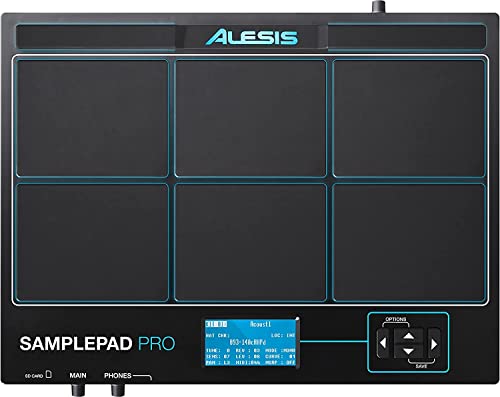
- Eight velocity-sensitive illuminated pads
- 200+ sounds and 10 built-in kits
- SD-card, MIDI, USB, and pedal support
Best For: Versatile practice, performance, and custom sample playback
Best Feature-Packed Sampler

- 1,000 sounds with 32GB internal storage
- Wireless Bluetooth sampling and onboard effects
- Expandable trigger and pedal connections
Best For: Live performance and advanced sample-based setups
Best Quiet Practice Pad

- Natural gum rubber for realistic rebound
- Portable, quiet, and usable on many surfaces
- Made in the USA with a wear-resistant finish
Best For: Quiet rudiment and technique practice anywhere
Best Expandable Electronic Pad

- Four velocity-sensitive pads for expressive playing
- Loads custom samples from SD/SDHC cards
- Includes built-in sounds, kits, and MIDI output
Best For: Electronic performance and sample-based setups
Best Portable Kids' Kit

- Nine pads with pedals for a complete beginner layout
- Foldable, lightweight design with built-in handle
- Includes speakers, rhythms, MIDI, and recording
Best For: Young beginners practicing and playing on the go
Flagship Choice – Roland SPD-SX PRO
For demanding sampling drum pads setups and touring performances, the Roland SPD-SX PRO combines nine playing surfaces, flexible trigger expansion, and detailed performance controls in a professional-focused design.
Best For: Touring drummers and musicians who need extensive triggering, routing, and sample-management options.
Pros:
- Nine pads with advanced trigger technology, including six large pads and three shoulder pads.
- Supports up to eight external individual triggers or pads.
- Offers a color display, customizable pad LEDs, onboard effects, and balanced direct outputs.
- Imports WAV, AIFF, and MP3 files and works with a dedicated Windows/Mac management app.
Cons:
- Its extensive professional feature set may be more than casual players need.
- The supplied notes do not specify included accessories.
The SPD-SX PRO is the most expandable and performance-oriented option here, particularly for players who need sophisticated sample control and stage-ready connectivity.
Creative Performance Pick – Alesis Strike Multipad
The Alesis Strike Multipad is a versatile choice among sampling drum pads, pairing nine velocity-sensitive RGB pads with onboard looping, sample loading, storage, and production-oriented connectivity.
Best For: Performers and creators who want sampling, looping, effects, and USB audio/MIDI in one unit.
Pros:
- Nine velocity-sensitive RGB-lit pads support one-shots, melodic parts, and loops.
- Built-in looper can record pad performances or external audio.
- Includes 32GB of storage with over 6GB of drums, percussion, loops, and melodic sounds.
- Provides five built-in effects processors, USB audio/MIDI, and Ableton Live Lite and MPC Beats.
Cons:
- Its 3,500-gram weight makes it less lightweight than some alternatives.
- The supplied notes do not describe external trigger expansion.
With its looper, large sound library, and software bundle, the Strike Multipad is especially appealing when sampling drum pads also need to support broader live production duties.
Bundle Value Pick – Roland SPD-SX Sampling Pad
This Roland SPD-SX bundle provides a proven sampling drum pads setup with internal storage, dynamic performance indicators, onboard effects, and useful cables and accessories included in the box.
Best For: Performers who want an SPD-SX package with basic playing accessories ready to use.
Pros:
- Offers 16GB of internal memory for up to 25 hours of stereo samples.
- Dynamic LED indicators show pad status and audio levels during performance.
- Includes three effects engines: one master effect and two kit effects.
- Bundle includes drumsticks, a 10-foot MIDI cable, a 10-foot instrument cable, and a polishing cloth.
Cons:
- Supports 16-bit/44.1 kHz WAV/AIFF audio rather than the broader file specifications listed for the PRO model.
- The supplied notes do not specify the number of playing surfaces or external trigger inputs.
This bundle is a practical way to get the SPD-SX platform plus several stage essentials, making it convenient for players who prefer a ready-to-use package.
Sound Variety Pick – Yamaha DTX-MULTI 12
The Yamaha DTX-MULTI 12 brings broad built-in sound selection to the sampling drum pads category, with percussion, effects, keyboard sounds, sequencing, and support for user samples.
Best For: Players who prioritize a wide range of built-in sounds, layering, and sequencer features.
Pros:
- Includes 1,061 drum, percussion, and effects sounds plus 216 keyboard sounds.
- Supports mute and layer functions for shaping performances.
- Provides a sequencer and preset loops for pattern-based playing.
- Includes 64MB of flash memory for user samples and inputs for five external pads.
Cons:
- The 64MB user-sample memory is smaller than the capacities listed for the Roland and Alesis options.
- The supplied notes do not specify a built-in display, pad lighting, or onboard effects engines.
The DTX-MULTI 12 stands out for sound diversity and sequencing, while its external-pad inputs add flexibility for expanding a percussion rig.
Best Practice Pad – Invader V3 Practice Pad
The Invader V3 is a focused choice for drummers looking for sampling drum pads in a purely practice-oriented format. Its DarkMatter polymer playing surface, metal body, and 360° stick-saving rim element are designed for hands-on pad work without electronic sounds or connectivity.
Best For: Quiet, focused practice and drummers who want a durable, ambidextrous practice surface.
Pros:
- 360° stick-saving rim element supports varied practice positions.
- Newly formulated DarkMatter polymer playing surface.
- Metal body and matte black finish.
- Ambidextrous design with a compact 14 x 14-inch footprint.
Cons:
- It is a practice pad rather than an electronic sampler.
- No built-in sounds, sample storage, or listed connectivity.
- At 4.9 pounds, it is less lightweight than some basic practice pads.
The Invader V3 makes the most sense when realistic pad practice is the priority. Choose an electronic option instead if you need onboard sounds, sample playback, or live-performance connections.
Best Entry-Level Sampler – Alesis SamplePad Pro
The Alesis SamplePad Pro is a versatile option for shoppers comparing sampling drum pads for rehearsal, performance, or MIDI setups. It combines eight velocity-sensitive rubber pads with 200-plus built-in sounds, expandable trigger and pedal inputs, and SD-card sample loading.
Best For: Performers who want built-in kits, external triggers, MIDI, and the ability to load custom samples.
Pros:
- Eight isolated, velocity-sensitive pads with blue LED illumination.
- Includes more than 200 built-in sounds and 10 ready-to-play kits.
- Supports up to 512 sounds and 20 kits per 32GB SD card.
- Offers MIDI, USB, stereo outputs, headphone output, auxiliary input, and pedal connections.
Cons:
- SD card is not included.
- Its plastic and rubber construction weighs 6.6 pounds.
- It has fewer built-in sounds than the PD708.
The SamplePad Pro is a practical middle ground for drummers who need electronic flexibility without moving to a larger setup. Its broad connectivity and SD-card support make it suitable for expanding beyond the included sounds.
Best Feature-Packed Sampler – HXW Avatar PD708
The HXW Avatar PD708 is a feature-rich choice among sampling drum pads, with 1,000 built-in sounds, 32GB of internal storage, onboard effects, and wireless sampling. Its expandable trigger inputs and customizable LED lighting also suit live performers building a more comprehensive electronic setup.
Best For: Live performers and studio users who want extensive sounds, onboard storage, wireless sampling, and expansion options.
Pros:
- Includes 30 kits, 1,000 built-in sounds, and 32GB internal memory.
- Wireless sampling over Bluetooth 5.0 can capture audio from a phone, tablet, or computer.
- Four effect processors provide access to 24 effects.
- Expandable trigger and pedal inputs support additional pads, cymbals, and foot control.
Cons:
- The unit weighs 7.19 pounds.
- Latest firmware may need to be downloaded from the HXW-Music website.
- Its extensive feature set may be more than needed for basic practice.
The PD708 stands out for storage and sampling flexibility, especially when wireless audio capture and onboard effects matter. It is a strong fit for users who expect to expand their rig rather than use a simple standalone pad.
Best Quiet Practice Pad – Evans RealFeel 6-Inch Pad
The Evans RealFeel is a compact option for drummers who want sampling drum pads for quiet, anywhere practice. Its natural gum rubber surface delivers realistic stick rebound for rudiments, paradiddles, and everyday technique work, while the single-sided design works on a table, carpet, lap, or inside a standard snare basket.
Best For: Drummers seeking a portable, quiet pad for focused technique practice.
Pros:
- Natural gum rubber provides realistic stick rebound.
- Compact and portable at 6 inches.
- Can be used on multiple surfaces, including a snare basket.
- Made in the USA with a wear-resistant fabric finish.
Cons:
- Single-sided design offers no alternate playing surface.
- The 6-inch target area is smaller than larger practice pads.
This is a straightforward, quiet practice tool rather than a sound-producing electronic pad. Choose it when rebound feel, portability, and low-noise practice matter more than built-in sounds or connectivity.
Best Expandable Electronic Pad – Alesis SamplePad 4
The Alesis SamplePad 4 suits players looking beyond basic sampling drum pads and into customizable electronic performance. It combines four velocity-sensitive pads with 25 built-in percussion and electronic sounds, SD/SDHC sample expansion, sound shaping, and MIDI output for controlling modules or software.
Best For: Performers and creators who want a compact pad with custom samples and MIDI control.
Pros:
- Accepts additional samples through a standard SD card.
- Four velocity-sensitive pads support expressive playing.
- Includes 25 sounds mapped across eight ready-to-play kits.
- Offers tuning, reverb, dual trigger input, and MIDI output.
Cons:
- Provides four main pads, fewer than a full electronic drum set.
- Requires power through the included adapter.
The SamplePad 4 is the most performance-oriented choice here for triggering sounds and integrating with other gear. It is a better fit than an acoustic-style practice pad when sample loading, sound control, and MIDI functionality are priorities.
Best Portable Kids' Kit – CAHAYA 9-Pad Electronic Set
The CAHAYA 9-Pad Electronic Drum Set is a beginner-friendly choice among sampling drum pads, especially for children ages 3 to 8. It provides a broad layout with toms, cymbals, hi-hat, snare, and bass drum, plus pedals, built-in kits, demo songs, recording, wireless connectivity, and a foldable 1.6-pound design.
Best For: Young beginners who need a lightweight, portable electronic drum set for practice and play.
Pros:
- Nine-pad layout covers core drum and cymbal parts.
- Includes two pedals, drumsticks, and drumstick grips.
- Foldable design and handle make it easy to carry.
- Supports headphones, USB MIDI, wireless connections, and recording.
Cons:
- Designed primarily for children ages 3 to 8.
- Its silicone pad surface may feel different from an acoustic drumhead.
- Built-in recording is limited to 300 seconds.
With speakers, rhythms, demo songs, and up to 10 hours of battery playtime, this set emphasizes accessible musical fun. It is a practical pick for young players who need more than a single practice surface but still want easy storage and transport.
How We Picked the Best Sampling Drum Pads
We focused on the features that matter most when a pad must do more than produce a basic drum sound: playing-surface response, sample loading, onboard storage, trigger inputs, MIDI and audio connectivity, effects, editing controls, and live usability. We also included simpler practice pads and portable multi-pad systems because not every drummer needs a stage-focused sampler.
Product specifications and intended use were weighed alongside setup flexibility. A professional performer may prioritize dependable triggering and fast access to sounds, while a beginner may value an affordable layout, built-in patterns, or a compact footprint.
Quick Comparison
| Best For | What to Prioritize |
|---|---|
| Professional live sampling | Multiple playing surfaces, trigger expansion, reliable controls, and robust storage |
| Electronic drum expansion | External trigger inputs, MIDI, and compatibility with existing gear |
| Budget sample triggering | Simple sample loading, clear pad assignment, and useful audio outputs |
| Portable practice | Compact size, headphone support, responsive surfaces, and easy setup |
| Traditional drum practice | Quiet rebound and a durable single-pad design |
Key Buying Factors for Sampling Drum Pads
Playing Surfaces and Trigger Inputs
More pads make it easier to assign separate sounds for kicks, snares, percussion, loops, and effects. External trigger inputs are equally important if you plan to add kick pedals, cymbals, hi-hat controllers, or extra pads later.
Sample Storage and Sound Editing
Check how samples are imported, how much storage is available, and whether the unit supports the file formats you use. Fast access to sample banks, adjustable levels, envelopes, and onboard effects can make a major difference during performance.
Connectivity
Look for the outputs and inputs that match your setup. USB and MIDI are useful for computer-based production, while dedicated audio outputs, headphone connections, and footswitch support can simplify live rigs. Confirm whether the pad supports the cables and controllers you already own.
Response, Layout, and Portability
Velocity sensitivity, playing-surface size, and pad spacing affect accuracy and comfort. A larger performance unit may be easier to play but harder to transport. Compact models are convenient, though they can require more precise playing and menu navigation.
Who Should Buy Which Sampling Drum Pads?
Choose a flagship performance sampler if you play concerts, need several simultaneous assignments, or expect to expand with external triggers. A midrange multi-pad is a strong choice for drummers who want broad sounds and flexible triggering without investing in the largest professional setup.
Compact sample pads suit musicians who need a few reliable one-shots, backing parts, or electronic textures in a small rig. Practice pads are better for quiet technique work than for sample-based performance, while portable multi-pad kits make sense for beginners, casual practice, and players who want an all-in-one electronic setup.
Before buying, list the sounds you need, count the physical pads and external triggers required, and verify your preferred connection method. That short checklist will usually narrow the choices faster than comparing sound-count claims alone.