Traveling musicians need instruments that balance portability with genuine sound-shaping control. The best compact synthesizers make it easier to sketch ideas on the road, practice quietly, or add expressive sounds to a mobile setup without carrying a full-size keyboard.
This roundup compares 10 portable options, including analog, digital, FM, chord-focused, sampler-based, and pocket-style instruments. Pay attention to the controls, connectivity, power options, and workflow that best match the way you create music away from the studio.
Best 10 Synthesizers for Traveling Musicians Picks for 2026
Most Versatile Experimental Pick
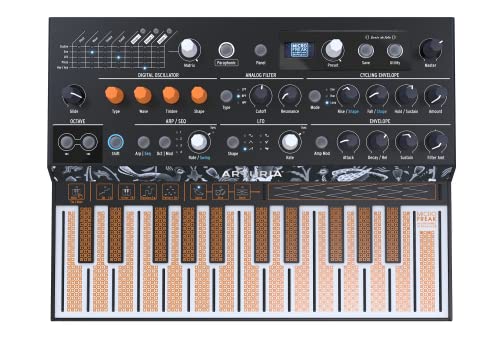
- Hybrid engine with 17 oscillator types
- 25-key poly-aftertouch touch keyboard
- CV, USB, and MIDI connectivity
Best For: Advanced travelers who want experimental sound design and deep control
Best Pocket Chord Companion

- Four-voice JUNO-60 synth engine
- 100 chord sets and 64-step patterns
- USB-C audio/MIDI and built-in battery
Best For: Traveling songwriters building chord progressions and compact arrangements
Best Full-Size Portable Monosynth

- Two wavefolding VCOs plus sub-oscillator
- 32 full-size keys with velocity and aftertouch
- 64-step sequencer and six CV patch points
Best For: Traveling players who prioritize expressive analog bass and lead sounds
Best for Mobile Sampling

- Built-in microphone for quick sample capture
- Chopping, resampling, and chromatic playback
- Granular controls, effects, and onboard keyboard
Best For: Traveling producers creating custom samples, loops, and textures
Best Pocket Analog Performer

- Battery operation and built-in speaker
- Analog controls with delay and sub-octaves
- CV/Gate outputs for hardware rigs
Best For: Portable analog sound design and expressive travel performances
Best Minimalist Mini Synth

- Compact form for travel setups
- Alloy-steel body
- MIDI connectivity
Best For: Lightweight MIDI-based mobile rigs
Best Feature-Packed FM Traveler
M-VAVE Wireless FM Synthesizer

- Battery-powered with built-in speaker
- Six-operator FM engine and 128 presets
- Wireless and wired MIDI options
Best For: Portable FM production, practice, and mobile composing
Pocket Retro Pick

- Pocket-sized, 8.8-ounce design
- Three-octave analog sound with vibrato
- Battery-powered with speaker and headphones
Best For: Travelers wanting a simple, distinctive retro synth
Hands-On FM Choice

- Six-operator FM engine with multiple algorithms
- Four assignable knobs for sound shaping
- Built-in sequencer and arpeggiator
Best For: Mobile producers seeking hands-on FM control
Full-Featured Travel Pick

- Six-operator FM engine with 128 presets
- Up to 12 hours of rechargeable battery life
- USB-C, Bluetooth, and 3.5mm MIDI
Best For: Traveling producers wanting a versatile standalone setup
Most Versatile Experimental Pick – Arturia MicroFreak
For traveling musicians who want unusual sounds in a compact format, the Arturia MicroFreak combines digital oscillator engines, an analog filter, and deep sequencing tools in a 2.3-pound instrument. Its 25-key touch-sensitive keyboard and broad connectivity make it a flexible choice for mobile sound design.
Best For: Advanced musicians seeking experimental tones, expressive sequencing, and CV/MIDI integration in a compact synthesizer.
Pros:
- Offers 17 oscillator types spanning wavetable, physical modeling, vocoder, and other timbres.
- 25-key PCB keyboard provides poly-aftertouch and pressure sensitivity without moving parts.
- Includes modulation-matrix routing, automation recording, Spice and Dice functions, CV, USB, and MIDI connectivity.
Cons:
- The touch-plate keyboard may feel less familiar than conventional keys.
- Its advanced sound-design and sequencing features may require a steeper learning curve.
The MicroFreak is a strong fit when portability does not mean giving up sonic variety. Choose it over simpler travel synths if experimental synthesis and external gear integration are priorities.
Best Pocket Chord Companion – Roland AIRA Compact J-6
The Roland AIRA Compact J-6 is a practical option for traveling musicians who want fast chord-based idea generation. This 1.3-pound portable unit combines a four-voice JUNO-60 engine with chord sets, arpeggios, sequencing, effects, and USB-C audio/MIDI.
Best For: Songwriters and performers who want compact chord progressions, classic JUNO-inspired sounds, and portable sketching tools.
Pros:
- Includes 100 chord sets and 64 user patterns with up to 64 steps each.
- Uses a four-voice JUNO-60 synth engine with 64 included presets.
- Provides filter and envelope controls, delay and reverb, MIDI, sync, and USB-C audio/MIDI.
Cons:
- Its compact format is focused more on chord and pattern creation than full-size keyboard performance.
- The plastic body may feel less substantial than larger metal instruments.
The J-6 is especially appealing for travel sketches, quick arrangements, and warm analog-like parts. Its built-in battery and streamlined workflow make it easy to add to a mobile setup.
Best Full-Size Portable Monosynth – Moog Messenger
For traveling musicians who prefer hands-on analog control, the Moog Messenger delivers two wavefolding VCOs, a sub-oscillator, and a versatile ladder filter in a portable monosynth design. Its 32 full-size semi-weighted keys provide a more traditional performance experience than many compact instruments.
Best For: Keyboardists and producers who want expressive monophonic Moog-style basses, leads, and sequence parts.
Pros:
- Two continuously variable-shape VCOs offer sync, frequency modulation, wavefolding, and sub-oscillator support.
- 32 full-size keys include velocity and aftertouch for expressive playing.
- Features a 64-step sequencer, arpeggiator, 256 presets, six CV patch points, and MIDI over USB-C.
Cons:
- At 5.14 kilograms, it is substantially heavier and less compact than pocket-sized travel synths.
- As a monophonic instrument, it is designed for one-note-at-a-time parts rather than polyphonic chords.
The Messenger suits musicians willing to carry a larger instrument for fuller controls and a traditional keybed. It is a compelling travel choice for bass and lead work, but less convenient for ultralight setups.
Best for Mobile Sampling – Roland AIRA Compact P-6
The Roland AIRA Compact P-6 gives traveling musicians a pocket-size way to capture and reshape sounds. Its built-in microphone, chopping and resampling tools, chromatic playback, granular controls, and onboard sequencing support creative production without requiring external recording equipment.
Best For: Producers and performers who want to sample environments, build custom loops, and manipulate sounds on the move.
Pros:
- Built-in microphone enables quick sample capture without external gear.
- Chop, step-sampling, resampling, and chromatic polyphonic playback support flexible sample workflows.
- Dedicated filters and envelopes plus granular parameters provide detailed sound shaping.
Cons:
- It is primarily a sampler and creative production tool rather than a conventional synthesizer keyboard.
- Sample editing and import/export rely on the P-6 Sample Tool software for macOS and Windows.
The P-6 is a strong companion for beatmakers and experimental performers who value portability and sound capture. Its tiny footprint makes it easy to add to a travel rig while retaining substantial sample-manipulation potential.
Best Pocket Analog Performer – Stylophone GENX-2
For musicians seeking synthesizers for traveling musicians, the Stylophone GENX-2 combines battery operation, a built-in speaker, and a compact metal body with hands-on analog sound shaping. Its stylus keyboard and expression strip make it especially suited to portable experimentation and expressive performance.
Best For: Traveling performers and sound designers who want a compact analog synth with CV/Gate connectivity.
Pros:
- Battery-powered design with built-in speaker, headphone output, and audio output
- Analog LFO, resonant low-pass filter, envelope, PWM, sub-octave switches, and delay
- CV and Gate outputs support modular and semi-modular setups
- Stylus keyboard and finger-sensitive expression strip encourage expressive playing
Cons:
- The stylus-based keyboard may require adjustment for players accustomed to conventional keys
- Its compact two-octave format may not suit full-range keyboard performances
The GENX-2 is a strong choice when portability and tactile sound design matter more than a traditional keyboard layout. It offers unusually broad analog control and hardware integration for a small travel instrument.
Best Minimalist Mini Synth – Behringer PHARA-O MINI
The Behringer PHARA-O MINI is a compact option for musicians comparing synthesizers for traveling musicians. Its small alloy-steel construction and MIDI connectivity make it practical for lightweight setups, though the supplied information focuses more on portability and connection than on detailed synthesis features.
Best For: Travelers who want a compact mini synthesizer for MIDI-based music setups.
Pros:
- Compact dimensions for easier transport
- Alloy-steel body construction
- MIDI connector supports integration with compatible equipment
Cons:
- The supplied specifications do not identify battery operation or a built-in speaker
- Detailed synthesis controls and included accessories are not specified
The PHARA-O MINI is worth considering when a small footprint and MIDI connectivity are the main priorities. Buyers who need standalone playing away from other equipment should verify power and onboard features before choosing it.
Best Feature-Packed FM Traveler – M-VAVE Wireless FM Synthesizer
For musicians looking for synthesizers for traveling musicians, the M-VAVE Wireless Portable FM Synthesizer offers battery operation, a built-in speaker, 27 silicone keys, and a compact design. Its FM engine, presets, effects, arpeggiator, sequencer, and multiple MIDI options give it broad capability for mobile composing and practice.
Best For: Mobile musicians who want a self-contained FM synth with presets, sequencing, and wireless MIDI.
Pros:
- Battery-powered, compact design with built-in speaker and 27 full-range keys
- Six-operator FM engine with 32 algorithms and 128 factory presets
- Six effects, arpeggiator, and 16-step sequencer support standalone creation
- USB MIDI, Bluetooth MIDI, and 3.5mm MIDI connectivity enable flexible integration
Cons:
- Plastic body and silicone keys may feel less substantial than larger instruments
- The compact key count may limit extended two-handed performances
The M-VAVE stands out as the most self-contained option in this group. It is a practical travel companion for sketching ideas, exploring classic FM sounds, and connecting to other devices without carrying a full-size keyboard.
Pocket Retro Pick – Stylophone Original
For musicians seeking synthesizers for traveling musicians, the Stylophone stands out as an exceptionally compact, battery-powered instrument. Its stylus-controlled metal keyboard produces a distinctive vintage sound and fits easily into a coat pocket.
Best For: Beginners, experienced musicians, and travelers who want a simple retro synth for quick musical ideas.
Pros:
- Extremely compact and lightweight at 8.8 ounces.
- Runs on three AA batteries and includes a built-in speaker and headphone socket.
- Offers three octaves, optional vibrato, and an iconic analog sound.
- Can connect to a computer or other gear through its auxiliary connection.
Cons:
- The stylus and touch-sensitive metal surface may feel less familiar than a conventional keyboard.
- Its distinctive, limited interface is better suited to portable sketches and effects than full keyboard performance.
The Stylophone is a fun, highly portable choice when size and character matter more than extensive sequencing or sound-design controls.
Hands-On FM Choice – M-VAVE FM Synthesizer
The M-VAVE FM Synthesizer is a compact option for synthesizers for traveling musicians who want deeper sound shaping than a pocket novelty instrument provides. Its six-operator FM engine, assignable knobs, sequencer, and arpeggiator support hands-on portable production.
Best For: Mobile producers and performers who want FM synthesis, pattern creation, and real-time controls in a small setup.
Pros:
- Six-operator FM engine with multiple algorithms for complex tones.
- Four assignable parameter knobs enable hands-on tweaking.
- Built-in sequencer and arpeggiator support melodic pattern creation.
- USB-C connectivity, headphone output, and audio output suit portable use.
Cons:
- At 1.1 pounds, it is less pocketable than the smallest travel synths.
- The supplied notes do not specify battery operation, so portable power may require planning.
With its focused FM architecture and dedicated controls, the M-VAVE offers a more production-oriented travel companion for musicians comfortable navigating a compact interface.
Full-Featured Travel Pick – Mini FM Synthesizer
For musicians comparing synthesizers for traveling musicians, this mini FM synthesizer combines a broad sound set with unusually complete portable production tools. Its rechargeable battery, built-in speaker, wireless MIDI, sequencing, and effects make it suitable for travel, busking, and desktop sessions.
Best For: Traveling performers and producers who want substantial FM synthesis, MIDI flexibility, and onboard sequencing in a lightweight instrument.
Pros:
- Six-operator FM engine includes 32 algorithms and 128 factory presets.
- Seven-mode arpeggiator, 16-step sequencer, and six onboard effects support complete sketches.
- USB-C, Bluetooth BLE MIDI, and 3.5mm MIDI input can be used simultaneously.
- Weighs 9.6 ounces and offers up to 12 hours of play from its rechargeable battery.
Cons:
- The 27-key silicone keyboard may not feel like a traditional full-size keyboard.
- Its many synthesis and production features may require more setup time than a simpler travel instrument.
This is the most versatile option of the three for independent portable creation, especially if rechargeable operation, wireless MIDI, and onboard production tools are priorities.
How We Picked These Synthesizers for Traveling Musicians
We focused on instruments that are practical to transport and useful beyond simple novelty playing. Selection criteria included overall size, battery or USB power support, built-in speakers where available, hands-on controls, sound-design flexibility, sequencing or sampling features, MIDI connectivity, and suitability for practice, songwriting, live performance, or sound experimentation.
The list covers several approaches rather than treating portability as a single specification. Some models prioritize keyboard-style playability, while others favor compact chord creation, analog synthesis, FM programming, sampling, or immediate hands-on fun.
Quick Comparison
| Type | Best For | What to Check |
|---|---|---|
| Compact keyboard synths | Players who want familiar note input and deeper controls | Key size, range, and external power needs |
| Chord and groove instruments | Fast songwriting and portable arrangement | Pattern memory, sequencing, and MIDI features |
| Sampler-focused devices | Beat making and sound manipulation | Sample storage, recording workflow, and pad controls |
| Pocket and mini synths | Casual practice, travel, and experimental sound design | Small controls, speaker quality, and connectivity |
| FM synthesizers | Bright digital tones and compact sound engines | Operator editing, presets, display, and sequencing |
Key Buying Factors for Synthesizers for Traveling Musicians
Size, Weight, and Durability
Measure the instrument against the bag you actually use, not just its published dimensions. Pocket models are easiest to carry, while larger compact keyboards may be more comfortable for extended playing. Look for sturdy controls and a layout that can handle frequent packing and unpacking.
Power and Headphone Options
USB power, rechargeable batteries, or standard batteries can make a major difference when working in transit. A built-in speaker is convenient for quick ideas, but a headphone output is more important for quiet hotel-room practice and shared spaces.
Workflow and Connectivity
Decide whether you need a self-contained instrument or a controller for a phone, tablet, laptop, or larger setup. USB or Bluetooth MIDI can simplify mobile production, while CV/Gate connectivity is valuable for modular systems. Sequencers, arpeggiators, and chord modes can help compensate for limited keyboard space.
Sound Design and Playability
Analog instruments often appeal to players who want immediate, tactile tone shaping, while FM and digital designs can provide detailed presets, complex timbres, and efficient hardware. Consider whether you prefer editing with dedicated knobs or selecting and modifying sounds through menus and displays.
Who Should Buy Which Synthesizers for Traveling Musicians?
Choose a compact keyboard synthesizer if playing melodies and bass lines naturally is your priority. Chord-oriented instruments suit songwriters who want quick harmonic ideas, while sampler-based devices are better for beat makers and performers who build music from recorded sounds.
Pick a small analog or pocket synth if immediacy, portability, and hands-on experimentation matter most. FM models are a strong choice for musicians seeking crisp digital tones, extended preset variety, and a lightweight sound-design tool. For the best match, prioritize the workflow you will actually use on the road over the highest feature count.